


Why Our Lifestyle Is Becoming More Expensive Than Our Needs—and How Psychological Management Can Change It
Most households never calculate their financial freedom gap — the space between what they earn and what they actually need to spend — and that single blind spot quietly decides whether a family builds wealth or just keeps up appearances.
The biggest threat to our financial security may not be inflation.
It may be our changing definition of what we need to live a good life.
Over the past few decades, the cost of essential goods and services has certainly increased. But alongside genuine inflation, another phenomenon has quietly emerged: lifestyle inflation.
We earn more, but we also want more. We have better technology, easier credit, faster delivery, more entertainment, more choices and greater social connectivity—but many people simultaneously experience more anxiety, debt, loneliness and financial insecurity.
This creates a paradox:
We are surrounded by more comforts than previous generations, yet many people feel less financially secure than ever.
The problem therefore deserves to be examined not only through economics, but also through psychology, family structure, marketing, technology and personal financial management.
Key Takeaways
- Most household overspending isn’t survival cost — it’s lifestyle cost driven by psychology, marketing and comparison, not genuine need.
- India’s household debt has climbed to 45.5% of GDP as of the RBI’s June 2026 Financial Stability Report, with more of that debt unsecured and income-dependent than ever before.
- Calculate your own financial freedom gap — monthly income minus essential expenditure — and protect it before lifestyle spending touches it.
Table of Contents
1. The Cost of Living Is Not the Same as the Cost of Living Well
There are two different expenses in modern life.
The first is the cost of survival: food, housing, education, healthcare, transportation, utilities and other necessities.
The second is the cost of lifestyle: frequent eating out, premium gadgets, expensive holidays, fashionable clothing, unnecessary subscriptions, impulsive shopping, lifestyle upgrades and purchases made primarily to maintain social status.
The first category is largely driven by economic conditions.
The second is heavily influenced by human psychology.
And this distinction is extremely important.
If someone spends ₹50,000 every month because basic necessities require it, reducing expenditure may be difficult.
But if ₹15,000–₹20,000 of that expenditure is driven by convenience, comparison, impulse, status or poor financial planning, behavioural management can make a substantial difference.
The objective should therefore not be to live miserably.
It should be to separate genuine needs from manufactured wants.
2. The Silent Collapse of the Joint Family Economy
The decline of the joint-family system has produced enormous social benefits, including greater individual freedom and mobility.
But it has also removed some of the economic efficiencies that existed within larger families.
A single household previously might have shared:
one kitchen,
household appliances,
domestic responsibilities,
childcare,
elderly care,
transportation,
housing infrastructure and
many other resources.
Today, several members of the same extended family may live separately.
That can mean multiple houses, multiple kitchens, multiple refrigerators, multiple vehicles, multiple domestic-help arrangements and duplicated household expenses.
This does not mean that people should return to joint families.
Rather, society needs to rediscover the economies of cooperation that joint families once provided.
Shared childcare, community kitchens, elderly support networks, neighbourhood cooperation and collective purchasing can recreate some of those efficiencies without sacrificing individual independence.
3. Marketing Has Learned How to Sell Emotions
Modern marketing does not simply sell products.
It increasingly sells identity, aspiration and emotion.
Advertising tells us:
You deserve an upgrade.
You deserve luxury.
You deserve convenience.
You deserve to look successful.
You deserve the latest phone.
You deserve the premium version.
And social media repeatedly shows us people apparently living extraordinary lives.
The result is subtle psychological conditioning.
A person may begin wanting something not because they need it, but because someone has successfully made them feel incomplete without it.
This is one of the most important financial lessons of the modern age:
Every purchase should answer the question: “What problem am I solving?”
If there is no meaningful answer, the purchase deserves reconsideration.
4. Easy Credit Has Turned Future Income Into Present Consumption
Credit is one of the greatest financial innovations when used responsibly.
But easy access to personal loans, credit cards, buy-now-pay-later facilities and consumer finance can create a dangerous psychological illusion:
“I can afford it because I can pay the EMI.”
But an EMI does not prove affordability.
It only proves that the purchase can be divided into smaller payments.
A ₹2 lakh purchase can psychologically feel very different when presented as ₹6,000 per month.
This is where financial discipline becomes essential.
Before borrowing, people should ask:
“If my income stops for six months, can I still manage this obligation?”
If the answer is no, the purchase may be affordable mathematically but dangerous financially.
Debt converts future freedom into today’s consumption.
5. The Shopping Trap: Buying to Feel Better
Shopping is not always an economic decision.
Sometimes it is an emotional decision.
People may shop when they are:
bored,
stressed,
lonely,
disappointed,
socially insecure,
seeking recognition or
trying to reward themselves.
Digital commerce has made this behaviour extraordinarily easy.
The distance between desire and purchase has almost disappeared.
See → desire → click → pay → delivery.
This is why a simple psychological technique can be powerful:
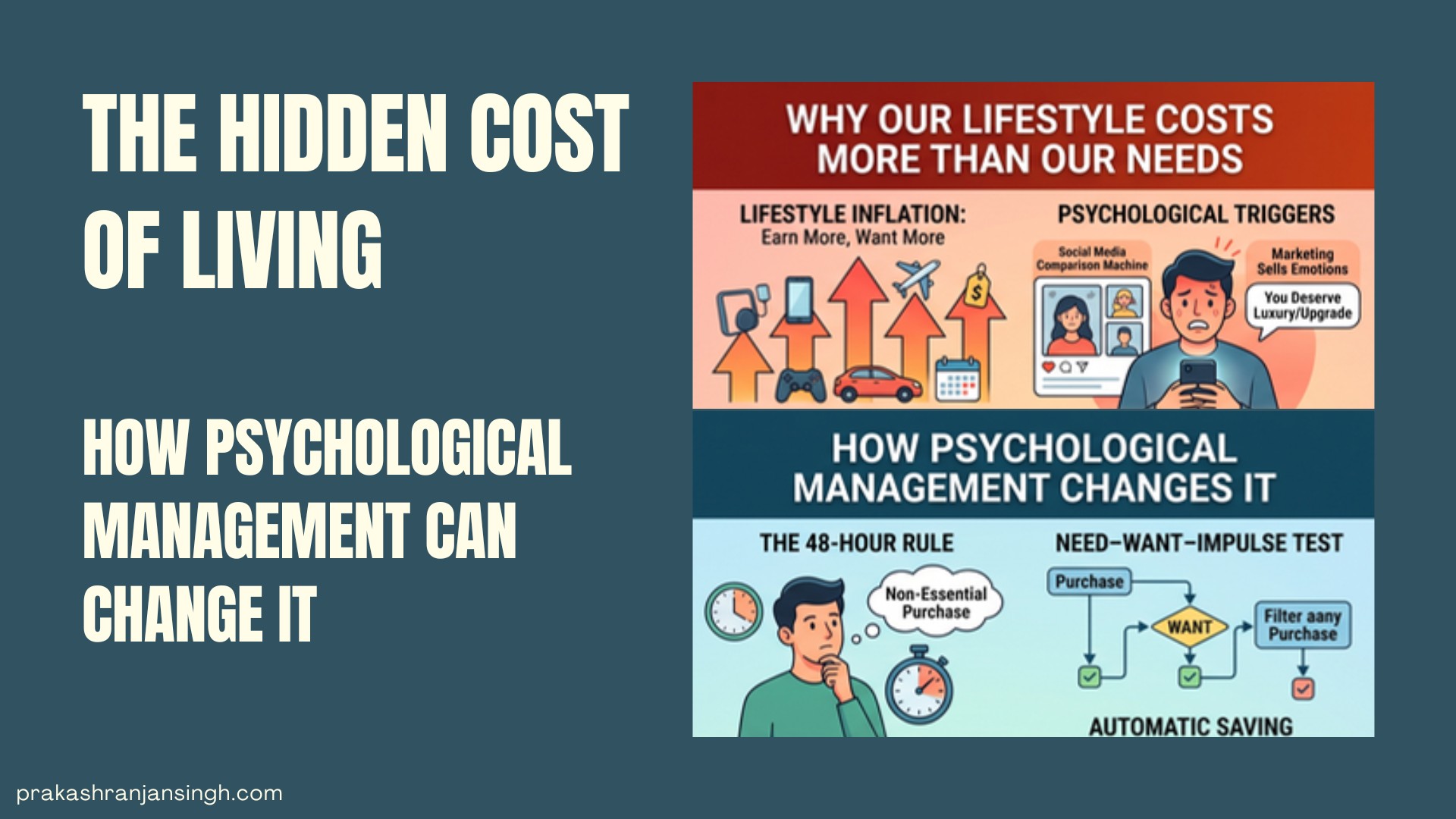
The 48-Hour Rule
For every non-essential purchase above a predetermined amount, wait 48 hours.
If the desire survives the waiting period and the purchase fits the budget, buy it.
Many impulsive purchases disappear naturally when the emotional impulse has passed.
6. Social Media Has Created a Permanent Comparison Machine
Human beings have always compared themselves with others.
Social media has industrialised comparison.
People see someone’s:
holiday,
car,
house,
clothes,
restaurant,
wedding,
career achievement or
apparent happiness.
But they rarely see the debt, family problems, anxiety, failures or sacrifices behind that image.
This creates what may be called artificial lifestyle pressure.
A person earning ₹60,000 may feel poor after repeatedly watching people displaying lifestyles worth several lakhs a month.
The result can be increased consumption, borrowing and dissatisfaction.
The solution is not necessarily to abandon social media.
It is to develop psychological immunity to curated lives.
Remember:
You are comparing your complete life with somebody else’s edited highlights.
7. Convenience Has a Price—and We Often Ignore It
Modern life increasingly rewards convenience.
Food delivery, taxis, instant shopping, subscriptions, domestic services and online entertainment save time.
But convenience becomes expensive when used automatically rather than strategically.
A ₹200 delivery charge may appear insignificant.
Repeated 20 times a month, however, it becomes ₹4,000.
The same principle applies to numerous small expenditures.
The modern household therefore needs a convenience budget.
Convenience should save valuable time—not become an unconscious substitute for planning.
8. Food Is Becoming Both an Economic and Medical Expense
Changing food habits are another major contributor.
Frequent restaurant meals, packaged foods, sugary beverages, excessive snacking and highly processed convenience foods can increase household expenditure.
But the larger concern is the potential downstream cost.
Poor lifestyle choices can contribute to health problems, which can subsequently increase:
medical expenses + insurance expenses + lost working days + reduced productivity + emotional stress.
Thus, food expenditure should not be viewed only as today’s grocery bill.
It is potentially part of a much larger lifetime health-cost equation.
Eating simpler, balanced food at home is therefore not merely an exercise in frugality.
It can also be an investment in long-term wellbeing.
9. Loneliness Has an Economic Cost
This is one of the least discussed aspects of the modern cost of living.
When social bonds weaken, people increasingly purchase substitutes for connection:
restaurants, entertainment, travel, shopping, digital subscriptions and other forms of consumption.
Earlier, community itself provided considerable emotional infrastructure.
Today, individuals increasingly have to purchase entertainment and convenience.
This does not mean consumption is inherently bad.
But it raises an important question:
Are we sometimes spending money to compensate for something money cannot actually provide?
Strong families, friendships, neighbourhood networks and meaningful community participation can therefore have an unexpected economic benefit:
they reduce the need to purchase constant stimulation.
10. The Medical Cost of Psychological Pressure
Financial stress and psychological stress can reinforce each other.
This is not a marginal concern: the Reserve Bank of India’s Financial Stability Report, June 2026 shows household debt has climbed to 45.5% of GDP, with the shift increasingly toward unsecured, income-dependent borrowing rather than asset-backed loans.
Anxiety can affect sleep and behaviour.
Poor sleep can reduce productivity and emotional control.
Stress can encourage unhealthy coping mechanisms.
Those behaviours may increase health risks and expenses.
The cycle becomes:
Higher consumption → higher debt → financial stress → psychological stress → unhealthy behaviour → higher medical expenditure → greater financial pressure.
Breaking the cycle therefore requires more than earning additional money.
It requires behavioural management.
11. The Five-Bucket Household Budget
Every household can simplify its financial management by dividing income into five broad buckets:
1. Essential Living
Housing, food, utilities, education, transportation and necessary healthcare.
2. Financial Security
Emergency fund, insurance and debt reduction.
3. Wealth Creation
Investments and long-term savings.
4. Lifestyle
Travel, entertainment, restaurants, hobbies and discretionary purchases.
5. Giving and Social Responsibility
Helping family, community or charitable causes according to one’s capacity.
The exact percentages should vary according to income and circumstances.
The important principle is:
Lifestyle expenditure should never consume the money required for financial security and wealth creation.
12. Introduce a “Need–Want–Impulse” Test
Before purchasing something, classify it.
Need
Something genuinely required.
Want
Something useful but not essential.
Impulse
Something being purchased primarily because of emotion, advertising, comparison or temporary excitement.
This simple classification can transform household behaviour.
The objective isn’t to eliminate wants.
It is to prevent impulses from masquerading as needs.
13. Make Wealth Creation Automatic
Financial discipline becomes easier when saving happens before spending.
Instead of:
Income → Spending → Whatever remains is saved
adopt:
Income → Saving/Investment → Essential Expenses → Lifestyle Spending
Automation is powerful because it removes repeated psychological decisions.
When money earmarked for long-term goals never reaches the spending account, the temptation to spend it becomes much smaller.
14. Measure Lifestyle Inflation Every Year
Whenever income rises, people should resist immediately increasing their lifestyle by the same proportion.
Suppose income rises by ₹20,000 a month.
Instead of automatically increasing monthly expenditure by ₹20,000, perhaps only ₹5,000–₹8,000 is used to improve lifestyle while the remaining amount goes toward investment, debt reduction or emergency reserves.
This creates an extremely powerful principle:
Let income rise faster than lifestyle.
That difference eventually becomes wealth.
15. Build a “Financial Freedom Gap”
Every household should calculate:
Monthly income − Essential expenditure = Financial Freedom Gap
The larger this gap becomes, the greater the household’s resilience.
For example, if a family earns ₹1 lakh and essential expenses are ₹60,000, the ₹40,000 gap provides the foundation for:
emergency savings,
investment,
debt repayment,
retirement planning and
future opportunities.
Wealth is not created merely by earning more.
It is created by creating a persistent gap between earning and spending.
16. The Goal Is Not a Cheap Life—It Is a Richer Life
Frugality is sometimes misunderstood.
A financially intelligent person does not necessarily avoid spending.
They spend deliberately.
Money should be spent generously on things that genuinely improve life:
health,
education,
meaningful experiences,
family,
personal development,
productive tools and
important relationships.
At the same time, unnecessary status consumption can be reduced.
The objective is not:
“How little can I spend?”
The better question is:
“How much value can I create from every rupee I spend?”
17. What Happens If Millions Adopt This Psychology?
The consequences could extend far beyond individual households.
Lower unnecessary consumption could mean:
Less household debt → lower financial stress → greater savings → higher investment → stronger household balance sheets → greater economic resilience.
It could also encourage:
healthier lifestyles,
stronger families,
reduced impulsive consumption,
greater financial literacy,
increased retirement security,
greater entrepreneurship,
more productive investment and
reduced psychological dependence on social comparison.
There could even be an environmental benefit because unnecessary consumption generates additional production, transportation, packaging and waste.
Thus, responsible consumption is not merely a personal financial strategy. It can become a social-economic philosophy.
18. The “50% Reduction” Should Be Understood Carefully
It may be possible for some households to dramatically reduce discretionary expenditure through behavioural changes.
But nobody should assume that every family’s total cost of living can simply be cut by half.
Housing, healthcare, education, transportation and essential food costs cannot always be reduced substantially.
The realistic target is different:
Reduce unnecessary expenditure substantially enough to increase the household’s savings and investment rate.
Even an additional 10–20% of income directed consistently toward wealth creation can produce a dramatic long-term difference because of compounding.
19. A New Definition of Prosperity
Perhaps society needs to redefine prosperity.
Prosperity should not mean:
big house + expensive car + latest phone + frequent holidays + visible consumption.
A more meaningful definition might be:
adequate income + low debt + good health + strong relationships + financial reserves + useful skills + meaningful work + freedom of choice.
The person who owns fewer luxury products but has no debt, six months of expenses saved and a steadily growing investment portfolio may actually be wealthier than the person displaying a luxurious lifestyle financed through EMIs.
20. The Psychological Revolution We Need
The next financial revolution may not come from earning more.
It may come from wanting more intelligently.
Modern society has become exceptionally efficient at increasing consumption.
We now need to become equally efficient at managing desire.
Parents need to teach children the difference between need and status.
Schools need to teach financial psychology alongside mathematics.
Workplaces can promote financial wellness rather than celebrating consumption alone.
Families can discuss money without embarrassment.
Individuals can periodically audit their digital subscriptions, EMIs, eating habits, shopping behaviour and social-media exposure.
And society can begin respecting financial independence more than financial display.
Frequently Asked Questions
What is a financial freedom gap?
A financial freedom gap is simply your monthly income minus your essential expenditure. The larger this gap, the more room a household has for savings, investment, debt repayment and emergency reserves without touching lifestyle spending.
How is lifestyle inflation different from real inflation?
Real inflation raises the price of necessities like food, housing and healthcare. Lifestyle inflation is self-inflicted: spending rises to match income or social comparison rather than genuine need, which is why it responds to behavioural discipline rather than economic policy.
How much of my income should go toward lifestyle spending?
There is no universal number, but the Five-Bucket Household Budget in this article suggests treating essential living, financial security and wealth creation as non-negotiable first, and letting lifestyle spending draw only from what remains afterward.
Does reducing lifestyle spending mean living miserly?
No. The goal is deliberate spending, not deprivation. Money spent on health, education, meaningful experiences and important relationships is not the target — status-driven, impulsive or comparison-driven spending is.
21. Conclusion: The Most Valuable Luxury Is Financial Freedom
The future is uncertain.
Employment patterns are changing. Technology and AI are transforming occupations. Healthcare costs can rise. Families are becoming smaller. Longevity is increasing. Traditional social-security mechanisms may not be sufficient for everyone.
In such an environment, financial resilience is becoming increasingly important.
We cannot control every economic variable.
But we can control many of our financial behaviours.
We can question unnecessary purchases.
We can resist artificial social comparison.
We can use credit carefully.
We can cook more and consume more consciously.
We can rebuild meaningful social relationships.
We can protect our mental health.
We can save before spending.
And, most importantly, we can learn to distinguish a better life from a more expensive life.
The ultimate objective is not to become miserly.
It is to become financially free.
Because when unnecessary expenditure falls, savings rise.
When savings rise, investments rise.
When investments rise, financial security rises.
And when financial security rises, something even more valuable often follows:
confidence.
Perhaps the most important lifestyle upgrade of the twenty-first century is therefore not a bigger house, a newer car or a more expensive phone.
It is the ability to say:
“I can live well without continuously buying more.”
That is not deprivation.
That is freedom.
Related Reading
- The Salary Investor’s Dilemma: How to Grow Wealth Without Gambling With Your Future
- From 15% Returns to Financial Freedom: How the Psychology of Early Retirement Has Changed
- The Credit Card Trap: How a Small Piece of Plastic Is Quietly Rewiring Our Psychology
- Positive Cash Flow: The Life Skill Gen Z Cannot Afford to Ignore
- Social Media Is Rewiring Our Financial Psychology — At What Cost?
See more of our stories on Google Search



Leave a Reply