

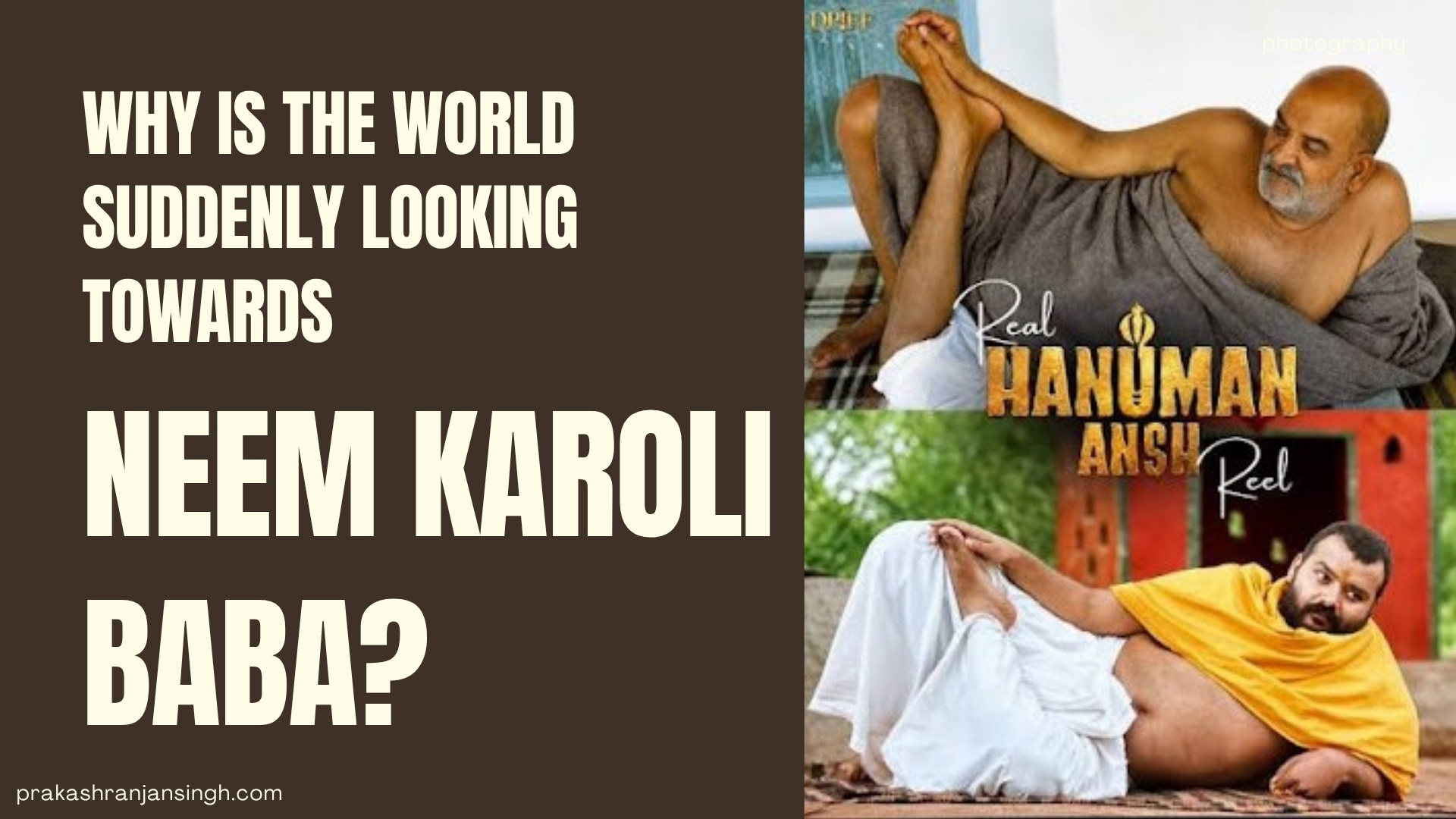
The phenomenon is bigger than a film—it is a fascinating meeting point of faith, psychology, success, uncertainty and the human search for meaning.
A devotional film rarely behaves like a conventional commercial movie.
It is usually expected to have a limited audience, a predictable business model and a largely religious appeal. Yet Hanuman Ansh, based on the life and spiritual legacy of Neem Karoli Baba, has become an extraordinary talking point in 2026.
Reports say the film was made on a modest budget and initially received a relatively small theatrical release, but its audience expanded dramatically through word-of-mouth. The film has subsequently crossed major box-office milestones.
But perhaps the more interesting question is not:
“Why is the film successful?”
The deeper question is:
Why does Neem Karoli Baba continue to fascinate people who already possess money, fame, technology, influence and professional success?
That question takes us beyond cinema and into psychology.
Key Takeaways
- Neem Karoli Baba’s teachings are drawing global attention because success and wealth don’t resolve deeper questions of meaning, identity and purpose.
- The devotional film Hanuman Ansh, made on a budget of roughly ₹2 crore, has crossed ₹100 crore at the box office through word-of-mouth alone.
- The lesson isn’t to abandon ambition, but to put ambition in service of something larger than the self.
Table of Contents
Who Is Neem Karoli Baba?
Neem Karoli Baba, also known as Maharaj-ji, was a revered Hindu spiritual teacher associated with Kainchi Dham in Uttarakhand, whose core teachings centred on love, service, humility and the remembrance of God. He died in 1973, but decades later his ashram continues to draw pilgrims, spiritual seekers and, notably, some of the world’s best-known technology and entertainment figures.
1. The Strange Meeting of Silicon Valley and the Himalayas
Few spiritual stories have created such an unusual cultural bridge.
On one side are technology entrepreneurs, global celebrities, doctors, investors and corporate leaders.
On the other side is a Himalayan spiritual tradition centred around a simple message of devotion, love, service and remembrance of God.
Steve Jobs travelled to India during his spiritual search and intended to seek Neem Karoli Baba, but arrived after Baba had died in 1973. Therefore, the popular statement that Jobs personally met or received advice from Baba is inaccurate.
Mark Zuckerberg has publicly spoken about visiting an Indian temple on Steve Jobs’ advice during a difficult period for Facebook; this visit is widely associated with Kainchi Dham.
Julia Roberts has also spoken about the influence of a photograph of Neem Karoli Baba on her spiritual journey.
These stories are powerful because they challenge a common assumption:
Does professional intelligence automatically satisfy the human need for meaning?
Apparently, it does not.
2. Success Does Not Eliminate Existential Anxiety
Modern society has created extraordinary material possibilities.
A successful entrepreneur can build a billion-dollar company.
A technology professional can communicate with millions of people instantly.
A celebrity can become globally recognised.
Yet success cannot eliminate several fundamental human questions:
Who am I?
What is the purpose of my life?
What happens when success is no longer enough?
Why do I still feel incomplete?
What remains when money, status and recognition disappear?
Psychology calls this dimension of human experience meaning-making.
Human beings do not live only for survival and pleasure. They also search for meaning, belonging, identity and transcendence.
This is one reason spiritual traditions continue to survive even in technologically advanced societies.
3. Why Highly Successful People Sometimes Turn Towards Spirituality
There is an interesting psychological paradox.
When a person has very little, he may pray for survival.
When a person acquires everything, he may begin praying for meaning.
Material scarcity creates one kind of anxiety.
Material abundance can create another.
The successful individual may experience:
decision fatigue,
loneliness,
performance pressure,
fear of failure,
identity crisis,
uncertainty about the future,
relationship problems,
loss of privacy,
constant competition and
the feeling that achievement never produces permanent satisfaction.
Spirituality can therefore become not an escape from ambition but a search for psychological balance.
4. The Psychology of the Guru
Why does a spiritual teacher have such enormous psychological influence?
One reason is that human beings naturally search for trusted frameworks of interpretation.
Life contains enormous uncertainty.
We do not know what will happen tomorrow.
We cannot control death, illness, relationships, markets, reputation or many external events.
A spiritual teacher can provide a framework that converts uncertainty into something psychologically manageable:
Serve.
Accept.
Remember God.
Control the ego.
Help others.
Do your duty.
Whether one accepts the supernatural dimension of such teachings or not, the psychological effect can be significant.
The mind becomes less obsessed with controlling everything.
5. Why Hanuman Is So Psychologically Powerful
The connection with Hanuman is particularly important.
Hanuman represents a remarkable psychological combination:
Strength without arrogance.
Power without personal ambition.
Devotion without weakness.
Courage without ego.
Service without expectation.
This makes Hanuman an unusually powerful archetype.
Modern leadership often celebrates the individual:
“Become number one.”
Hanuman’s philosophy suggests something different:
“Use your strength in the service of something greater than yourself.”
That distinction has enormous psychological importance.
The first approach can produce ego.
The second can produce purpose.
6. The Kainchi Dham Phenomenon
Kainchi Dham in Uttarakhand has consequently evolved into much more than a religious destination.
It has become a cultural meeting point where traditional Indian spirituality intersects with modern global curiosity.
The annual gathering, the Himalayan environment, the stories surrounding Neem Karoli Baba and the presence of influential visitors have collectively created a powerful symbolic ecosystem.
But there is another psychological factor at work:
The power of place.
A quiet mountain environment removes many of the stimuli that dominate modern urban life.
No constant notifications. No office hierarchy. No traffic pressure. No continuous advertising. No performance dashboard.
The mind gets an opportunity to slow down.
Sometimes people attribute the resulting psychological transformation entirely to the spiritual place, whereas part of the effect may also come from silence, nature, reduced stimulation, reflection and social withdrawal from everyday pressures.
That does not diminish the spiritual experience.
It makes the experience psychologically more interesting.
7. Why the Stories of Steve Jobs and Zuckerberg Are So Powerful
There is a powerful narrative hidden inside these stories.
The world’s most advanced technology and one of India’s oldest spiritual traditions appear to meet at the same point.
Silicon Valley asks: How can we change the world?
Spirituality asks: Who is the person trying to change the world?
Technology improves external capability. Spirituality attempts to improve internal capability.
Technology asks us to increase intelligence. Spirituality asks us to increase wisdom.
Technology gives us connectivity. Spirituality asks us to develop connection.
Technology gives us information. Spirituality asks us what information is worth pursuing.
That contrast explains much of the fascination.
8. The Psychology of Faith: Belief Can Change Behaviour
Faith should not be examined only through the question of whether a supernatural claim can be scientifically demonstrated.
There is another important question: What does belief do to human behaviour?
If a person genuinely believes that life has a higher purpose, that belief may influence self-control, resilience, generosity, patience, hope, ethical behaviour, stress management and willingness to serve others.
Research in psychology has repeatedly examined relationships between religious or spiritual practices and outcomes such as coping, social support, meaning and psychological wellbeing. The effects are not universally positive and depend heavily on the individual’s beliefs and circumstances, but the psychological dimension of spirituality is undeniable.
Thus, the practical question becomes: Does faith make the believer a better human being?
That may be more important than winning an argument about faith versus disbelief.
9. The Most Important Message May Not Be the Miracles
Every spiritual tradition eventually attracts stories of miracles.
People remember extraordinary incidents because the human brain is naturally attracted to the unusual.
But there is a danger here.
If spirituality becomes exclusively about miracles, it can become another form of entertainment.
The deeper teaching associated with Neem Karoli Baba is often described through much simpler ideas: Love. Service. Compassion. Devotion. Humility. Remembering God.
These principles do not require supernatural evidence to have social value.
A person who feeds someone hungry, helps an elderly person, serves society honestly or controls his ego is already converting spirituality into action.
10. Why the Corporate World Is Also Looking Towards Spirituality
The modern corporate environment has created a new paradox.
Companies increasingly invest in mindfulness, emotional intelligence, leadership coaching, purpose, employee wellbeing, meditation, resilience and mental health.
Why? Because organisations are finally discovering that human performance is not purely mechanical.
An exhausted mind cannot innovate indefinitely. A fearful employee cannot remain creative indefinitely. A leader driven entirely by ego eventually creates organisational problems. A person without purpose struggles to sustain motivation.
This is where ancient philosophical traditions suddenly become relevant to modern management.
11. The Celebrity Effect—And Its Hidden Risk
There is, however, another psychological mechanism that deserves caution.
When famous people visit a spiritual place, ordinary people may automatically assume: “If successful people believe in it, it must be true.”
This is called an authority or social-proof effect.
Celebrity association can dramatically increase public curiosity.
But spirituality should not become a celebrity endorsement model.
Steve Jobs’ spiritual journey belongs to Steve Jobs. Mark Zuckerberg’s experience belongs to Mark Zuckerberg. Julia Roberts’ experience belongs to Julia Roberts.
A person’s spiritual journey cannot be transferred like a brand recommendation.
The real test is what the teachings do to our own behaviour.
12. Why Hanuman Ansh Arrived at the Right Psychological Moment
Perhaps the film’s success is not accidental.
Modern society is experiencing a peculiar combination: more technology + more information + more connectivity + more loneliness + more uncertainty.
People can communicate with thousands of people while feeling emotionally disconnected.
They can watch unlimited content while struggling to find meaning.
They can purchase almost anything while remaining psychologically dissatisfied.
They can access artificial intelligence but still struggle to understand themselves.
This creates fertile ground for a renewed search for spirituality.
Hanuman Ansh may therefore be succeeding not simply because people want to watch a religious story.
It may be succeeding because people are searching for something they feel modern life has not completely provided.
The Real Lesson: From Achievement to Meaning
The Neem Karoli Baba phenomenon should not be reduced either to blind faith or to celebrity fascination.
It deserves a more sophisticated interpretation.
It represents a conversation between two worlds.
The Himalayas and Silicon Valley. Faith and technology. Ambition and surrender. Achievement and meaning. Individual success and service. Material progress and inner development.
Perhaps that is why the story continues to attract attention.
Human civilisation has become extraordinarily powerful externally.
But the fundamental human questions remain remarkably unchanged.
Who am I? Why am I here? What is enough? What should I do with my power? What will remain after my achievements disappear?
Perhaps the enduring message of Neem Karoli Baba’s tradition is not that we should abandon ambition.
It is that ambition should ultimately become larger than the self.
Build—but serve. Earn—but share. Become powerful—but remain humble. Achieve—but do not become imprisoned by achievement.
And perhaps most importantly: Use the outer journey to improve the inner human being.
That may be the real reason a story about a Himalayan saint is suddenly finding an audience in a world dominated by artificial intelligence, billion-dollar corporations and digital technology.
Technology may tell us how to make the world more powerful. Spirituality continues to ask the older and harder question: What kind of human being should possess that power?
Frequently Asked Questions
Who was Neem Karoli Baba?
Neem Karoli Baba was a Hindu spiritual teacher based at Kainchi Dham in Uttarakhand, known for teachings centred on love, service and devotion. He died in 1973, but his influence has continued to grow in the decades since.
What is Hanuman Ansh about?
Hanuman Ansh is a 2026 devotional film based on the early life of Neem Karoli Baba. Made on a modest budget, it became one of the year’s biggest word-of-mouth box-office successes.
Did Steve Jobs actually meet Neem Karoli Baba?
No. Steve Jobs travelled to India intending to meet Neem Karoli Baba but arrived after his death in 1973. The popular claim that they met in person is inaccurate.
Why is Kainchi Dham famous?
Kainchi Dham is Neem Karoli Baba’s main ashram in Uttarakhand. It has become a pilgrimage site associated with well-known visitors from technology and entertainment, alongside its ongoing role as a place of devotion and service.
Related Reading
- Prayer: The Most Underrated Technology of the Human Mind?
- Sunderkand: The Power of Faith, Sound and the Human Mind
- Satyanarayana Katha: A Simple Story, A Profound Manual for Life
- Why Osho Still Speaks to the Modern Mind: The Psychology Behind the Unusual Popularity of Rajneesh
- Rudrabhishek: Where Faith Meets Science, Psychology and the Wisdom of Ancient India
See more of our stories on Google Search



Leave a Reply