The Investment Gurus Are Not Your Financial GPS
There is a strange phenomenon in modern personal finance.
A successful investor writes a book, gives interviews, develops a philosophy, becomes famous—and millions of ordinary people begin treating his principles almost like universal laws of wealth creation.
Warren Buffett becomes synonymous with value investing. Robert Kiyosaki becomes associated with financial education, assets, liabilities and cash flow. Other personalities promote index investing, real estate, trading, entrepreneurship, passive income or aggressive wealth creation — a whole marketplace of competing wealth-building philosophies.
Their books sell. Their seminars sell. Their interviews attract millions. Their quotations circulate endlessly on social media.
But there is one question the ordinary investor rarely asks:
“Does a financial principle that worked for this person actually fit my life?”
That question is far more important than memorising another investment quotation.
The problem is not that these personalities have nothing valuable to teach. Quite the opposite. Many of their ideas contain important lessons about discipline, patience, financial literacy, risk and long-term thinking.
The problem begins when a principle is converted into a prescription.
Investing is not mathematics alone. It is mathematics mixed with psychology, income, geography, taxation, family responsibilities, market structure, opportunity and time.
And these variables are dramatically different for different people — which is exactly why wealth-building philosophies that work brilliantly for one investor can quietly fail another.
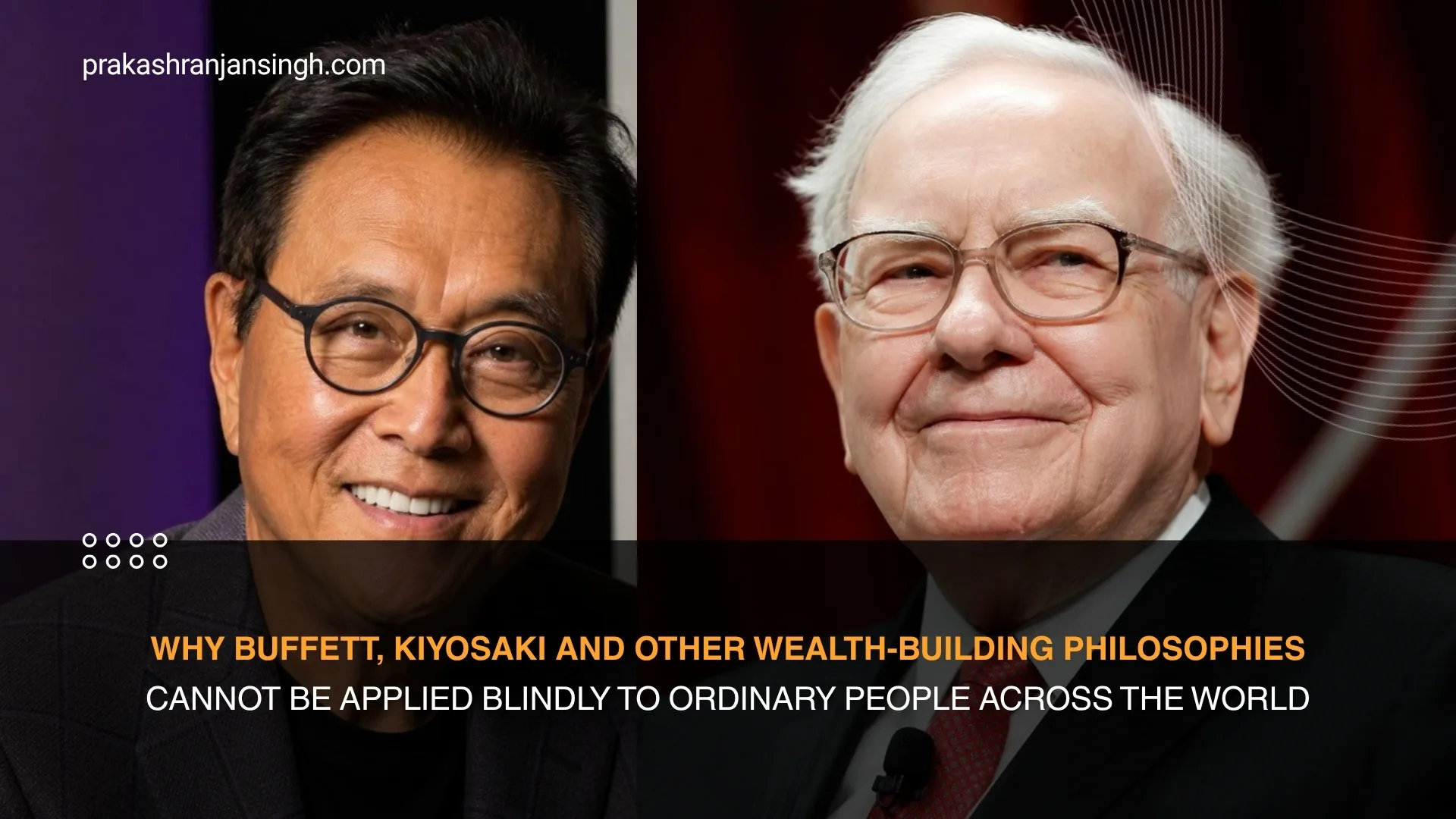
Table of Contents
Key Takeaways
- Warren Buffett’s and Robert Kiyosaki’s wealth-building philosophies were both shaped by a specific income, market, tax system and risk tolerance — the principles travel, but the exact prescriptions rarely do.
- Two people reading the same book can end up with wildly different outcomes once income, inheritance, geography, taxation and psychology are factored in — a universal wealth formula does not really exist.
- The safest way to use any financial guru’s advice is to extract the timeless principle (patience, financial education, cash-flow thinking) and test it against your own numbers, not to copy the prescription exactly as written.
A Successful Investor Is Not Automatically a Universal Financial Adviser
This is where most popular wealth-building philosophies start to break down once they leave the page and meet an actual life.
Warren Buffett’s extraordinary record has made him one of the most respected investors in history.
His emphasis on long-term ownership, business quality, patience and avoiding emotional decisions has enormous educational value — documented first-hand in his own annual letters to Berkshire Hathaway shareholders.
But the average employee in India, Brazil, Nigeria, Japan, Germany or the United States is not Warren Buffett.
The circumstances are different.
A salaried employee may have a home loan, children’s education expenses, ageing parents, medical costs and limited investable surplus.
Someone in another country may have a completely different pension system, healthcare structure, inflation rate, taxation regime and investment market.
Even within the same country, two people earning the same salary may have completely different financial lives.
One may have inherited a house.
Another may be paying rent.
One may have ₹50 lakh available for investment.
Another may struggle to save ₹5,000 a month.
Therefore, the first principle of personal finance should perhaps be:
Do not copy an investor. Understand the principle behind the investor.
Books Explain Principles; Life Creates Constraints
Financial books are usually written around principles.
Real life is governed by constraints.
A book may say:
“Invest for the long term.”
Excellent advice.
But what happens when someone needs money after three years for a child’s education?
Another principle may say:
“Buy assets, not liabilities.”
Again, useful.
But a house purchased for personal residence cannot simply be treated like an investment property. It has emotional value, utility, financing costs, maintenance costs and opportunity costs.
Similarly, “avoid debt” sounds simple until we recognise that not all debt is economically identical.
A high-interest credit-card balance is completely different from a reasonably priced home loan — a distinction explored in more depth in The Credit Card Trap.
A business loan used productively is different from borrowing to finance a lifestyle.
Therefore, financial literacy requires classification and context, not slogans.
The Biggest Missing Variable Is Often the Investor’s Starting Point
Most wealth-building philosophies frequently ignore one uncomfortable reality:
People do not start from the same starting line.
Consider two investors.
Investor A earns ₹2 lakh a month and can invest ₹80,000.
Investor B earns ₹35,000 and can save ₹3,000.
Both may read exactly the same book. Both may follow the same investment philosophy.
But their outcomes will obviously be dramatically different.
Now add inheritance. Add property ownership. Add family support. Add education. Add access to credit. Add taxation. Add health expenditure. Add currency. Add inflation. Add political and economic stability.
Suddenly, the idea of a universal wealth formula begins to look much less convincing.
The investment strategy cannot be separated from the economic ecosystem surrounding the investor.
Geography Changes the Meaning of an Investment Principle
One of the biggest mistakes in global financial content is assuming that markets behave similarly everywhere.
They do not.
Interest rates differ. Inflation differs. Taxation differs. Currency risks differ. Property markets differ. Stock-market structures differ. Pension systems differ. Social-security systems differ. Banking systems differ. Regulations differ. Even investor behaviour differs.
A real-estate strategy that worked exceptionally well in one American city may not produce the same result in an Indian city.
A tax-efficient investment available to an American investor may not exist in India.
A retirement strategy suitable for someone with a strong employer-sponsored pension system may be inappropriate for someone whose retirement depends largely on personal savings.
Therefore:
Financial principles may be universal, but financial products and implementation are not.
The Most Dangerous Market Variable Is Sitting Between Your Ears
There is another reason why financial gurus cannot simply be copied.
Human psychology.
Investment decisions are rarely made by calculators alone — a theme covered at length in The Psychology of Money.
They are made by human beings experiencing fear, greed, regret, excitement, envy and impatience.
A person may promise:
“I will hold this investment for 20 years.”
Then the market falls 30%.
Suddenly the same investor starts thinking:
“Maybe the market is finished.”
A friend makes money in an IPO. The investor feels left behind.
A neighbour makes money in cryptocurrency. Fear of missing out appears.
A social-media influencer announces a “multibagger”. The carefully designed financial plan suddenly looks boring.
This is the real battlefield.
The biggest enemy of long-term investing is often not the market.
It is the investor’s changing mind.
Buffett’s Patience Is Easier to Admire Than to Practise
“Buy good businesses and hold them for the long term” sounds wonderfully simple.
The difficult part is actually doing it.
Imagine buying a fundamentally strong company and watching its price decline 40%.
Can the investor continue holding? What if the decline lasts three years? What if everyone around him is making money elsewhere? What if newspapers declare that the investment thesis is dead? What if he needs the money for a family emergency?
This is where theoretical knowledge collides with human psychology.
Long-term investing requires not only knowledge but financial capacity to wait.
An investor with sufficient emergency savings can remain invested during a downturn.
An investor without liquidity may be forced to sell at precisely the wrong time.
Thus, patience is partly a psychological quality—but it is also a financial privilege.
Kiyosaki’s Ideas Can Educate—But Slogans Can Also Oversimplify
Kiyosaki’s wealth-building philosophies are a good example of ideas that teach a mindset far better than they teach a step-by-step plan.
Robert Kiyosaki has popularised concepts such as financial education, cash flow, assets and liabilities, and the importance of developing income-producing assets — ideas examined in more depth in Rich Dad Poor Dad: The Lessons the New Generation Must Learn.
These concepts can encourage people to think beyond salary alone.
But the ordinary reader must distinguish between educational concepts and practical financial prescriptions.
For example, encouraging people to build assets can be valuable.
But borrowing heavily to acquire assets introduces leverage risk.
Real estate can create wealth—but property is illiquid, location-dependent and often highly leveraged.
Business ownership can generate extraordinary wealth—but businesses also fail.
Entrepreneurship can create financial independence—but it can also destroy capital.
Therefore, “asset” does not automatically mean “safe wealth”.
An asset can be productive, unproductive, volatile, illiquid or highly leveraged.
That distinction matters.
Where Are the Ordinary Success Stories?
There is another question worth asking about every set of celebrated wealth-building philosophies.
When financial philosophies become globally famous, we often hear about their greatest success stories.
But how many ordinary people became financially independent simply by following a particular guru’s philosophy exactly as written?
This is difficult to measure, because personal-finance outcomes are rarely attributable to one philosophy.
A person may say they followed Buffett, but their wealth may also have resulted from a high salary, inheritance, property appreciation, entrepreneurship, favourable taxation and decades of saving.
Similarly, someone may read Kiyosaki and become financially successful because the book changed their mindset—but the actual wealth may have come from their business.
This does not make the philosophy worthless. It simply means we should distinguish between:
“This idea influenced me” and “This idea alone created my wealth.”
That distinction is often missing in popular financial storytelling.
The Invisible Advantage of Time
Many investment stories become spectacular because of compounding.
But compounding requires something ordinary people often underestimate: time.
A person who starts investing at 25 has an enormous advantage over someone who starts at 50.
But the 50-year-old cannot simply copy the strategy of the 25-year-old.
Their risk capacity is different. Their retirement horizon is different. Their responsibilities are different. Their ability to recover from a major loss is different.
Therefore, age is not merely a biological number in investing. It changes the risk budget.
Income Is the Engine; Investment Is the Accelerator
Personal finance discussions often focus excessively on investment returns.
But for a young or middle-income person, increasing earning capacity may be more important than finding the next multibagger.
If someone can increase annual income by ₹3 lakh, that may have a larger impact on financial security than squeezing another few percentage points from an investment portfolio.
Skills, education, career development, entrepreneurship and professional reputation can therefore be considered human-capital investments.
The financial guru who teaches only investment selection may be addressing the accelerator while ignoring the engine.
For many ordinary people, the first wealth-building strategy should be:
earn → protect → save → invest → compound.
Not:
borrow → speculate → become rich.
Debt Is Neither Automatically Evil Nor Automatically Productive
This is another area where simplistic financial messaging can mislead.
Debt can destroy wealth. It can also help create wealth.
The difference lies in interest cost, purpose, repayment capacity, cash flow, asset quality, duration, risk and leverage.
A person earning ₹50,000 a month who takes multiple consumer loans to maintain a lifestyle may eventually become financially trapped — a pattern examined further in The Credit Card Trap.
Another person may use carefully managed business financing to expand a profitable enterprise.
Both have “debt”. Their financial consequences can be completely different.
Therefore, the question is not merely “Do you have debt?”
The better question is:
“What is the debt doing to your future cash flow?”
The Middle-Class Investor Needs a Different Philosophy
Most famous wealth-building philosophies were never written with the average middle-class investor’s constraints in mind.
The average middle-class investor does not necessarily need spectacular wealth.
They need financial resilience.
They need enough emergency liquidity to survive job loss. They need insurance appropriate to their circumstances. They need manageable debt. They need retirement planning. They need protection against catastrophic financial events. They need diversified investments. They need the ability to remain invested during market corrections.
And perhaps most importantly, they need a financial plan that they can psychologically follow.
A theoretically superior strategy that causes an investor to panic and sell is inferior to a slightly less aggressive strategy that the investor can maintain for decades.
The Greatest Financial Mistake Is Copying Somebody Else’s Risk Tolerance
Every investor has a different psychological tolerance for losses.
One person sees a 20% market decline as an opportunity. Another cannot sleep.
Neither person is necessarily irrational — as Investment Psychology: Why Young Investors Must Choose Wisdom Over FOMO explores in more detail.
They simply have different financial circumstances and psychological responses.
Risk tolerance is also not constant. It can change after marriage, childbirth, job loss, retirement, illness, family emergencies or major market crashes.
Therefore, an investment portfolio should not be designed according to someone else’s personality.
Your portfolio must be compatible with your own sleep cycle.
If an investment keeps you awake at night, the expected return may not compensate for the psychological cost.
What Should Ordinary Investors Actually Learn From the Gurus?
The answer is not to reject their wealth-building philosophies wholesale.
It is to extract the timeless principles while rejecting blind imitation.
From Buffett, an investor can learn: patience, discipline, business quality, long-term thinking and the danger of emotional decisions.
From Kiyosaki, one can learn: financial awareness, cash-flow thinking, the importance of understanding assets and liabilities and the value of financial education.
From index-investing advocates, one can learn: simplicity, diversification and the danger of unnecessary costs.
From successful entrepreneurs, one can learn: initiative, innovation and the potential value of human capital.
But none of these automatically tells an individual:
“This is exactly what you should buy tomorrow.”
That decision requires personal context.
The Future Belongs to Financially Independent Thinkers—Not Financial Followers
The internet has democratised financial information.
That is a tremendous advantage. But it has also created a new danger.
The investor now has access to thousands of experts, influencers, YouTubers, newsletters, podcasts and social-media opinions.
One says buy. Another says sell. One says real estate is the safest asset. Another says stocks are superior. One says gold is essential. Another says cryptocurrency is the future.
The ordinary investor can become overwhelmed.
The solution is not finding the “perfect guru”.
It is developing the ability to think independently.
Ask: What is my income? What are my liabilities? What is my emergency reserve? What is my investment horizon? What happens if the market falls 30%? When will I need this money? What taxes apply? What are the costs? What happens if my income stops? What risks am I actually taking?
And finally:
Can I stay invested when my emotions tell me to run?
The Financial Guru Should Be a Teacher—Not a Driver
Perhaps this is the most important lesson buried inside every set of borrowed wealth-building philosophies.
A financial expert can provide a map. But the investor must drive the vehicle.
Buffett’s map was created from his experience. Kiyosaki’s map emerged from his philosophy. Other investors have their own maps.
But your destination may be different. Your vehicle may be different. Your fuel may be different. Your road conditions may be different. And your ability to tolerate a breakdown may be completely different.
Therefore, copying another person’s investment strategy without understanding one’s own circumstances is like using somebody else’s prescription because both people have a human body.
The broad principles may be useful. The prescription may not be.
The Final Lesson: Building Your Own Wealth-Building Philosophy
The world loves financial heroes because complicated financial reality becomes easier when represented by a personality, which is exactly how borrowed wealth-building philosophies end up replacing personal judgment.
But wealth creation is rarely a single-person formula.
It is a combination of income, savings, time, compounding, discipline, risk management, opportunity, geography, taxation, family circumstances and psychology.
The real financial guru is therefore not the person who gives you the most attractive investment idea.
It is the person—or better still, the knowledge—that helps you understand why an investment suits you, what can go wrong and whether you can survive that outcome.
Read Buffett. Read Kiyosaki. Read other successful investors.
Learn from them. Question them. Understand their context.
But do not surrender your financial judgment to them, and do not adopt someone else’s wealth-building philosophies without first testing them against your own numbers.
Because the greatest investment principle may be the simplest one:
Do not invest according to somebody else’s life. Invest according to your own financial reality.
The objective of investing should not be to become the next Warren Buffett.
For most ordinary people, the real victory is much more practical:
to reach old age without financial dependence, without destructive debt and with enough wealth to live with dignity.
That is a definition of financial success worth pursuing anywhere in the world.
Frequently Asked Questions
Why can’t Warren Buffett’s or Robert Kiyosaki’s advice be applied blindly everywhere?
Because their wealth-building philosophies were shaped by a specific income level, market, tax system, currency, pension structure and personal risk tolerance. The broad lessons — patience, financial education, thinking in cash flow — travel well, but the specific products, leverage levels and timelines they used do not automatically fit someone with a different income, country or life stage.
What is the biggest risk of copying a financial guru’s wealth-building philosophies exactly?
Mismatched risk tolerance and liquidity. A strategy built for someone with decades of runway, high income or emergency reserves can force an ordinary investor with none of those buffers to sell at the worst possible moment during a downturn.
Should ordinary investors ignore Buffett and Kiyosaki altogether?
No. Both offer genuinely useful, timeless principles — patience and business quality from Buffett, financial awareness and cash-flow thinking from Kiyosaki. The lesson is to extract the principle, not copy the prescription, and to test any wealth-building philosophies against your own income, liabilities and psychology before acting.
How should someone build a personal wealth-building philosophy instead of borrowing one?
Start with your own numbers, not someone else’s story: income, liabilities, emergency reserve, investment horizon, tax situation and how you actually behave when the market falls 30%. A plan you can psychologically sustain for decades beats a theoretically superior one you abandon in a panic.
Related Reading
- Rich Dad Poor Dad: The Lessons the New Generation Must Learn Before Money Teaches Them the Hard Way
- Warren Buffett: The Psychology of Wealth
- Investment Psychology: Why Young Investors Must Choose Wisdom Over FOMO
- The Psychology of Money: The Invisible Force That Drives Human Life
- Rich Dad Poor Dad (background & reception)


Leave a Reply