Key Takeaways
- The Vvaan draws on real Van Devi folklore from a forest shrine near Bihta, Bihar — but its supernatural elements are cinematic imagination, not documented fact.
- India’s sacred-forest, sacred-river and sacred-tree traditions turned ecological dependence into cultural reverence, a psychological mechanism that protected nature long before formal conservation law existed.
- The deeper lesson for the next generation isn’t supernatural belief — it’s remembering to respect and protect what actually sustains human life.
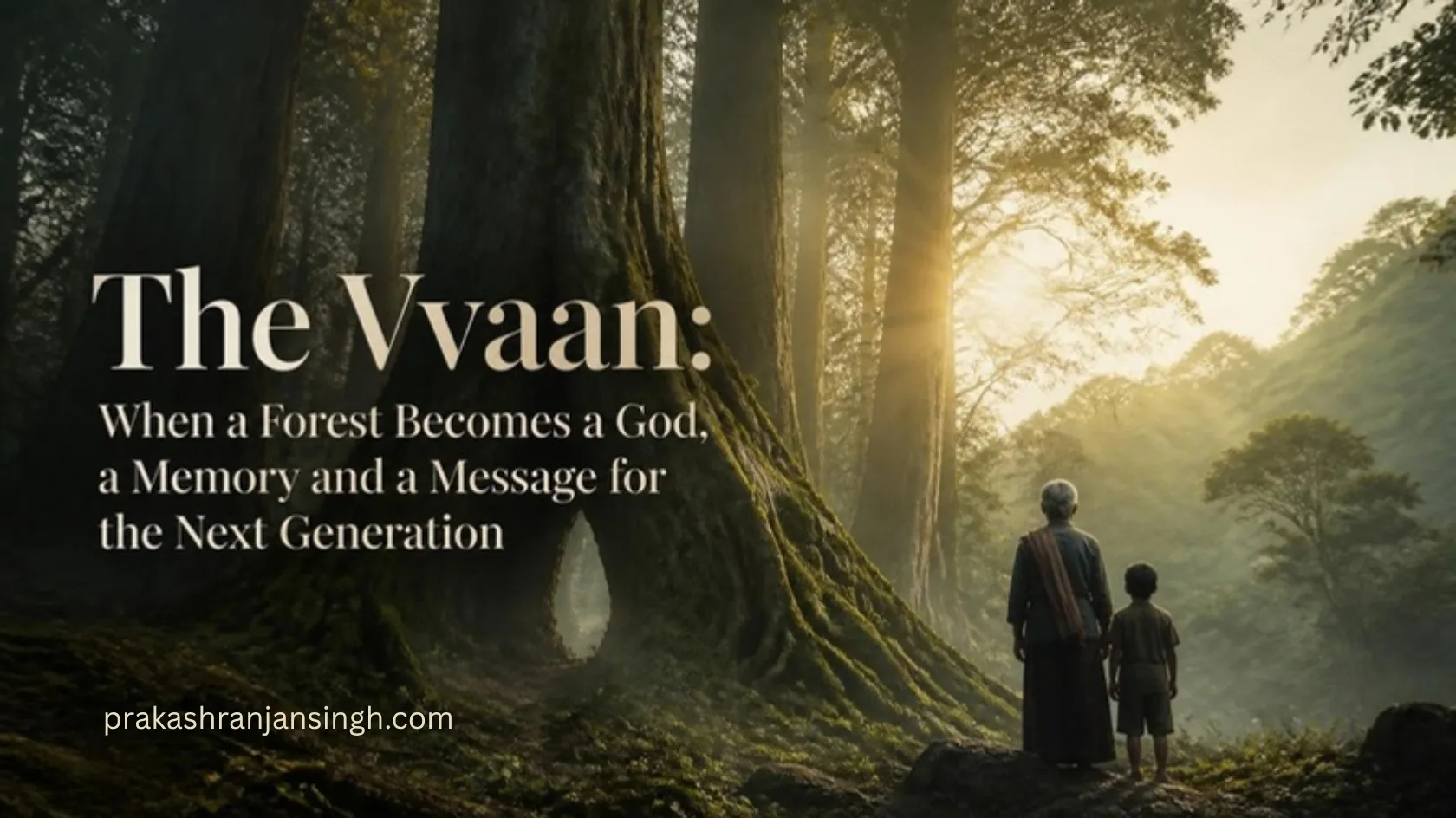
India’s ancient relationship with nature was not merely religious—it was psychological, ecological and civilisational.
A forest is usually described as a collection of trees.
But in the Indian imagination, a forest has never been merely a collection of trees.
It can be Dev Van, Tapovan, Aranyaka, sacred land, the home of a deity, the place of meditation, the source of medicine, the protector of water and the habitat of countless forms of life.
This is perhaps why the story behind the recently released Hindi film The Vvaan: Force of the Forest is much more interesting than a conventional supernatural story.
The film draws inspiration from the folklore surrounding Maa Van Devi Temple near Bihta in Bihar, a shrine associated with a sacred forest and a longstanding local tradition that the area should not be entered after sunset. The deity is worshipped in the form of a sacred pind rather than a conventional idol. The temple is locally believed to be several centuries old, although its exact historical age is not established by archaeological evidence.
The cinema may present this world through fantasy, mystery and supernatural forces.
But behind the entertainment lies a much bigger question:
Why did Indian civilisation repeatedly convert elements of nature into objects of reverence?
Perhaps the answer is hidden in our own survival.
Nature Was Never Separate From Indian Life
Modern science tells us that human life depends upon an extraordinary chain of ecological conditions—water, oxygen, suitable temperature, soil, sunlight, biodiversity and functioning ecosystems.
Ancient Indians did not possess today’s atmospheric models, satellite observations or climate databases.
Yet they lived intimately with the consequences of ecological balance.
They depended on rivers for water and agriculture.
They depended on forests for food, fuel, medicines, timber and livelihoods.
They depended on animals for agriculture and transport.
They depended upon sunlight for life and agriculture.
They depended upon seasonal cycles to determine sowing and harvesting.
And therefore nature was not something outside human life.
Nature was life itself.
This understanding gradually became embedded in culture, ritual, mythology and social behaviour.
The result was something extraordinary:
ecological dependence was converted into cultural reverence.
When a Tree Becomes More Than a Tree
India has numerous traditions in which trees, plants, rivers, mountains, animals and natural forces acquire sacred significance.
The peepal, banyan, tulsi and many other plants have cultural and religious importance. Rivers such as the Ganga and Yamuna are revered. Mountains such as the Himalayas have an enormous place in Indian thought. The Sun is worshipped. Animals associated with different deities receive protection through religious sentiment.
This does not mean that ancient Indians possessed modern ecological science in its present form.
It means something psychologically important happened:
Nature was given emotional and moral value.
A person may cut an ordinary tree for convenience.
But cutting a sacred tree creates hesitation.
A river may technically be a water channel.
But when the river becomes Maa Ganga, polluting it acquires a moral dimension.
A forest may contain commercially valuable timber.
But when it becomes Dev Van, entering it casually may become socially unacceptable.
This is a powerful psychological mechanism.
Reverence can sometimes protect what regulation alone struggles to protect.
The Ministry of Environment itself recognises India’s long tradition of sacred groves and notes that forests and trees have been revered in Indian culture. Sacred groves conserved by communities can serve as repositories of plant and animal diversity.
Chhath: A Festival Where Nature Is the Place of Worship
Few Indian festivals demonstrate the relationship between human beings and nature as visibly as Chhath Puja.
There is no elaborate temple required.
The devotee goes towards a water body.
The Sun becomes the focus.
Water becomes part of the ritual environment.
Fruits and naturally produced offerings become prasad.
The setting Sun is worshipped, followed by the rising Sun.
The official Bihar Tourism description itself highlights the unusual feature of Chhath: both the setting and rising Sun are worshipped, with rituals taking place around rivers or other water bodies.
Psychologically, this creates a remarkable experience.
For several days, the individual temporarily moves away from ordinary consumer life.
There is fasting.
There is discipline.
There is cleanliness.
There is contact with water.
There is exposure to the open sky.
There is collective participation.
There is gratitude.
The festival therefore does something that modern psychology increasingly recognises: it creates a structured break from everyday stress and reconnects the individual with the physical environment and community.
The Forest Is Not Only Producing Oxygen
It is tempting to reduce the importance of forests to one sentence:
“Trees give us oxygen.”
That is true but dramatically incomplete.
Forests regulate water cycles, protect soil, support biodiversity, store carbon, provide livelihoods and contribute to climate resilience.
They also provide ecosystem services whose economic value is often invisible in everyday life.
India’s State of Forest Report 2023 recorded total forest cover of about 715,343 sq km, approximately 21.76% of India’s geographical area, with forest cover and tree cover together accounting for a larger share. The report also records substantial differences between states and changes over time.
So the forest is not simply a collection of trees waiting to be harvested.
It is an interconnected system.
Destroy one part and consequences may appear somewhere else—in groundwater, agriculture, soil, temperature, wildlife or human livelihoods.
The World Health Organization also recognises that nature-based solutions can contribute to air, soil and water quality, physical activity, mental well-being and social cohesion.
India’s Conservation Story Is Both Ancient and Modern
It would be incorrect to say that India has always perfectly protected nature.
History also contains deforestation, hunting, exploitation and ecological degradation.
But alongside those realities exists a long tradition of conservation.
Sacred groves survived because communities attached religious significance to them.
The Bishnoi tradition is an important example of a community whose cultural practices emphasise protection of biodiversity and trees. The Ministry of Environment specifically identifies the Bishnoi tradition as an example of an eco-friendly social ethic.
Modern India has also built formal conservation mechanisms.
The Forest (Conservation) Act, 1980 established central approval requirements for diversion of forest land for non-forest purposes. The compensatory-afforestation framework and CAMPA were subsequently developed to address ecological losses associated with permitted diversion.
India also has wildlife conservation programmes such as Project Tiger, protected areas and various habitat-conservation initiatives.
Thus, India’s environmental journey has two different languages:
the language of faith and tradition, and the language of law and science.
The challenge is to make both work together.
And Then Comes The Vvaan
This is where the film becomes psychologically fascinating.
The Vvaan takes folklore surrounding Van Devi and converts it into a cinematic story involving a forest, faith, supernatural forces and the conflict between an ancient sacred landscape and development. The trailer explicitly sets up the forest temple against development plans, while the film’s narrative incorporates Bihar’s cultural setting and Chhath.
The film should therefore not be treated as a documentary proving supernatural claims.
The reported Van Devi traditions belong to local folklore; the supernatural elements are part of the cinematic imagination. There is no established evidence that supernatural activity actually occurs in the forest after sunset.
And that distinction is important.
The value of folklore does not necessarily depend upon proving every supernatural element literally.
A story can communicate a behavioural message even when its narrative form is mythological.
Why Does the Human Mind Create Sacred Boundaries?
Imagine telling a child:
“Don’t enter this forest because it is ecologically sensitive.”
The child may ask:
“Why?”
Now tell the same child:
“This is the forest of the goddess. You must respect it.”
The psychological response can be completely different.
Fear, reverence, curiosity, identity and belonging can become powerful behavioural forces.
This is one reason sacred geography has historically mattered.
A geographical boundary becomes a psychological boundary.
The forest is no longer merely there.
It becomes ours to respect, not ours to possess.
That distinction may be one of the most important lessons hidden inside the Van Devi story.
Fear Can Protect—But Reverence Can Protect Better
There is another psychological dimension.
Human beings are not motivated only by rational calculations.
We respond to:
fear,
love,
identity,
belonging,
tradition,
social approval,
guilt,
responsibility,
gratitude and
the desire to protect what we consider sacred.
Environmental policy generally operates through laws, penalties and incentives.
Traditional societies often added another mechanism:
sacredness.
When a forest becomes sacred, destroying it can feel like violating something larger than oneself.
That is not a substitute for science or law.
But it is a powerful complement.
The Modern Generation Has a Different Psychological Problem
Our children are growing up in a radically different environment.
Many spend hours looking at screens.
Entertainment is increasingly digital.
Food arrives through apps.
Shopping happens online.
Work happens through computers.
Friendships increasingly involve social media.
Urban children may know the names of hundreds of digital characters but may not know the names of ten trees growing around their homes.
This creates a subtle psychological distance from nature.
Nature becomes a photograph.
A forest becomes a location on Google Maps.
A river becomes an Instagram background.
A mountain becomes a holiday destination.
The danger is not simply environmental ignorance.
It is emotional disconnection.
The Vvaan Can Reopen a Conversation Between the Young and Nature
This is perhaps where cinema can perform an important cultural function.
A young person may not voluntarily read an environmental report.
But a mystery surrounding a forest can capture attention.
A supernatural story can create curiosity.
A character entering a forbidden forest can create emotional involvement.
A connection with Chhath can introduce cultural context.
And after entertainment comes the opportunity for questions:
Why was the forest considered sacred?
Why did people create restrictions around it?
Why are rivers worshipped?
Why is the Sun worshipped?
Why did communities protect certain trees?
Why are forests important even to people who never enter one?
This is how popular culture can become an entry point into environmental education.
The Psychology of Awe: When Nature Makes Us Feel Small
There is another powerful psychological effect.
Stand inside a dense forest.
Look at the Himalayas.
Watch a river during the monsoon.
Stand on the bank of the Ganga during sunrise.
Watch the Sun disappear below the horizon.
Something happens inside the human mind.
Our individual problems temporarily appear smaller.
Modern research increasingly examines the psychological and health benefits associated with contact with natural environments, including stress reduction, physical activity and social connection.
Indian civilisation incorporated many such experiences into everyday cultural life long before modern psychology developed its terminology.
Perhaps the forest was not merely a source of material resources.
It was also a place where the human ego could become smaller.
Ancient Wisdom Should Not Be Romanticised—It Should Be Understood
There is an important balance.
We should neither say:
“Everything ancient was scientifically correct.”
Nor should we say:
“Everything religious is merely superstition.”
Both positions are too simplistic.
Some traditional practices may have ecological value.
Some may have cultural value.
Some may contain symbolic wisdom.
Some claims may be purely matters of faith.
Modern science must investigate ecological claims scientifically.
But science does not need to destroy cultural meaning.
Similarly, religious faith does not need to reject scientific evidence.
India’s future environmental model could be strongest when science, law, community knowledge and cultural values work together.
From Dev Van to Smart City: Can India Carry Nature Forward?
India is urbanising rapidly.
We need roads.
We need houses.
We need industries.
We need electricity.
We need transportation.
We need employment.
Development cannot simply stop.
But development that destroys the ecological systems upon which development itself depends eventually creates another bill for society to pay.
India’s own forest policy framework has long expressed the objective of maintaining ecological stability, while present-day conservation programmes combine legal protection, compensatory afforestation, habitat restoration and urban greening.
The question therefore should not be:
Development or environment?
The more intelligent question is:
How can development remain compatible with the ecological systems that make human life possible?
Perhaps Van Devi Was Never Only About a Goddess
This may be the deepest psychological interpretation of the Van Devi tradition.
A society living beside a forest knows that the forest is powerful.
It provides.
It shelters.
It feeds.
It protects water.
It contains unknown animals.
It can also be dangerous.
Instead of treating nature only as an object of exploitation, the community gives it personality.
The forest becomes Van Devi.
And once nature acquires a sacred identity, the human being is psychologically encouraged to approach it with humility.
That is a remarkable civilisational idea.
The Real Villain May Be Forgetfulness
Perhaps the greatest environmental danger today is not simply the axe, the machine or the construction project.
It is forgetfulness.
We forget where our food comes from.
We forget where our water comes from.
We forget that soil is alive.
We forget that forests regulate ecological systems.
We forget that human beings are biological creatures.
We forget that economic growth ultimately depends upon physical resources.
And when we forget our dependence upon nature, we begin to behave as though we are independent of it.
We are not.
What Should the Next Generation Learn From The Vvaan?
Not that every forest contains a supernatural creature.
Not that every ancient story must be accepted literally.
Not that development is evil.
And not that science and tradition are enemies.
The larger lesson can be much simpler:
Respect what sustains you.
If a river sustains you, protect it.
If a forest protects your ecological system, conserve it.
If soil produces your food, don’t destroy its fertility.
If biodiversity supports your life, don’t treat every living species as disposable.
And if an ancient tradition teaches respect for nature, perhaps we should understand the wisdom behind the tradition before dismissing it.
India’s Oldest Environmental Message May Still Be Relevant
The remarkable thing about Indian civilisation is that nature was often brought into the family of the sacred.
The Sun was worshipped.
Rivers were revered.
Trees received religious significance.
Mountains became sacred landscapes.
Animals became associated with deities.
Forests became Dev Van.
Festivals such as Chhath brought millions of people physically to water bodies and under the open sky.
These practices should not be viewed merely as rituals belonging to the past.
They can become a cultural foundation for environmental consciousness in the present.
The challenge before modern India is to translate reverence into responsible behaviour.
Because praying before a river while polluting it is not conservation.
Planting a tree and then allowing it to die is not conservation.
Talking about forests while destroying biodiversity is not conservation.
The real test begins after the prayer.
The Vvaan’s Most Important Message May Lie Outside the Cinema Hall
The Vvaan begins with folklore.
It enters the world of cinema through mystery, faith and supernatural imagination.
But its most valuable conversation may begin when the audience leaves the theatre.
A child may ask:
“Does Van Devi really exist?”
Perhaps the better adult response is:
“Let us first understand what the forest gives us.”
Then comes the next question:
“Why did our ancestors consider some forests sacred?”
And finally:
“What will happen if our generation forgets to protect them?”
That is where mythology becomes education.
That is where cinema becomes conversation.
And that is where an ancient Indian idea can acquire a modern meaning.
A forest does not need to be called God for us to protect it.
But perhaps our ancestors understood something psychologically profound: when human beings begin to see nature as sacred, they become less willing to treat it as disposable.
Van Devi, therefore, may not merely be a story about a goddess living in a forest. It may be a story about a civilisation reminding its children that human life itself lives inside the forest’s larger story.
Table of Contents
- Nature Was Never Separate From Indian Life
- When a Tree Becomes More Than a Tree
- Chhath: A Festival Where Nature Is the Place of Worship
- The Forest Is Not Only Producing Oxygen
- India’s Conservation Story Is Both Ancient and Modern
- And Then Comes The Vvaan
- Why Does the Human Mind Create Sacred Boundaries?
- Fear Can Protect—But Reverence Can Protect Better
- The Modern Generation Has a Different Psychological Problem
- The Vvaan Can Reopen a Conversation Between the Young and Nature
- The Psychology of Awe: When Nature Makes Us Feel Small
- Ancient Wisdom Should Not Be Romanticised—It Should Be Understood
- From Dev Van to Smart City: Can India Carry Nature Forward?
- Perhaps Van Devi Was Never Only About a Goddess
- The Real Villain May Be Forgetfulness
- What Should the Next Generation Learn From The Vvaan?
- India’s Oldest Environmental Message May Still Be Relevant
- The Vvaan’s Most Important Message May Lie Outside the Cinema Hall
- Frequently Asked Questions
Frequently Asked Questions
Is The Vvaan based on a true story?
The Vvaan draws on real folklore surrounding the Maa Van Devi Temple near Bihta in Bihar, including the local tradition that the forest should not be entered after sunset. The film’s supernatural elements are cinematic imagination built on that folklore — there is no established evidence that supernatural activity actually occurs there.
What is a Dev Van or sacred grove?
A Dev Van (sacred grove) is a patch of forest that a community protects because of its religious significance, often linked to a local deity. India’s Ministry of Environment recognises sacred groves as a long-standing conservation tradition that can serve as repositories of plant and animal diversity.
Why did ancient Indian culture treat nature as sacred?
Ancient Indian communities depended directly on rivers, forests, soil and sunlight for survival. Turning that ecological dependence into religious reverence — sacred trees, rivers, mountains and forests — created a psychological and social mechanism that protected resources which formal regulation alone often struggled to protect.
How much forest cover does India have today?
India’s State of Forest Report 2023 recorded total forest cover of about 715,343 sq km, approximately 21.76% of the country’s geographical area, with forest and tree cover together accounting for a larger share, and notable variation between states.
What is the real lesson The Vvaan offers the next generation?
Not that every forest hides a supernatural being, but that respect for whatever sustains you — a river, a forest, the soil, biodiversity — is worth carrying forward. The film’s folklore is an entry point into a conversation about why India’s ancestors protected nature and why that still matters today.
Related Reading
- Ramayana: The Story That Lives Inside the Human Mind
- Hindu Civilization at a Crossroads: The Need for Reform, Awareness, and Cultural Confidence
- Rudrabhishek: Where Faith Meets Science, Psychology and the Wisdom of Ancient India
- The Neem Karoli Baba Phenomenon: Divine Grace, Himalayan Energy and the Psychology of Faith
- Ministry of Environment, Forest and Climate Change — on India’s sacred groves tradition
Leave a Reply