The return of Merchant Discount Rate may not take India back to cash—it may instead create a new commercial ecosystem around digital money.
For six years, India became accustomed to something extraordinary.
You could buy groceries, pay a taxi driver, send money to a friend, pay school fees or purchase something worth thousands of rupees—and the digital payment itself generally carried no visible transaction charge.
That experience changed the psychology of an entire generation. Digital payment became synonymous with free payment.
Now India’s Unified Payments Interface is entering a new phase, and the new UPI MDR framework is at the centre of it.
From 15 October 2026, a new Merchant Discount Rate (MDR) framework will apply to specified UPI person-to-merchant transactions above ₹2,000. The headline rate is 0.4%, subject to a maximum of ₹300 per transaction. Person-to-person UPI transactions remain free, while payments to merchants up to ₹2,000 and qualifying small-merchant transactions remain outside the MDR. According to NPCI and the government, roughly 96% of P2M transactions will remain unaffected.
This is much more than a small change in payment pricing. The UPI MDR framework may represent the beginning of UPI’s transition from a largely subsidy-supported, zero-MDR ecosystem toward a commercially sustainable digital financial infrastructure.
And that raises a fascinating question: could MDR eventually create an entirely new financial segment built around digital transactions?
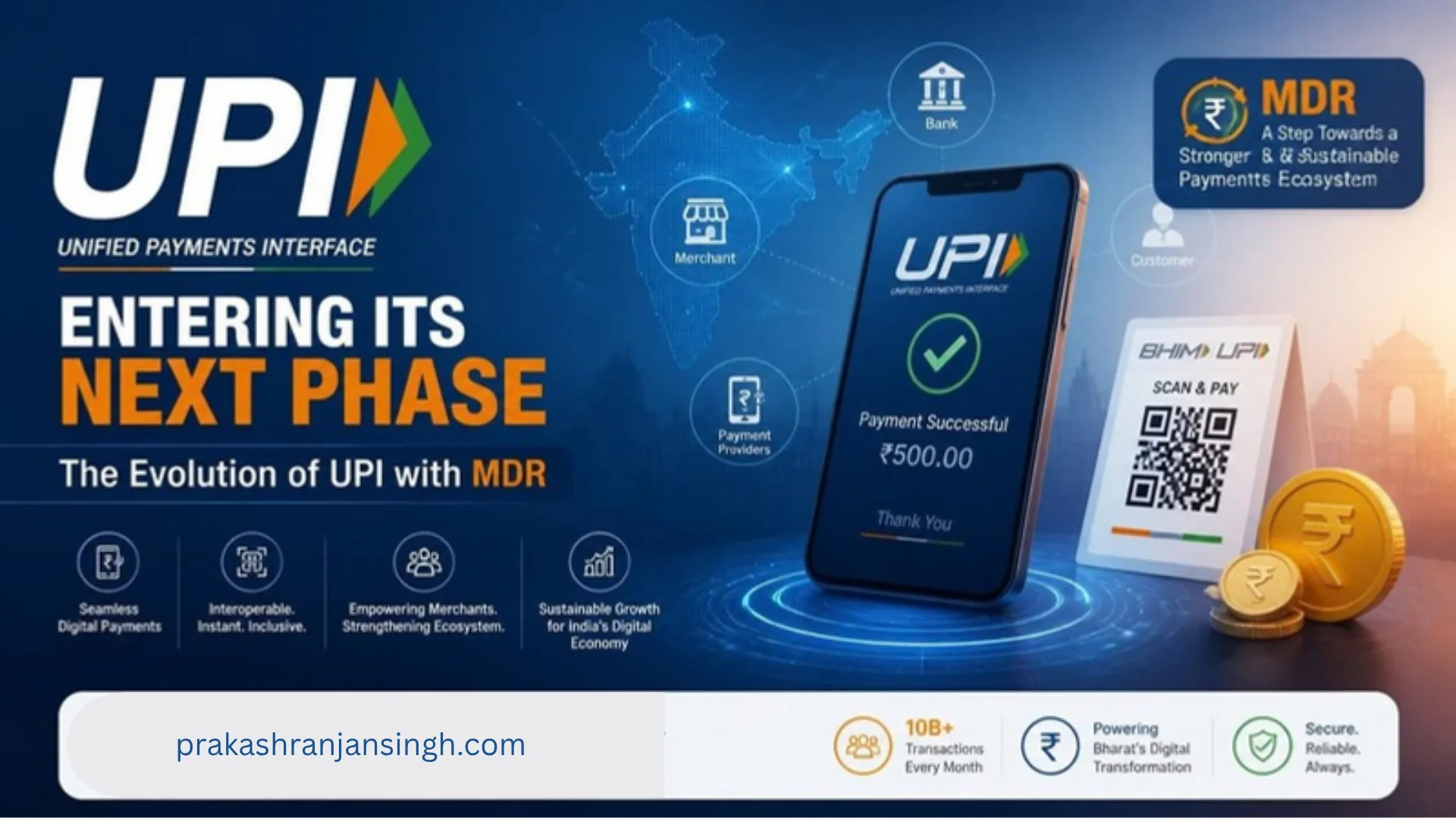
Table of Contents
- First, What Exactly Is the New UPI MDR?
- The Most Interesting Part: Where Does the Money Go?
- Will India Return to Cash?
- Convenience Has Changed the Meaning of Money
- But Psychology Can Work in Both Directions
- The Birth of the “Digital Financial Customer”
- MDR Could Create a New Marketing Weapon
- Could “Cashback Banking” Return in a New Form?
- The Bank of the Future May Look Different
- Could a New Class of Financial Institutions Emerge?
- The Merchant May Become the New Centre of Competition
- But There Is a Danger: Data Can Become the New Currency
- UPI MDR May Also Change the Economics of Innovation
- The Competition May Move From Price to Ecosystem
- The ₹2,000 Threshold May Itself Shape Behaviour
- Why Cash Is Unlikely to Disappear Either
- The Real Revolution May Be Invisible
- From Payment Infrastructure to Financial Infrastructure
- The Possible New Financial Segment
- But Regulation Will Determine the Shape of the Future
- The Bigger Question Is Not MDR
- The Final Paradox
- Frequently Asked Questions
Key Takeaways
- The new UPI MDR framework applies a 0.4% fee (capped at ₹300) on eligible UPI merchant transactions above ₹2,000, effective 15 October 2026.
- Around 96% of P2M transactions stay free — person-to-person UPI and small-merchant transactions are unaffected.
- MDR revenue splits 40/30/20/10 between the issuer bank, merchant acquirer, UPI app/TPAP and PSP bank.
- The bigger story isn’t whether cash returns — it’s whether a new, commercially sustainable “Digital Transaction Finance” segment emerges around UPI.
- Merchant data generated by transactions could become as commercially valuable as the transactions themselves, raising fresh privacy questions.
First, What Exactly Is the New UPI MDR?
MDR — Merchant Discount Rate — is essentially a fee associated with accepting a digital merchant payment.
Under the new framework, eligible P2M UPI transactions above ₹2,000 will attract a 0.4% MDR, with a ₹300 cap for transactions of ₹75,000 and above. For example, a ₹10,000 eligible transaction would generate ₹40 of MDR.
The merchant bears this cost rather than the consumer directly. Banks and UPI payment providers have been instructed not to pass the MDR on to customers as a transaction charge.
There are also special structures for certain sectors. For categories such as railways, fuel, telecom, insurance and some other specified essential payments, the MDR is set at a flat ₹5 for applicable transactions above ₹2,000. Capital-market transactions have a separate 0.02% rate, subject to a ₹300 cap. Merchants receiving up to ₹1 lakh a month through UPI QR codes continue to enjoy zero MDR.
The objective is not simply to collect money. The government has argued that the growing UPI ecosystem requires continuing investment in infrastructure, cybersecurity, fraud prevention, resilience and expansion, and that a sustainable revenue model can encourage greater participation and competition.
The Most Interesting Part: Where Does the Money Go?
This is where the change becomes structurally important. The MDR is not simply government revenue — the new revenue is distributed among the participants that make the transaction possible.
The reported distribution, per the NPCI framework, on a ₹10,000 transaction generating ₹40 of MDR:
- Issuer — the customer’s bank: 40% (₹16)
- Merchant acquirer: 30% (₹12)
- UPI app / TPAP: 20% (₹8)
- Partner / PSP bank: 10% (₹4)
The significance is easy to miss. For the first time, a major part of India’s enormous UPI transaction volume acquires a defined commercial revenue stream that is shared across the ecosystem. That could change behaviour among banks, fintech companies, payment apps and merchant-acquiring businesses.
Will India Return to Cash?
This is the first fear being expressed once the UPI MDR framework takes effect. If digital payments become chargeable, will people go back to cash? The answer is unlikely to be a simple yes or no.
There may certainly be some behavioural response among merchants, particularly businesses operating on thin margins. Traders in Delhi and Bengaluru, for example, have already raised concerns about the effect of MDR on their margins.
But returning to the old cash economy would require reversing something much deeper than a pricing decision. It would require reversing habit and convenience — and these two forces are extraordinarily powerful.
Convenience Has Changed the Meaning of Money
Imagine a consumer who has used UPI every day for five years. He no longer thinks about finding an ATM. He does not need to carry sufficient cash, count change, or remember a bank account number for every small payment. He scans. He authenticates. He pays. The transaction is finished.
This has created a new psychological expectation:
“Money should move immediately.”
That expectation is unlikely to disappear simply because a limited category of merchant transactions now carries UPI MDR charges. This is similar to how people become accustomed to smartphones — once convenience becomes a habit, people do not easily return to the previous system.
Therefore, MDR may change the economics of digital payments without necessarily reversing the psychology of digital payments.
But Psychology Can Work in Both Directions
There is another side. Suppose a merchant has a profit margin of only 2%. A 0.4% MDR on an eligible transaction is not psychologically or financially insignificant. The merchant may begin looking at transaction size, payment method, customer behaviour, cash discounts, digital-payment incentives, pricing strategies and merchant-acquiring costs.
This could create a new battlefield. The competition may shift from “Who gives the cheapest banking service?” to “Who can create the most profitable digital customer ecosystem?” That is a profound change.
The Birth of the “Digital Financial Customer”
One of the quieter effects of UPI MDR is how it reshapes who counts as a valuable customer. For decades, banks largely viewed customers through traditional categories: savings account customer, current account customer, loan customer, credit-card customer, investment customer, insurance customer.
The UPI era creates another possibility: the digital transaction customer. A customer who generates thousands of digital transactions annually is economically valuable even if the individual transaction is tiny — because every transaction creates an opportunity.
The bank can potentially build relationships around payments, savings, credit, investments, insurance and other financial services. This may encourage financial institutions to compete for transaction behaviour, not merely deposits.
MDR Could Create a New Marketing Weapon
The possible redistribution of MDR is particularly interesting. Suppose Bank A receives revenue from the digital transactions generated by its customers. Instead of keeping all of that economic benefit, it could theoretically decide to use part of its broader digital-payment economics to strengthen customer acquisition or retention — through rewards, merchant offers, loyalty programmes or bundled services, subject to applicable regulations and commercial viability.
Then Bank B may respond. The result could be a new competitive cycle:
Transaction → revenue → customer benefit → more transactions → more revenue.
That creates a potentially powerful network effect. The bank may no longer be interested merely in acquiring a ₹10,000 deposit — it may want a customer who makes 500 digital transactions a year. The merchant may want a payment provider that gives superior settlement, analytics and credit access. The consumer may choose an app not merely because it works, but because the ecosystem gives additional benefits. The payment itself becomes the beginning of the relationship rather than the end of it.
Could “Cashback Banking” Return in a New Form?
India has already experienced aggressive cashback competition among digital-payment platforms. MDR potentially creates a different economic foundation for such competition.
Imagine future financial institutions offering packages such as “Use our account for digital transactions and receive benefits,” or “Maintain your relationship with us and receive merchant offers based on your payment activity,” or “Use our digital ecosystem and receive preferential access to selected financial products.”
The exact commercial models will depend on regulations, economics and competitive behaviour. But the underlying possibility is important: UPI revenue could become part of customer-acquisition economics. This could produce a new generation of financial products designed specifically around digital behaviour.
The Bank of the Future May Look Different
Traditional banking requires expensive infrastructure — branches, ATMs, cash-management systems, physical paperwork, large operational teams.
Digital-first institutions can potentially operate with a different cost structure. Their customer interface may be a smartphone. Their branch may be a digital application. Their payment infrastructure may be API-driven. Their customer acquisition may happen through digital ecosystems, and their relationship may be built through thousands of small transactions rather than occasional branch visits.
MDR does not itself create such institutions. But by creating a revenue stream around digital transactions, it could improve the economics supporting digital-first financial businesses. That is where the larger opportunity lies.
Could a New Class of Financial Institutions Emerge?
This is perhaps the most interesting long-term possibility. Imagine an institution whose primary business is not traditional branch banking. Its core assets could be digital payments, merchant networks, transaction analytics, automated credit assessment, embedded finance, digital savings, insurance distribution, investment products, AI-based financial assistance and cross-border payments.
Such an institution could potentially serve millions of customers at a much lower physical cost. It might not look like yesterday’s bank — it could resemble a combination of bank + fintech + payment network + financial marketplace.
Whether such institutions will emerge at scale remains uncertain. But the economics created by digital payments make the possibility increasingly credible.
The Merchant May Become the New Centre of Competition
MDR also changes the strategic importance of merchants. Today a merchant is not simply someone accepting payments — a merchant generates a continuous stream of digital financial activity.
That information can potentially support services such as cash-flow analysis, working-capital finance, inventory finance, insurance, accounting, tax management, business analytics and payment reconciliation.
This means the payment relationship can become the entry point for a much larger financial relationship. A bank that controls the merchant’s payment flow may eventually understand the merchant’s business better than a conventional lender relying primarily on periodic financial statements. That could transform small-business lending.
But There Is a Danger: Data Can Become the New Currency
There is a critical issue behind this transformation. Digital payments generate data — a tremendous amount of data: where people spend, how frequently they spend, average transaction size, merchant categories, business turnover, payment patterns.
Such information can be economically valuable. If used responsibly and within applicable privacy, consent and data-protection frameworks, transaction information can help improve financial services. But if used irresponsibly, it can create surveillance, profiling, discrimination or excessive commercial targeting.
Therefore, the next battle in digital finance may not merely be about who moves money. It may be about who understands the data generated when money moves.
UPI MDR May Also Change the Economics of Innovation
For years, UPI’s extraordinary growth created a paradox: the volume was enormous, but monetisation was limited. A payment infrastructure can process billions of transactions and still face the economic challenge of funding infrastructure, cybersecurity, fraud management, technology upgrades and customer support.
The new MDR framework attempts to address part of that problem. The government has described the move as supporting long-term sustainability, technological advancement and resilience. This could encourage companies to invest more aggressively in cybersecurity, fraud detection, artificial intelligence, merchant tools, payment reliability, customer service, rural expansion and international payments.
In other words: revenue can finance innovation, and innovation can create more revenue.
The Competition May Move From Price to Ecosystem
Traditional banking competition was often based on interest rates and branch presence. Digital finance may increasingly compete through ecosystems.
One institution might offer payments + savings + credit + insurance + investments. Another might offer payments + shopping + rewards + travel. Another could focus on payments + merchant finance + accounting + business intelligence. Another could specialise in cross-border payments + remittances + foreign exchange.
This could produce financial institutions designed around specific customer behaviour rather than traditional banking categories.
The ₹2,000 Threshold May Itself Shape Behaviour
There is another interesting psychological dimension. If payments up to ₹2,000 remain free while larger eligible transactions attract MDR, consumers and merchants may become more conscious of transaction structure.
Could merchants split transactions? Could customers change payment methods? Could businesses encourage other forms of payment? Such behaviour will depend on enforcement, merchant economics and the detailed rules.
The UPI MDR framework therefore needs careful monitoring to ensure that the pricing structure does not unintentionally create distortions or encourage artificial transaction splitting.
Why Cash Is Unlikely to Disappear Either
There is an important lesson here. Digitalisation does not necessarily mean the death of cash. Cash still has characteristics that digital money does not: privacy, offline usability, universal familiarity and independence from networks and devices.
Therefore, India’s future is unlikely to be completely cashless. Instead, it is more likely to become cash-light. Cash will remain important for certain people, situations and businesses. But digital payments can continue to dominate where convenience, record-keeping and speed matter.
The Real Revolution May Be Invisible
Most people will not notice the biggest consequence of UPI MDR. They will simply continue scanning QR codes. But behind every scan, a complex financial ecosystem is developing: a customer bank, a merchant bank, a payment app, a payment-service provider, a technology company, a fraud-management system, a cybersecurity network, a data infrastructure, a merchant-acquiring platform — and increasingly, financial products connected to the transaction.
The ₹40 MDR on a ₹10,000 transaction is therefore not merely ₹40. It is potentially the economic fuel for a much larger ecosystem.
From Payment Infrastructure to Financial Infrastructure
This is the critical distinction. UPI began as a way to move money. It is increasingly becoming infrastructure around which financial businesses can be constructed.
The next stage could therefore be:
UPI → digital transactions → transaction economics → customer acquisition → financial products → new institutions.
That chain is still developing. But if competition, regulation and technology evolve in the right direction, India could witness the emergence of financial institutions whose economics are fundamentally different from those of traditional banks — operating with fewer physical assets, much greater digital reach and a stronger dependence on technology, data and transaction ecosystems.
The Possible New Financial Segment
We may eventually need a new vocabulary. Not merely banking. Not merely fintech. Not merely payments. Perhaps: “Digital Transaction Finance.”
A financial segment where the payment itself becomes the gateway to the entire customer relationship. Its business model could combine transaction revenue + merchant services + financial products + data-driven personalisation + embedded credit + digital investment + insurance + cross-border services.
That could become one of the most important financial developments of the next decade.
But Regulation Will Determine the Shape of the Future
The commercialisation of UPI cannot be left entirely to market forces. Regulators will have to balance several objectives:
- Affordability: digital payments must remain accessible.
- Competition: a few dominant platforms should not permanently control the ecosystem.
- Privacy: customer data must remain protected.
- Security: fraud and cyberattacks must be aggressively addressed.
- Innovation: new companies should have space to compete.
- Financial inclusion: rural and low-income users should not be pushed aside.
- Merchant protection: small businesses must not face disproportionate costs.
- Consumer protection: charges must remain transparent.
The success of India’s digital-payment revolution will ultimately depend on maintaining this balance.
The Bigger Question Is Not MDR
The headline question is: “Will UPI charges bring back cash?” The more important question is: “What will India build around monetised digital transactions?” That is where the real story begins.
If UPI MDR merely increases the cost of digital payments without improving infrastructure, competition or service quality, its economic significance could remain limited. But if the new revenue stream encourages investment, innovation and competition, it could become a turning point.
Banks could compete for transaction-rich customers. Fintech companies could develop new business models. Merchant-acquiring companies could become more sophisticated. Digital-first financial institutions could emerge. Small businesses could gain access to financial services built around their actual transaction flows. And customers could receive increasingly integrated financial ecosystems.
The next generation may not ask, “Which bank has the biggest branch network?” They may ask, “Which financial institution gives me the best digital ecosystem?” That is a completely different question.
The Final Paradox
India spent years encouraging people to move from cash to digital payments. Now, as UPI reaches extraordinary scale, the ecosystem has to confront the economic question: who pays for the infrastructure that makes “instant money” possible?
The new UPI MDR framework is one answer. But it could also be the beginning of another transformation. The first UPI revolution changed how Indians pay. The next revolution could change how financial institutions make money, acquire customers and deliver financial services.
Cash may survive. UPI may become more commercial. Banks may become more digital. Fintech companies may become more financial. And entirely new institutions may emerge somewhere between banking and technology.
The QR code that once represented simply “Pay Here” may eventually represent something much bigger: “Enter the financial ecosystem here.” That may be the real significance of India’s next UPI chapter.
What is UPI MDR and who has to pay it?
UPI MDR refers to the new Merchant Discount Rate applied to eligible UPI person-to-merchant transactions above ₹2,000, effective 15 October 2026. The 0.4% fee (capped at ₹300) is paid by the merchant, not the customer — banks and UPI apps have been told not to pass UPI MDR on as a customer-facing charge.
Will UPI stop being free for everyday users?
No. Person-to-person UPI transfers remain completely free, and payments to merchants up to ₹2,000 — about 96% of all P2M transactions — are also unaffected. Only larger, eligible merchant transactions above the threshold attract the new fee.
How is the MDR revenue split among banks and apps?
On a ₹10,000 eligible transaction generating ₹40 of MDR, the reported NPCI split is 40% to the issuer (customer’s bank), 30% to the merchant acquirer, 20% to the UPI app/TPAP, and 10% to the partner/PSP bank.
Could this MDR framework bring back cash payments in India?
It is unlikely to reverse UPI’s dominance on its own. Habit and convenience run deeper than a pricing change affecting a narrow slice of transactions, though thin-margin merchants may adjust pricing or payment preferences at the margins.
Related Reading
- UPI: From an Indian Payment Revolution to a Possible New Financial Order
- India’s Private Banking Revolution: When the Customer Became the Product
- The Credit Card Trap: How a Small Piece of Plastic Is Quietly Rewiring Our Psychology
- AI in Banking: Could the World’s Digital Banking Backbone Become the Next Battlefield?
- Cyber Fraud in the Digital Age: Awareness Is the Strongest Security
- PIB: UPI Continues to Remain Free for Peer to Peer Transactions and 96% of Merchant Transactions

Leave a Reply