The New Psychology of Bank Unions, Government, NPCI, Digital Banking and the Rise of Private Banks
There was a time when a bank strike meant a banking strike.
If bank employees did not come to work, the customer could not deposit money, withdraw cash, clear a cheque, obtain a draft, submit documents or complete many routine banking transactions.
The employee sitting behind the counter was the banking system.
Today, that psychological equation has changed.
A customer can wake up, open a banking application, transfer ₹50,000 through UPI, pay electricity bills, invest in a mutual fund, book a train ticket, receive salary, repay a loan and check an account balance—without speaking to a bank employee even once.
This transformation creates a fascinating question in the present five-day banking controversy — a fresh bank strike is once again on the table (UNI Global Union):
If bank unions can still mobilise a huge majority of banking employees, but customers increasingly possess banking in their own hands, where exactly does the real power of a bank strike lie in 2026?
The question becomes even more important when the unions claim to represent around 90% of India’s banking workforce.
The number is undoubtedly significant for any bank strike headline.
But 90% of employees does not necessarily mean 90% of banking transactions can be stopped.
That is the fundamental psychological change a bank strike now reveals about Indian banking.
Key Takeaways
- A bank strike today no longer freezes banking the way it once did — UPI, net banking, ATMs and private-sector banks keep most transactions moving even when union membership is near 90% of the workforce.
- NPCI’s shared digital rails and the steady rise of private banks have quietly shifted real bargaining power away from the picket line and toward public perception and policy argument.
- The union movement’s future strength depends less on shutting counters and more on “knowledge power” — building a public case, not just a shutdown, for demands like the five-day banking week.
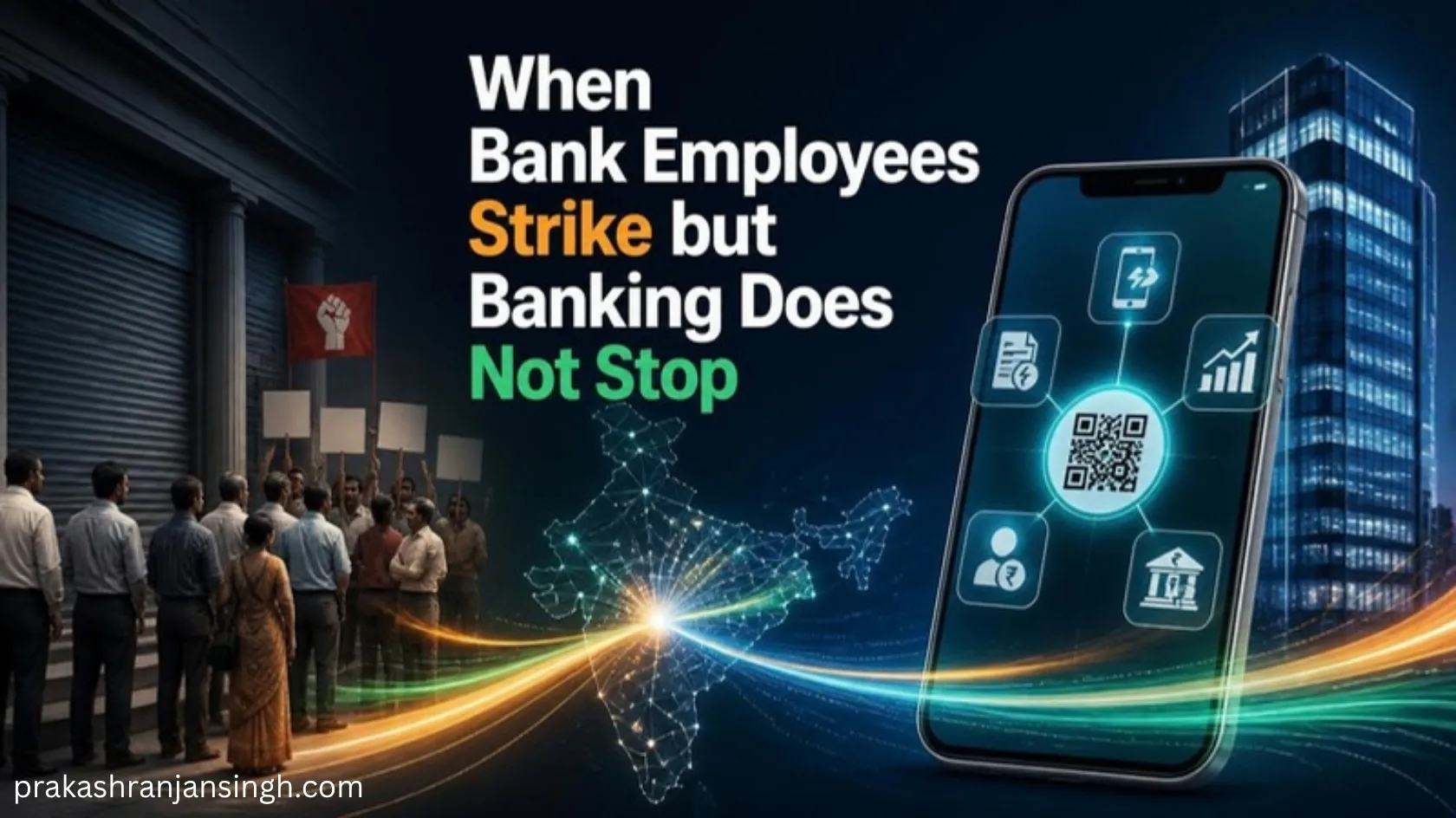
Table of Contents
- From the Bank Counter to the Customer’s Smartphone
- NPCI: The Invisible Infrastructure Behind the New Banking Psychology
- The Most Important Psychological Change: The Customer Has Options
- The Silent Strength of Private-Sector Banks
- The Second Silent Revolution: Banking Has Been Outsourced
- The Psychological Impact on the Public
- Every Strike Can Teach the Customer to Become More Digital
- But the Government Is Also Learning
- The Union’s Psychological Strength Is Still Real
- The Old Formula: “Close the Bank”
- The New Battlefield Is Public Perception
- “Why will a five-day banking week make the banking system better?”
- The Union Should Move From “Strike Power” to “Knowledge Power”
- The Private Bank Factor Should Be Used Carefully
- The Government Also Has to Understand the Psychology of Employees
- A New Social Contract Between Bankers and Customers
- What Should the Union Strategy Look Like?
- The Biggest Lesson: Banking Has Become an Ecosystem
- The Customer Has Become the New Banking Counter
- The Future of Union Power
- From “Strike” to “Strategy”
- Frequently Asked Questions
From the Bank Counter to the Customer’s Smartphone
Indian banking has travelled an extraordinary distance since the days when a bank strike alone could bring the country’s finances to a halt.
Earlier, the customer carried a passbook.
A bank strike is far less disruptive today because the customer carries a banking application.
Earlier, the cheque was the centre of many transactions.
Today, UPI can move money in seconds.
Earlier, a bank employee was required to verify almost everything.
Today, authentication, APIs, mobile applications, Aadhaar-linked systems, cards and automated processes perform a large part of the work.
And behind this transformation stands a digital infrastructure that has fundamentally changed the economics and psychology of banking.
The National Payments Corporation of India (NPCI), RBI, banks and the government have created an ecosystem in which digital payments have expanded enormously. Government data show that retail digital payment transactions reached 22,167.90 crore in FY 2024-25, with UPI accounting for about 81% of retail digital-payment transaction volume.
This is not merely a technological achievement.
It is a psychological revolution.
The customer has gradually started believing:
“I don’t need the bank branch for everything.”
And once that belief becomes established in society, the bargaining power of physical branch disruption naturally changes.
NPCI: The Invisible Infrastructure Behind the New Banking Psychology
Perhaps one of the least visible but most important changes in Indian banking has been the emergence of NPCI as part of the country’s payment infrastructure.
Most ordinary customers do not think about NPCI when they scan a QR code.
They simply think:
“I have UPI.”
That psychological shift is extremely important.
The customer no longer thinks primarily in terms of:
Which bank employee will process my transaction?
Instead, the customer thinks:
Which application will allow me to complete my transaction?
That could be a bank’s own application or another UPI-enabled application.
The distinction is profound.
The banking relationship has gradually moved from the branch to the platform.
The Most Important Psychological Change: The Customer Has Options
Suppose a customer has a salary account with a public-sector bank.
Earlier, the relationship might have been almost exclusive.
The customer’s salary came into that account, savings were kept there, loans were taken there, cheques were deposited there and almost every financial activity was conducted through the same branch.
Today, the same customer may have:
a public-sector bank salary account;
an account with HDFC Bank, ICICI Bank, Axis Bank or another private bank;
a UPI-enabled application;
a credit card;
an investment account;
a fintech relationship;
an insurance platform;
a digital lending relationship.
Therefore, a public-sector bank strike does not necessarily mean that the customer’s entire financial life stops.
The customer has developed redundancy.
And redundancy is one of the strongest forces against disruption.
The Silent Strength of Private-Sector Banks
This is perhaps the most important strategic development that bank unions need to recognise.
The private-sector banking industry was once viewed largely as a competitor to public-sector banks.
Today, it performs another important function in the psychology of the Indian financial system:
It provides an alternative.
When a public-sector bank branch remains closed, the customer may increasingly have another banking relationship available.
When a public-sector bank’s physical service is temporarily unavailable, digital channels continue.
When a customer needs a transaction urgently, another bank’s ATM, application or payment channel may provide an alternative.
This does not mean private banks can replace public-sector banks.
Public-sector banks continue to perform major roles in financial inclusion, priority-sector lending, government programmes and many other areas. RBI’s 2024-25 Annual Report records the continuing role of PSBs in financial inclusion and lead-bank responsibilities.
But the psychological reality has changed:
The customer no longer feels completely dependent upon one bank.
That is a major strengthening of private-sector banking.
The Second Silent Revolution: Banking Has Been Outsourced
There is another transformation that receives much less public attention.
A significant amount of banking activity has moved outside the traditional branch workforce.
Technology companies, ATM service providers, cash-management companies, call centres, card processors, software companies, recovery agencies, document-management companies, courier networks, business correspondents, fintech platforms and other specialised service providers now participate in different parts of the banking value chain.
Even the Reserve Bank’s regulatory material recognises banks’ reliance on third-party technology service providers for areas such as data centres, ATM switches, core banking, card management and mobile banking.
The result is an important structural change:
The bank employee is no longer the only person performing the banking function.
The modern bank is increasingly an ecosystem.
This makes a traditional employee strike structurally different from a strike in the old branch-centric banking model.
The Psychological Impact on the Public
The first major effect of a strike is inconvenience.
But the second effect can be much more important:
Behavioural adaptation.
Suppose a customer visits a closed branch during a strike.
The customer may initially be angry.
But then someone tells him:
“Why don’t you do it through UPI?”
Another customer discovers mobile banking.
Someone else uses an ATM.
A business owner shifts a payment to another bank.
A younger customer begins using digital banking more extensively.
The customer may return to the branch after the strike.
But the psychological lesson remains:
“Perhaps I don’t need the branch as much as I thought.”
That is how temporary disruption can unintentionally accelerate permanent behavioural change.
Every Strike Can Teach the Customer to Become More Digital
This is an uncomfortable strategic reality.
If a customer learns during a strike that:
UPI works;
mobile banking works;
ATM services are available;
private-bank services remain accessible;
digital investments can continue;
online payments can continue;
then the customer becomes more comfortable with alternatives.
The next time there is a strike, the inconvenience may be smaller.
This creates a potential cycle:
Strike → customer searches for alternatives → customer discovers digital banking → customer becomes comfortable with alternatives → future strike creates less disruption.
Therefore, the effectiveness of the traditional strike model can gradually diminish as digital adoption increases.
But the Government Is Also Learning
The government is not merely watching this transformation.
It is adapting to it.
During the proposed September 28–30, 2026 strike, the government arranged for public-sector banks and regional rural banks to operate on Sunday, September 27, with RBI approval, specifically to reduce the extended disruption to customers.
The government has also publicly highlighted the concern that the proposed strike coincides with the September 30 half-yearly closing, a particularly important date for banking operations.
This is an example of counter-disruption psychology.
Instead of waiting for the strike to create maximum inconvenience, the system attempts to absorb some of its impact beforehand.
In other words:
The government is learning how to manage around the strike.
That is another reason why the traditional disruption strategy may have diminishing marginal impact.
The Union’s Psychological Strength Is Still Real
None of this means bank unions have become irrelevant.
Far from it.
Eight lakh employees and a claimed representation of around 90% of the banking workforce constitute a formidable organisational force. The present UFBU action demonstrates that bank employees can still create substantial physical disruption, particularly at public-sector branches.
There are also areas where digital banking cannot completely replace employees.
Consider:
cash-intensive customers;
senior citizens;
rural customers;
complex loan documentation;
account disputes;
KYC issues;
legal documentation;
government banking;
branch-level customer grievances;
specialised credit operations;
physical verification;
recovery and field operations.
Therefore, the employee remains an important component of the banking ecosystem.
The question is not whether unions have power.
The question is:
What kind of power will be most effective in the future?
The Old Formula: “Close the Bank”
The traditional formula was simple:
Employees stop working
↓
Branches close
↓
Customers suffer
↓
Economy feels pressure
↓
Government intervenes
↓
Negotiation follows
But the modern formula is becoming different:
Employees stop working
↓
Physical branches are disrupted
↓
Digital channels continue
↓
Private banks provide alternatives
↓
NPCI-based payment infrastructure continues
↓
Customers adapt
↓
Government manages essential services
↓
Economic disruption becomes less than expected
This does not mean a strike becomes ineffective.
It means the relationship between employee participation and economic disruption has weakened.
The New Battlefield Is Public Perception
This is where bank unions may need a major strategic change.
The strongest union argument should not simply be:
“We represent 90% of employees.”
The stronger question is:
“Why will a five-day banking week make the banking system better?”
That requires evidence.
For example:
Will weekday working hours increase?
Will productivity improve?
Will customer service remain adequate?
Will employee fatigue decline?
Will absenteeism decline?
Will recruitment and retention improve?
Will technology compensate for Saturday closure?
What happens to rural customers?
What happens to cash-dependent customers?
What arrangements will be made for month-end and quarter-end operations?
These are questions that can be answered with data.
And data-based bargaining is more powerful than disruption-based bargaining in a digital economy.
The Union Should Move From “Strike Power” to “Knowledge Power”
Imagine if the banking unions released a detailed Five-Day Banking White Paper.
It could demonstrate:
Present system
Six-day availability on selected Saturdays + existing weekday hours.
Proposed system
Five-day banking + additional weekday working hours.
Productivity calculation
Total working hours under both models.
Customer-service arrangement
Extended weekday branch timings where necessary.
Digital migration
Greater use of UPI, mobile banking and internet banking.
Employee benefit
Better work-life balance and potentially improved productivity.
Bank benefit
Better employee engagement and reduced fatigue.
Customer benefit
Predictable Monday-Friday full-service banking.
That would transform the conversation.
It would no longer be:
“Employees want Saturday off.”
It would become:
“India is redesigning the banking workweek.”
That is a much stronger narrative.
The Private Bank Factor Should Be Used Carefully
There is an interesting irony here.
The strengthening of private-sector banks has reduced the disruptive power of public-sector bank strikes.
But the same private-sector competition can also strengthen the unions’ argument in another way.
If employees believe that private banks offer increasingly technology-driven and customer-oriented services, public-sector banks must continuously improve their employee productivity, technology and work culture to remain competitive.
Therefore, the real issue should not be:
PSB versus private bank.
It should be:
How can Indian banking combine the social purpose and reach of public-sector banking with the technology, efficiency and customer expectations of modern banking?
That is a much larger national question.
The Government Also Has to Understand the Psychology of Employees
There is a danger in assuming that because digital banking continues, employee concerns can simply be ignored.
An employee sees the transformation differently.
He may think:
“The bank wants technology to increase productivity, but wants employees to remain available six days a week.”
If this perception develops, resistance becomes psychological rather than merely contractual.
The government and management therefore need to demonstrate that technology is being used not simply to extract more work from employees, but also to redesign work intelligently.
A New Social Contract Between Bankers and Customers
India may need a new understanding of what banking employment means.
The traditional contract was:
“I work six days; the customer comes to the branch.”
The emerging contract could become:
“I work productively five days; technology provides 24×7 basic access; specialised human assistance remains available where technology cannot solve the problem.”
This is not merely an employee issue.
It is a future-of-banking issue.
What Should the Union Strategy Look Like?
If unions want greater long-term influence, five changes could make their strategy more relevant.
1. From employee numbers to economic data
Don’t merely say:
“We represent 90%.”
Show:
“Here is the measurable economic contribution of these employees.”
2. From inconvenience to public education
Explain why the demand matters to:
customers;
families;
businesses;
employees;
banks;
the economy.
3. From confrontation to negotiation backed by evidence
A detailed productivity model can sometimes achieve more than repeated shutdowns.
4. From branch-centric thinking to digital-era thinking
A modern banking union must understand:
NPCI + UPI + APIs + mobile banking + fintech + outsourcing + AI + cloud + automation.
The union that understands the future of banking will be better positioned to negotiate the future of banking employment.
5. Protect public goodwill
The customer should not become the enemy.
The union’s message should increasingly be:
“We are fighting for better banking, not against the customer.”
The Biggest Lesson: Banking Has Become an Ecosystem
The Indian banking system of 2026 cannot be understood simply by counting bank employees.
It must be understood through an ecosystem:
Bank employees
Branches
ATMs
NPCI
UPI
Banking applications
Fintech companies
Outsourced service providers
Private-sector banks
Public-sector banks
Cloud and technology infrastructure
Customers themselves
That final component—the customer—is perhaps the most important.
Because technology has gradually transformed the customer from a passive recipient of banking services into an active participant in the banking system.
The Customer Has Become the New Banking Counter
This may ultimately be the most important psychological transformation.
Earlier:
Customer → Bank counter → Bank employee → Transaction
Today:
Customer → Smartphone → Banking app/UPI → Digital infrastructure → Transaction
The employee has not disappeared.
But the counter has moved into the customer’s hand.
That single change explains why the psychology of bank strikes is changing.
The Future of Union Power
The future bank union cannot depend only upon the ability to close branches.
It will increasingly depend upon its ability to answer difficult questions:
Can employee welfare improve productivity?
Can five-day banking coexist with 24×7 digital banking?
Can technology reduce routine workload rather than merely increase targets?
Can customers receive uninterrupted essential services?
Can public-sector banks remain competitive with private banks?
Can outsourcing be balanced with employment security and operational control?
Can the banking workforce be reskilled for AI and digital banking?
These are the questions that will define the next generation of banking unions.
From “Strike” to “Strategy”
The five-day banking controversy therefore represents something much bigger than whether Saturday should be a working day.
It is a test of whether India’s traditional industrial-relations model can adapt to a banking industry that has fundamentally changed.
The union still has numbers.
The government still has regulatory authority.
Private banks have created alternatives.
NPCI has created digital payment infrastructure.
Technology has created new delivery channels.
Outsourcing has distributed banking activities across a wider ecosystem.
And the customer now carries a bank branch in his pocket.
Therefore, the real question is no longer:
“Can bank employees shut the banks?”
The more relevant question is:
“Can bank unions create enough economic, intellectual and public pressure to make their demands impossible to ignore?”
That requires a different kind of leadership.
Not merely the ability to call a strike.
But the ability to understand technology, economics, customer psychology, employee behaviour and the competitive banking landscape—and then convert that understanding into a credible negotiating strategy.
The future battle for the banking workforce will not be won only at the branch gate.
It will be won in the minds of employees, customers, management and policymakers.
And in a banking system where the smartphone has become the new counter, the most powerful banking union of the future may be the one that learns how to use information as effectively as it once used industrial disruption.
Frequently Asked Questions
What happens to customers during a bank strike in India today?
Most day-to-day banking keeps working. UPI, net banking, mobile apps and ATMs are largely unaffected by a bank strike because they run on shared digital infrastructure rather than a branch counter, so customers can still transfer money, pay bills and check balances even when a majority of bank employees stay off work.
Why are bank unions demanding a five-day banking week?
Unions argue a five-day banking week would match global banking norms and improve work-life balance for employees, while the government and RBI have so far been cautious about a change that affects public access to bank branches on Saturdays.
Can a bank strike still shut down banking completely?
Not the way it once could. Public-sector banks still feel the impact directly, but private-sector banks generally stay open, and digital channels routed through NPCI infrastructure keep processing the bulk of everyday transactions regardless of a strike.
How many bank employees are typically involved in a nationwide bank strike?
Unions under the United Forum of Bank Unions (UFBU) umbrella claim to represent roughly 90% of India’s banking workforce, though that headcount no longer translates directly into 90% of banking transactions being stopped.
What should bank unions do differently in the digital banking era?
The article argues that unions need to shift from relying purely on strike power to building knowledge power — making a clear public case for demands like the five-day banking week, rather than assuming a shutdown alone will move public or government opinion.
Related Reading
- India’s Private Banking Revolution: When the Customer Became the Product
- UPI Enters Its Next Phase: Will MDR Create a New Digital Financial Economy?
- UPI: From an Indian Payment Revolution to a Possible New Financial Order
- AI in Banking: Could the World’s Digital Banking Backbone Become the Next Battlefield?
- India Needs Stronger Rules on Digital Lending to Protect Young Borrowers
- UNI Global Union: Indian Banking Unions Renew Strike Call for a Five-Day Work Week


Leave a Reply