


A financial freedom mindset begins with one small pause before spending — the moment you stop asking “Can I afford this today?” and start asking what it costs your future freedom.
Key Takeaways
- The single most powerful financial change is psychological: before spending, ask “What will this decision do to my future freedom?” instead of “Can I afford this today?”
- Earlier generations saved before they spent and sacrificed present comfort for future security; today’s generation often spends before it earns, using expected future income today.
- Control the temptation, control the lifestyle, control the EMI—the greatest wealth created may not be money, but freedom.
Table of Contents
1. Stop Spending for Today—Start Thinking for Tomorrow
There may be no investment, salary increase or financial product as powerful as one simple change in human psychology:
“Before spending money, stop asking, ‘Can I afford this today?’ Start asking, ‘What will this decision do to my future freedom?’”
This single mental shift has the power to reduce the cost of living, increase savings, create wealth and, perhaps most importantly, give the next generation a stronger financial foundation.
The greatest financial revolution does not necessarily begin in the stock market, a bank or a business.
It begins in the mind.
2. Yesterday’s Generation Saved Before It Spent. Today’s Generation Often Spends Before It Earns.
Our earlier generations generally lived with a different psychological framework.
They asked:
How much can we save?
How can we avoid unnecessary debt?
How can we buy a house, land or other assets?
How can we secure our children?
How can we leave something behind for the next generation?
They often sacrificed present comfort to create future security.
Today, the psychology has increasingly reversed.
The modern question is often:
What can I buy now?
What EMI can I manage?
What lifestyle do others expect me to maintain?
Why wait if credit is available?
Why save for years when I can use my expected future income today?
And this is where the danger begins.
Future income is being consumed before it is earned.
The salary of tomorrow is already committed to today’s EMI.
The bonus that has not yet arrived has already been mentally spent.
The next pay rise is already included in the lifestyle budget.
And slowly, a person may earn more without becoming financially stronger.
3. The Biggest Financial Trap Is Not Low Income. It Is an Uncontrolled Desire to Upgrade Lifestyle.
A person earning ₹30,000 can be financially disciplined.
A person earning ₹3 lakh can be financially stressed.
Why?
Because income determines capacity, but psychology determines behaviour.
The market understands this extremely well.
Every industry competes for one thing:
Your attention—and then your desire.
The FMCG industry says: Try something new.
The lifestyle industry says: You deserve better.
The automobile industry says: Upgrade.
The smartphone industry says: Your current phone is outdated.
The fashion industry says: Follow the trend.
The financial industry says: Why wait? Take it now and pay later.
Individually, none of these products or services is necessarily bad.
The problem begins when marketing enters the human mind and converts a desire into a psychological necessity.
4. The Psychology of Temptation: Why We Buy What We Do Not Really Need
Human beings are not always rational consumers.
We are emotional consumers.
Several psychological forces influence our financial decisions. The Reserve Bank of India’s financial education initiative was built precisely because these forces are common and predictable, not rare exceptions.
5. The Instant Gratification Trap
The brain naturally enjoys immediate rewards.
Saving money gives a future benefit.
Buying something gives an immediate emotional reward.
That is why clicking “Buy Now” often feels easier than transferring money into a savings or investment account.
The product is visible.
The future is invisible.
The pleasure is immediate.
The financial cost is postponed.
This is exactly why “Buy Now, Pay Later” psychology can become dangerous for undisciplined spending.
The brain says:
“Enjoy today. Tomorrow will take care of itself.”
But tomorrow eventually arrives—with bills, EMIs and financial pressure.
6. Social Comparison: The Costliest Invisible EMI
We do not always buy because we need something.
Sometimes, we buy because someone else has it.
A colleague buys a new car.
A neighbour renovates his house.
A friend goes on an expensive vacation.
Someone posts a luxury lifestyle on social media.
Suddenly, our perfectly adequate life begins to feel inadequate.
This is called the comparison trap.
We compare our real financial situation with the carefully displayed lifestyle of others.
And then we make financial decisions to protect our social image.
One of the costliest financial decisions in life is spending money to impress people who may not even remember what you bought.
Financial freedom requires the courage to say:
“I do not need to keep up with everyone.”
7. The EMI Illusion
A product costing ₹1 lakh may feel expensive.
But when it is presented as:
“Only ₹3,499 per month”
the brain suddenly sees it differently.
The total cost disappears from psychological focus.
The small monthly amount looks affordable.
Then another EMI is added.
And another.
Individually, every EMI may appear manageable.
Collectively, they can consume a large portion of future income.
This is how financial stress often develops—not through one major decision, but through many small commitments made without looking at the total burden.
8. The Most Powerful Brain Rewiring: Create a Pause Between Desire and Purchase
Here is a simple psychological tool:
Never allow your first desire to make the final financial decision.
When you feel the urge to buy something non-essential, pause.
Ask yourself five questions:
1. Do I really need it—or do I simply want it?
2. Will I still want it after 30 days?
3. What future financial freedom am I sacrificing for this purchase?
4. Am I buying this for utility—or for social approval?
5. If I had to pay the entire amount in cash today, would I still buy it?
This small pause can completely change spending behaviour.
Because temptation is emotional, but evaluation is rational.
The winner is the person who gives rational thinking enough time to defeat emotional impulse.
9. Make Saving Your First Expense, Not What Is Left After Spending
One of the greatest lessons from earlier generations was simple:
First save. Then spend.
Modern life often follows the reverse formula:
Income → Spending → EMI → Lifestyle → Whatever is left becomes savings.
But the stronger formula is:
Income → Savings/Investment → Essential Expenses → Controlled Lifestyle.
This requires another psychological change.
Do not think:
“I will save whatever remains at the end of the month.”
Think:
“My future is the first person who deserves to be paid.”
Treat your savings as an unavoidable monthly commitment.
The moment income arrives, a portion should move toward:
Emergency reserves
Investments
Retirement security
Children’s education or future
Asset creation
Long-term financial independence
A person who spends first and saves later may always find a reason not to save.
A person who saves first learns to adjust life within the remaining income — this is the financial freedom mindset in daily practice.
10. The New Definition of Luxury Should Be a Financial Freedom Mindset
Perhaps the most important brain rewiring of modern civilization should be redefining success.
Luxury is not necessarily:
A bigger EMI
An expensive car
A constantly upgraded phone
A lifestyle financed by credit
A house full of things that are rarely used
Real luxury may be:
No panic on salary day
No fear of unexpected expenses
The ability to leave a toxic job
Freedom from excessive debt
Enough savings to survive a crisis
The ability to support parents and children
The freedom to choose how to spend your time
The person who needs less to live has more freedom to live.
This is a powerful financial truth.

11. Every Rupee You Do Not Waste Is a Worker for Your Future
Imagine two people earning the same income.
One spends ₹10,000 every month on unnecessary lifestyle expenses.
The other controls those expenses and regularly directs the same amount toward long-term productive assets.
Initially, their lifestyles may appear different.
The spender may look more successful.
But over time, the saver may accumulate:
Investments
Financial reserves
Assets
Greater opportunities
Freedom from dependence on loans
The difference is not necessarily intelligence.
It is not always salary.
It is often behaviour repeated consistently.
Money saved is not money denied. It is money redirected toward your future freedom.
12. The Generational Responsibility: Are We Leaving Assets or EMIs?
Every generation transfers something to the next.
Sometimes it is education.
Sometimes values.
Sometimes property.
Sometimes wealth.
But increasingly, there is another danger:
We may transfer a culture of debt.
If children grow up seeing:
Everything purchased on EMI
Credit used for routine consumption
Savings postponed continuously
Lifestyle treated as more important than financial security
they may unconsciously accept this as normal.
The greatest gift parents can give children is not only money.
It is financial psychology.
Teach them early:
Delayed gratification
The difference between assets and liabilities
The cost of debt
The importance of saving
How compounding works
Why social comparison is dangerous
How to distinguish needs from wants
A financially educated child may build more wealth from a modest inheritance than a financially undisciplined child can preserve from a large inheritance.
13. The Market Will Always Create Desire. You Must Create Your Own Discipline.
We should not blame the market for doing what markets are designed to do.
Businesses will advertise.
Brands will compete.
Financial institutions will offer credit.
Technology will make purchasing easier.
Temptations will never disappear.
Therefore, financial discipline cannot depend on the market becoming less attractive.
It must depend on our mind becoming stronger.
The future winner will not necessarily be the person who earns the highest income.
It may be the person who has mastered three abilities:
The ability to earn.
The ability to control unnecessary desires.
The ability to convert surplus income into future assets.
14. A Simple Formula for Financial Freedom
Before every major lifestyle decision, remember:
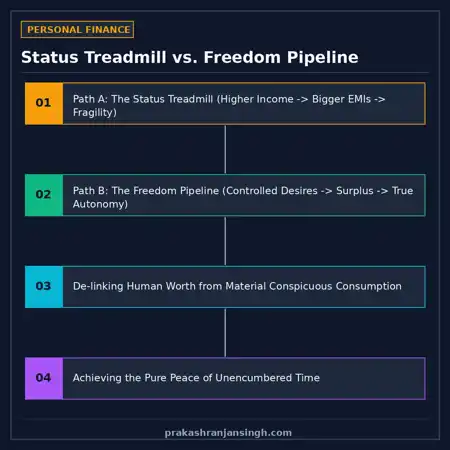
Need → Think → Plan → Buy
Not:
Temptation → EMI → Stress → Regret
And before increasing your lifestyle, increase your assets — that is what a financial freedom mindset looks like in practice.
Before taking a new EMI, calculate your total financial commitments.
Before buying something to impress others, ask whether it will improve your life.
Before using tomorrow’s income, ask whether tomorrow has already been given too many responsibilities.
15. The Final Lesson: Control the Mind, and the Money Will Follow
The battle for wealth creation is often presented as a battle for higher income.
But there is another battle happening every day:
A battle between desire and discipline.
The market constantly tells us:
“You deserve more.”
Financial wisdom sometimes quietly says:
“You deserve freedom.”
And these two messages are not always the same.
One small change—a genuine financial freedom mindset—can therefore transform an entire family.
When we stop spending merely because we can afford the EMI and start investing because we want to afford freedom, the direction of life begins to change.
We reduce unnecessary costs.
We reduce financial stress.
We increase savings.
We create assets.
We protect our future.
And we give the next generation something far more valuable than an expensive lifestyle:
The freedom to begin life without carrying the financial mistakes of the previous generation.
The richest person is not necessarily the one who owns the most things. The richest person may be the one who has the greatest control over desires, the least unnecessary financial burden and the maximum freedom to choose their future.
Control the temptation. Control the lifestyle. Control the EMI.
And one day, you may discover that the greatest wealth you created was not just money—but freedom.
Frequently Asked Questions
What is the one psychological change that can transform financial fortune?
It’s shifting from asking “Can I afford this today?” to “What will this decision do to my future freedom?” before spending. This single mental shift can reduce the cost of living, increase savings, and create wealth—the greatest financial revolution begins in the mind, not the stock market or a bank.
How did earlier generations think about money differently?
Earlier generations asked how much they could save, how to avoid unnecessary debt, and how to secure their children’s future, often sacrificing present comfort for future security. Today’s generation more often asks what it can buy now and what EMI it can manage, spending before it earns.
What is the biggest financial trap for people today?
It is not low income—it’s an uncontrolled desire to upgrade lifestyle. Controlling temptation, lifestyle, and EMI matters more than income level, because the greatest wealth created may not be money but freedom.
Related Reading
- Positive Cash Flow: The Life Skill Gen Z Cannot Afford to Ignore
- Debt Trap: When Financial Crisis Becomes a Psychological Emergency
- The Psychology of Financial Comfort: Building Stability at Every Stage of Life
- Investment Psychology: Why Young Investors Must Choose Wisdom Over FOMO
- The Salary Investor’s Dilemma: How to Grow Wealth Without Gambling With Your Future



Leave a Reply