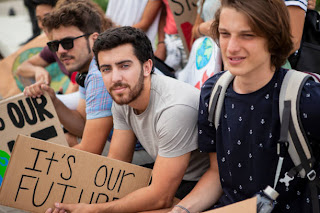
Frustration and joblessness don’t make young people foolish — they make them psychologically more receptive to anyone offering identity, belonging, and quick answers, and the antidote isn’t lecturing youth about caution but giving them real opportunity: education, employment, mentorship, and critical thinking skills that make manipulation less appealing than building something real.
Human beings naturally seek recognition, purpose, and achievement. It is a basic psychological tendency to look for the shortest and easiest path toward success, popularity, or social acceptance. This instinct is not inherently wrong; it is part of human nature. However, when combined with frustration, unemployment, uncertainty, and a lack of opportunities, it can make individuals—particularly young people—more vulnerable to influence from those pursuing their own agendas.
Youth represent the greatest strength of any nation. Their energy, creativity, courage, and willingness to take risks have the power to transform societies. History has repeatedly shown that every major scientific breakthrough, social reform, and economic revolution has been driven by young minds. At the same time, the same energy can be diverted toward destructive paths when psychological vulnerabilities are exploited.
Why Do Unemployed Youth Become More Vulnerable?
Employment is not merely a source of income. It provides identity, dignity, purpose, routine, and hope. A young person without meaningful work often experiences frustration, anxiety, declining self-esteem, and uncertainty about the future. These emotions create a psychological vacuum.
When individuals feel ignored by society or believe that their aspirations are unattainable, they naturally seek groups or leaders who promise recognition, belonging, and quick solutions. This is not necessarily because they lack intelligence, but because every human being desires acceptance and hope.
Psychologists describe several forces that become stronger during such periods: the need for identity and belonging, the desire for recognition and respect, the search for purpose and meaning, emotional frustration caused by repeated failures, hope for quick solutions to complex problems, and the tendency to trust charismatic leaders during uncertain times.
These psychological needs make young people more receptive to persuasive narratives, whether those narratives are constructive or harmful.
What Is the Psychology of Those Who Influence Others?
Not every leader or organization acts with harmful intentions. Many work genuinely for social welfare, education, entrepreneurship, and nation-building. However, some individuals or groups may exploit emotional vulnerabilities to gain influence, power, financial benefit, or public attention.
The psychology behind such influence often includes understanding people’s fears better than their strengths, offering emotionally satisfying explanations for complex problems, creating an “us versus them” mindset that simplifies reality, providing a sense of belonging and importance, using repeated messaging to reinforce particular beliefs, and rewarding loyalty with recognition and social status.
Such approaches can be highly persuasive because emotions often influence decision-making more strongly than facts alone.
How Does Group Behaviour Change Individual Psychology?
Human beings are social creatures. Once individuals become part of a group, their behaviour often changes.
Several psychological phenomena contribute to this: social identity (people begin defining themselves primarily through group membership), peer pressure (individuals hesitate to disagree with those around them), emotional contagion (feelings such as anger, excitement, or fear spread rapidly within groups), confirmation bias (people tend to seek information that supports their existing beliefs while ignoring opposing evidence), and deindividuation (in large groups, individuals may feel less personally responsible for their actions).
These processes are not limited to politics. They occur in workplaces, educational institutions, social media communities, sports groups, and many other settings.
What Role Does Social Media Play in All This?
Digital platforms have transformed communication. They connect people, spread knowledge, and create opportunities. However, they also amplify emotional content because emotionally charged messages attract more attention and are more likely to be shared.
Young people spending several hours daily online may repeatedly encounter content designed to provoke outrage, fear, or excitement. Over time, repeated exposure can shape perceptions, reinforce biases, and narrow viewpoints if people consume information from only one perspective.
Developing digital literacy and critical thinking is therefore essential in today’s world.
Who Is Responsible for Protecting Youth From Manipulation?
Protecting youth is not the responsibility of one institution alone. Every stakeholder has an important role.
Families should encourage open communication, emotional support, and independent thinking rather than fear or blind obedience. Educational institutions should develop critical thinking, problem-solving abilities, financial literacy, emotional intelligence, and civic responsibility alongside academic knowledge. Governments should prioritize quality education, skill development, entrepreneurship, employment opportunities, transparent governance, and accessible career guidance. Businesses and industries should invest in apprenticeships, internships, mentoring, and employment pathways that allow young people to build confidence and practical skills. Community organizations and civil society should provide constructive platforms for volunteering, leadership development, sports, cultural activities, and social service. Media and digital platforms should promote accurate information, responsible reporting, and awareness about misinformation while encouraging informed public discussion.
Finally, young people themselves should cultivate curiosity, verify information from multiple reliable sources, develop practical skills, and avoid making important decisions based solely on emotionally charged messages.
How Can We Convert Youth Energy Into National Strength?
Every nation succeeds when its youth spend more time building than destroying, creating than complaining, and innovating than reacting. The same physical energy and determination that can be directed toward conflict can instead fuel entrepreneurship, scientific research, technological innovation, public service, environmental conservation, and community development.
Young people should be encouraged to ask questions, learn continuously, acquire employable skills, and participate constructively in society. A society that provides hope, opportunity, and a sense of purpose reduces the likelihood that frustration will be exploited by anyone seeking to manipulate public sentiment.
Conclusion
Youth are not merely the future of a nation—they are its greatest present-day asset. Their psychological need for identity, respect, belonging, and purpose is universal. Whether these needs are fulfilled through education, employment, innovation, and service, or through divisive and destructive influences, depends on the collective efforts of families, educators, policymakers, employers, media, and the youth themselves.
The true measure of a society is not how effectively it mobilizes its young people, but how wisely it empowers them to think independently, act responsibly, and contribute positively. By investing in opportunities, critical thinking, and constructive engagement, we can ensure that the immense energy of our youth becomes a force for progress, unity, and national development rather than division or manipulation.
Leave a Reply