



Money is often described as a medium of exchange. But the psychology of money is far more complex than currency, notes, coins, or numbers in a bank account.
Money is psychology. Money is emotion. Money is security. Money is motivation. And, in many situations, money becomes the invisible force that influences our mental, physical, social, and even emotional well-being.
From childhood to old age, human beings develop a deep psychological relationship with money. A child may not understand economics, but soon learns that money can buy a toy, a book, good food, or something desired. As we grow older, money becomes connected with education, career, marriage, family, healthcare, social status, freedom, and dignity.
The psychology of money is so powerful that it is often difficult to explain in words—it is something that must be experienced.
Key Takeaways
- Money functions as an invisible psychological force—the same person can feel completely different emotionally as their salary balance rises and falls through the month.
- The American Psychological Association’s “Stress in America” surveys have found that money and finances consistently rank among the top sources of stress for adults.
- The real power of money isn’t earning more—it’s developing the wisdom to ask how much is enough for a secure, dignified, and meaningful life.
Table of Contents
1. Why the Psychology of Money Makes Salary Day Feel So Different
Ask a working person how they feel on salary day.
There is often an immediate change.
The mind becomes lighter. Plans become bigger. Confidence increases. A person may think about shopping, eating out, paying bills, investing, helping family members, or planning a trip.
Interestingly, the same person, with the same body and the same job, may feel psychologically different just a few days later as the salary balance starts declining.
This is the fascinating psychology of money.
When money enters the account, the brain experiences a feeling of relief, reward, control, and security. The future suddenly appears manageable.
But as the month progresses, EMIs, rent, school fees, household expenses, credit-card bills, medical costs, and unexpected expenses begin reducing the available balance.
And with every financial obligation, the enthusiasm may also start declining.
It is not merely the bank balance that changes.
The emotional balance changes too.
2. The Psychology of Money and Mental Peace
Many of life’s tensions are not directly caused by a lack of intelligence, talent, or hard work. They are caused by financial uncertainty.
Questions such as:
How will I pay the next EMI?
What if I lose my job?
How will my children’s education be funded?
What will happen during a medical emergency?
How will I manage after retirement?
…can continuously occupy the human mind.
A person may have a beautiful house but still lack peace if there is no financial stability. Another person may live simply but sleep peacefully because savings are available and expenses are under control.
This is why money, up to the level of meeting one’s needs and creating reasonable security, can have a profound relationship with mental well-being.
Financial insecurity can keep the mind in survival mode. Financial security can create psychological breathing space.
This is not just personal experience — the American Psychological Association’s annual “Stress in America” surveys have found that money and finances consistently rank among the top sources of stress for adults, regardless of the wider economic climate (American Psychological Association).
3. Can Money Influence Physical Health?
The connection may not always be direct, but financial stress can influence daily behaviour.
A financially comfortable person may be more likely to:
Seek timely medical care.
Buy nutritious food.
Join a fitness programme.
Take vacations or rest when needed.
Access better healthcare.
Spend time on preventive health.
On the other hand, prolonged financial pressure can disturb sleep, increase stress, and force people to ignore health problems because treatment appears unaffordable.
We have all seen how a person’s mood can improve after receiving good financial news—and how a sudden financial crisis can drain energy overnight.
The body and mind are deeply connected.
Sometimes, a message saying “Salary Credited” can produce more immediate relief than a motivational speech.
That is the raw psychology of money.
4. Money Is Also Social Confidence
Like it or not, money influences social life.
Financial strength can provide access to better education, networks, experiences, mobility, and opportunities. It can also increase a person’s confidence in social situations.
This does not mean that a rich person is automatically happier, wiser, or more respected in a meaningful sense.
But economic hardship can sometimes create hesitation.
A person may avoid social gatherings because they cannot afford to participate. Parents may feel uncomfortable when they cannot provide opportunities for their children that others can easily afford. A talented young person may suppress dreams because of a lack of financial resources.
Therefore, money does not define human worth—but it can significantly influence a person’s choices, confidence, and participation in society.
5. The Salary-Day High and the Month-End Reality
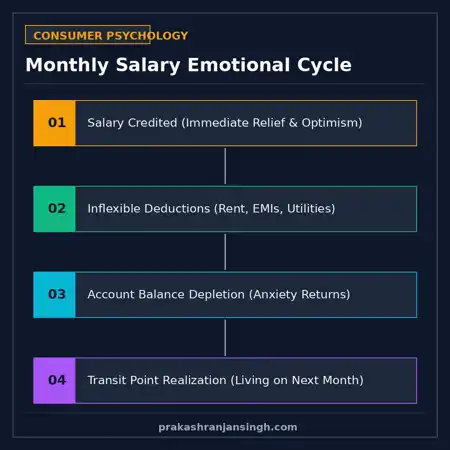
Modern life has created an interesting monthly emotional cycle.
Salary arrives → happiness rises.
Then comes:
EMI → rent → credit-card bill → school fees → insurance → groceries → fuel → unexpected expenses.
And suddenly, the same person who felt financially powerful at the beginning of the month begins calculating every rupee.
This cycle is becoming even more intense because modern consumers are increasingly living on future income.
Credit cards, instant loans, Buy Now Pay Later schemes, consumer loans, and easy EMIs allow people to enjoy tomorrow’s income today.
The result is psychologically dangerous.
The excitement of spending is immediate, but the pain of repayment arrives later—and often stays much longer.
This is why some people experience salary not as wealth, but merely as a monthly transit point through which money passes into the accounts of lenders, landlords, schools, insurance companies, and service providers.
The salary arrives.
For a few hours, there is happiness.
Then the money begins leaving.
6. The Great Motivation Behind Human Effort
Why does a person wake up early, travel long distances, tolerate workplace pressure, learn new skills, face competition, and work for decades?
Of course, purpose, passion, recognition, and personal satisfaction are important.
But for most people, money remains one of the strongest practical motivators.
Money represents:
Food for the family.
Education for children.
Healthcare for parents.
Security for old age.
Freedom from dependence.
The ability to make choices.
This is why a financial reward, salary increase, bonus, or business profit can generate extraordinary motivation.
A person may suddenly work with renewed energy after receiving recognition in financial form because money provides a measurable signal:
“My effort has value.”
7. But Here Is the Great Paradox
Money can motivate us—but the endless pursuit of money can also exhaust us.
There comes a stage when earning more is not enough because desires grow faster than income.
A person earning ₹50,000 may dream of ₹1 lakh.
After earning ₹1 lakh, the lifestyle may expand and create the desire for ₹2 lakh.
Then comes a bigger house, a better car, expensive education, premium lifestyle, more EMIs, and higher social expectations.
The finish line keeps moving.
Therefore, the real power of money is not simply in earning more.
It is in developing the wisdom to ask:
How much is enough for a secure, dignified, and meaningful life?
Without this question, even a high income can become a financial prison.
8. The Most Powerful Psychological Benefit of Money: Freedom
Perhaps the greatest gift of money is not luxury.
It is freedom of choice.
Savings can give a person the courage to leave an unhealthy job.
Financial stability can allow someone to care for ageing parents.
A retirement corpus can reduce dependence in old age.
An emergency fund can transform a crisis from a disaster into a manageable problem.
Money can allow a person to say “No” when necessary.
And the ability to say “No” is often one of the greatest forms of personal freedom.
9. The Real Lesson: Don’t Worship Money—Understand It
Money is neither inherently good nor evil.
It is a powerful tool.
The real problem begins when money controls our psychology instead of our psychology controlling money.
A wise person does not merely chase money.
They learn:
How to earn it.
How to save it.
How to invest it.
How to protect it.
How to spend it wisely.
And most importantly, how not to become mentally enslaved by it.
Because the person with the highest income is not necessarily the richest.
The person with financial security, controlled desires, manageable expenses, and peace of mind may be far richer in the true sense of life.
10. The Final Thought
The psychology of money is indeed amazing and beyond the boundaries of words.
It can change our mood without touching our body.
It can create confidence without changing our personality.
It can reduce anxiety without solving every problem.
It can motivate us to work harder, dream bigger, and take responsibility for our future.
And yet, the ultimate wisdom lies in understanding one profound truth:
Money can make life comfortable, but only a balanced relationship with money can make life peaceful.
So, earn money with honesty. Save it with discipline. Invest it with patience. Spend it with wisdom.
Because money is a powerful servant—but it can become a dangerous master.
A question for every reader:
When was the last time you felt genuinely happy after receiving money—and when was the last time you felt genuinely peaceful even without thinking about money?
The answer may reveal your true relationship with wealth.
Frequently Asked Questions
Why does salary day feel so different psychologically than the days before it?
When money enters the account, the brain experiences relief, reward, control, and security, and the future suddenly appears manageable. But as EMIs, rent, school fees, and other expenses reduce the balance through the month, the emotional balance changes along with the bank balance.
Is money a leading source of stress for adults?
Yes—the American Psychological Association’s annual “Stress in America” surveys have found that money and finances consistently rank among the top sources of stress for adults, regardless of the wider economic climate. Financial insecurity can keep the mind in survival mode, while financial security creates psychological breathing space.
Does earning more money always bring more happiness?
Not necessarily—desires often grow faster than income, so the finish line keeps moving as lifestyle expands with earnings. The real power of money lies not in earning more but in developing the wisdom to ask how much is enough for a secure, dignified, and meaningful life.
Related Reading
- The Psychology of Financial Comfort: Building Stability at Every Stage of Life
- The One Psychological Change That Can Transform Your Financial Fortune
- Warren Buffett: The Psychology of Wealth
- The Salary Investor’s Dilemma: How to Grow Wealth Without Gambling With Your Future
- The Psychology of the Losing Investor: Why Chasing Losses Often Creates Bigger Losses



Leave a Reply