


A banking system does not fail when a borrower faces genuine business failure. It fails when a loan that should have been prevented from becoming a bad loan is allowed to travel through years of weak appraisal, inadequate monitoring, delayed recognition and eventually a settlement that leaves society questioning: Who actually paid the price?
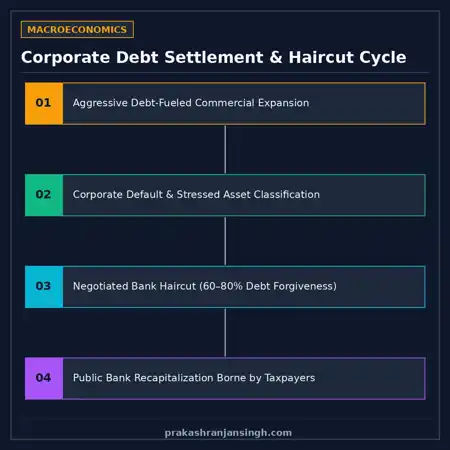
A recent corporate loan settlement has put this exact question in the spotlight: a resolution plan involving claims of about ₹22,006 crore against Essel Group founder Subhash Chandra, with a proposed recovery of only around ₹6.5 crore, has once again brought India’s corporate-credit architecture under intense public scrutiny. The matter is legally more nuanced than the headline suggests—the claims arose in personal insolvency proceedings involving guarantees, while creditors retain rights relating to the underlying corporate borrowers and some lenders have indicated they will challenge the order.
Key Takeaways
- A recent resolution plan involving claims of about ₹22,006 crore against Essel Group founder Subhash Chandra proposed a recovery of only around ₹6.5 crore, reigniting scrutiny of India’s corporate-credit system.
- The claims arose in personal insolvency proceedings involving guarantees—creditors retain rights relating to the underlying corporate borrowers, and some lenders have indicated they will challenge the order.
- A bank should never ask only “How much can we lend?”—it must continuously ask “How safely can this money return?” since losses ultimately reach depositors, investors and taxpayers.
Table of Contents
Yet the public question remains legitimate:
How can a financial exposure of this magnitude reach a stage where recovery becomes so extraordinarily small?
The answer lies not in one person, one bank or one tribunal.
It lies in the psychology of the entire credit ecosystem.
1. The Psychology Changes the Moment a Loan Becomes “Big”
For a small borrower, a bank asks simple questions:
Can you repay?
What is your income?
What is your security?
What happens if you don’t pay?
But when the borrower is a large corporate house, the psychology can become completely different.
A large borrower may come with:
an impressive business history,
thousands of employees,
substantial turnover,
multiple companies,
prestigious advisers,
influential relationships,
apparently strong assets,
a celebrated promoter,
a powerful market reputation.
These factors can unconsciously transform a credit decision from “Is the loan safe?” to “How can we accommodate this borrower?”
That is where the first crack can appear.
Reputation can begin replacing repayment capacity.
2. The Borrower’s Psychology: “Too Big to Fail”
A large corporate borrower understands the system differently from an ordinary individual borrower.
A small borrower may fear a single missed EMI.
A large borrower may have:
several lending institutions,
multiple subsidiaries,
complex corporate structures,
secured and unsecured creditors,
legal advisers,
financial advisers,
restructuring specialists,
access to political and business networks,
considerable negotiating power.
The psychology can gradually change from:
“I must repay the bank.”
to:
“We will negotiate with the bank.”
And eventually, in extreme cases:
“The system will find a solution.”
This is dangerous.
Credit should be based on the capacity and intention to repay, not on the borrower’s ability to negotiate after default. This is exactly the psychology that makes an eventual corporate loan settlement look inevitable rather than exceptional.
3. The Banker’s Psychology: The Dilemma of the Big Name
The second psychology exists inside the lending institution.
A banker making a large credit decision knows that rejecting a proposal from an apparently successful corporate house can be professionally uncomfortable.
The borrower may have:
a prestigious background,
a strong balance sheet,
influential connections,
an established brand,
excellent presentations,
reputed consultants,
optimistic projections.
The credit officer therefore faces a subtle psychological dilemma:
“What if I reject this proposal and the company becomes the next big success story?”
This creates a dangerous tendency toward assumptions.
Projected cash flow is treated as almost certain.
Collateral valuation is accepted with insufficient challenge.
Promoter contribution is considered adequate.
Future business growth is assumed.
And sometimes the most important question—“What can go wrong?”—receives less attention than:
“How much business can we generate?”
4. The Sales Psychology of Banking
Modern banking is also a business.
Banks have growth targets.
Branches have targets.
Relationship managers have targets.
Corporate banking teams have targets.
Senior management wants loan growth, profitability and market share.
This creates an inherent tension:
Risk management says “be careful.”
Business development says “don’t lose the client.”
For a ₹10 lakh loan, the consequences of a mistake may be limited.
For a ₹10,000-crore exposure, one wrong assumption can become a systemic problem.
Therefore, the larger the loan, the stronger the independent risk assessment should be—not the weaker.
5. The Psychology of Collateral
Collateral creates another illusion.
A ₹1,000-crore loan may be supported by property, shares, machinery, receivables or other assets valued at ₹1,500 crore.
On paper, the bank appears protected.
But collateral value is not the same as recovery value.
During distress:
Market value falls.
Forced-sale value falls further.
Legal disputes consume time.
Valuation becomes contested.
Assets may deteriorate.
Multiple creditors may claim rights.
A ₹1,500-crore asset on the day of sanction may not produce ₹1,500 crore when the bank actually needs the money.
Therefore:
Collateral should be the second line of defence. Repayment capacity must always remain the first.
6. The Most Dangerous Stage: After Disbursement
Credit appraisal does not end when the loan is sanctioned.
In reality, the most important part begins after disbursement.
RBI’s Prudential Framework for Resolution of Stressed Assets has long emphasised early identification of stress, including classification into Special Mention Accounts after default signals.
But the philosophy needs to go further for very large exposures.
A ₹5-crore borrower cannot be monitored in the same way as a ₹5,000-crore borrower.
Large-ticket borrowers should be subject to continuous monitoring of:
cash flows,
leverage,
interest coverage,
promoter contribution,
related-party transactions,
inter-company transfers,
asset sales,
guarantees,
contingent liabilities,
promoter wealth,
pledged shares,
diversion of funds,
changes in business strategy,
auditor observations,
rating changes,
tax and statutory dues,
major litigation,
management changes.
A large loan should never become a “set and forget” loan.
7. The Psychology of Delayed Recognition
One of the most expensive psychological mistakes in banking is postponing bad news.
Nobody likes to declare that a large corporate account has become stressed.
Why?
Because recognition of failure creates consequences.
Provisioning increases.
Profitability suffers.
Management faces questions.
The lending team faces scrutiny.
The borrower’s reputation is affected.
Therefore, there can be an unconscious preference for:
“Let’s give it some more time.”
Then:
“Let’s restructure.”
Then:
“Let’s wait for the business recovery.”
Then:
“Let’s negotiate.”
And finally:
“Let’s settle.”
By that time, the recoverable value may have fallen dramatically.
The fundamental principle should be:
Early recognition is not an admission of failure. Delayed recognition often creates failure.
8. The Legal System Has a Different Psychology
Insolvency law is not designed simply to punish borrowers.
Its purpose is to provide an orderly mechanism for resolving financial distress, preserving viable businesses where possible and maximising value for stakeholders.
India’s Insolvency and Bankruptcy Code has created a formal framework for corporate insolvency as well as separate regulations concerning personal guarantors to corporate debtors.
That is necessary.
But the system must ensure that insolvency does not become a strategic destination for an avoidable default.
There is an enormous difference between:
A genuine failed entrepreneur
and
a borrower who strategically uses complexity, delay, restructuring and legal processes to minimise repayment.
The law must protect the first without unintentionally rewarding the second.
9. The Credit Buyer’s Psychology
When stressed loans are transferred or sold to asset reconstruction companies or other buyers, another psychology enters the system.
The original lender may have already suffered:
provisioning,
management pressure,
years of litigation,
declining collateral value.
A distressed-debt buyer may purchase the exposure at a deep discount.
The buyer’s calculation becomes completely different:
“If I acquire this claim for ₹X and recover ₹Y, I make a return.”
This can be perfectly legitimate.
But it creates a larger public-policy question. Was the original bank sufficiently aggressive in preventing the deterioration before this corporate loan settlement became necessary?
The real loss may have occurred years before the loan was sold.
10. And Then Comes the Most Important Stakeholder: The Public
Banks do not operate in isolation.
They operate on public confidence.
Depositors keep money with banks.
Investors provide capital.
Taxpayers support the financial system indirectly.
Millions of ordinary citizens borrow and repay their loans every month.
A salaried employee who misses an EMI may face:
penalties,
damaged credit history,
recovery calls,
legal consequences,
loss of assets.
When that same person sees a gigantic corporate exposure being settled at a fraction of the claimed amount, a dangerous psychological message can emerge:
“Rules are different for the powerful.”
Even if that conclusion is legally incorrect in an individual case, repeated perceptions of unequal treatment can damage public trust.
And once trust begins to disappear, the cost is much larger than the amount of one settlement.
11. The Moral Hazard Problem
The biggest danger is not the loss in one case.
It is the precedent created in people’s minds.
If an entrepreneur believes:
Upside = mine.
Downside = negotiable with creditors.
then the incentive structure becomes distorted.
Successful businesses naturally involve risk.
But the financial system should not allow a model where private gains remain private while extraordinary losses are effectively transferred to lenders and, indirectly, to society.
This is the essence of moral hazard.
A responsible system must ensure:
Failure is acceptable. Strategic failure is not.
12. Why Calling Every Haircut a “Loot” Is Also Dangerous
There is another side that must be acknowledged.
Not every large haircut means corruption.
Not every insolvency means fraud.
Not every failed business means deliberate default.
A business can genuinely collapse because of:
economic cycles,
technological disruption,
commodity prices,
geopolitical shocks,
regulatory changes,
excessive leverage,
unforeseen market conditions.
In such cases, recovering 30% today may be economically better than recovering 60% after ten years of litigation.
Therefore, a haircut can sometimes be a rational economic decision.
The real question is not:
“Why was the haircut given?”
The real questions are:
“Why did the exposure deteriorate?”
“When was stress first visible?”
“What did the lender do at that stage?”
“Were assets preserved?”
“Was there diversion of funds?”
“Was the promoter’s actual financial capacity properly examined?”
“Was the settlement the best available economic outcome?”
“Who bears accountability for the original credit decision?”
That is where meaningful scrutiny should begin.
13. The Biggest Reform: Credit Monitoring Must Be a Continuous Process
For very large corporate loans, credit appraisal should not be a one-time event.
It should be a loan-life-cycle discipline.
Stage 1 — Before sanction
Conduct:
forensic-quality financial analysis,
independent valuation,
promoter background verification,
beneficial ownership analysis,
related-party mapping,
cash-flow stress testing,
sensitivity analysis,
worst-case scenario modelling.
Stage 2 — Immediately after disbursement
Verify:
end use of funds,
promoter contribution,
project expenditure,
supplier payments,
related-party transactions.
Stage 3 — Periodic monitoring
Review:
financial ratios,
cash flows,
repayment behaviour,
business performance,
leverage,
contingent liabilities,
asset values.
Stage 4 — Early-warning triggers
Create automatic alerts for:
falling sales,
increasing leverage,
delayed statutory payments,
auditor qualifications,
rating downgrades,
promoter share pledging,
unusual related-party transactions,
delayed interest payments.
Stage 5 — Independent intervention
Once predefined triggers are breached, the account should move from relationship management to independent risk management.
The person responsible for generating the business should not be the sole person deciding whether the business remains healthy.
14. Make the Promoter’s Net Worth a Living Document
A promoter’s net worth should not be checked only when the guarantee is signed.
For huge exposures, it should be monitored periodically.
The system should continuously examine:
What assets does the promoter actually own?
Where are they located?
Are they encumbered?
Have they been transferred?
Have related entities acquired them?
Has the promoter’s financial position changed materially?
The recent Subhash Chandra controversy has itself generated questions about how personal financial capacity and net worth were assessed in the context of guarantees.
That is an important lesson for future credit architecture.
15. Accountability Must Travel Backward
When a ₹10,000-crore loan eventually produces a ₹500-crore recovery, the investigation should not stop at the recovery department.
The system should travel backward.
Who sanctioned it?
Who recommended it?
What assumptions were made?
What valuation was accepted?
What warnings were ignored?
When did the account first show stress?
Why was corrective action delayed?
Was there any conflict of interest?
Were monitoring reports accurate?
Was the promoter’s contribution genuine?
Was there any diversion?
Only then can the banking system learn from failure.
Otherwise, every cycle begins again with a new borrower, a new project and a new optimistic projection.
16. Create a “Large Exposure Early Warning System”
India needs an institutional mechanism in which very large exposures receive enhanced supervision based on risk—not merely on whether the account has technically defaulted.
For example, exposures above a predetermined threshold could require:
Quarterly independent credit review
Annual independent valuation
Promoter financial-capacity review
Related-party transaction analysis
End-use verification
Stress testing
Cash-flow monitoring
Early-warning reporting to senior risk committees
Immediate escalation after defined trigger events
The larger the exposure, the smaller should be the room for assumption.
17. Separate Business Relationship From Credit Judgment
One of the strongest reforms would be structural independence.
The relationship manager’s job is:
Build the relationship.
The risk team’s job is:
Challenge the relationship.
The credit committee’s job is:
Make the decision.
The monitoring team should then ask:
Did reality match the assumptions?
This creates a system of internal checks and balances.
A healthy banking culture should not reward the person who merely brings the biggest loan.
It should reward the institution that makes the best risk-adjusted lending decision.
18. Public Money Requires Public Accountability
The public does not expect every rupee lent by a bank to be recovered.
It understands that lending involves risk.
What the public finds difficult to accept is the perception that small borrowers face rigid enforcement while large borrowers get years of negotiation.
Therefore, every large corporate loan settlement should be accompanied by appropriate transparency about:
original sanctioned amount,
security available,
recoveries already made,
present recoverable value,
reasons for settlement,
valuation methodology,
competing recovery alternatives,
estimated litigation cost and duration,
accountability for the original deterioration.
Transparency can protect both the public and genuine borrowers.
19. The Real Cost Is Larger Than the Written-Off Amount
Suppose a bank loses ₹1,000 crore.
The cost is not merely ₹1,000 crore.
There is also:
Cost of capital
Provisioning cost
Legal expenses
Management time
Opportunity cost
Impact on lending capacity
Impact on credit pricing
Loss of public confidence
Moral hazard
Distortion of competition
Ultimately, honest businesses may end up paying more for credit because the banking system must price in the losses created elsewhere.
Thus, the cost of irresponsible corporate borrowing can travel silently through the entire economy.
20. The Real Question Behind Every Corporate Loan Settlement
Every corporate loan settlement carries a lesson if the system is willing to look backward honestly. The debate should not become:
“Are banks forgiving ₹22,000 crore?”
Nor should it become:
“Is every corporate borrower a fraud?”
The better question is much deeper:
How did such a gigantic financial exposure reach a point where recovery became so difficult?
That question takes us from sensational headlines to institutional accountability.
Because the real failure may not happen on the day a tribunal approves a settlement.
The real failure may have happened years earlier—when a loan was sanctioned without sufficient challenge, when warning signals were ignored, when monitoring became routine, when restructuring replaced corrective action, or when the system assumed that a famous borrower could never become a serious credit risk.
21. From “Big Borrower” to “Big Responsibility”
India needs large businesses.
India needs entrepreneurs.
India needs banks willing to finance ambitious projects.
India needs risk-taking.
But capitalism works only when reward and responsibility travel together.
A promoter who creates a successful business deserves the reward.
A genuine entrepreneur whose business fails deserves a fair opportunity to restructure and rebuild.
But if the financial system repeatedly allows enormous exposures to deteriorate while ordinary citizens remain disciplined borrowers, society begins to lose faith in the very foundation of credit.
And that is far more dangerous than a single bad loan.
The final principle should be simple:
Small borrower or large borrower—credit discipline must be equal.
Large loan or small loan—monitoring must be proportional to risk.
Business failure is not a crime.
Fraud and deliberate misuse must not be rewarded.
A haircut can be economically rational.
But unexplained deterioration must never become routine.
And above all:
A bank should never ask only, “How much can we lend?”
It must continuously ask, “How safely can this money return?”
Because ultimately, when a bank loses enormous amounts of money, it is not only the bank that loses.
The cost eventually reaches depositors, investors, honest borrowers, taxpayers and the economy itself.
That is why large-ticket corporate credit is not merely a banking issue.
It is a public-interest issue.
Frequently Asked Questions
What is the Subhash Chandra corporate loan settlement about?
A resolution plan involved claims of about ₹22,006 crore against Essel Group founder Subhash Chandra, with a proposed recovery of only around ₹6.5 crore. The claims arose in personal insolvency proceedings involving guarantees, and creditors retain rights relating to the underlying corporate borrowers, with some lenders indicating they will challenge the order.
Why does bank psychology change when a loan is very large?
With a large corporate borrower, factors like an impressive business history, prestigious advisers, and a powerful market reputation can unconsciously shift a credit decision from “Is the loan safe?” to “How can we accommodate this borrower?” This is where reputation can begin replacing repayment capacity in the lending decision.
Who ultimately bears the cost when a bank loses large amounts of money?
The cost eventually reaches depositors, investors, honest borrowers, taxpayers and the economy itself, which is why large-ticket corporate credit is described as a public-interest issue, not merely a banking one. That’s why banks must continuously ask “How safely can this money return?” rather than only “How much can we lend?”
Related Reading
- Is Banking System Really Playing With Public Money?
- Loan Against Property: The Hidden Risk Behind the Collateral
- Debt Trap: When Financial Crisis Becomes a Psychological Emergency
- Gold Loan: When the Family’s Last Resort Becomes a Debt Trap
- Prakash Ranjan Singh’s banking experience
The article deliberately avoids alleging that any particular borrower or banker committed wrongdoing without evidence. The current case is still being contested by creditors, and some lenders are pursuing appeals.


Leave a Reply