Key Takeaways
- The Ramayana survives not as a fixed religious text but as a living psychological system — Rama, Sita, Lakshmana, Hanuman and Ravana function as characters every generation reinterprets for itself.
- As Nitesh Tiwari’s new Ramayana film starring Ranbir Kapoor, Sai Pallavi and Yash reaches Diwali 2026, it could introduce the epic to millions who have never read Valmiki or Tulsidas.
- In the age of AI, the Ramayana’s real relevance is not religious instruction but a psychological vocabulary for questions technology cannot answer: what is loyalty, restraint, wisdom and self-control when capability keeps expanding.
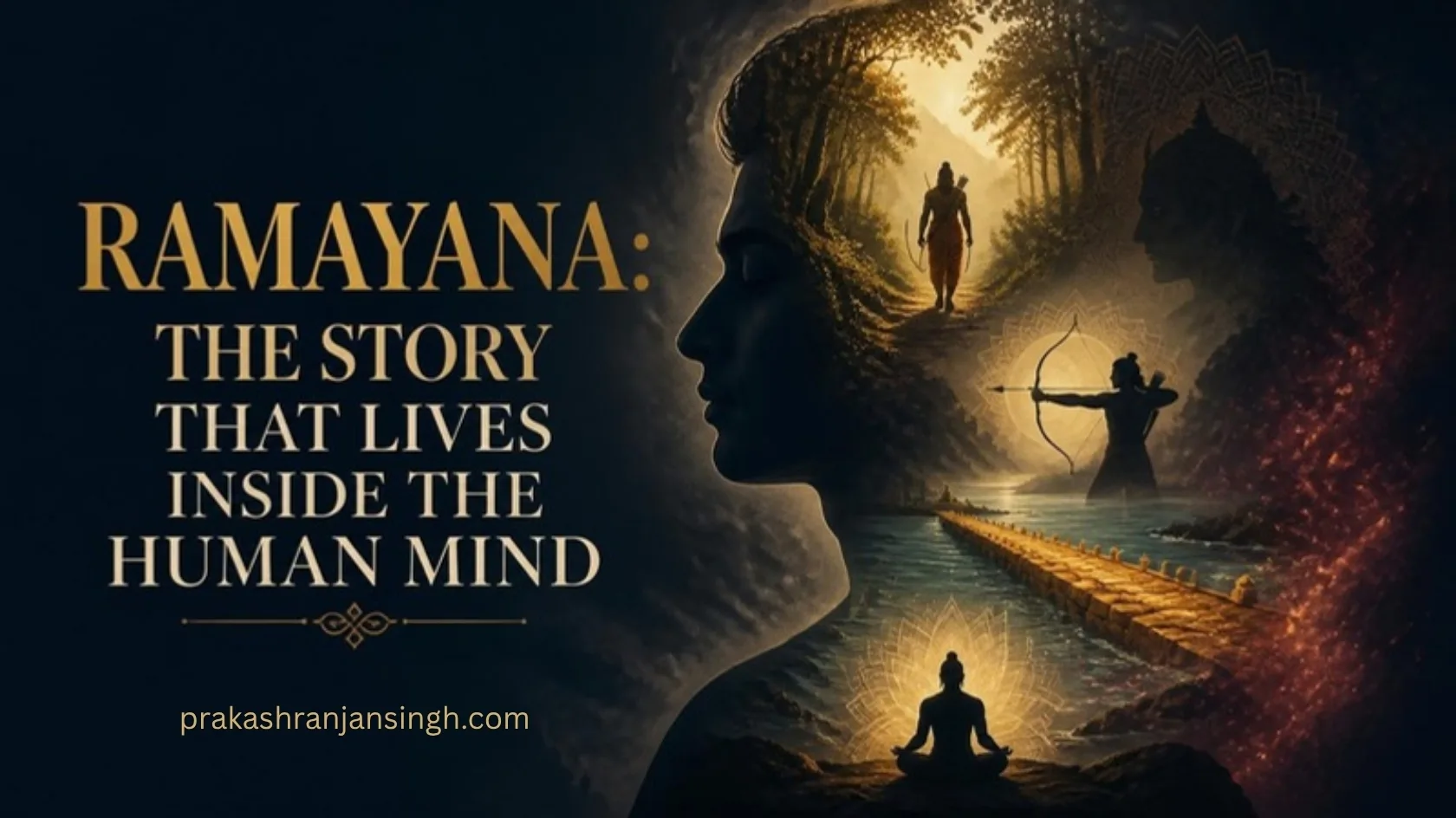
Table of Contents
- 1. Ramayana Is Not Merely a Religious Text
- 2. Why Does the Same Story Feel Different Every Time?
- 3. The Ramayana Trains the Mind Through Characters
- 4. It Creates a Psychological Vocabulary for Difficult Situations
- 5. The Most Powerful Character May Be the One Who Reminds Us of Our Own Potential
- 6. Ramayana and the Psychology of Self-Control
- 7. Why the Story Becomes Embedded in the Subconscious
- 8. What Could a New Ramayana Film Do Differently?
- 9. But Cinema Will Also Shape Interpretation
- 10. Why the Ramayana May Matter Even More in the Age of AI
- 11. The Greatest Lesson May Be That Intelligence Alone Is Not Wisdom
- 12. Every Generation Must Rediscover the Story for Itself
- THE RAMAYANA DOES NOT NEED A NEW GENERATION—THE NEW GENERATION NEEDS NEW WAYS TO DISCOVER IT
- Frequently Asked Questions
As Ranbir Kapoor, Sai Pallavi and Yash bring the epic to a new generation, can an ancient story speak to a civilisation entering the age of AI?
There are films that people watch.
There are stories that people remember.
And then there are stories that become part of the psychological architecture of a civilisation.
The Ramayana belongs to the third category.
When a child hears the story of Rama, Sita, Lakshmana and Hanuman, when a family watches Ramleela, when a temple echoes with Ram Naam, when an elderly person listens to Ramcharitmanas, or when a young person encounters the story through television, books, audio or cinema, something more than entertainment takes place.
The characters become familiar psychological figures.
Rama becomes an image of duty and restraint.
Sita becomes associated with courage, dignity and endurance.
Lakshmana represents loyalty and sacrifice.
Hanuman represents devotion combined with extraordinary capability.
Ravana represents intelligence and power confronted by the consequences of ego and desire.
The story therefore survives not simply because it is repeatedly narrated.
It survives because every generation finds a part of itself inside it.
And now, with Nitesh Tiwari’s Ramayana: Part 1, starring Ranbir Kapoor as Rama, Sai Pallavi as Sita and Yash as Ravana, the ancient narrative is entering another technological and cinematic environment. Current reporting places the first part for Diwali 2026, with the Rama–Ravana confrontation planned for the second instalment in 2027.
The real question is therefore much larger than whether the movie succeeds at the box office.
What happens when an ancient civilizational story enters the imagination of millions of people through modern cinema?
1. Ramayana Is Not Merely a Religious Text
For millions, the Ramayana is unquestionably sacred. But its cultural influence extends beyond the boundaries of religious practice.
UNESCO has described the Ramayana as one of the great epics that deeply influenced the cultural and religious life of the Indian subcontinent and much of Asia.
Its influence can be seen in literature, theatre, sculpture, dance, music, festivals, language and storytelling traditions.
Indonesia’s Prambanan temple complex, for example, contains extensive reliefs depicting the Ramayana.
In India, Ramlila—the dramatic performance tradition based on the Ramayana—was inscribed by UNESCO on the Representative List of the Intangible Cultural Heritage of Humanity in 2008. UNESCO notes that Ramlila brings communities together through narration, music, dialogue, participation and performance.
This tells us something important:
The Ramayana did not remain confined to a book. It became a living cultural system.
2. Why Does the Same Story Feel Different Every Time?
One of the most fascinating psychological features of the Ramayana is that the story does not remain psychologically static.
A child may hear it as a story about a prince and a demon king.
A teenager may see friendship, loyalty, attraction, jealousy and difficult choices.
A parent may see Dasharatha differently.
A husband may interpret Rama and Sita differently.
A brother may understand Lakshmana differently.
A person facing adversity may discover an entirely different meaning in exile.
This is one reason great stories survive for centuries.
The story remains the same, but the person experiencing the story changes.
The Ramayana therefore works almost like a psychological mirror.
We do not merely ask, “What happened to Rama?”
At different stages of life, we unconsciously ask:
“What would I have done?”
That question itself creates introspection.
3. The Ramayana Trains the Mind Through Characters
Modern education often tries to teach values through definitions.
The Ramayana teaches through characters.
Instead of saying “be loyal,” it presents Hanuman.
Instead of simply saying “respect relationships,” it creates a world of brothers, parents, spouses, friends, teachers and allies whose decisions carry consequences.
Instead of merely discussing the dangers of uncontrolled ambition, it presents Ravana as a complex figure possessing enormous knowledge and power but also confronting the destructive consequences of ego and desire.
This is psychologically powerful because human beings often remember stories better than instructions.
A moral principle written on a page can be forgotten.
A character with whom a person emotionally identifies can remain in memory for decades.
4. It Creates a Psychological Vocabulary for Difficult Situations
Life rarely provides perfectly clean choices.
People face betrayal, separation, responsibility, temptation, uncertainty, grief, family conflict, failure and moral dilemmas.
The Ramayana provides a vocabulary through which people can think about such situations.
Exile can become a metaphor for unexpected hardship.
The search for Sita can become a metaphor for perseverance.
Hanuman’s journey can become a metaphor for discovering one’s own capability.
The bridge to Lanka can become a metaphor for collective effort.
Ravana can become a reminder that knowledge and capability alone do not necessarily produce wisdom.
These interpretations are not substitutes for professional psychological care, but interestingly, Indian psychiatric researchers have investigated whether Ramayana-based narratives can be incorporated into culturally relevant counselling. A 2024 study developed and validated such a counselling module, while later feasibility research involving 17 participants reported improvements in some measures of coping and well-being. These are preliminary findings, not proof that reading the Ramayana is a medical treatment.
That distinction matters.
The psychological value of a story can be meaningful without turning the story into a medical prescription.
5. The Most Powerful Character May Be the One Who Reminds Us of Our Own Potential
Hanuman offers one of the most fascinating psychological ideas in the epic.
He possesses extraordinary capability, yet at a crucial moment he needs to be reminded of what he is capable of doing.
The symbolism is remarkably contemporary.
Millions of young people today have knowledge, education and technological access, but many struggle with confidence, comparison and self-doubt.
Social media continuously shows them other people’s achievements.
AI continuously demonstrates capabilities that appear superhuman.
Automation makes people wonder whether their own skills will remain valuable.
In such an environment, the psychological message represented by Hanuman becomes particularly relevant:
Sometimes the problem is not absence of capability. It is failure to recognise capability.
The story can therefore be read as an invitation to discover strength rather than merely admire strength in others.
6. Ramayana and the Psychology of Self-Control
Modern society has created unprecedented access to instant gratification.
One click can deliver food.
One swipe can deliver entertainment.
One notification can provide social validation.
One credit transaction can provide consumption before income has actually been earned.
AI can generate an answer within seconds.
But human character still develops slowly.
The Ramayana repeatedly places characters in situations involving desire, anger, attachment, power and temptation.
Its psychological relevance lies partly in the question:
Can human beings possess power without becoming controlled by power?
This question is becoming increasingly important in the age of artificial intelligence.
A civilisation capable of creating extraordinarily powerful machines will still need individuals capable of controlling themselves.
Technology can increase capability.
Character determines how capability is used.
7. Why the Story Becomes Embedded in the Subconscious
The Ramayana is not usually consumed only once.
A person may encounter it through grandparents, parents, school, television, temple traditions, festivals, Ramlila, books, songs, religious discourse and cinema.
Repetition creates familiarity.
Emotion creates attachment.
Characters create identification.
Ritual creates continuity.
Community creates reinforcement.
Together, these processes can make the narrative part of a person’s cultural memory.
That helps explain why an ordinary Ramleela performance can attract people who already know exactly what is going to happen.
They are not attending merely to discover the ending.
They are returning to a familiar psychological world.
UNESCO describes Ramlila as a participatory tradition in which audiences sing and participate in the narration, while communities collectively contribute to costumes, masks, performances and associated activities.
The audience therefore does not remain completely outside the story.
It becomes part of the story.
8. What Could a New Ramayana Film Do Differently?
Cinema possesses something ancient storytellers did not have at the same scale:
visual immersion.
Modern cinematography, sound design, visual effects and global distribution can reconstruct forests, kingdoms, battles, journeys and mythical landscapes with extraordinary sensory detail.
The forthcoming film’s scale could therefore introduce the Ramayana to people who may never have opened Valmiki’s Ramayana or read Ramcharitmanas.
That creates both an opportunity and a responsibility.
A successful cinematic adaptation can stimulate curiosity.
A young viewer may watch the film and subsequently ask:
“What is the original story?”
“What does Valmiki actually say?”
“How does Tulsidas present it?”
“Why are different versions of the Ramayana found across India and Asia?”
“Why does Southeast Asia have its own Ramayana traditions?”
Cinema can therefore become the doorway to deeper learning rather than the final destination.
9. But Cinema Will Also Shape Interpretation
This is where the psychological power of the new film becomes especially significant.
Every adaptation selects.
Every screenplay emphasises some characters, events and emotions more strongly than others.
Every actor brings a particular human personality to a character.
Every visual interpretation creates an image in the viewer’s mind.
Consequently, a major film cannot simply show the Ramayana.
It will inevitably influence how a generation imagines the Ramayana.
That does not mean cinema replaces the original texts.
Rather, it means viewers should understand the difference between the ancient epic tradition and a contemporary cinematic interpretation of it.
The opportunity is greatest when cinema creates curiosity rather than closing curiosity.
10. Why the Ramayana May Matter Even More in the Age of AI
The coming generation is entering a world radically different from the one their parents knew.
AI can write.
AI can compose music.
AI can generate images.
AI can analyse information.
AI can assist decision-making.
Robots may increasingly perform physical tasks.
The young person of tomorrow may therefore face a strange question:
“If machines can do so much, what makes me valuable?”
The answer cannot be merely technical.
Technical skills will change.
Software will change.
Professions will change.
But qualities such as integrity, courage, empathy, responsibility, loyalty, restraint, perseverance and the ability to distinguish right from wrong will remain fundamentally human concerns.
This is where civilizational stories acquire renewed importance.
The Ramayana does not provide an instruction manual for artificial intelligence.
It provides something more foundational:
a vocabulary for thinking about human behaviour when power, desire, responsibility and consequences collide.
And that is precisely the kind of question that becomes more important—not less important—as technology becomes more powerful.
11. The Greatest Lesson May Be That Intelligence Alone Is Not Wisdom
This distinction deserves particular attention in the AI era.
Human civilisation has historically admired intelligence.
But the modern world is discovering that intelligence without ethical direction can create enormous risks.
The Ramayana offers many characters through whom readers can examine different combinations of knowledge, power, loyalty, courage, desire and judgement.
The story therefore allows a civilisation to ask:
What should intelligence serve?
This question may become one of the defining questions of the twenty-first century.
AI can potentially make humans more capable.
But capability without wisdom can amplify mistakes.
Technology can increase the speed of decisions.
But speed without reflection can increase the consequences of bad decisions.
The future therefore needs intelligent human beings—but also wise human beings.
12. Every Generation Must Rediscover the Story for Itself
Perhaps the greatest strength of the Ramayana is that it does not belong exclusively to one generation.
Our grandparents encountered it differently.
Our parents encountered it through books, oral traditions, radio, theatre and television.
Our generation encountered it through serials, books, religious programmes and cinema.
The next generation may encounter it through spectacular global filmmaking, streaming platforms, gaming, immersive technology and AI-assisted storytelling.
The medium will change.
The psychological questions will remain.
Who am I?
What is my responsibility?
How should I behave when circumstances become difficult?
What is loyalty?
What is sacrifice?
What happens when desire becomes uncontrolled?
What is courage?
What is leadership?
What is the relationship between power and morality?
What makes a person worthy of respect?
These questions are older than modern technology and will probably remain relevant long after today’s technology becomes obsolete.
THE RAMAYANA DOES NOT NEED A NEW GENERATION—THE NEW GENERATION NEEDS NEW WAYS TO DISCOVER IT
The forthcoming Ramayana may become a major cinematic event, but its deeper significance could lie beyond box-office numbers.
If millions watch it, discuss it, question it and subsequently explore the original traditions, the film could create a new cultural conversation.
A child who watches Rama today may understand him differently twenty years later.
A teenager who identifies with Hanuman may discover another meaning of courage as an adult.
A person who sees Ravana only as an antagonist may later become interested in the deeper questions surrounding knowledge, ego and power.
That is the extraordinary nature of a living civilisation.
It does not simply preserve its stories. It continuously reinterprets them.
The Ramayana has survived manuscripts, languages, kingdoms, political systems, social transformations and technological revolutions.
It moved from oral narration to manuscripts.
From manuscripts to regional languages.
From temples to Ramlila stages.
From theatre to radio.
From television to cinema.
And now it is entering an era of global-scale visual effects and artificial intelligence.
Perhaps this is why the Ramayana remains so powerful.
It is ancient in origin but contemporary in questions.
A civilisation may change its technology every few years.
It may change its occupations, communication systems and lifestyles.
But the human mind continues to wrestle with love, fear, ambition, loyalty, temptation, responsibility, loss and hope.
And that is where the Ramayana continues to live.
Not merely in a book.
Not merely in a temple.
Not merely on a Ramlila stage.
Not merely on a cinema screen.
It lives in the questions human beings ask themselves when nobody else is watching.
Perhaps the real success of the new Ramayana will therefore not be measured only by tickets sold.
Its deeper success will be visible if a generation leaves the cinema asking:
“What does this story mean for my life?”
Because when a civilisation’s oldest stories continue to generate new questions in the minds of its youngest citizens, the story is not merely surviving.
The civilisation is still learning.
Frequently Asked Questions
When is the new Ramayana film releasing?
Nitesh Tiwari’s Ramayana: Part 1, starring Ranbir Kapoor as Rama, Sai Pallavi as Sita and Yash as Ravana, is currently reported for a Diwali 2026 release, with the Rama-Ravana confrontation planned for a second instalment in 2027.
Why do psychologists study the Ramayana?
Indian researchers have explored whether Ramayana-based narratives can support culturally relevant counselling — a 2024 study developed and validated such a module, and later feasibility research with 17 participants reported improvements in some measures of coping and well-being. These are preliminary findings, not proof the Ramayana is a medical treatment.
What does UNESCO say about the Ramayana’s cultural influence?
UNESCO has described the Ramayana as one of the great epics that deeply shaped the cultural and religious life of the Indian subcontinent and much of Asia, and in 2008 inscribed Ramlila, the dramatic performance tradition based on the Ramayana, on its Representative List of the Intangible Cultural Heritage of Humanity.
Why does the Ramayana matter more in the age of AI?
As AI takes over more technical and creative tasks, human qualities such as integrity, courage, restraint and wisdom become more valuable, not less. The Ramayana offers a psychological vocabulary for these questions — including whether intelligence and power, without wisdom, can become dangerous.
Is the Ramayana only a religious story?
For millions it is sacred, but its cultural reach extends far beyond religious practice — into literature, theatre, sculpture, dance, festivals and language across India and Southeast Asia, including temple reliefs such as those at Indonesia’s Prambanan complex.
Related Reading
- Sunderkand: The Power of Faith, Sound and the Human Mind
- Rambola: When Human Attachment Became Divine Devotion
- Hanuman Ansh: Why Is the World Suddenly Looking Towards Neem Karoli Baba?
- Hindu Civilization at a Crossroads: The Need for Reform, Awareness, and Cultural Confidence
- The Great Career Dilemma in the Age of Artificial Intelligence
- UNESCO: Ramlila, the Traditional Performance of the Ramayana


Leave a Reply