Category: Religion & Spirituality

  • Sunderkand: The Power of Faith, Sound and the Human Mind

    Sunderkand: The Power of Faith, Sound and the Human Mind

    Sunderkand’s power isn’t just spiritual—the chanting, rhythm and collective devotion behind it align with what modern psychology and neuroscience already know about how sound, ritual and belief calm the human mind during hardship.

    Sunderkand recitation, faith, sacred sound and the human mind

    How Devotion, Faith, Sacred Sound and Positive Psychology Can Strengthen Human Well-Being

    India has always been a civilization that looked beyond material solutions when life entered a difficult phase. When human effort appeared insufficient, people often turned inward—to faith, prayer, meditation, self-discipline and the power of sacred sound.

    Among the most widely recited spiritual texts during difficult times is Sunderkand, the celebrated section of the Ramcharitmanas devoted primarily to the extraordinary journey, courage, devotion and service of Lord Hanuman.

    For millions of devotees, Sunderkand is not merely a religious recitation. It is a source of hope when life feels hopeless, courage when fear dominates, patience when circumstances become difficult and faith when the future appears uncertain.

    Many religious traditions believe that its recitation helps reduce the adverse effects of difficult phases of life, including what believers describe as planetary or spiritual imbalances. Such claims belong primarily to the domain of faith and religious belief. However, modern understanding of psychology, neuroscience and the effects of sound also gives us interesting insights into why chanting, rhythmic recitation, devotional music and collective prayer can influence the human mind and behaviour.

    Perhaps this is where ancient spiritual wisdom and modern psychology meet.

    Sunderkand Is a Story of Courage in the Face of the Impossible

    The power of Sunderkand is deeply connected with its message.

    Lord Hanuman is faced with an apparently impossible task—crossing the vast ocean, searching for Mata Sita, entering an unknown and hostile territory, confronting powerful obstacles and returning with hope.

    Yet the story repeatedly teaches a timeless lesson:

    The greatest strength often lies dormant within us until faith, purpose and courage awaken it.

    Hanuman initially does not begin his journey with arrogance. He is reminded of his own strength. Once that inner strength is awakened, he moves forward with extraordinary determination.

    This psychological message remains relevant even today.

    In moments of crisis, human beings often forget their own capabilities. Financial difficulties, illness, professional setbacks, family conflicts, loneliness and uncertainty can create a feeling of helplessness. A spiritual practice can sometimes become a psychological anchor—a daily reminder that difficult circumstances are temporary and that one must continue making sincere effort.

    Sunderkand, therefore, can be understood not only as a sacred text but also as a powerful narrative of:

    Courage

    Devotion

    Discipline

    Service

    Humility

    Persistence

    Hope

    Mental strength

    The Power of Sound: More Than Just What We Hear

    Sound has a profound relationship with the human mind.

    A sudden loud sound can trigger fear. Gentle music can create calmness. A familiar song can revive memories. A mother’s lullaby can comfort a child. The rhythm of waves or rainfall can help some people relax.

    This demonstrates an important fact:

    Sound does not merely enter our ears; it can influence attention, emotion, memory and physiological arousal.

    During chanting or rhythmic recitation, several psychological processes may become active.

    1. Rhythm Can Help Focus a Restless Mind

    The modern mind is constantly distracted.

    Notifications, social media, financial worries, professional pressure and endless streams of information keep the brain in a state of continuous stimulation.

    Rhythmic recitation can provide a single point of attention. When a person repeatedly focuses on verses, pronunciation, rhythm and meaning, intrusive thoughts may temporarily reduce.

    This is one reason repetitive spiritual practices across different cultures can feel mentally stabilizing.

    The mind that is scattered in ten directions may gradually return to one.

    2. Slow and Controlled Recitation Can Encourage Relaxation

    Chanting often involves regulated breathing.

    When a person recites slowly, pauses naturally and maintains a steady rhythm, breathing may become more regular. Calm and controlled breathing is commonly associated with relaxation and reduced physiological stress responses.

    The benefit may not come from sound alone. It can arise from the combined effect of:

    Breath + rhythm + concentration + emotion + belief.

    This combination can create a powerful experience of calm.

    Why Faith Can Change the Way We Face Problems

    One of the most underestimated powers in human life is meaning.

    Two people may face the same difficulty but respond differently. One may feel completely defeated, while another may find the strength to continue.

    Faith can provide a framework through which suffering is interpreted.

    For a believer, prayer may create the feeling:

    “I am facing this difficulty, but I am not alone.”

    That feeling itself can be psychologically significant.

    Faith may encourage a person to:

    Remain hopeful

    Avoid panic

    Control impulsive decisions

    Continue treatment during illness

    Maintain discipline

    Seek support

    Work patiently toward a solution

    This does not mean prayer should replace medical care, financial planning or practical action. Rather, spiritual strength can complement responsible action.

    Faith can strengthen the person who must take action.

    The Psychology of Collective Recitation

    Anyone may engage with Sunderkand according to their faith and tradition. Some prefer to recite it personally, while others listen to a recording or participate in a group recitation.

    The experience of collective chanting can have an additional psychological dimension.

    When people gather with a shared intention, sing together and focus on a common sacred experience, they may experience:

    Social connection

    Emotional support

    A sense of belonging

    Reduced loneliness

    Shared hope

    Collective optimism

    In a society where many people are increasingly isolated despite being digitally connected, such community experiences can have considerable emotional value.

    Sometimes, a person does not need someone to solve every problem. They need to feel that they are not fighting every battle alone.

    Listening and Reciting: Both Can Have Value

    A common question is whether one must personally recite Sunderkand or whether listening to a recorded version can also be beneficial.

    From the perspective of devotional faith, people may follow the traditions and guidance they personally believe in. From a psychological perspective, both active recitation and attentive listening can have value, although the experience may differ.

    Active recitation may involve:

    Greater concentration

    Controlled breathing

    Vocal participation

    Memory engagement

    Deeper involvement with the words

    Attentive listening may offer:

    Relaxation

    Emotional comfort

    A peaceful environment

    Familiar spiritual association

    A helpful pause from stressful thoughts

    The important factor may be mindful engagement rather than mere background noise.

    A sacred recording playing continuously while the mind remains completely occupied elsewhere may create a different experience from listening with attention, understanding and devotion.

    The Role of Positive Expectation

    Science recognizes that expectation can influence human experience.

    If a person sincerely believes that a particular practice will help them remain calm and strong, that belief can influence behaviour. They may sleep better, worry less, become more disciplined and face difficulties with greater confidence.

    This should not be misunderstood as a guarantee that every problem will immediately disappear.

    But a calmer mind can often make better decisions.

    And better decisions can gradually change outcomes.

    This creates an important chain:

    Positive faith → Reduced panic → Better emotional control → Better decisions → Consistent effort → Improved possibilities.

    Perhaps many experiences described as “immediate effects” are deeply connected with this rapid transformation in a person’s mental and emotional state.

    When fear reduces, clarity may increase.

    When clarity increases, action becomes better.

    And when action becomes consistent, life may begin to change.

    Can Spiritual Practice Lead to Success and Prosperity?

    No sacred practice can honestly be presented as a mechanical guarantee of wealth.

    Life is influenced by many factors—health, opportunity, education, economic conditions, decisions, relationships and sometimes circumstances beyond individual control.

    However, spiritual discipline can help develop qualities that are strongly relevant to success.

    Regular recitation may encourage a person to become:

    More patient

    More disciplined

    Less fearful

    More emotionally balanced

    More optimistic

    More focused on purposeful action

    Lord Hanuman himself represents these qualities.

    He possesses immense power but remains humble.

    He achieves extraordinary results but does not become arrogant.

    He faces danger but does not surrender to fear.

    He has strength but uses it in service of a higher purpose.

    These are not merely religious ideals. They are also powerful principles of leadership and personal development.

    Wealth without wisdom can create anxiety.

    Success without humility can create loneliness.

    Power without purpose can become destructive.

    True well-being requires balance.

    The Deeper Meaning of “Removing Obstacles”

    Perhaps the greatest obstacle in human life is not always outside us.

    Sometimes the biggest barriers are:

    Fear

    Anger

    Overthinking

    Lack of confidence

    Jealousy

    Impatience

    Hopelessness

    Addiction

    Negative thinking

    When a person repeatedly connects with a narrative of courage and devotion, their inner attitude can gradually change.

    This may be the deeper meaning of seeking the blessings of Lord Hanuman.

    The obstacle outside may remain for some time.

    But the person facing it may become stronger.

    And often, a stronger mind finds solutions that a frightened mind cannot see.

    A Scientific and Spiritual Balance

    In discussing sacred practices, it is important to maintain both respect and responsibility.

    Spiritual recitation may support psychological well-being, relaxation and resilience, but it should not replace:

    Medical diagnosis and treatment

    Professional mental-health care when required

    Financial planning

    Legal advice

    Responsible decision-making

    A person suffering from a serious illness should seek appropriate medical care. A person experiencing severe anxiety or depression should not suffer silently in the belief that spiritual practice alone must solve everything.

    Prayer and professional care need not be enemies.

    Medicine can treat the body.

    Counselling can support the mind.

    Family can provide emotional strength.

    Faith can provide meaning and courage.

    A holistic life may need all of them.

    The True Miracle May Be the Transformation Within

    The greatest benefit of a spiritual practice may not always be that the world changes instantly.

    Sometimes, the transformation begins within us.

    A worried person becomes calmer.

    A frightened person becomes courageous.

    A confused person begins to see clearly.

    A hopeless person finds a reason to continue.

    An impatient person learns to wait.

    An arrogant person learns humility.

    A lonely person feels connected to something greater than himself.

    And when the individual changes, his response to the world also changes.

    That is why sacred practices have survived for centuries.

    Their power lies not merely in the words that are spoken but also in the attention, faith, emotion, discipline, community and meaning that those words can awaken.

    A Message for Modern Life

    We live in an age of extraordinary technology but increasing mental restlessness.

    We can communicate instantly across the world but often struggle to communicate with ourselves.

    We have endless information but limited inner peace.

    Perhaps this is why ancient practices are finding relevance even in modern life.

    The answer is not to reject science in the name of spirituality.

    Nor is the answer to reject spirituality in the name of science.

    The wiser approach is to understand the value and limitations of both.

    If the recitation of Sunderkand inspires a person to wake up with hope, control fear, strengthen discipline, respect others, serve society and face challenges with courage, then its influence extends far beyond ritual.

    Conclusion: Faith Must Become Strength

    Sunderkand continues to occupy a special place in the hearts of millions because its message is timeless.

    It tells humanity that even when the journey appears impossible, one should not surrender.

    When obstacles appear, intelligence must be used.

    When fear arises, courage must be awakened.

    When strength is received, it must be used with humility.

    And when success comes, one must remember the higher purpose behind it.

    Whether one approaches Sunderkand through religious devotion, spiritual discipline, psychological reflection or the calming power of sacred sound, its central message remains inspiring:

    Do not allow adversity to convince you that you are powerless.

    Within every difficult phase lies a test of patience.

    Within every obstacle lies an opportunity to discover strength.

    Within every restless mind lies the possibility of peace.

    And perhaps that is the enduring power of faith:

    It may not always remove the storm immediately—but it can give us the courage to sail through it.

    “जहाँ भय समाप्त होता है, वहीं से विश्वास की शक्ति शुरू होती है।”

    Recite with devotion. Listen with attention. Understand with wisdom. And then rise with courage to perform your duty.

    Related Reading

  • Rudrabhishek: Where Faith Meets Science, Psychology and the Wisdom of Ancient India

    Rudrabhishek: Where Faith Meets Science, Psychology and the Wisdom of Ancient India

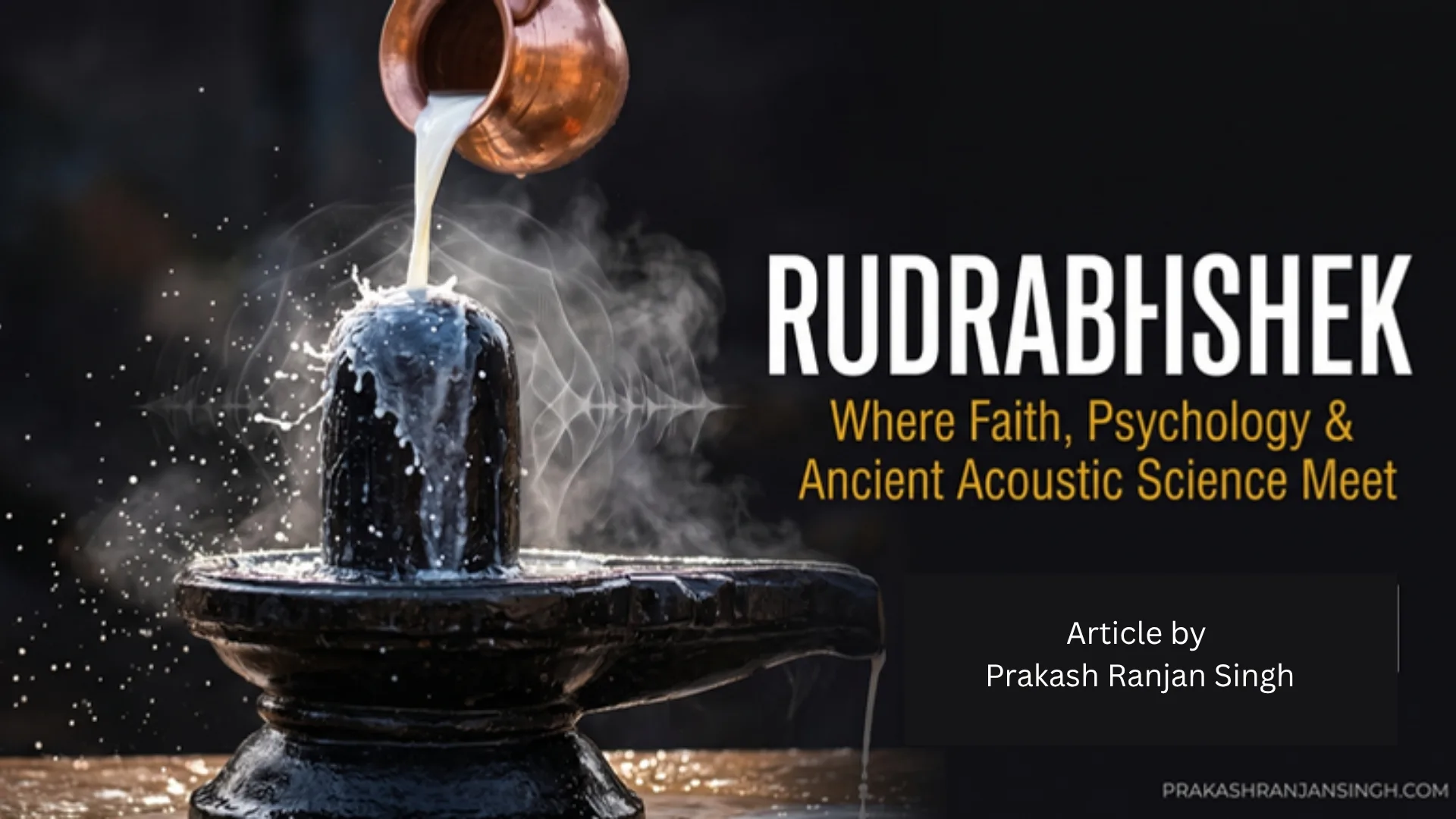
    There are some rituals in Indian civilisation that have survived thousands of years not merely because people believed in them, but because they became deeply woven into human life, family traditions and social consciousness. Rudrabhishek, the ceremonial bathing of Lord Shiva with water and other sacred offerings while chanting mantras, is one such ancient practice.

    Rudrabhishek ritual, ceremonial bathing of the Shiva Lingam

    For a devotee, Rudrabhishek is an act of worship and surrender to Lord Shiva. For a student of Indian culture, it is an extraordinary combination of sound, rhythm, symbolism, discipline, community participation and reverence for nature.

    Modern science may not be able to prove every spiritual claim associated with the ritual—and it is important not to present religious belief as established medical fact—but research into mantra meditation, chanting, slow breathing and meditation does provide interesting evidence for several mechanisms that can operate during such practices.

    Perhaps this is where the real beauty of Rudrabhishek lies: what appears to be a simple religious ritual may simultaneously engage the mind, body, senses, emotions, family and community.

    Rudra: More Than a Ritual

    Rudra is one of the ancient names associated with Shiva. In the traditional understanding, Shiva represents both destruction and transformation—the destruction of ignorance, ego, negativity and attachments, followed by renewal.

    Rudrabhishek therefore carries a profound symbolic message.

    Water is continuously offered over the Shiva Lingam while sacred mantras are recited. The devotee watches the water flow, listens to the chanting, performs the ritual in a prescribed manner and gradually moves the mind away from worldly distractions.

    It is not simply about offering something to God.

    It can also be understood as offering one’s ego, anxiety, anger and burdens to a higher consciousness.

    That psychological interpretation makes the ritual surprisingly relevant to modern life.

    The Power of Mantra and Sound

    One of the most fascinating components of Rudrabhishek is sound.

    The Rudra mantras are not ordinary sentences spoken casually. They are traditionally recited with specific pronunciation, rhythm and repetition.

    Modern research has increasingly examined what happens to the human body and brain during mantra-based practices.

    A systematic review and meta-analysis of mantra-based meditation found small-to-moderate improvements in areas such as anxiety, stress, depression and mental-health-related quality of life, although the researchers also cautioned that the evidence has limitations and some studies have methodological weaknesses.

    Research specifically examining Om chanting has also reported changes in autonomic nervous-system activity associated with relaxation. One study found increased parasympathetic activity after five minutes of Om chanting, suggesting a possible calming effect.

    Another fMRI pilot study observed reduced activity in several limbic brain regions during Om chanting, including the amygdala, a region strongly associated with emotional processing. The study was small, so its findings should be regarded as preliminary rather than definitive.

    This does not prove that every mantra in Rudrabhishek produces a specific medical outcome.

    But it does provide an intriguing scientific perspective:

    repetitive sacred sound + controlled breathing + focused attention + ritual environment can create conditions conducive to mental relaxation and concentration.

    The Forgotten Science of Breathing

    There is another component that deserves attention—breathing.

    When a person chants slowly and rhythmically, breathing naturally becomes slower and more controlled. This is particularly evident in prolonged chanting practices.

    Research examining Om chanting has found synchronization between respiration, heart-rate oscillations and blood-pressure oscillations during slow chanting.

    This is important because modern human beings frequently live in a state of psychological acceleration.

    We eat quickly.

    We speak quickly.

    We work quickly.

    We scroll quickly.

    We react quickly.

    And consequently, our minds rarely experience silence.

    A ritual such as Rudrabhishek forces us to slow down.

    For a period of time, the mind follows the mantra, the ears follow the sound, the eyes follow the ritual and breathing follows the rhythm.

    The result can be a temporary withdrawal from the constant stimulation of everyday life.

    Water: The Central Symbol

    Water occupies a central position in Rudrabhishek.

    Scientifically, we should be careful about claiming that water poured over a Shiva Lingam becomes medically or chemically “purified” merely because of the ritual. Such claims require controlled scientific evidence.

    But the symbolic and environmental significance of water is undeniable.

    Indian civilisation developed around rivers, monsoon cycles, agriculture, wells, ponds and water conservation. Water was never merely a commodity; it was treated as sacred.

    When generations repeatedly hear that water is worthy of reverence, they may develop a deeper cultural respect for it.

    The ritual therefore contains a powerful environmental message:

    That which sustains life must not be treated carelessly.

    The challenge for modern society is to preserve this principle while also ensuring that religious practices use natural resources responsibly.

    Faith should create reverence for water—

    not wastefulness.

    The Ingredients and Their Symbolism

    Traditional Rudrabhishek may involve water, milk, curd, honey, ghee, sugar, bilva leaves, flowers and other offerings depending upon regional and ritual traditions.

    Each has symbolic significance.

    Milk represents nourishment.

    Honey represents sweetness.

    Curd represents prosperity and transformation.

    Ghee represents purity and vitality.

    Bilva leaves are particularly associated with Shiva worship.

    The important lesson is that human beings were taught to see divinity in ordinary elements of nature.

    Today we often speak about environmental consciousness as a modern concept.

    But Indian traditions frequently embedded environmental respect into religious behaviour.

    The underlying philosophy was simple:

    Nature is not merely a resource to be consumed; it is something to be respected.

    Rudrabhishek as Psychological Therapy—Without Calling It Medicine

    Imagine a person carrying financial pressure, family problems, professional stress and uncertainty.

    He enters a temple.

    For the next hour, his mobile phone may remain aside.

    He sits before Shiva.

    He hears the mantra.

    He watches water flow continuously.

    He repeats sacred words.

    His breathing slows.

    His attention becomes concentrated.

    For some time, he stops thinking about tomorrow’s problems.

    Nothing magical needs to be assumed to understand why such an experience may feel calming.

    It creates structured attention.

    Meditation research broadly supports the possibility that practices involving focused attention and mantra repetition can reduce aspects of psychological stress and anxiety.

    The ritual may therefore work as a kind of psychological reset.

    Not a replacement for medical treatment.

    Not a substitute for professional psychological care.

    But potentially a meaningful spiritual and contemplative practice.

    The Power of Collective Chanting

    Rudrabhishek is often performed collectively.

    This creates another dimension: social connection.

    When several people chant together, individual voices become part of a collective rhythm.

    The wealthy and poor can stand together.

    The educated and uneducated can participate together.

    Young and old can sit together.

    For a moment, social identities can become less important than the shared act of devotion.

    This is one of the greatest strengths of Indian religious traditions.

    A temple can become not merely a place of worship but a social institution that connects generations.

    Grandparents teach children.

    Parents teach traditions.

    Children learn Sanskrit verses, discipline, respect and cultural history.

    A ritual thus becomes a mechanism for transferring civilisation from one generation to another.

    Rudrabhishek and the Psychology of Surrender

    Modern society constantly teaches us to control everything.

    Control your career.

    Control your finances.

    Control your future.

    Control your image.

    Control your social-media presence.

    But life repeatedly reminds us that everything cannot be controlled.

    Rudrabhishek introduces another psychological principle:

    Surrender.

    The devotee stands before Shiva and accepts that there are forces greater than individual human control.

    This does not mean abandoning responsibility.

    Rather, it can mean:

    “I will do my duty, but I will not allow anxiety about the result to destroy my peace.”

    That is a remarkably modern lesson.

    The Moral Dimension

    The greatest benefit of any religious ritual should ultimately be visible in human behaviour.

    If someone performs Rudrabhishek in the morning but behaves dishonestly with employees in the afternoon, cheats someone in business, mistreats parents or exploits the weak, the ritual has lost its deeper purpose.

    The real Rudrabhishek begins when the water stops flowing.

    It begins when we return to our homes and workplaces.

    Can we become less angry?

    Can we become more truthful?

    Can we control greed?

    Can we forgive?

    Can we help someone weaker?

    Can we respect nature?

    Can we perform our responsibilities honestly?

    If the answer is yes, the ritual has transformed into character development.

    Rudrabhishek and the Modern Stressful Life

    Our ancestors lived without smartphones, social media notifications and 24-hour information cycles.

    Today’s human being is exposed to an extraordinary amount of stimulation.

    The brain is continuously processing messages, advertisements, videos, financial information, political arguments and social comparisons.

    Against this background, a ritual involving silence, repetition, rhythm and concentration acquires an entirely new relevance.

    Perhaps our ancestors understood something that modern civilisation is rediscovering:

    The human mind needs periods of deliberate slowing down.

    Scientific research on mantra meditation supports the possibility of benefits for stress and anxiety, although the evidence is not strong enough to claim that a particular religious ritual is a medical treatment.

    The Environmental Question We Must Not Ignore

    There is, however, an important responsibility attached to interpreting Rudrabhishek scientifically.

    We should not blindly convert every traditional belief into a scientific claim.

    For example, claims that a particular ingredient automatically kills pathogens, purifies the atmosphere or cures a disease require direct scientific evidence.

    Similarly, excessive use of milk or other food substances in rituals can raise legitimate questions about waste and environmental responsibility.

    The better approach is not to reject tradition.

    Nor is it to defend every traditional practice without examination.

    The better approach is:

    Preserve the spirit of the tradition while improving the practice with modern wisdom.

    Use water respectfully.

    Avoid unnecessary wastage.

    Ensure offerings are handled hygienically.

    Do not pollute rivers or water bodies.

    Do not make unverified medical claims.

    This is how ancient wisdom can coexist with modern science.

    Faith and Science Do Not Always Have to Fight

    Perhaps the greatest misunderstanding is that something must either be “religious” or “scientific.”

    They answer different questions.

    Science asks:

    How does something work?

    Faith often asks:

    Why does it matter?

    Science can investigate breathing, sound, attention, stress and physiological responses.

    Faith provides meaning, devotion, symbolism and a framework for living.

    Rudrabhishek can therefore be appreciated at multiple levels.

    For the believer, it is worship.

    For the psychologist, it can be a structured contemplative practice.

    For the neuroscientist, it is an interesting combination of attention, sound and breathing.

    For the sociologist, it is a mechanism of community bonding.

    For the environmentalist, it carries a cultural message about reverence for nature—provided the ritual itself is conducted responsibly.

    For the moral philosopher, it is an opportunity for self-reflection.

    And for an ordinary human being struggling with the complexities of life, it can simply provide a few moments of peace.

    The Greatest Rudrabhishek

    Perhaps the most beautiful interpretation of Rudrabhishek is not about what we pour over Shiva.

    It is about what we remove from ourselves.

    Let water wash away anger.

    Let the mantra quiet the restless mind.

    Let milk remind us of compassion and nourishment.

    Let honey remind us to make our words sweeter.

    Let bilva leaves remind us of simplicity.

    Let the temple remind us of community.

    Let Shiva remind us that destruction can be followed by transformation.

    And let the ritual ultimately change our behaviour.

    Because the greatest offering to Shiva may not be milk, honey or water.

    It may be the transformation of a human being.

    When an angry person becomes calm, a greedy person becomes generous, an arrogant person becomes humble, a frightened person becomes courageous and an irresponsible person becomes responsible, the real purpose of the ritual has perhaps been achieved.

    That is why Rudrabhishek deserves to be viewed not merely as an ancient religious ceremony, but as a multidimensional human practice combining faith, sound, attention, breathing, symbolism, social bonding, environmental consciousness and moral reflection.

    Science may continue to investigate its measurable effects.

    Faith will continue to provide its spiritual meaning.

    And perhaps the most beautiful lesson lies precisely at their meeting point:

    Ancient wisdom does not necessarily become irrelevant when science advances. Sometimes, science simply gives us new questions through which we can look again at the wisdom of our ancestors.

    Har Har Mahadev. 🙏

    Related Reading

  • Satyanarayana Katha: A Simple Story, A Profound Manual for Life

    Satyanarayana Katha: A Simple Story, A Profound Manual for Life

    The Satyanarayana Katha looks like a simple religious story, but it is really a practical guide to keeping promises, staying humble in prosperity, and judging people fairly—lessons that matter as much today as they did centuries ago.

    Religious stories are often judged by their simplicity. But perhaps that is exactly their strength. They were never meant merely to entertain or frighten people into following rituals. They were created in a language that ordinary people could understand—through characters, mistakes, consequences, emotions, faith and redemption.

    Satyanarayana Katha puja, devotees offering prayers to Lord Satyanarayana


    The Satyanarayana Katha is one such story. Recited in many Indian homes on auspicious occasions, it appears at first to be a simple religious narrative about devotion to Lord Satyanarayana. But beneath the surface lies a remarkably practical philosophy of life.

    It speaks about truth, promises, gratitude, humility, judgment, family relationships, prosperity, greed, faith, consequences and the importance of remembering one’s responsibilities.

    The deeper message is not simply perform the puja and receive blessings. It is: live truthfully, honour your commitments, remain grateful, do not become arrogant when life becomes comfortable, and do not judge people without knowing the complete truth.

    1. The First Lesson: Never Make a Promise Carelessly

    One of the most powerful lessons in the Katha comes through the story of the devotee who makes a vow to perform the Satyanarayana Puja but later forgets or postpones fulfilling it.

    This is much more than a religious warning.

    In everyday life, we make promises constantly—to parents, children, spouses, friends, colleagues, employees, customers and even ourselves.

    We say:

    “I will do it tomorrow.”

    “I will take care of my parents.”

    “I will repay the money.”

    “I will spend more time with my family.”

    “I will change my habit.”

    But as life becomes busy, promises are forgotten.

    The Katha therefore gives us a timeless principle:

    Do not make a promise merely because the situation demands it. But once you make one, make every sincere effort to fulfil it.

    A promise creates an expectation in another person’s mind. Breaking it slowly damages trust.

    The psychological lesson is equally important. A person who repeatedly makes commitments and fails to fulfil them develops an internal conflict between what he says and what he actually does. Over time, this weakens self-discipline and credibility.

    Thus, the Katha teaches:

    Your word is an invisible contract. Treat it with respect.

    2. Gratitude: Do Not Remember God Only During Crisis

    Another recurring theme is human forgetfulness.

    When life is difficult, people pray intensely. When the difficulty disappears, the prayer often disappears too.

    This is not restricted to religion.

    People remember their parents when they need support, old friends when they need help, employees when work has to be completed and institutions when they need a loan.

    Once the need disappears, gratitude often disappears with it.

    The Satyanarayana Katha reminds us that gratitude should not be conditional upon necessity.

    Psychologically, gratitude is one of the strongest ways of changing our perception of life. A person who constantly focuses on what he lacks experiences dissatisfaction even after achieving considerable success. Someone who recognises what he has tends to experience greater contentment.

    The Katha therefore encourages an important habit:

    Remember the source of your strength even after the crisis has passed.

    3. Wealth Is Useful, But Wealth Should Not Create Ego

    The Katha contains stories involving merchants, kings, prosperity and material possessions.

    This is particularly relevant to modern society.

    Money provides security, education, comfort and opportunity. There is nothing inherently wrong with prosperity.

    The problem begins when prosperity changes the personality of the person who possesses it.

    A person may begin with humility and gratitude but gradually become arrogant, careless and dismissive of others.

    The Katha repeatedly reminds us that wealth is temporary while character is permanent.

    A successful person therefore needs two things simultaneously:

    prosperity in the hands and humility in the heart.

    The psychological danger of success is that repeated achievement can create a false belief that everything is under one’s control.

    Life eventually reminds everyone that circumstances can change.

    Therefore, the wiser approach is not to reject wealth but to remain humble while possessing it.

    4. The King’s Punishment: Never Decide Without Knowing the Complete Truth

    This is perhaps one of the most relevant lessons for today’s world.

    In the story, the king’s decision and subsequent consequences remind us of the danger of judging without understanding the facts.

    This principle has enormous relevance in modern society.

    Today, a person can be judged within minutes.

    A social-media post can become viral.

    A short video can create outrage.

    A headline can create an opinion.

    A rumour can destroy someone’s reputation.

    People often react before verifying.

    The Satyanarayana Katha gives us an ancient version of a modern principle:

    Do not punish before you investigate. Do not judge before you understand.

    This applies to parents judging children, managers judging employees, institutions judging customers and citizens judging other citizens.

    A mature mind asks:

    What actually happened?

    What was the intention?

    What facts are missing?

    Have I heard both sides?

    Only then should a conclusion be reached.

    5. The Daughter Returning Home Late: Faith and Family Concern Can Coexist

    The episode involving the daughter returning home late and her mother’s questioning also carries a beautiful lesson.

    The mother’s concern is natural. A parent wants to know where a child has been, particularly when the child returns home late.

    But the daughter’s explanation that she had gone to participate in a Satyanarayana Puja represents another dimension—faith, social participation and trust in a higher moral order.

    The deeper lesson is not that parents should stop asking questions.

    Rather, it teaches us that concern should not automatically become suspicion.

    This distinction is increasingly important in today’s families.

    Parents worry about their children.

    Children sometimes interpret that concern as control.

    Parents may think:

    “I am protecting you.”

    Children may think:

    “You don’t trust me.”

    Both may be acting from genuine emotions.

    The solution is communication.

    Concern without communication becomes control; freedom without responsibility becomes recklessness.

    A healthy family requires both trust and accountability.

    6. Faith Gives Psychological Strength

    The Katha repeatedly demonstrates the power of faith.

    Faith does not necessarily mean that every difficulty will disappear magically.

    Its psychological value is deeper.

    Faith gives people hope when circumstances are uncertain.

    A person who believes that life still has meaning can tolerate difficult periods better than someone who believes that every setback is the end of everything.

    Faith can provide:

    emotional stability,

    hope,

    patience,

    resilience,

    moral direction,

    acceptance of uncertainty,

    and a sense of connection with something larger than oneself.

    However, faith should not become an excuse for avoiding responsibility.

    The better interpretation is:

    Have faith in God, but perform your duty.

    Pray for strength, but take action.

    Seek blessings, but also correct your mistakes.

    7. Consequences Are Sometimes the Greatest Teachers

    Several incidents in the Katha follow a simple pattern:

    Action → consequence → realisation → correction → restoration.

    This is essentially the psychology of learning.

    Human beings often do not learn from advice alone. Experience leaves a deeper impression.

    A child may be told not to touch fire, but one painful experience can permanently teach the lesson.

    Similarly, the characters in the Katha experience consequences that force them to reconsider their behaviour.

    The lesson is not necessarily that God is waiting to punish people.

    Rather, it can be understood as a philosophical representation of a universal truth:

    Actions have consequences.

    Dishonesty can destroy trust.

    Arrogance can destroy relationships.

    Greed can destroy peace.

    Negligence can create losses.

    Broken promises can damage credibility.

    And humility, responsibility and truthfulness can rebuild relationships.

    8. Truth Is the Central Philosophy

    There is a reason the name Satyanarayana is associated with Satya—truth.

    Truth is not merely about avoiding lies.

    Truth also means:

    being honest with oneself,

    accepting one’s mistakes,

    keeping one’s commitments,

    not manipulating others,

    not hiding inconvenient facts,

    and not creating a false image of oneself.

    Modern society has created enormous opportunities to manufacture appearances.

    Social media allows people to display success while hiding struggle.

    Professional platforms can display achievements while concealing failures.

    People can project happiness without actually experiencing it.

    The Katha reminds us that external appearance cannot permanently replace inner truth.

    9. The Danger of Forgetfulness After Success

    Perhaps one of the deepest psychological insights of the Katha is the recurring human tendency to forget.

    When people are struggling, they are humble.

    When they become successful, they sometimes forget the people, circumstances and values that helped them reach there.

    A poor person may pray for a better life.

    After becoming wealthy, he may become too busy to pray.

    A young employee may desperately seek a job.

    After becoming a senior executive, he may forget the difficulties faced by junior employees.

    A child may depend completely upon parents.

    After becoming financially independent, the same child may become too busy for them.

    This is the psychology of success-induced forgetfulness.

    The Katha tells us:

    Never allow success to erase the memory of your struggle.

    10. Family Is an Important Moral Institution

    The stories are filled with family relationships—husband and wife, parents and children, relatives and communities.

    This reminds us that spirituality is not limited to temples.

    How we treat our parents, spouse, children, employees, neighbours and vulnerable people is itself a reflection of our values.

    A person cannot claim to be spiritually advanced while being cruel at home.

    The real test of spirituality is often not how peacefully we sit before God but how respectfully we behave with human beings.

    What Can the New Generation Learn?

    The Satyanarayana Katha is particularly relevant to today’s young generation—not because young people need more rituals, but because they need stronger foundations of character in an increasingly complicated world.

    1. Think before you promise

    Do not promise under emotional pressure.

    But once you give your word, respect it.

    2. Verify before believing

    Do not forward information simply because everyone else is forwarding it.

    Social media rewards speed; wisdom requires verification.

    3. Do not judge from one incident

    A person’s entire character cannot be understood from one mistake, one post or one conversation.

    Know the complete story.

    4. Respect parents without surrendering your independence

    Independence and respect can coexist.

    Young people should have freedom, but freedom must come with responsibility.

    5. Do not allow money to become your identity

    Earn well.

    Grow professionally.

    Build wealth.

    But never measure your entire worth by your bank balance.

    6. Maintain gratitude

    Remember those who helped you when you were struggling.

    Remember your parents.

    Remember your teachers.

    Remember your first employer.

    Remember the friend who stood beside you when others did not.

    7. Develop faith, but do not abandon effort

    Prayer can give strength.

    Action creates results.

    The combination is far more powerful than either alone.

    8. Learn to accept mistakes

    A mistake does not make a person a failure.

    Refusing to learn from a mistake is the real failure.

    9. Control anger before making decisions

    An angry decision can create a problem that patience could have prevented.

    The Katha’s lessons about judgment remain extraordinarily relevant here.

    10. Preserve family conversations

    Technology has connected the world while sometimes disconnecting families sitting in the same room.

    A family meal, a conversation with parents and listening to grandparents can teach lessons that no algorithm can provide.

    The Psychological Power of Religious Stories

    There is another important dimension worth understanding.

    Religious stories were historically a powerful method of value education.

    Instead of presenting philosophy as complicated theory, they converted it into memorable stories.

    A child may forget a lecture about honesty.

    But the child remembers a character who suffered because of dishonesty.

    A person may forget a lecture about gratitude.

    But the person remembers a story in which someone forgot a promise after receiving prosperity.

    Stories therefore work at both intellectual and emotional levels.

    They create mental models.

    When faced with a real-life situation, a person may unconsciously remember a story and ask:

    “What would be the right thing to do here?”

    That is the real educational power of mythology and religious literature.

    Ritual vs. Meaning

    However, there is one important caution.

    If we reduce the Satyanarayana Katha merely to:

    “Perform the puja and your wishes will be fulfilled,”

    we miss its deeper message.

    The real value lies in understanding the principles behind the story.

    A person can perform the ritual every month but still lie, cheat, break promises, judge others unfairly and mistreat family members.

    In that situation, the ritual has been performed, but the lesson has not been absorbed.

    The greater purpose should be:

    Puja should change behaviour, not merely occupy a few hours of the calendar.

    If after listening to the Katha a person becomes more truthful, more grateful, more patient and more responsible, the real purpose has been achieved.

    The Satyanarayana Katha as a Life Manual

    Viewed from a modern perspective, the Katha can almost be interpreted as a compact manual of human behaviour.

    Promise → Responsibility

    Prosperity → Humility

    Difficulty → Faith

    Judgment → Verification

    Family → Communication

    Mistake → Learning

    Success → Gratitude

    Power → Responsibility

    Faith → Hope

    Truth → Character

    These principles have not become outdated.

    If anything, they have become more important.

    We live in an age of artificial intelligence, instant communication, social media, financial abundance, rapid career changes and enormous personal freedom. Yet technology has not eliminated the oldest human problems—ego, greed, jealousy, anger, impatience, broken promises and poor judgment.

    That is why ancient stories continue to matter.

    From Katha to Karma

    Perhaps the greatest lesson is that listening to a story is not enough.

    The Katha must move from our ears to our mind, from our mind to our behaviour, and from our behaviour to our character.

    The true Satyanarayana Puja is therefore not completed merely when the ritual ends.

    It is completed when:

    we keep our promises,

    we speak the truth,

    we remain grateful,

    we control our ego,

    we investigate before judging,

    we respect our parents,

    we take responsibility for our actions,

    we help those in need,

    and we maintain faith during difficult times.

    The beauty of Indian spiritual literature is that an apparently simple story can carry layers of wisdom for generations.

    The Satyanarayana Katha may have been narrated centuries ago, but its central questions remain remarkably modern:

    Can we keep our word?

    Can we remain humble after success?

    Can we verify before judging?

    Can we remain grateful after our difficulties disappear?

    Can we balance faith with responsibility?

    Can we preserve our relationships while pursuing individual freedom?

    And perhaps the most important question:

    Are we merely listening to the Katha—or are we allowing the Katha to change the way we live?

    That is where a religious story stops being a ritual and becomes a philosophy of life.

    And perhaps that is the real power of Satyanarayana Katha: it does not merely tell us what to pray for; it quietly teaches us what kind of human being we should become.

    Related Reading

  • Faith Demands Transparency: The Need for an Independent Inquiry into the Ayodhya Temple Donation Controversy

    Faith Demands Transparency: The Need for an Independent Inquiry into the Ayodhya Temple Donation Controversy

    Faith Demands Transparency: The Need for an Independent Inquiry into the Ayodhya Temple Donation Controversy

    Allegations of irregularities in Ram Mandir donation management have shaken public trust more than any sum of money could: what’s needed now is a thorough, time-bound, independent inquiry into the collection and accounting process, plus modernised transparent governance for all major religious institutions handling public donations.

    The construction of the Ram Mandir in Ayodhya is one of the most significant cultural and spiritual milestones in modern India. For millions of Hindus across the world, the temple is not merely a place of worship but a symbol of faith, sacrifice, and civilizational identity. Every donation made by devotees represents an offering to Lord Ram, given with complete trust that it will be used honestly and responsibly.

    It is therefore deeply disturbing that reports and allegations of irregularities in the management of temple donations have surfaced in the public domain. Whether these allegations ultimately prove true or false, they have already created confusion and concern among countless devotees. The greatest casualty in such situations is not money—it is public trust.

    What Exactly Is Under Scrutiny?

    The controversy has reportedly brought under scrutiny multiple entities involved in the donation management process, including the temple trust and service providers associated with the collection and processing of donations. If institutions of national reputation, such as banks or technology companies, were entrusted with handling any part of this process, the public naturally expects the highest standards of integrity, transparency, and accountability. However, it would be unfair to conclude that any individual or institution is guilty unless an impartial investigation establishes the facts.

    The issue is larger than determining legal liability. It concerns moral responsibility. Every institution associated with managing donations offered in the name of faith has a duty not only to fulfil contractual obligations but also to uphold the confidence of millions of devotees. Technical compliance with agreements cannot substitute for ethical accountability when public faith is involved.

    Religious donations are unlike ordinary financial transactions. They are acts of devotion. Devotees do not seek financial returns; they seek spiritual satisfaction. Any suspicion that these sacred offerings have been mishandled can leave a lasting scar on the collective consciousness of society.

    What Should Happen Next?

    The need of the hour is neither sensationalism nor political blame. What India requires is a thorough, time-bound, and independent inquiry conducted by competent authorities. Every stage of the donation collection, accounting, reconciliation, auditing, and utilisation process should be examined. If no wrongdoing has occurred, the inquiry will restore confidence. If irregularities are established, those responsible—regardless of their position or influence—must face appropriate legal consequences.

    This episode also highlights the urgent need to modernise the governance of major religious institutions. Every large temple, mosque, church, gurudwara, and other public place of worship receiving substantial donations should maintain transparent digital accounting systems, undergo regular independent audits, and publish annual financial reports accessible to the public. Faith flourishes where transparency exists.

    The Ram Mandir belongs not to any individual or organisation but to the faith of millions of devotees. Protecting that faith requires honesty, accountability, and openness. The nation deserves facts, not speculation; transparency, not secrecy.

    If the allegations are found to be baseless, the institutions concerned should be publicly cleared so that confidence is restored. If they are substantiated, corrective action must be swift and exemplary. In either case, the truth must prevail.

    A civilization as old as India has survived because faith has always been accompanied by a sense of duty. Today, that duty lies with every institution entrusted with managing the sacred offerings of the people. Transparency is not an attack on religion—it is the strongest protection of its sanctity.

    Related Reading

  • When Astrology Becomes a Business: A Threat to India’s Human Capital

    When Astrology Becomes a Business: A Threat to India’s Human Capital

    When Astrology Becomes a Business: A Threat to India's Human Capital

    Astrology isn’t the problem — its commercial exploitation is: rising unemployment and uncertainty are pushing vulnerable young Indians toward self-proclaimed astrologers selling guaranteed remedies for career, marriage, and money problems, and the real fix is ethical standards for commercial astrology plus stronger career counselling and mental health support, not banning belief itself.

    Astrology has been an integral part of Indian civilization for thousands of years. It is based on astronomical observations, mathematical calculations, and the study of planetary positions. For millions of people, it remains a source of faith, cultural identity, and personal guidance. Whether one considers astrology a science, a tradition, or a belief system, it undeniably occupies an important place in Indian society.

    However, the real concern today is not astrology itself but its commercialization and misuse.

    Why Is Commercial Astrology Booming Right Now?

    Modern India is facing a serious social challenge. Rising unemployment, increasing competition, family breakdown, declining emotional support systems, academic pressure, and uncertainty about the future have created widespread frustration, particularly among the youth. Instead of receiving proper career counselling, psychological support, mentorship, and skill development, many vulnerable individuals seek instant solutions to complex problems.

    This growing desperation has created a flourishing market for self-proclaimed astrologers who promise miraculous remedies, guaranteed success, instant wealth, marriage solutions, business growth, examination success, and relief from every imaginable problem. Many operate without deep knowledge of astrology, ethics, or responsibility. Their primary objective often appears to be commercial gain rather than genuine guidance.

    If astrology has any predictive value, it demands precise birth details, accurate mathematical calculations, and careful interpretation by a knowledgeable practitioner. Such expertise cannot be replaced by mass-produced computer-generated reports, social media advertisements, or exaggerated claims of guaranteed success.

    What Is This Doing to India’s Human Capital?

    Unfortunately, many individuals begin to believe that wearing gemstones, performing expensive rituals, purchasing lucky objects, or following magical remedies can substitute for hard work, education, discipline, and perseverance. This mindset is dangerous because it shifts responsibility away from personal effort and practical decision-making.

    The consequences extend far beyond individual financial loss.

    When a young person spends years searching for supernatural shortcuts instead of upgrading skills, preparing for competitive examinations, learning technology, or building entrepreneurship, the nation loses valuable human capital. Productive energy is diverted into false hope rather than meaningful action.

    Families under financial stress sometimes spend enormous amounts of money on rituals, gemstones, and remedies while neglecting investments in education, healthcare, or professional counselling. Emotional vulnerability becomes an opportunity for commercial exploitation.

    This issue also raises ethical questions. Fear should never become a business model. Predicting disasters, exaggerating planetary effects, or convincing people that every failure is caused by destiny can create anxiety and dependence rather than confidence and resilience.

    What Should Change — and Who Should Act?

    India’s future depends on its demographic dividend. Vision 2047 can only become a reality if the country’s youth are encouraged to embrace scientific thinking, innovation, entrepreneurship, vocational training, and continuous learning. Faith and spirituality can certainly provide emotional strength, but they should complement—not replace—personal effort, rational decision-making, and professional guidance.

    The government should consider establishing ethical standards for commercial astrology services, prohibit misleading advertisements promising guaranteed outcomes, and strengthen consumer protection against fraudulent claims. Educational institutions should expand career counselling, mental health support, and financial literacy so that young people are less vulnerable to exploitation during periods of uncertainty.

    Society, too, has a responsibility. Parents must guide their children with patience rather than pressure. Teachers should inspire confidence instead of fear. Religious and spiritual leaders should encourage honesty, ethics, and hard work rather than dependence on expensive rituals.

    Astrology may continue to exist as a matter of personal belief and cultural tradition. But when it becomes a business built on exploiting human fear and insecurity, it ceases to be a source of guidance and becomes an obstacle to national development.

    India cannot achieve its aspiration of becoming a developed nation merely through predictions of a brighter future. It will achieve that future through knowledge, innovation, integrity, disciplined effort, and the productive use of its greatest asset—its people.

    Related Reading

  • Hindu Civilization at a Crossroads: The Need for Reform, Awareness, and Cultural Confidence

    Hindu Civilization at a Crossroads: The Need for Reform, Awareness, and Cultural Confidence

    Hindu Civilization at a Crossroads

    Hindu civilization’s biggest threat today isn’t external pressure but internal drift: younger generations are losing touch with their own philosophical texts and traditions, and reversing that needs honest reform, better cultural education, and stronger family transmission of values, not fear or hostility toward other communities.

    Hinduism is among the world’s oldest surviving civilizations and spiritual traditions. More than a religion, it has historically been a way of life encompassing philosophy, ethics, science, art, spirituality, and social values. Its ability to absorb diverse ideas and adapt to changing circumstances has enabled it to survive for thousands of years despite invasions, political upheavals, and social transformations.

    Yet many Hindus today feel that their cultural and religious identity is facing unprecedented challenges. These concerns arise not only from external influences but also from internal weaknesses that have accumulated over generations. If Hindu society wishes to preserve its heritage and remain relevant in the modern world, it must address these issues with honesty, wisdom, and determination.

    Why Are Young Hindus Disconnecting From Their Roots?

    One major concern is the growing disconnect between younger generations and their religious roots. Modern education often emphasizes career development and technological advancement while giving little attention to cultural literacy and spiritual understanding. As a result, many young Hindus know very little about the philosophical depth of the Upanishads, the Bhagavad Gita, the Ramayana, and other foundational texts. This knowledge gap makes them vulnerable to misinformation, stereotypes, and simplistic narratives about their own traditions.

    Another challenge is the increasing complexity associated with religious practices. Hinduism possesses a rich diversity of rituals, customs, and traditions. However, many young people find these practices difficult to understand and relate to. When religion becomes associated only with rituals rather than values and philosophy, it risks losing its appeal to future generations. Religious leaders and institutions must therefore simplify communication and explain the meaning behind traditions in a language that modern youth can understand.

    How Should Hindu Society Respond to Conversion Concerns?

    The issue of religious conversion also generates significant debate within society. Many Hindus worry about demographic and cultural changes resulting from conversions. While every individual in a democratic society has the right to choose their faith, Hindu organizations must reflect on why some people feel disconnected from their own tradition. The most effective response is not hostility toward other communities but greater social outreach, education, service activities, and community engagement within Hindu society itself.

    Equally important is the need to strengthen family structures and cultural transmission. Traditionally, values, stories, and spiritual teachings were passed from one generation to another within families. As modern lifestyles become increasingly individualistic, this chain of transmission is weakening. Parents and elders must take greater responsibility for introducing younger generations to their cultural heritage in an engaging and meaningful manner.

    At the same time, Hindu society must avoid the trap of viewing every challenge through the lens of conspiracy or hostility toward other religions. India’s strength has always been its diversity and coexistence. Constructive competition among ideas is healthy, but communal mistrust and polarization ultimately weaken the social fabric. The future of Hinduism will not be secured by fear; it will be secured by confidence, knowledge, and reform.

    What Does a Path Forward Look Like?

    The path forward lies in combining ancient wisdom with modern relevance. Hindu institutions should invest in digital education, youth engagement, social service, environmental protection, and intellectual discourse. Temples and religious organizations should become centers of learning and community development rather than merely places of worship.

    The greatest threat to any civilization is not external criticism but internal complacency. Hinduism has survived for millennia because of its ability to reform itself while preserving its core principles. If Hindu society can rediscover this spirit of self-renewal, it will continue to flourish and inspire humanity for generations to come.

    The challenge before Hindus today is therefore not merely to preserve a religion but to revitalize a civilization. This requires knowledge instead of ignorance, confidence instead of fear, and reform instead of complacency. Only then can Hinduism continue its historic role as a source of spiritual guidance and cultural strength in an increasingly complex world.

    Related Reading