Key Takeaways
- Flydubai pilot Captain Smit Machchhar recited the Hanuman Chalisa while fighting off a cockpit attack on Flight FZ1073 (30 September 2026, Dubai to Tel Aviv), which diverted and landed safely in Tabuk, Saudi Arabia.
- The Hanuman Chalisa is a 16th-century, 40-verse devotional composition by Tulsidas, written in Awadhi rather than Sanskrit, which is part of why it is so widely memorised.
- Psychology offers a real, testable explanation for why repeated prayer helps under stress: attention, breathing rhythm, emotional regulation, memory and familiarity, not a claim of supernatural intervention.
- A published meta-analysis of mantra-based meditation found small-to-moderate reductions in anxiety, depression and stress — evidence for the mechanism, not proof about this specific prayer.
- Faith and preparation are not competitors: Machchhar’s training, decisive action and help from others aboard mattered as much as his faith did.
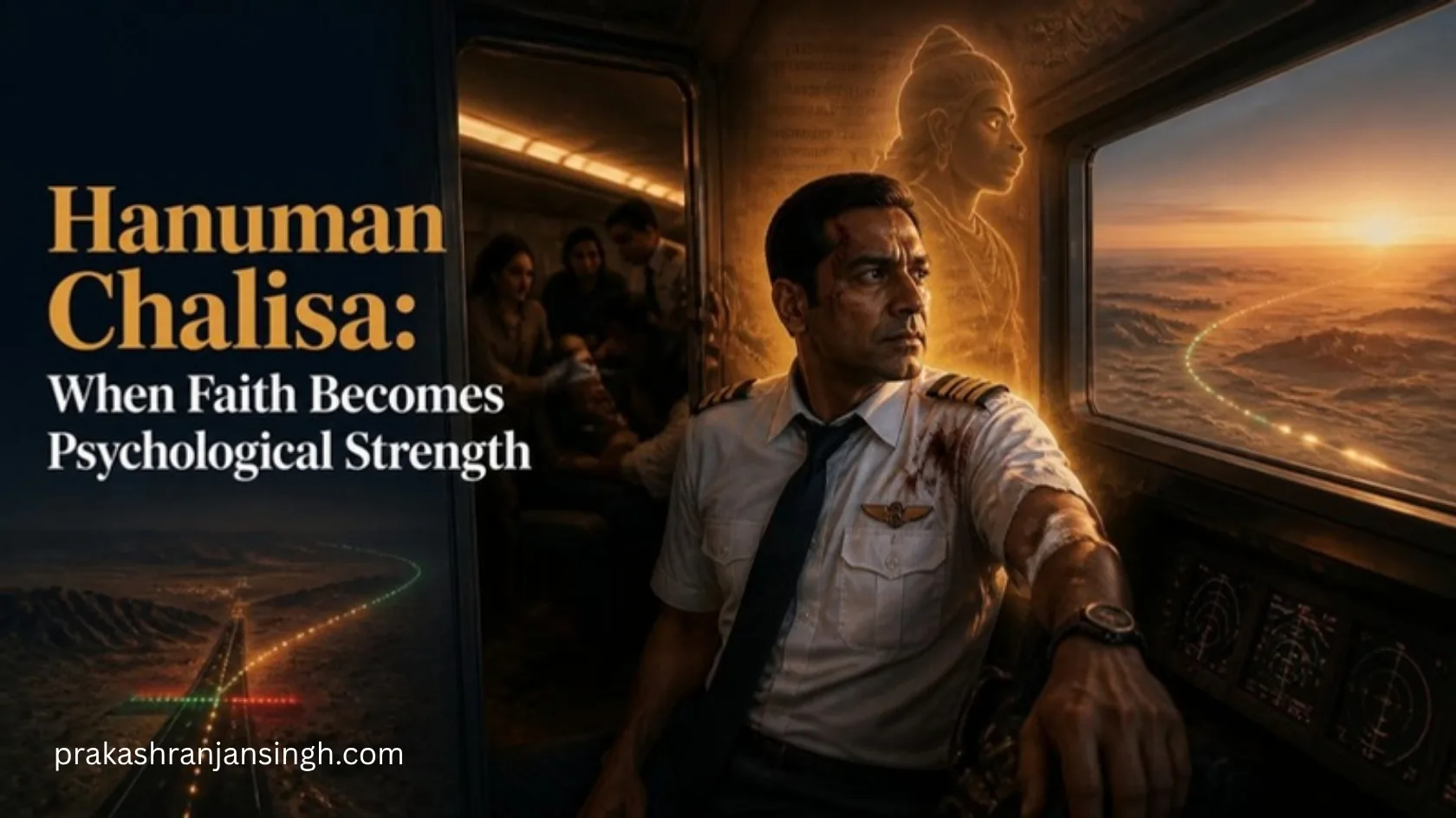
Table of Contents
- The Hanuman Chalisa Is Much More Than a Prayer
- Why Do People Remember Hanuman When They Are Frightened?
- The Psychology of Repetition: Why Chanting Can Calm the Mind
- Hanuman Is an Unusual Model of Heroism
- Captain Smit Machchhar: A Modern Example of Courage Under Pressure
- Faith Can Become a Psychological Anchor
- Sankat: Why the Hanuman Chalisa Is Especially Associated With Trouble
- The Extraordinary Popularity of the Hanuman Chalisa
- Admiration for Hanuman Is Not Merely About Physical Strength
- The Hidden Psychological Lesson: Courage Does Not Mean Absence of Fear
- But Faith Should Never Become Superstition
- The Real Power May Lie in What the Prayer Teaches
- From Tulsidas to a Modern Aircraft Cockpit
- Perhaps That Is the Greatest Psychological Power of the Hanuman Chalisa
- The Larger Lesson
- Frequently Asked Questions
How 40 verses of devotion have become a source of courage, concentration and hope for millions
On 30 September 2026, an extraordinary aviation emergency unfolded aboard Flydubai Flight FZ1073 travelling from Dubai to Tel Aviv. Indian Captain Smit Machchhar was seriously injured during an attack by his co-pilot. The aircraft rapidly lost altitude, but Machchhar managed to open the cockpit door, allowing passengers and crew to intervene. The aircraft was subsequently diverted and landed safely at Tabuk, Saudi Arabia. Reports say 174 people were aboard.
Two days later, while speaking with Prime Minister Narendra Modi from hospital, Machchhar revealed something deeply personal: during the ordeal he kept reciting the Hanuman Chalisa. He explained that whenever he experiences fear or pain, the prayer comes naturally to him.
That statement raises a fascinating question:
Can a prayer become so deeply embedded in the human mind that, during an extraordinary crisis, it becomes a psychological anchor for courage and action?
The answer deserves to be examined from both faith and psychology.
1. The Hanuman Chalisa Is Much More Than a Prayer
The Hanuman Chalisa is traditionally attributed to the 16th-century poet-saint Goswami Tulsidas and is written in Awadhi rather than Sanskrit. Its central body contains forty chaupais, which explains the word Chalisa—“forty.” It praises Hanuman’s strength, wisdom, discipline, courage and devotion to Lord Rama.
Its extraordinary popularity comes partly from its accessibility.
It does not require knowledge of classical Sanskrit.
A child can memorise it.
An elderly person can recite it.
A farmer can recite it.
A student can recite it before an examination.
A soldier can remember it during uncertainty.
A traveller can chant it before a journey.
And someone frightened or distressed can repeat it almost automatically.
That accessibility is one reason it became much more than a literary composition.
It became a psychological companion.
2. Why Do People Remember Hanuman When They Are Frightened?
There is a powerful psychological association at work.
Hanuman represents:
courage without arrogance,
strength controlled by discipline,
intelligence combined with action,
devotion combined with responsibility,
extraordinary physical ability,
humility despite enormous power.
Therefore, when a devotee repeatedly recites the Chalisa, the words are not merely sounds.
They repeatedly activate an internal mental image of Hanuman.
Over years, that image can become associated with:
“I am not helpless.”
“I must remain courageous.”
“I must perform my duty.”
“Fear should not stop action.”
This is particularly relevant to Captain Machchhar’s experience.
His own account establishes that the Chalisa was present in his mind during the emergency. It does not, however, prove scientifically that the prayer itself caused his successful actions. His aviation training, experience, situational awareness, physical effort, passengers’ intervention and the actions of other crew members were also important parts of the event.
3. The Psychology of Repetition: Why Chanting Can Calm the Mind
Modern research into mantra-based meditation provides an interesting parallel.
A systematic review and meta-analysis of mantra-based meditation found small-to-moderate improvements in measures of anxiety, depression and stress compared with control conditions. That research concerns mantra-based meditation generally, not the Hanuman Chalisa specifically, so it should not be interpreted as scientific proof of supernatural effects from the Chalisa.
Repeated chanting can potentially provide several psychological mechanisms:
Attention
Instead of allowing the mind to jump continuously between frightening thoughts, repetition gives attention something structured to follow.
Breathing and rhythm
Slow, rhythmic recitation can coordinate attention, breathing and vocalisation.
Emotional regulation
A familiar prayer may provide a predictable mental routine when circumstances are unpredictable.
Memory
A memorised prayer requires no book, phone or external assistance.
Meaning
The words connect the individual to a larger belief system.
And perhaps most importantly:
Familiarity
A prayer repeatedly practised during ordinary life may become particularly accessible during extraordinary circumstances.
That last point is crucial.
What we practise repeatedly in calm circumstances can become psychologically available during crisis.
4. Hanuman Is an Unusual Model of Heroism
Indian mythology does not portray Hanuman simply as a powerful warrior.
His greatness comes from the combination of power + wisdom + humility + service.
He possesses enormous strength but does not use it for personal glory.
He possesses extraordinary abilities but remains devoted to Rama.
He can cross the ocean, confront enemies and carry the Sanjeevani-bearing mountain—but his motivation is service.
This creates a very different definition of heroism:
Real strength is not the ability to dominate others; it is the ability to use one’s strength when others need you.
That principle makes the Hanuman Chalisa psychologically relevant even beyond religious belief.
5. Captain Smit Machchhar: A Modern Example of Courage Under Pressure
The recent Flydubai incident should therefore be viewed carefully.
According to Reuters, Machchhar was attacked by his co-pilot and seriously injured. The aircraft descended rapidly. Despite his injuries, he managed to open the cockpit door, allowing passengers and crew to intervene. Other pilots subsequently took control and the aircraft landed safely in Saudi Arabia.
Machchhar subsequently told Prime Minister Narendra Modi that whenever he gets a chance in a moment of danger, he recites only the Hanuman Chalisa, and that it gave him courage during the ordeal.
This provides an important distinction.
The Chalisa did not replace aviation training.
It may have functioned, in Machchhar’s own experience, alongside his training, professional responsibility and instinct for survival.
That is a much more meaningful way to understand the relationship between faith and performance.
6. Faith Can Become a Psychological Anchor
Imagine a person experiencing extreme fear.
The mind begins asking:
What will happen?
Will I survive?
What should I do?
Is everything finished?
Fear can consume cognitive attention.
A familiar prayer can interrupt that mental spiral.
Instead of continuously generating new fearful thoughts, the person repeats something deeply familiar.
The mind gets an anchor.
For a believer, that anchor may be:
“Jai Hanuman.”
For another person it may be:
“Waheguru.”
For another:
“Allah.”
For another:
“Om Namah Shivaya.”
For someone else it might be a secular breathing technique, a remembered instruction or a personal affirmation.
The psychological principle can therefore be broader than any one religion:
A deeply internalised practice can provide structure when the mind encounters chaos.
7. Sankat: Why the Hanuman Chalisa Is Especially Associated With Trouble
There is a reason the word Sankat appears so strongly in Hanuman devotion.
Hanuman is traditionally regarded as a remover of difficulties and a protector against fear and adversity. Devotees commonly turn toward Hanuman worship particularly during periods of uncertainty, fear or perceived danger.
This has produced a remarkable cultural habit.
When everything else appears uncertain, many people know at least one thing they can do:
They can start reciting.
That creates a sense of agency.
Instead of remaining psychologically paralysed, the person begins doing something familiar and meaningful.
8. The Extraordinary Popularity of the Hanuman Chalisa
It is difficult to establish a precise global number of Hanuman Chalisa reciters, so claims such as “the world’s most-chanted prayer” should be treated as cultural descriptions rather than scientifically measured rankings.
But its enormous popularity is beyond doubt.
It is recited in:
homes,
temples,
religious gatherings,
schools,
workplaces,
vehicles,
pilgrimage centres,
villages and cities,
India and the Indian diaspora.
Its popularity crosses generations because it is short enough to memorise and emotionally powerful enough to remember.
Children learn it from parents.
Parents learned it from their parents.
Grandparents pass it to grandchildren.
Thus a prayer becomes part of family memory.
9. Admiration for Hanuman Is Not Merely About Physical Strength
Perhaps one of the greatest misunderstandings is to reduce Hanuman to a symbol of muscular power.
The deeper message is much more sophisticated.
Strength without wisdom can become destructive.
Wisdom without courage can remain inactive.
Courage without discipline can become recklessness.
Devotion without service can become merely personal.
Hanuman combines all four.
That is why his character continues to appeal to soldiers, athletes, students, professionals, entrepreneurs and ordinary families.
The ideal is not simply:
“Become powerful.”
It is:
“Become powerful enough to serve, wise enough to control yourself, and courageous enough to act when duty demands it.”
10. The Hidden Psychological Lesson: Courage Does Not Mean Absence of Fear
This may be the most important lesson.
A courageous person is not necessarily someone who feels no fear.
Courage can mean:
feeling fear—and acting responsibly despite it.
Machchhar’s own account illustrates this distinction. He described fighting for his life while simultaneously recognising the danger to passengers.
That is very different from cinematic heroism.
Real emergencies are messy.
People bleed.
People panic.
People hesitate.
People become confused.
And yet sometimes a person performs one decisive action.
Opening that cockpit door became one such action in this incident.
11. But Faith Should Never Become Superstition
There is an important educational responsibility when discussing the Chalisa.
We should not tell people:
“If you chant Hanuman Chalisa, nothing bad can happen to you.”
That is not something science can establish.
Nor should people abandon:
medical treatment,
professional training,
safety procedures,
emergency preparedness,
financial planning,
legal protection,
aviation protocols,
simply because they have faith.
A healthier understanding is:
Faith can strengthen the person; preparation enables the person to act.
The two need not compete.
12. The Real Power May Lie in What the Prayer Teaches
The deepest value of Hanuman Chalisa may not be that it magically changes external circumstances.
Its deeper contribution may be that it repeatedly reminds the believer of a particular model of human behaviour:
Be strong.
Be disciplined.
Control the ego.
Remain devoted to duty.
Use intelligence.
Do not surrender to fear.
Serve others.
Remain humble after success.
Those principles have value even when considered outside a supernatural framework.
13. From Tulsidas to a Modern Aircraft Cockpit
There is something remarkable about the journey.
Centuries ago, a poet-saint composed forty verses in a vernacular language.
Generations memorised them.
Families transmitted them orally.
Millions made them part of daily life.
And centuries later, an Indian pilot facing a life-threatening emergency at approximately 30,000 feet reported turning instinctively to the same prayer.
That does not prove a supernatural mechanism.
But it demonstrates something extraordinarily important about human culture and memory.
A civilisation’s ideas can become so deeply internalised that they remain available when everything else disappears.
No library is required.
No smartphone is required.
No internet connection is required.
The words live inside the person.
14. Perhaps That Is the Greatest Psychological Power of the Hanuman Chalisa
The most important question may not be:
“Does Hanuman Chalisa perform miracles?”
A more useful question is:
“What kind of person does repeated remembrance of Hanuman encourage us to become?”
If the answer is:
less fearful, more disciplined, more compassionate, more courageous, more responsible and more willing to serve others,
then the prayer has already produced a profound human effect.
And for a believer, there is another dimension beyond psychology:
faith itself.
Science can investigate stress, attention, breathing and emotional regulation.
Science cannot settle the metaphysical question of divine grace.
That remains a matter of religious belief and personal experience.
15. The Larger Lesson
The story of Captain Smit Machchhar offers a remarkable meeting point between ancient faith and modern psychology.
A 16th-century devotional composition cannot be reduced merely to a psychological technique. For millions, it is a sacred relationship with Hanuman.
At the same time, faith can have psychological consequences that are understandable through modern concepts such as attention, emotional regulation, familiarity, meaning and resilience.
Perhaps the greatest lesson is therefore neither “faith alone saves” nor “science explains everything.”
It is something more balanced:
Train the body. Train the mind. Prepare for emergencies. Develop professional competence. And if faith gives you courage, carry that faith within you.
Captain Smit Machchhar’s experience reminds us that extraordinary situations can demand extraordinary composure. His own account says that the Hanuman Chalisa was with him in those moments; the documented outcome also depended on his aviation experience, decisive action, and the intervention of passengers, crew and other pilots.
Perhaps that is why Hanuman remains such a powerful symbol in Indian civilisation—not simply because he was strong, but because his strength was placed in the service of others.
The true lesson of Hanuman Chalisa may therefore be not merely to ask for courage, but to cultivate the kind of courage that becomes useful when somebody else’s life depends upon us.
Frequently Asked Questions
What exactly did Captain Smit Machchhar say about the Hanuman Chalisa?
Speaking with Prime Minister Narendra Modi after the Flydubai Flight FZ1073 cockpit attack on 30 September 2026, Captain Smit Machchhar said that whenever he faces fear or pain he recites the Hanuman Chalisa, and that he was reciting it during the emergency itself.
Why do people recite the Hanuman Chalisa during moments of fear?
Hanuman is traditionally regarded as a remover of difficulties and a protector against fear and adversity, so devotees often turn to his worship during uncertainty or danger. Psychologically, a memorised, familiar prayer can also give the mind a structured focus instead of spiralling fearful thoughts.
Who wrote the Hanuman Chalisa and in what language?
The Hanuman Chalisa is traditionally attributed to the 16th-century poet-saint Tulsidas. It is composed of two opening dohas, forty chaupais (hence “Chalisa”, meaning forty) and a closing doha, written in Awadhi rather than Sanskrit, which is part of why it spread so widely.
Does science support mantra chanting reducing anxiety?
A published systematic review and meta-analysis of mantra-based meditation found small-to-moderate improvements in anxiety, depression and stress compared with control conditions. That research is about mantra-based meditation generally, not the Hanuman Chalisa specifically, so it supports a psychological mechanism rather than proving anything supernatural.
Does reciting the Hanuman Chalisa replace the need for training or safety preparation?
No. Captain Machchhar’s own account makes clear that his aviation training, decisive action and the intervention of passengers and crew were central to the outcome alongside his faith. Faith can provide courage and composure; it is not a substitute for professional training, safety procedures or preparation.
Related Reading
- Rambola: When Human Attachment Became Divine Devotion — the life of Tulsidas, the author of the Hanuman Chalisa.
- Sunderkand: The Power of Faith, Sound and the Human Mind — another Hanuman-centred text and its psychological resonance.
- Prayer: The Most Underrated Technology of the Human Mind? — the broader psychology of prayer and ritual.
- The Neem Karoli Baba Phenomenon: Divine Grace, Himalayan Energy and the Psychology of Faith — faith, devotion and modern psychology.
- Ramayana: The Story That Lives Inside the Human Mind — how India’s epics continue to shape the modern mind.
- WION: Captain Smit Machchhar’s own account of the Flydubai cockpit attack.
Leave a Reply