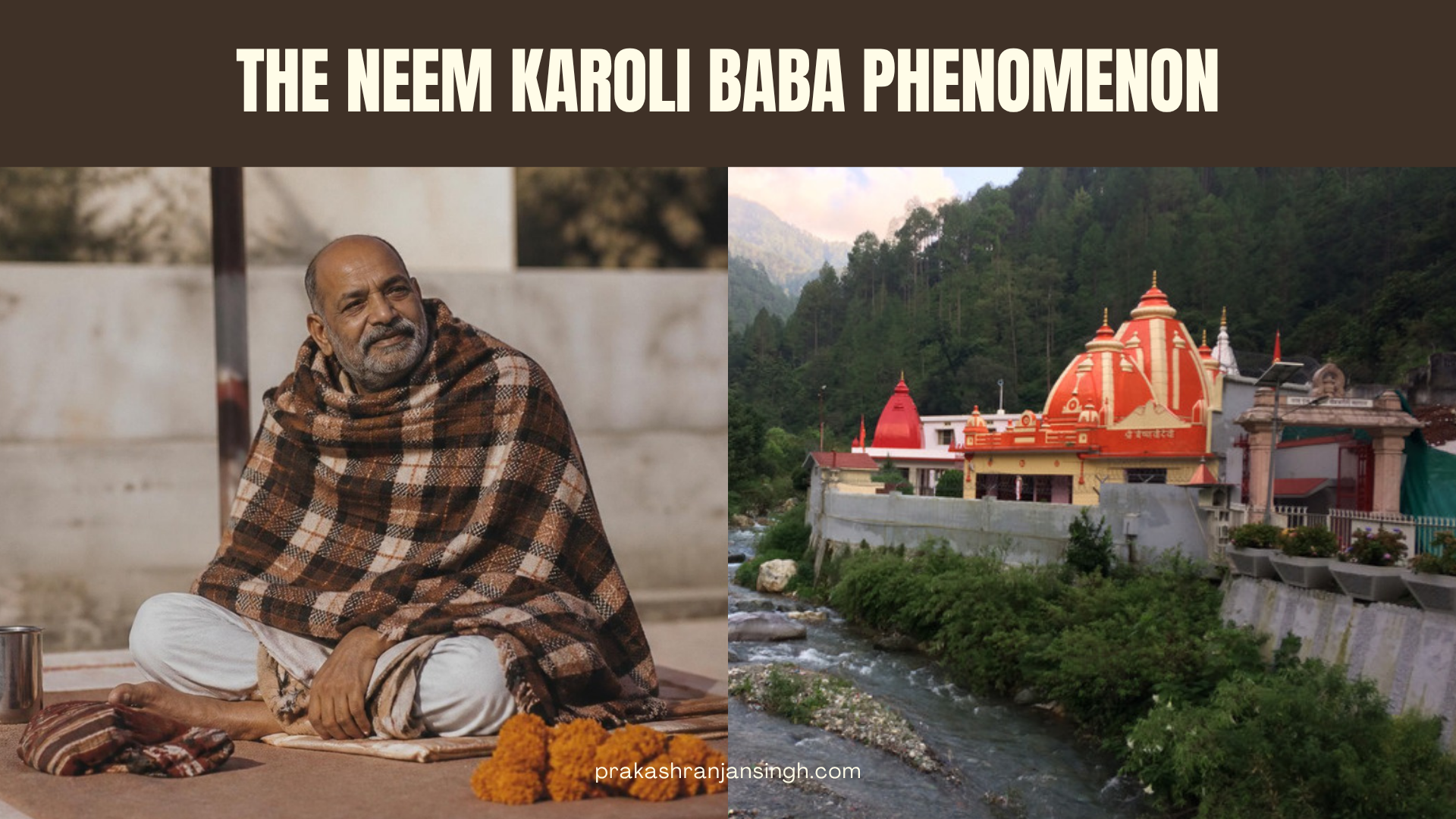
Why is a quiet saint from the Kumaon hills attracting entrepreneurs, celebrities, technology leaders and millions of ordinary seekers? Perhaps the answer lies at the intersection of faith, human psychology, place, personality and the timeless search for meaning.
There is something fascinating about the Neem Karoli Baba phenomenon. And much of it comes down to one thing: the psychology of faith — what belief actually does to the human mind and to human behaviour.
Key Takeaways
- The psychology of faith explains much of the Neem Karoli Baba phenomenon: belief changes behaviour, place changes consciousness, and collective devotion amplifies both.
- Celebrity visits (Steve Jobs, Zuckerberg, Julia Roberts) are not proof of divinity — they are evidence that success alone does not answer life’s deeper questions.
- The simplest test of any spiritual experience is behavioural, not supernatural: does it make the believer more compassionate, truthful and of service to others?
Table of Contents
A saint who lived a relatively simple life in the Himalayan region has, decades after his Mahasamadhi, become one of the most discussed spiritual figures among a new generation. His name is now associated not only with devotees and spiritual seekers but also with personalities from technology, business, entertainment and sport.
The renewed public interest has intensified dramatically with the success of Hanuman Ansh, a devotional film inspired by his life and spiritual legacy. The film has brought a largely traditional spiritual narrative into contemporary popular culture.
But beneath the celebrity stories and cinematic success lies a much deeper question:
What is it about Neem Karoli Baba, Kainchi Dham and the surrounding Himalayan environment that creates such a powerful psychological and spiritual attraction?
The answer depends partly on what one believes.
For a devotee, it may be divine grace.
For a psychologist, it may involve faith, suggestion, emotional regulation, meaning-making and transformation.
For a seeker, it may simply be an experience that words cannot adequately explain.
And perhaps all three perspectives can coexist.
1. The Saint Who Became Bigger After His Physical Departure
Neem Karoli Baba, affectionately known as Maharaj-ji, died in 1973. Yet his influence appears to have expanded rather than diminished.
His legacy spread internationally through people such as Ram Dass, born Richard Alpert, a Harvard psychology professor who travelled to India in 1967 and became one of Baba’s most influential Western disciples. Ram Dass subsequently wrote Be Here Now, a landmark work that introduced millions of Western readers to meditation, yoga and Eastern spirituality.
This is an extraordinary example of how a spiritual tradition can travel.
It did not travel primarily through advertising.
It travelled through transformed human beings.
A professor became a spiritual teacher.
A seeker became an author.
An experience became a philosophy.
A Himalayan ashram became internationally recognised.
That is how spiritual movements often grow: one transformed person influences another.
2. The Silicon Valley Connection Makes the Story Extraordinary
The Neem Karoli Baba story became particularly fascinating when it became associated with Silicon Valley.
Steve Jobs travelled to India during his search for spiritual understanding and wanted to meet Neem Karoli Baba, but Baba had already passed away. The encounter that never happened nevertheless became part of Jobs’ spiritual journey.
Years later, Mark Zuckerberg visited Kainchi Dham during a difficult period for Facebook, reportedly following Steve Jobs’ advice.
Julia Roberts has also publicly described how seeing a photograph of Neem Karoli Baba profoundly influenced her spiritual curiosity and eventually contributed to her interest in Hinduism.
Indian personalities, including Virat Kohli and Anushka Sharma, have also been associated with visits to the ashram.
The important point, however, is not to turn these personalities into evidence of supernatural power.
Celebrity association is not proof of divinity.
But it is evidence of something else:
Even extraordinarily successful people continue to search for something beyond professional achievement.
3. The Strange Psychology of Successful People
Modern society often assumes that successful people have solved life’s problems.
They have not.
Money can solve financial problems.
Technology can solve technological problems.
Fame can solve problems of recognition.
But none of these necessarily solves:
Who am I?
Why am I here?
What is enough?
Why am I still restless despite success?
What happens when achievement stops giving satisfaction?
This is where spirituality becomes psychologically powerful.
A person can conquer the external world and still feel powerless internally.
The corporate executive may control hundreds of employees but struggle to control his own anxiety.
The entrepreneur may create enormous wealth but remain uncertain about the meaning of life.
The celebrity may receive millions of admirers but experience profound loneliness.
The technology leader may build systems connecting billions of people while personally searching for deeper connection.
This paradox — success without peace — is exactly what the psychology of faith tries to explain, and it accounts for much of the attraction of spiritual traditions.
4. Is There Really a “Divine Power” Around Baba?
This is perhaps the most fascinating and sensitive question.
Devotees describe Neem Karoli Baba as possessing extraordinary spiritual powers. Numerous stories circulate about his ability to know things beyond ordinary perception, heal people, appear mysteriously, protect devotees and perform other miraculous acts.
Ram Dass’ own accounts contain extraordinary experiences that he interpreted through the language of grace and mystical transformation.
From the perspective of faith, devotees may see such experiences as evidence of divine shakti.
From the perspective of science, however, extraordinary supernatural claims cannot simply be treated as established facts without independently verifiable evidence.
That distinction is important.
We can respect a person’s spiritual experience without pretending that every miraculous story has been scientifically established.
And perhaps the more interesting question is:
What happens to the human mind when it genuinely experiences something it cannot explain?
That is where psychology becomes fascinating.
5. Faith Can Change the Architecture of Behaviour
This is the psychology of faith in its most practical form: faith is not merely an intellectual belief.
A deeply held belief can change behaviour.
If someone believes:
“I am protected.”
fear may decrease.
If someone believes:
“My life has a purpose.”
motivation may increase.
If someone believes:
“I must serve others.”
self-centred behaviour may decline.
If someone believes:
“Everything cannot be controlled by me.”
anxiety may reduce.
This is one reason spiritual traditions can have enormous psychological power even when the supernatural dimension remains a matter of personal belief.
The mind does not respond only to facts.
It responds to meaning.
6. Why Kainchi Dham Feels Different
Kainchi Dham is situated in the Kumaon hills of Uttarakhand. The state tourism board describes it as a peaceful spiritual retreat in the Himalayan landscape, noting its tranquil surroundings and the large annual gathering associated with the ashram.
And here another fascinating psychological factor enters the story:
Place changes consciousness.
Consider the environment.
Mountains.
Trees.
Fresh air.
Reduced noise.
Natural surroundings.
Temples.
Chanting.
Ritual.
Silence.
Distance from urban life.
For a person accustomed to traffic, phones, meetings, notifications and financial pressure, such an environment itself can produce a dramatic psychological shift.
The nervous system gets fewer stimuli.
The mind becomes less occupied with immediate demands.
Attention turns inward.
The person becomes more receptive to reflection.
A devotee may call this Baba’s energy.
A psychologist might describe part of it as environment-induced psychological regulation.
Both descriptions are attempting to describe the same human experience from different frameworks.
7. The Power of Collective Faith
There is another phenomenon at work.
Imagine entering a place where thousands of people have arrived with the same belief:
“This is a sacred place.”
Their behaviour reinforces the meaning of the place.
Prayer reinforces prayer.
Devotion reinforces devotion.
Stories reinforce stories.
Personal experiences become shared experiences.
This creates what sociology calls collective meaning.
The individual is no longer experiencing faith alone.
He becomes part of a community of believers.
That can produce an enormous emotional effect.
Human beings are social creatures.
We derive meaning not only from what we personally experience but also from what our community considers meaningful.
8. The Psychology of the “Sacred Place”
Every civilisation has sacred geography.
For Hindus, it may be Varanasi, Kedarnath, Ayodhya, Vrindavan or Kainchi Dham.
For Christians, Jerusalem or the Vatican.
For Muslims, Mecca and Medina.
For Buddhists, Bodh Gaya.
The physical location becomes a psychological anchor.
People arrive carrying emotional burdens.
They pray.
They cry.
They make promises.
They seek forgiveness.
They express gratitude.
They ask for guidance.
The place therefore becomes associated with powerful emotional states.
Over generations, those associations become part of the collective memory.
This can make the experience exceptionally intense.
9. The Power of Expectation
Psychology also teaches us something uncomfortable, right at the core of the psychology of faith:
Expectation changes perception.
If someone enters an ashram believing that he will experience something extraordinary, his attention becomes highly sensitive to unusual sensations, coincidences and emotional experiences.
A coincidence may feel like a divine message.
A sudden emotional release may feel like spiritual intervention.
A peaceful environment may feel like an extraordinary energy field.
This does not necessarily mean that the experience is false.
It means that human perception is not a camera.
The brain continuously interprets experience.
For a believer, interpretation may become:
“Baba called me.”
For another person:
“My subconscious mind finally became quiet.”
The experience can be real even though interpretations differ.
10. Why Stories of Miracles Spread So Rapidly
Human beings love extraordinary stories.
A normal event rarely becomes folklore.
A mysterious event does.
The psychology is simple:
Unusual + emotionally powerful + repeated by others = memorable belief.
Over time, stories become part of the identity of a spiritual tradition.
This is why Neem Karoli Baba’s miracle stories continue to attract attention.
But there is an important distinction between:
“Devotees believe this happened.”
and
“This has been scientifically proven to have happened.”
A responsible spiritual discussion should preserve that distinction.
It protects both faith and intellectual honesty.
11. The Most Powerful Teaching May Not Be Any Miracle
Interestingly, the teachings associated with Neem Karoli Baba are remarkably simple.
The Ram Dass/Love Serve Remember tradition summarises the essence through:
Love Everyone. Serve Everyone. Remember God. Tell the Truth.
There is profound psychology hidden inside these apparently simple instructions.
Love Everyone → reduces hatred and social isolation.
Serve Everyone → shifts attention away from excessive self-centredness.
Remember God → creates a larger frame of meaning.
Tell the Truth → reduces the psychological burden of deception.
None of these requires a miracle.
They require practice.
And perhaps that is where the real transformation occurs.
12. Service Is the Bridge Between Spirituality and Psychology
Among all these teachings, seva may be the most psychologically important.
When a person helps another human being, attention moves away from the self.
Modern life can become intensely self-referential:
My career. My salary. My house. My status. My followers. My success. My problems.
Service changes the sentence:
“How can I help?”
That psychological shift can be powerful.
Ram Dass’ later work strongly emphasised service and compassionate action, including initiatives connected with the Hanuman Foundation.
Thus spirituality does not necessarily mean withdrawing from society.
It can mean returning to society with a different psychological orientation.
13. Why Entrepreneurs May Be Particularly Attracted
Entrepreneurs operate in uncertainty.
Every major decision contains risk.
Markets change. Employees leave. Competitors emerge. Technology becomes obsolete. Regulations change. Investments fail.
The human mind naturally seeks something stable in an unstable environment.
Spirituality provides an internal anchor — the psychology of faith at work in the boardroom, not just the ashram.
This may explain why entrepreneurs and technology leaders sometimes become interested in meditation, mindfulness, yoga and spiritual traditions.
They are not necessarily abandoning ambition.
They may be searching for mental stability capable of supporting ambition.
14. The Most Interesting Lesson for Corporate India
There is a fascinating management lesson hidden inside the Baba phenomenon.
Modern organisations spend enormous amounts on: leadership training, employee engagement, mindfulness, wellness, emotional intelligence, purpose-driven management, resilience and stress reduction.
But many ancient spiritual teachings were already dealing with these questions.
Control the ego. Serve others. Remain truthful. Accept uncertainty. Develop compassion. Do your duty.
These principles can be interpreted spiritually—or translated into contemporary leadership language.
Either way, they remain relevant.
15. But We Should Avoid Creating a “Celebrity Spirituality”
There is also a danger in the growing popularity.
If people begin visiting Kainchi Dham merely because Steve Jobs, Zuckerberg or celebrities visited, spirituality can become another status symbol.
“I went where billionaires went.”
That completely misses the point.
The value of a pilgrimage is not determined by the number of famous people who visited before us.
It is determined by what happens inside us after we leave.
If we return with greater compassion, patience, humility and responsibility, the journey has meaning.
If we return only with photographs for social media, perhaps we have missed the deeper experience.
16. Divine Energy or the Psychology of Faith?
Perhaps the most mature way to approach the phenomenon is not to force a choice between the two.
A believer may say:
“It is divine energy.”
A psychologist may say:
“It is the interaction of expectation, environment, emotion, belief and consciousness — the psychology of faith at work.”
A scientist may say:
“Extraordinary supernatural claims require extraordinary evidence.”
A seeker may simply say:
“I experienced something that changed me.”
These statements need not always be enemies.
The spiritual experience belongs to the individual.
The scientific explanation requires evidence.
And the ethical test is visible in behaviour.
17. The Ultimate Test of Baba’s Legacy
Perhaps there is one question that can bring the entire phenomenon into perspective:
Does devotion make us better human beings?
If visiting an ashram makes someone more compassionate—something has happened.
If faith makes someone more truthful—something has happened.
If prayer makes someone less fearful—something has happened.
If spirituality makes an entrepreneur more ethical—something has happened.
If belief motivates someone to serve the poor—something has happened.
If remembrance of Baba makes someone love his family more deeply—something has happened.
Whether one describes that transformation as divine grace, spiritual energy, psychological change or a combination of all three is ultimately a matter of interpretation.
The Real Power of Neem Karoli Baba
Perhaps the greatest mystery surrounding Neem Karoli Baba is not whether every miracle story can be scientifically demonstrated.
The greater mystery is this:
How can the presence of a man who left his physical body more than five decades ago continue to influence people living in an age of artificial intelligence, billion-dollar technology companies and hyper-connected digital lives?
Maybe because technology changes the way we live but does not fundamentally change the questions we ask.
We still seek love. We still fear death. We still experience loneliness. We still want purpose. We still struggle with ego. We still need hope. We still search for something larger than ourselves.
And that is perhaps where the enduring attraction of Neem Karoli Baba lies.
The Himalayas may provide the silence. The ashram may provide the atmosphere. The stories may provide the mystery. The devotees may provide the collective faith. The psychology of faith may explain part of the experience.
But for millions of believers, there remains one final dimension that cannot be reduced to any psychological formula:
Grace.
And perhaps that is why, decades after Maharaj-ji’s departure, people continue to travel towards the little ashram in the Kumaon hills—not merely looking for a saint, but looking for a different version of themselves. Understanding the psychology of faith does not diminish that journey — it only makes it more human.
Frequently Asked Questions
What is the psychology of faith behind the Neem Karoli Baba phenomenon?
The psychology of faith looks at what belief actually does to behaviour and perception — it can reduce fear, increase motivation, and create a sense of protection and purpose, regardless of whether the supernatural claims themselves can be proven.
Did Steve Jobs and Mark Zuckerberg really visit Neem Karoli Baba?
Steve Jobs travelled to India hoping to meet Neem Karoli Baba but arrived after his death in 1973. Mark Zuckerberg has spoken publicly about visiting an Indian temple widely associated with Kainchi Dham during a difficult period at Facebook.
Why does a place like Kainchi Dham feel spiritually powerful?
Part of it is environmental: mountains, silence, reduced stimulation and collective devotion all shift the nervous system and attention inward. Devotees describe this as Baba’s energy; psychology describes part of it as environment-induced regulation — both are describing the same human experience.
Is celebrity interest evidence that Neem Karoli Baba had real spiritual powers?
No. Celebrity association is not proof of divinity — it is evidence that even highly successful people continue to search for meaning beyond professional achievement, which is itself a psychologically interesting fact.


Leave a Reply