

Banks are shifting from being cautious lenders focused on productive credit to aggressive sellers chasing loan-disbursement targets—raising the real question of whether banks are playing with public money.
Many depositors quietly ask, “Is my money safe in Indian banks?” It is a fair question, and the answer depends on both the safeguards in place and the way banks behave. The banking system survives on public trust. But aggressive lending, easy digital credit and ever-increasing pressure for growth are forcing us to ask an uncomfortable question: Is the banking system still focused primarily on productive credit, or has lending itself become a race for numbers?
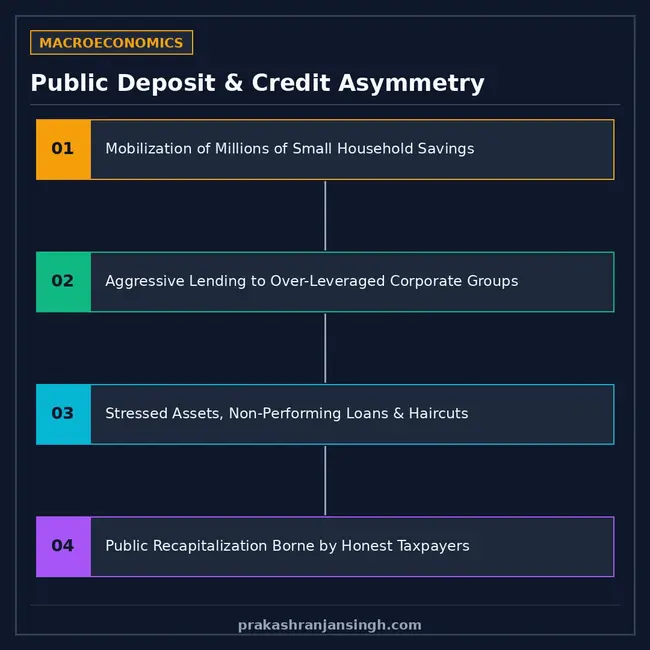
A bank is fundamentally a financial intermediary. People deposit their hard-earned money with the expectation that it will remain safe and available when required. The bank, in turn, uses a substantial portion of these funds to provide loans to individuals, businesses and institutions that need capital.
This simple mechanism is one of the foundations of a modern economy. Depositors provide the fuel, banks provide the mechanism, and productive borrowers are expected to create economic value.
But the character of banking is changing rapidly, and it raises the uncomfortable question of whether banks are playing with public money.
Key Takeaways
- Banks are shifting from cautious lenders focused on productive credit to aggressive sellers chasing loan-disbursement targets—raising the real question of whether banks are playing with public money.
- Banks use deposits for lending while maintaining liquidity, which works only because depositors don’t all demand their money simultaneously—public confidence is itself an invisible asset of the banking system.
- Repeated loan restructuring without addressing the underlying repayment problem can postpone recognition of stress rather than solve it—banking needs growth discipline, credit discipline and customer discipline together.
Table of Contents
- The race to become a star performer
- When the borrower becomes a revenue opportunity
- Digital lending: convenience or a new debt culture?
- Credit cards: plastic money can create real debt
- Is rescheduling solving the NPA problem?
- What happens if everyone withdraws their money from banks at once?
- Is My Money Safe in Indian Banks? 3 Safeguards Every Depositor Should Know
- Are we converting savings into productive capital?
- Banking needs three kinds of discipline
- The real test of a bank
- Playing With Public Money: The Uncomfortable Truth
The race to become a “star performer”
Today, banks operate under enormous pressure to grow deposits, loans, credit-card portfolios, digital lending numbers, fee income and profitability.
The problem begins when growth becomes more important than the quality of growth.
A bank employee or business unit may be under pressure to achieve ambitious loan-disbursement targets. A customer who genuinely needs ₹5 lakh may suddenly be offered ₹10 lakh. A person who already has several liabilities may receive another credit facility because the system considers him eligible.
The question is not whether banks should lend.
The question is:
Are banks lending because the money will be productively used—or simply because the loan will increase this quarter’s numbers?
When the borrower becomes a revenue opportunity
There is another uncomfortable trend.
A customer approaching a bank for a loan may also be offered insurance, mutual funds, investment products, credit cards and other financial products. Cross-selling is a legitimate part of modern banking, but aggressive selling to financially vulnerable customers raises questions about suitability and financial awareness.
Someone who comes to borrow money because of a temporary financial difficulty should not automatically be treated as an unlimited source of fee income.
Banking should create financial empowerment, not financial dependence.
Digital lending: convenience or a new debt culture?
Digital banking has transformed the financial sector.
Loans can now be sanctioned within minutes. Credit cards can be obtained almost instantly. Buy-now-pay-later facilities and app-based lending have made borrowing extraordinarily easy.
This is undoubtedly convenient.
But convenience has a hidden danger: when borrowing becomes easier than earning, consumption can outrun repayment capacity.
Earlier, obtaining a substantial loan often required documentation, personal interaction and considerable deliberation. Today, a customer may borrow money while sitting at home with a smartphone.
The technology is not the problem.
The real question is whether credit assessment has evolved as rapidly as credit delivery.
Credit cards: plastic money can create real debt
Credit cards are useful financial instruments when used responsibly.
But aggressive expansion can create a dangerous psychological illusion: the customer spends today and worries about payment tomorrow.
One card becomes two. Two become three. Minimum payments replace full payments. Interest accumulates. Eventually, the customer’s income is being used to service yesterday’s consumption rather than finance tomorrow’s needs.
At that point, credit has stopped being an instrument of financial progress and started becoming a financial trap.
Is rescheduling solving the NPA problem—or postponing it?
One of the most important questions concerns stressed loans.
When a borrower cannot repay, restructuring or rescheduling may sometimes be a legitimate solution. Genuine businesses can face temporary difficulties because of economic cycles, natural disasters, market disruptions or unforeseen events.
But repeated restructuring without addressing the underlying repayment problem can create a dangerous illusion.
A loan does not become healthy merely because its repayment schedule has been changed.
If the borrower’s cash flow has not recovered, postponing instalments may simply postpone recognition of the problem.
Therefore, the banking industry must continuously distinguish between temporary stress and structural insolvency. The RBI’s Financial Stability Report is exactly the kind of system-wide check meant to catch this before it becomes systemic.
What happens if everyone withdraws their money from banks at once?
There is a fundamental characteristic of banking that ordinary depositors rarely think about.
Banks do not keep every rupee deposited by customers sitting idle in cash.
They use deposits as part of their lending and investment operations, while maintaining liquidity and complying with regulatory requirements. This transformation of short-term and demand liabilities into longer-term assets is at the heart of banking.
This works because normally, all depositors do not demand their money simultaneously.
But imagine a hypothetical situation where a very large proportion of depositors suddenly demand their funds.
Could any banking system immediately return every depositor’s money in cash?
The answer is not as simple as looking at the bank’s total deposits. Banking is built on liquidity management, asset quality, regulatory safeguards and the assumption that withdrawals will occur in a relatively predictable pattern.
That is why public confidence is itself an invisible asset of the banking system.
A loss of confidence can create a liquidity crisis even in an institution whose underlying assets may not be worthless.
Is My Money Safe in Indian Banks? 3 Safeguards Every Depositor Should Know
None of this means ordinary depositors should panic. Indian bank deposits come with real safeguards, and it helps to know what they are. This is general information, not financial advice.
- Deposit insurance. According to the Deposit Insurance and Credit Guarantee Corporation (DICGC), each depositor is insured up to ₹5 lakh per bank, covering principal and interest together. Deposits in different branches of the same bank are added up, while deposits in different banks are insured separately (DICGC guide to deposit insurance). There have been reports that the limit may be reviewed, so check the DICGC website for the current figure.
- Regulation and supervision. The RBI supervises banks and requires them to hold part of their deposits as cash reserves and liquid government securities. These rules exist precisely because banks do not keep every rupee idle.
- Your own habits. Check that your bank is covered by DICGC (primary cooperative societies are not), and avoid keeping far more than the insured amount in a single bank. Also remember that mutual funds, shares and NBFC deposits are not covered by this insurance.
The safeguards are real, but they are the reason to keep asking hard questions about lending discipline, not a reason to stop asking.
Are we converting savings into productive capital?
This should perhaps be the central question.
Depositors save money because they have postponed consumption.
The banking system receives those savings and should ideally channel them toward productive activities—factories, businesses, infrastructure, housing, education, agriculture, entrepreneurship and other activities capable of generating economic value.
But if an increasing portion of credit simply finances consumption, speculative activity or repeated refinancing of existing debt, we must ask whether the banking system is creating new economic capacity or merely moving future income into the present.
Consumption has its own role in an economy. But excessive debt-funded consumption cannot become a substitute for sustainable income growth.

Banking needs three kinds of discipline
The future of banking requires a balance between three objectives:
1. Growth discipline
Banks must grow, but not at any cost.
2. Credit discipline
A loan should be assessed on the borrower’s genuine repayment capacity, not merely on the ability to complete a target.
3. Customer discipline
Customers must also understand that easy credit is not free money.
The responsibility therefore lies on both sides.
Banks must lend responsibly.
Customers must borrow responsibly.
Regulators must ensure that competition does not encourage irresponsible lending.
And shareholders must understand that a rapidly growing loan book is not necessarily a healthy loan book.
The real test of a bank
The real performance of a bank should not be measured only by how many loans it disbursed, how many credit cards it issued or how rapidly its portfolio grew.
A truly strong bank should be judged by:
The quality of its loan book
Sustainable repayment by borrowers
Low levels of avoidable stressed assets
Responsible customer acquisition
Proper assessment of repayment capacity
Efficient use of deposits
Adequate liquidity
Transparency in selling financial products
Long-term customer relationships
And, above all, the trust of its depositors
Banking is ultimately a business built on trust.
A depositor gives the bank money today in the belief that the bank will honour its obligation tomorrow.
That trust must never become an excuse for reckless expansion.
Playing With Public Money: The Uncomfortable Truth
We often ask whether banks are making enough profit.
Perhaps we should also ask:
Are banks making enough productive credit?
We should ask whether every additional loan is creating economic value, whether every digital loan is genuinely affordable, whether every restructuring reflects genuine temporary stress, and whether aggressive credit expansion is strengthening household finances or quietly increasing household indebtedness.
Playing with public money at this scale is what makes the stakes so high: the banking system is one of the most powerful engines of economic development.
But an engine becomes dangerous when speed becomes more important than control.
The objective of banking should not be maximum lending. It should be maximum responsible lending.
Because ultimately, banks are not merely dealing with numbers on a balance sheet.
Behind every deposit is someone’s lifetime savings. Behind every loan is someone’s future income. And behind the entire banking system is public trust.
That trust is too valuable to be sacrificed for the sake of becoming the next “star performer.”
Frequently Asked Questions
Are banks really playing with public money?
Banks use deposits – public money – as part of their lending operations while maintaining liquidity and regulatory requirements. The concern is not that banks lend, but whether growth pressure is pushing them to chase loan-disbursement targets rather than assess genuine repayment capacity.
What happens if a large number of depositors demand their money at once?
Banking is built on the assumption that withdrawals occur in a relatively predictable pattern, not all at once. A loss of public confidence can create a liquidity crisis even in an institution whose underlying assets may not be worthless, which is why depositor trust is itself an invisible asset.
Does loan restructuring actually solve bad debt problems?
Not always. Repeated restructuring without addressing the underlying repayment problem can create a dangerous illusion – a loan does not become healthy merely because its schedule has changed. If the borrower’s cash flow hasn’t recovered, postponing instalments may simply postpone recognition of the problem.
Is my money safe in Indian banks?
Deposits in banks insured by the DICGC are covered up to Rs 5 lakh per depositor per bank, including principal and interest, and the RBI supervises banks and sets liquidity and reserve requirements. Anything above the insured amount is not covered, so spreading large savings across banks is a common precaution. This is general information, not advice.
How much of my bank deposit is insured in India?
According to the DICGC, up to Rs 5 lakh per depositor per bank, with principal and interest counted together and all branches of one bank added up. Deposits in different banks are insured separately. Primary cooperative societies, mutual funds, shares and NBFC deposits are not covered, and the limit may be reviewed, so check the DICGC website.


Leave a Reply