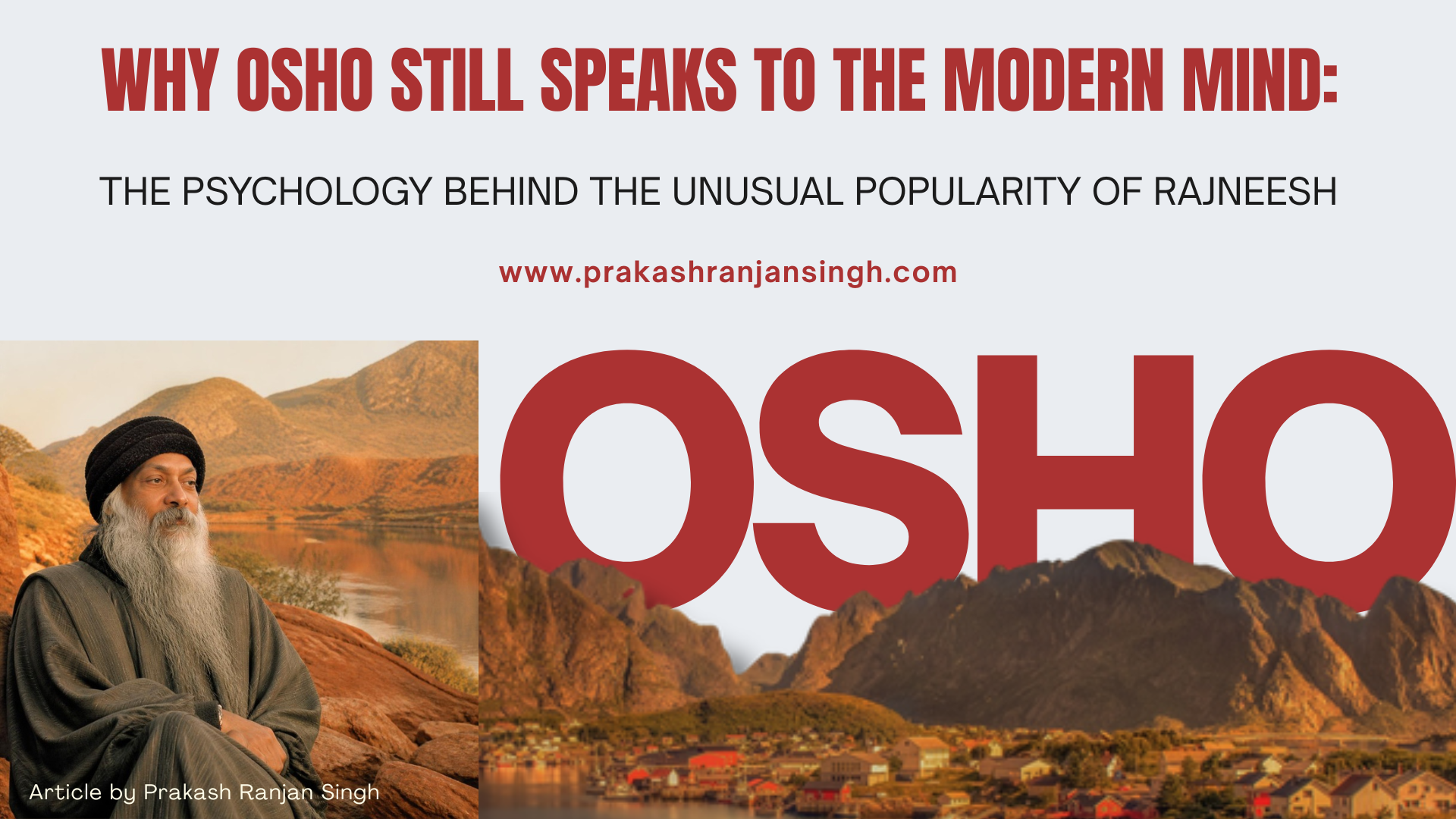
Few spiritual thinkers of the modern era have remained as controversial, fascinating and commercially influential as Osho, formerly Bhagwan Shree Rajneesh. He died in 1990, yet his books, recorded discourses, meditation techniques and ideas continue to circulate widely—particularly among younger people, entrepreneurs, professionals and those searching for an alternative understanding of spirituality. Recent reporting notes that his discourses and dynamic meditations continue to attract interest and have found renewed visibility through digital and social-media platforms.1
But what explains this unusual longevity? The answer lies less in what Osho said and more in the Osho psychology behind it — how he spoke directly to the psychological needs of the modern human being.
His appeal can be understood as a combination of philosophy, psychology, communication, rebellion against convention, spirituality, personal freedom and—importantly—his ability to make complicated philosophical questions feel personally relevant.
Key Takeaways
- Osho psychology explains why his ideas still spread decades after his death: permission, rebellion, individual identity and experiential spirituality all map onto real psychological needs.
- His central pitch was not belief but self-observation — a message that fits a generation that increasingly asks “why should I believe this?” instead of blindly following authority.
- His legacy is genuinely contested: the same movement that pioneered active meditation was also engulfed by the Oregon commune’s criminal controversies — both deserve honest examination, not hero-worship or dismissal.
Table of Contents
1. Osho did not begin by telling people what to believe
Traditional religious teaching often begins with belief:
“Believe this.” “Follow this.” “Do this.” “Do not do that.”
Osho frequently approached spirituality from a different direction. His central emphasis was often on awareness, observation and personal experience rather than blind acceptance.
The attraction is obvious. The modern educated individual increasingly asks: “Why should I believe this?” rather than “Who told me to believe this?” Osho’s language therefore fitted naturally into the psychology of an increasingly questioning society.
Academic scholarship describes his approach as iconoclastic and notes his rejection of established religious institutions and his ability to adapt his message to different audiences.2
That made him attractive to people who felt uncomfortable with rigid religious structures but were still searching for something spiritual.
2. He converted spirituality from a duty into an experience
One of Osho’s most powerful psychological contributions was his attempt to make spirituality experiential. Instead of presenting spirituality only as rituals, renunciation, morality, punishment, heaven and hell, he frequently spoke about consciousness, meditation, joy, love, sexuality, creativity, silence, awareness, celebration and freedom.
This created a very different emotional proposition: spirituality does not necessarily mean escaping life. It can mean becoming more conscious while living it.
His later “Zorba the Buddha” formulation particularly represented this attempt to combine worldly enjoyment with spiritual awareness. Scholars have described the Osho movement as an unusual meeting point between Eastern spirituality and modern consumer culture.3
That idea remains remarkably compatible with modern aspirations. People want success without guilt, wealth without shame, relationships without unnecessary repression and spirituality without abandoning ordinary life.
3. His greatest psychological weapon was permission
Modern human beings carry enormous amounts of psychological conditioning. Family says: “Be like this.” Society says: “People will judge you.” Religion says: “This is right; that is wrong.” Work says: “Perform.” Social media says: “Look successful.”
Osho frequently challenged this psychological conditioning. His message, broadly interpreted, was: Look at yourself. Understand yourself. Do not live merely according to borrowed ideas.
That creates a powerful psychological experience—permission to be oneself. For a young person struggling between family expectations, career pressure, social comparison and personal desires, such a message can feel liberating. This is Osho psychology at its most direct: permission itself as therapy.
4. He understood the psychology of rebellion
Every generation eventually questions the previous generation. Young people naturally ask: “Why must I live exactly the way my parents lived?”
Osho’s deliberate challenge to established institutions, conventional morality and religious authority therefore created an immediate psychological connection with rebellious minds. His style was not merely philosophical—it was provocative. He questioned revered figures, attacked established assumptions and deliberately created intellectual discomfort.
This was one reason he became extraordinarily controversial. But controversy itself can increase attention. Psychologically, humans are attracted to forbidden subjects, unconventional personalities, controversial opinions, intellectual rebellion and ideas that challenge established authority. Osho understood this communication dynamic exceptionally well.
5. He talked about subjects people normally avoided
Osho did something unusual for a spiritual teacher: he openly discussed subjects such as sex, desire, death, jealousy, fear, ego and repression.
His treatment of sexuality and Tantra became one of the major reasons for his international fame and controversy. Scholar Hugh Urban describes his teaching as a hybrid involving Hindu Tantra and post-Freudian psychological ideas.3
This matters psychologically. People often become intensely interested in precisely those subjects they are not allowed to discuss openly. When a teacher says: “Let’s examine the subject instead of pretending it doesn’t exist,” the listener experiences intellectual relief. That does not automatically make every conclusion correct. But it makes the conversation compelling.
6. Osho made meditation active
Another reason for his continuing popularity is his attempt to move meditation beyond the stereotype of simply sitting silently with closed eyes. His active meditation methods incorporated movement, breathing, emotional expression and periods of silence.
Academic research on the Osho meditation resort has specifically examined cathartic therapies and active meditation as practices of self-formation.4
This is psychologically significant. Modern people often live with accumulated stress, information overload, suppressed emotions, sedentary lifestyles and continuous digital stimulation. For such people, a purely passive meditation practice may initially feel difficult. Osho’s active approaches offered another entry point: move first. Release. Observe. Become silent. Whether every technique works equally well for every individual is another question, but the underlying communication strategy was highly accessible.
7. He spoke the language of the individual
Traditional societies often emphasised: family → community → religion → duty. Modern societies increasingly emphasise: individual → identity → choice → self-development.
Osho’s philosophy strongly emphasised individual consciousness. This is one reason his ideas can feel particularly attractive to younger generations. The young person asks: “Who am I?” Osho repeatedly brought the discussion back to consciousness and self-observation. That makes his philosophy—and Osho psychology more broadly—compatible with the modern search for identity.
8. Why corporate professionals became interested
At first glance, spirituality and corporate life appear contradictory. But psychologically they address different sides of the same individual. The corporate professional wants productivity, emotional stability, creativity, better decision-making, stress management, leadership, concentration and meaning.
Meditation has consequently entered mainstream discussions of executive wellbeing. Harvard Business Review, for example, has discussed what meditation can do for leadership.5
Research has also explored associations between mindfulness practice and perceived leadership outcomes, although such findings should not be interpreted as proof that meditation automatically produces better leaders.6
This creates a bridge between Osho’s world and corporate psychology. The modern executive does not necessarily want to leave the marketplace. He or she may simply want to remain mentally balanced while operating inside it.
9. “Zorba and Buddha” solved an important modern contradiction
Perhaps one of Osho’s most commercially and psychologically attractive ideas was the attempt to integrate two apparently opposing personalities: Zorba — enjoyment of life. Buddha — awareness and transcendence.
This creates an appealing psychological synthesis. The modern person often feels trapped between two extremes: material success vs spiritual meaning, pleasure vs discipline, career vs family, money vs morality, individual freedom vs social responsibility.
Osho’s philosophy suggested that perhaps the human being does not have to permanently choose one side. This is a powerful proposition. It tells the modern individual: you don’t necessarily have to reject life to understand life.
10. His communication style was itself revolutionary
Osho was not simply a philosopher writing academic books. He was primarily an extraordinary oral communicator. He told stories. He used humour. He provoked. He contradicted himself. He shifted between philosophy and ordinary life. He discussed Buddha and sex, death and laughter, meditation and money.
This made complex philosophical subjects conversational. In the age of podcasts, YouTube and short-form video, this format has become even more compatible with modern consumption. His ideas are therefore no longer restricted to people who visit an ashram or read philosophical books.
A person can encounter a 60-second Osho clip while scrolling through social media. And one provocative sentence can send that person searching for an entire discourse. Recent reporting specifically notes the continuing circulation of Osho’s audio/video discourses and books through digital platforms.1
11. The psychology of “being understood”
Perhaps the deepest reason for Osho’s appeal is surprisingly simple: people feel that he is talking about them. Fear. Jealousy. Love. Sex. Ambition. Loneliness. Ego. Failure. Death. Freedom. Relationships. Society.
These are not abstract philosophical problems. They are everyday human experiences. When philosophy explains something that a person has secretly experienced, philosophy stops feeling like philosophy. It feels like personal discovery. That psychological identification can create a strong bond between speaker and listener.
12. His philosophy also contained contradictions—and that is important
A serious examination of Osho cannot be reduced to admiration. His movement became surrounded by major controversies, including the events associated with the Oregon commune, criminal activity involving members of the movement, conflicts with American authorities and questions concerning money, power and institutional control.
Scholars have therefore studied not only his philosophy but also the organisational dynamics, power relationships and ideological tensions within the movement.7
This distinction is essential: a compelling idea does not automatically make its teacher infallible. Likewise: a controversial teacher does not mean every idea associated with that teacher is worthless. The mature approach—consistent with Osho psychology’s own emphasis on self-observation—is to examine the ideas independently.
13. The Osho phenomenon teaches us something bigger about human psychology
The Osho phenomenon is ultimately not only about Osho. It tells us something about human beings. People are attracted to philosophies that provide: freedom from excessive social conditioning, meaning in an increasingly materialistic world, identity in a society filled with comparison, permission to question inherited beliefs, experience rather than merely theoretical knowledge, emotional release from accumulated psychological pressure, belonging without necessarily accepting conventional institutions, and hope that one’s inner life can be transformed.
These needs have not disappeared. If anything, the digital age has intensified many of them — which is exactly what Osho psychology helps explain.
14. Why Osho may become even more relevant in the AI era
There is an interesting irony here. Artificial intelligence is making information cheaper and faster. But information is not wisdom.
AI can answer “What is meditation?” But the human being still has to experience silence. AI can explain “What is fear?” But the individual must still understand his own fear. AI can provide thousands of philosophical quotations. But it cannot automatically provide self-awareness.
This could make philosophies centred around consciousness, observation and inner development newly relevant. The future may therefore create an unusual combination: AI for information + meditation for awareness + psychology for understanding behaviour.
15. The real lesson: Don’t follow Osho—study yourself
Perhaps the most useful way to approach Osho is neither as a saint nor as a villain. Approach him as a psychological and philosophical phenomenon. Read him. Question him. Compare him with Buddha. Compare him with Jiddu Krishnamurti. Compare him with Freud. Compare him with Carl Jung. Compare him with modern psychology. And most importantly: observe your own mind.
Because the ultimate value of any philosophy is not the number of followers it creates. It is the degree to which it helps a human being become more aware, less fearful, more responsible, psychologically mature and capable of thinking independently.
The Osho Paradox
Osho’s greatest strength and greatest danger may actually have been the same thing: he encouraged people to question authority—while becoming an authority himself.
That paradox deserves serious reflection. A person may begin by saying: “I will not blindly follow anyone.” And eventually discover that he has simply exchanged one authority for another.
The deepest interpretation of Osho, therefore, may not be: “Believe Osho.” It may be: “Use Osho to understand why you believe anything at all.”
And perhaps that is why, decades after his death, the conversation around Osho refuses to disappear. He did not merely offer answers. He disturbed questions that people had stopped asking. And human beings have always been fascinated by anyone who makes them question themselves — which, in the end, is what Osho psychology is really about.
Frequently Asked Questions
What is Osho psychology?
Osho psychology refers to the psychological mechanisms behind Osho’s lasting appeal — permission to be oneself, rebellion against conditioning, experiential rather than dogmatic spirituality, and radical honesty about subjects like sex, fear and ego that most teachers avoided.
Why is Osho still popular decades after his death?
His discourses and meditations continue to circulate widely through books, audio and now social media, and his core ideas — individual consciousness, self-observation, freedom from inherited belief — remain psychologically compatible with how younger, more questioning generations already think.
Was Osho’s movement controversial?
Yes. Beyond the philosophy, the movement was engulfed by serious controversies connected to the Oregon commune, including criminal activity and conflicts with U.S. authorities. A fair assessment of Osho psychology separates the ideas from the organisational history.
What is the “Zorba the Buddha” idea?
It was Osho’s attempt to merge worldly enjoyment (Zorba) with spiritual awareness (Buddha) — the proposition that a person does not have to choose between material life and inner development.


Leave a Reply