From economics to psychology, from payment systems to cultural diplomacy, BRICS is quietly changing the language of global power.
There are moments in international politics when a summit is more than a meeting of leaders.
The 18th BRICS New Delhi Summit on September 12–13, 2026, may become one such moment (confirmed by India’s Press Information Bureau).
India, a founding member of BRICS, is hosting the grouping at a time when the world is passing through an unusually uncertain phase—wars, geopolitical rivalries, sanctions, supply-chain disruptions, energy insecurity, technological competition and growing dissatisfaction with institutions created in a very different era.
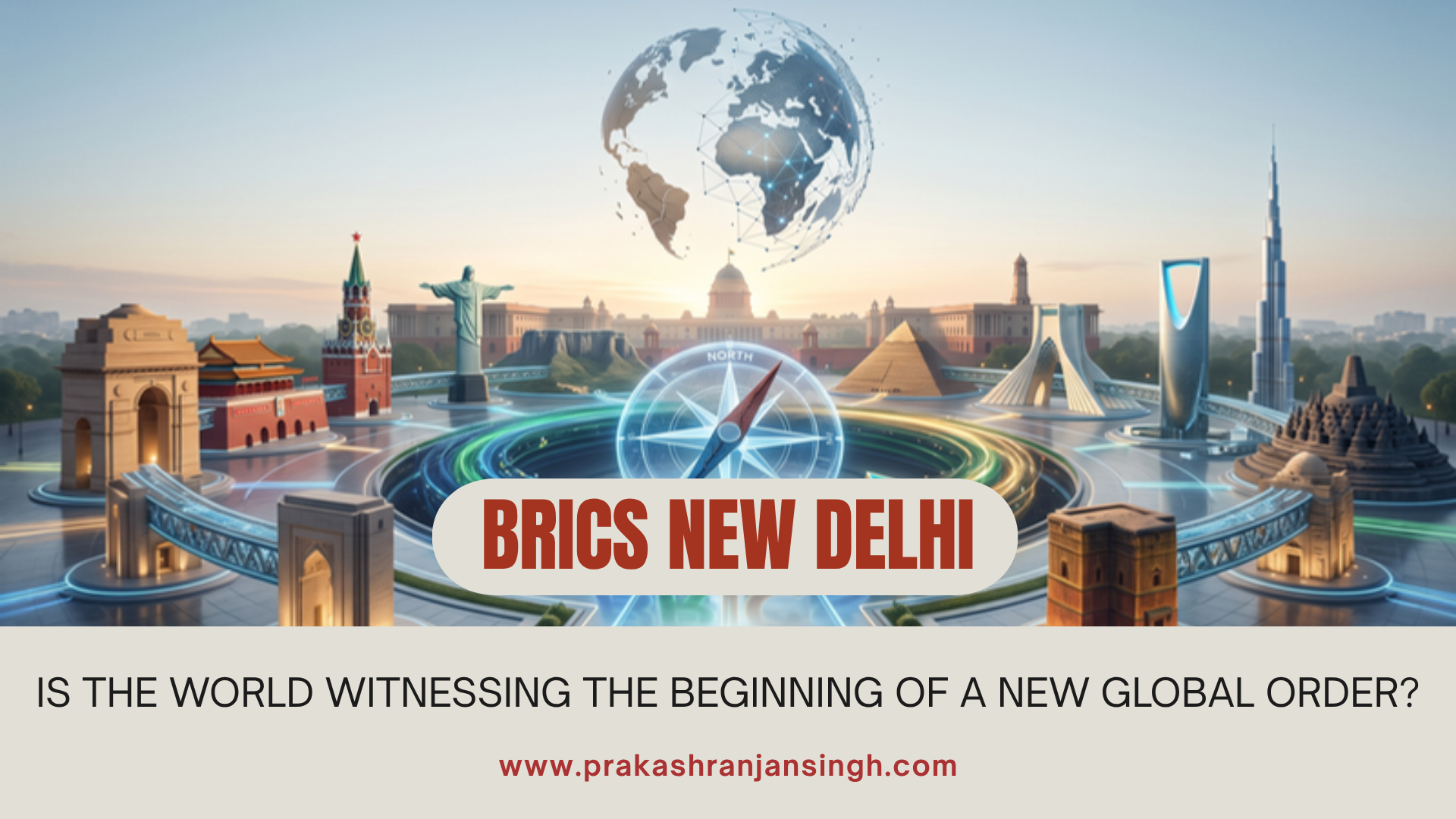
The BRICS story is therefore no longer simply about Brazil, Russia, India, China and South Africa.
It is increasingly about a fundamental question:
Who should shape the rules of the twenty-first-century world?
India’s 2026 BRICS chairship has adopted the theme “Building for Resilience, Innovation, Cooperation and Sustainability,” with a people-centric philosophy of “Humanity First.” India has conducted more than 350 meetings and high-level engagements across more than 25 cities during its chairship, covering political-security, economic-financial and cultural-people-to-people cooperation.
Table of Contents
Key Takeaways
- The 18th BRICS Summit in New Delhi (September 12–13, 2026) brings together a grouping that represents roughly 49.5% of the world’s population, 40% of global GDP and 26% of global trade — making it a genuine bargaining bloc, not just a symbolic gathering.
- The most consequential BRICS development may not be a common currency but the BRICS Payment Task Force’s push for interoperable cross-border payment systems and greater local-currency trade settlement.
- Watch what survives after the summit ends: institutional follow-through (payment corridors, the New Development Bank, technology cooperation) matters far more for the future than the photographs of the Modi-Xi-Putin meetings.
BRICS is no longer a small emerging-market club
BRICS began as BRIC—Brazil, Russia, India and China—and South Africa joined in 2010.
The acronym itself originated from an economic analysis by Goldman Sachs in 2001. What began as an observation about emerging economies gradually evolved into an institutional platform.
Today, the expanded BRICS includes Brazil, Russia, India, China, South Africa, Egypt, Ethiopia, Iran, Indonesia, Saudi Arabia and the UAE.
Together they represent approximately 49.5% of the world’s population, 40% of global GDP and 26% of global trade.
Therefore, describing BRICS merely as an “alternative to the West” is too simplistic.
It is better understood as a growing platform through which a large part of the Global South is seeking greater voice, bargaining power and strategic autonomy.
The New Delhi psychology: presence itself is a message
International diplomacy is not conducted only through documents.
It is also conducted through images, body language, seating arrangements, handshakes, hospitality, cultural symbolism and personal chemistry between leaders.
The presence of Prime Minister Narendra Modi, Chinese President Xi Jinping and Russian President Vladimir Putin in BRICS New Delhi carries psychological significance.
India has maintained strategic relationships with both Russia and the West while simultaneously managing a difficult relationship with China.
That makes India’s position unusual. India is not simply choosing one camp.
It is demonstrating that it wants the ability to talk to everyone, trade with everyone and cooperate wherever national interests permit.
The meeting between Modi and Xi on the sidelines of the New Delhi summit is particularly significant because India-China relations have been strained since the 2020 border crisis. Their renewed engagement is therefore more than a ceremonial handshake; it represents an attempt to reopen political and economic space while major differences remain unresolved.
“We may disagree, but we are prepared to talk.” That psychological space can eventually become economic cooperation.
India-China: a new chapter, but not necessarily a complete reset
The India-China relationship remains one of the most complicated relationships inside BRICS.
Both countries are competitors. Both are ancient civilisations. Both have enormous populations. Both aspire to greater global influence. Both possess rapidly developing technology ecosystems. And both have unresolved strategic and border issues.
Yet BRICS creates an interesting diplomatic paradox: countries can compete bilaterally while cooperating multilaterally. This is perhaps one of BRICS’ greatest strengths.
The meeting between Modi and Xi in New Delhi therefore should not automatically be interpreted as the disappearance of differences.
Rather, it could represent a managed thaw—an effort to prevent disagreements from permanently destroying areas where cooperation remains possible.
That distinction is important. Peace does not always begin with agreement. Sometimes it begins with communication.
The most important BRICS revolution may happen in payments
For years, one of the most discussed possibilities surrounding BRICS has been a common currency.
But a common BRICS currency is not the immediate reality. The more realistic development is potentially much more important in the long run:
Can countries conduct more international trade without depending entirely upon existing Western-dominated financial infrastructure?
BRICS is working through its Payment Task Force on cross-border payment mechanisms, interoperability between payment and messaging systems, and greater use of local currencies for trade settlements. BRICS finance ministers and central bank governors met in Mumbai on September 10, 2026, to advance exactly this agenda, aiming to make cross-border transactions “fast, low-cost, more accessible, efficient, transparent, and safe.”
India’s experience with UPI gives it an important technological asset.
The BRICS discussion is increasingly moving toward practical questions: How can payments become faster? How can transaction costs be reduced? Can national payment systems communicate with one another? Can local currencies be used more extensively? Can cross-border digital payments become easier? Can financial sanctions and geopolitical disruptions be made less damaging?
These questions could eventually be more consequential than the political speeches.
A new global payment architecture, if successfully developed over many years, could gradually reduce dependence on any single financial channel. That would be a structural change rather than a political slogan.
BRICS currency: dream or distant possibility?
A unified BRICS currency would be enormously difficult. The members have different inflation rates, monetary policies, exchange-rate regimes, capital controls, fiscal positions, trade balances, political systems and economic priorities.
Therefore, creating a currency comparable to the euro would require an extraordinary level of monetary integration.
The more realistic path may be: local currencies → interoperable payment systems → digital settlement mechanisms → greater financial connectivity → possibly a future common settlement mechanism.
Even financial experts discussing BRICS payments acknowledge significant technical and economic obstacles, including incompatible systems, capital controls and trade imbalances—BRICS itself has acknowledged there is “no one-size-fits-all approach” and is pursuing flexible, member-specific solutions rather than a single uniform framework.
In other words: the future may not begin with a BRICS banknote. It may begin with a BRICS payment transaction.
The cultural diplomacy behind the summit
Perhaps one of the most fascinating aspects of India’s BRICS presidency is that it is not being presented purely through economics.
India has deliberately brought civilisation and culture into diplomacy. This is strategically intelligent.
Countries understand statistics. But people remember stories. They remember temples, monuments, food, music, yoga, Buddhism, Ayurveda, spirituality, philosophy and civilisational connections.
The use of India’s cultural heritage in the BRICS narrative therefore creates a different psychological environment.
The Ramanathaswamy Temple at Rameswaram, for example, is one of India’s most important sacred sites, associated with Lord Shiva, Lord Rama and the Ramayana tradition. It is also one of the Jyotirlinga shrines and a Char Dham pilgrimage centre.
Importantly, the temple has become part of the visual language surrounding the 2026 BRICS summit. Its use as a backdrop for welcoming international leaders is an example of how India is combining modern diplomacy with its civilisational heritage.
One should, however, be careful about claiming a specific ancient institutional connection between the Ramanathaswamy Temple and China unless supported by reliable historical evidence.
The broader India-China cultural connection is much stronger historically through Buddhism, ancient intellectual exchange and the journeys of Chinese pilgrims to India.
The larger diplomatic message is therefore not “India is exporting one religion.” It is: “India possesses a civilisation that has interacted with Asia for centuries.” That is a far more powerful diplomatic narrative.
Culture creates emotional familiarity
There is a psychological principle behind cultural diplomacy. People resist what they do not understand. But familiarity reduces psychological distance.
Yoga created familiarity. Buddhism created familiarity. Indian food created familiarity. Bollywood created familiarity. Ayurveda created familiarity. Indian festivals created familiarity.
And now India’s civilisational heritage is increasingly being incorporated into international diplomacy. This produces what might be called soft-power familiarity.
A foreign leader may disagree with India’s economic policies. But if the country becomes culturally familiar, the psychological barrier between societies becomes smaller. That is why cultural diplomacy can sometimes achieve something conventional diplomacy cannot.
The Modi-Xi-Putin chemistry: symbolism matters
International politics often focuses excessively on official statements. But television cameras capture something else.
They capture who meets whom, who walks together, who shakes hands, who smiles, who speaks privately, who attends which event, and how leaders behave around one another.
These images are consumed not only by diplomats but by billions of ordinary citizens. This creates mass psychological messaging.
The image of India simultaneously engaging with China and Russia communicates one central idea: India wants strategic space, not strategic submission.
It tells the Global South that a country does not necessarily have to become an exclusive member of one geopolitical camp to remain globally influential.
It also tells Western countries that India cannot be easily placed into a single geopolitical box. That is India’s unique BRICS advantage.
BRICS is not necessarily anti-West
This distinction deserves attention. BRICS contains countries with enormous economic relationships with the United States and Europe.
India itself has deep strategic, technological, educational, investment and defence relationships with Western countries. Therefore, BRICS should not automatically be interpreted as a military alliance against the West.
Its deeper objective may be multipolarity. The psychological difference is enormous.
An anti-Western organisation says: “We want to defeat the existing system.” A multipolar organisation says: “We want more participants in designing the system.” India appears much closer to the second philosophy.
The real battle is over rule-making
The world order is ultimately not controlled only by armies. It is controlled by currencies, payment networks, technology standards, financial institutions, supply chains, energy routes, data, artificial intelligence, trade rules, international institutions, and the ability to influence global narratives.
This is where BRICS becomes strategically important. If its members collectively develop stronger alternatives in these areas, their negotiating power will increase — and that is precisely the rule-making contest BRICS New Delhi is trying to shape.
The objective need not be to destroy existing institutions. It may simply be to ensure that no single group possesses disproportionate influence over every major global system.
The 50% psychological threshold
There is another fascinating psychological factor. When a grouping represents almost half of humanity, its members begin to perceive themselves differently.
A small coalition thinks: “How can we survive?” A coalition representing nearly half the world’s population begins to think: “How should the world system work?”
That psychological transformation can be more important than the numerical statistic itself. BRICS’ current membership represents approximately 49.5% of global population.
The number is therefore not merely demographic. It creates collective confidence. And confidence changes diplomacy.
India’s unique position: bridge rather than bloc
India’s greatest BRICS strength may actually be its ability to speak across geopolitical divisions.
India has: BRICS + G20 + Quad + SCO + bilateral partnerships with Europe + strong US relations + historical Russia ties + engagement with the Middle East + Global South leadership.
This gives New Delhi unusual diplomatic flexibility. India can potentially act as a bridge between competing worlds. This is particularly important when wars and geopolitical tensions are dividing the international community.
A bridge does not belong exclusively to either bank. Its value comes precisely from connecting both.
BRICS and the psychology of uncertainty
The world is currently experiencing multiple forms of uncertainty. People worry about war, inflation, energy, food security, employment, artificial intelligence, cyber threats, financial instability, climate change, and geopolitical fragmentation.
Governments experience the same anxiety at a larger scale. BRICS therefore offers something psychologically powerful: collective resilience.
A country may not be able to control the entire global environment. But it can build partnerships that reduce vulnerability. This is why the Indian chairship’s emphasis on resilience, innovation, cooperation and sustainability is strategically relevant.
The hidden BRICS opportunity: technology
The next BRICS transformation may come from technology rather than traditional diplomacy.
Imagine a future in which member countries cooperate on digital public infrastructure, AI governance, cybersecurity, fintech, CBDCs, cross-border payments, logistics, semiconductor supply chains, healthcare technology, renewable energy, space technology, and digital identity frameworks.
India has already proposed initiatives involving digital public infrastructure, AI governance, industrial competencies and financial risk cooperation during its 2026 chairship.
If such cooperation becomes institutionalised, BRICS could evolve from a political-economic grouping into a technology and development ecosystem.
But BRICS has a major weakness
Its strength is also its weakness. The members are extraordinarily diverse.
India and China compete. Russia and Western countries remain locked in confrontation. Middle Eastern members have their own strategic priorities. Brazil has a different geopolitical orientation. African members have different development needs.
Some members want stronger de-dollarisation. Others want greater flexibility without confrontation with the West.
Therefore, BRICS unity cannot be assumed. The organisation will succeed only if it focuses on practical common interests rather than ideological uniformity. This is perhaps India’s biggest challenge as chair.
The greatest test: can BRICS move from symbolism to institutions?
Summits create headlines. Institutions create history.
A photograph of leaders shaking hands lasts for one day. A functioning payment network can last for decades.
A declaration can be forgotten. A new financial institution can transform markets.
A cultural performance can inspire emotion. A student-exchange programme can change generations.
Therefore, the ultimate test of BRICS New Delhi will not be the beauty of the summit. It will be: what survives after the leaders return home?
New Delhi as a psychological stage
The location itself matters. India is presenting modern infrastructure, digital technology, ancient civilisational heritage and democratic politics simultaneously.
That combination communicates a powerful message: ancient civilisation does not necessarily mean an old-fashioned society.
India is effectively presenting itself as: civilisationally old + demographically young + technologically ambitious + democratically governed + economically expanding.
That is an attractive identity for the Global South. And it strengthens India’s claim to play a larger role in designing the future.
The deeper meaning of BRICS New Delhi
The real significance of BRICS may not be the creation of a single currency. It may not even be the replacement of SWIFT.
It may be something more gradual and profound: the diversification of global power.
For centuries, global influence has moved through changing centres of power. The twenty-first century may witness another transition—from a relatively concentrated international system toward a more distributed one.
BRICS is one of the instruments through which that transition is being negotiated. India’s role is particularly interesting because it does not need to choose between civilisational identity and modern technology. It can use both.
From Ramayana to digital payments
There is an extraordinary symbolic contrast here.
On one side stands Ramanathaswamy Temple, representing India’s ancient civilisational memory. On the other side stands UPI and India’s digital public infrastructure, representing India’s technological future.
Between these two lies India’s diplomatic strategy: heritage + technology, tradition + innovation, culture + commerce, spirituality + modernity, democracy + strategic autonomy.
This combination may become one of India’s most powerful forms of soft power.
What could BRICS become by 2047?
The possibilities are enormous. A mature BRICS ecosystem could eventually see:
- Greater local-currency trade
- Interoperable cross-border payment systems
- Digital-currency and settlement experiments
- Stronger New Development Bank financing
- Alternative investment platforms
- Shared technology standards
- Greater cooperation in AI
- Coordinated energy and food-security strategies
- Stronger Global South representation in international institutions
- Greater cultural and educational exchange
Some of these are already being discussed; others remain long-term possibilities rather than established commitments. That distinction is essential.
The Indian opportunity
India should not attempt to make BRICS merely an anti-Western institution. Its greater opportunity is to make BRICS a problem-solving institution.
If India can persuade members to concentrate on trade, technology, development, health, education, payment systems, energy, food security, AI and peace, then BRICS can become more credible globally.
India’s democratic identity also gives it a potentially important role in ensuring that the organisation does not become merely a platform for great-power rivalry.
The final psychological message
Perhaps the most important lesson of New Delhi BRICS is psychological.
Power is not only the ability to command. Power is also the ability to bring people together.
A country becomes influential when others are willing to sit at its table — which is exactly what BRICS New Delhi has just demonstrated on a global stage.
When leaders from different political systems, different continents and different strategic interests come together in New Delhi, India is demonstrating a particular kind of power: convening power.
Convening power can eventually become negotiating power. Negotiating power can become institutional power. Institutional power can eventually become rule-making power.
That may be the real journey beginning in New Delhi.
BRICS New Delhi: a new chapter, not a finished story
The world should therefore avoid two extremes.
It would be premature to declare that BRICS has already created a completely new world order. But it would equally be a mistake to dismiss BRICS as merely another diplomatic forum.
Its demographic scale, economic weight, geographic diversity and growing institutional ambitions make it an important force in the evolution of global governance.
The BRICS New Delhi summit is particularly significant because India is attempting to connect economics with culture, technology with diplomacy, and national interest with Global South aspirations.
The Modi-Xi engagement shows that competition does not necessarily eliminate dialogue. The Modi-Putin relationship shows that historical partnerships can survive changing geopolitical circumstances.
The BRICS payment discussions show that financial architecture can evolve incrementally. And India’s cultural diplomacy shows that international influence is not created only in boardrooms and military headquarters.
Sometimes it is created through civilisation, memory, hospitality and human connection.
The world order of tomorrow may therefore not emerge from one dramatic declaration. It may emerge quietly—through thousands of agreements, payment transactions, technology standards, cultural exchanges and diplomatic conversations.
And perhaps that is the most important message from BRICS New Delhi 2026:
The next world order may not be created by one country replacing another. It may be created by a larger number of countries demanding a larger voice in deciding the future.
New Delhi has provided the stage. BRICS has provided the platform. The real question is whether its members possess the patience, trust and institutional imagination to build what comes next.
Frequently Asked Questions
What is the 18th BRICS Summit in New Delhi?
It is the 2026 annual summit of the BRICS grouping (Brazil, Russia, India, China, South Africa, Egypt, Ethiopia, Iran, Indonesia, Saudi Arabia and the UAE), held in New Delhi on September 12–13, 2026 under India’s chairship theme “Building for Resilience, Innovation, Cooperation and Sustainability.”
Is BRICS trying to replace the US dollar?
Not immediately. A common BRICS currency remains a distant possibility given members’ very different monetary policies and fiscal positions. The nearer-term focus is interoperable cross-border payment systems and greater use of local currencies for trade settlement.
Why does the Modi-Xi meeting at BRICS New Delhi matter?
India-China relations have been strained since the 2020 border crisis. Their engagement on the sidelines of the New Delhi summit signals a managed thaw—reopening space for dialogue and limited cooperation without pretending underlying disputes are resolved.
Is BRICS an anti-Western bloc?
Most BRICS members, including India, retain deep economic and strategic ties with the US and Europe. The grouping’s deeper objective is better understood as multipolarity—more participants shaping global rules—rather than an anti-Western alliance.

Leave a Reply