

India’s civilizational legacy is one of the richest and most diverse on Earth. Genetic and historical research points to tens of thousands of years of continuous habitation, innovation and cultural influence. This is not proof of superiority, and India’s youth should learn this history not for chauvinism but to reclaim genuine pride and curiosity.
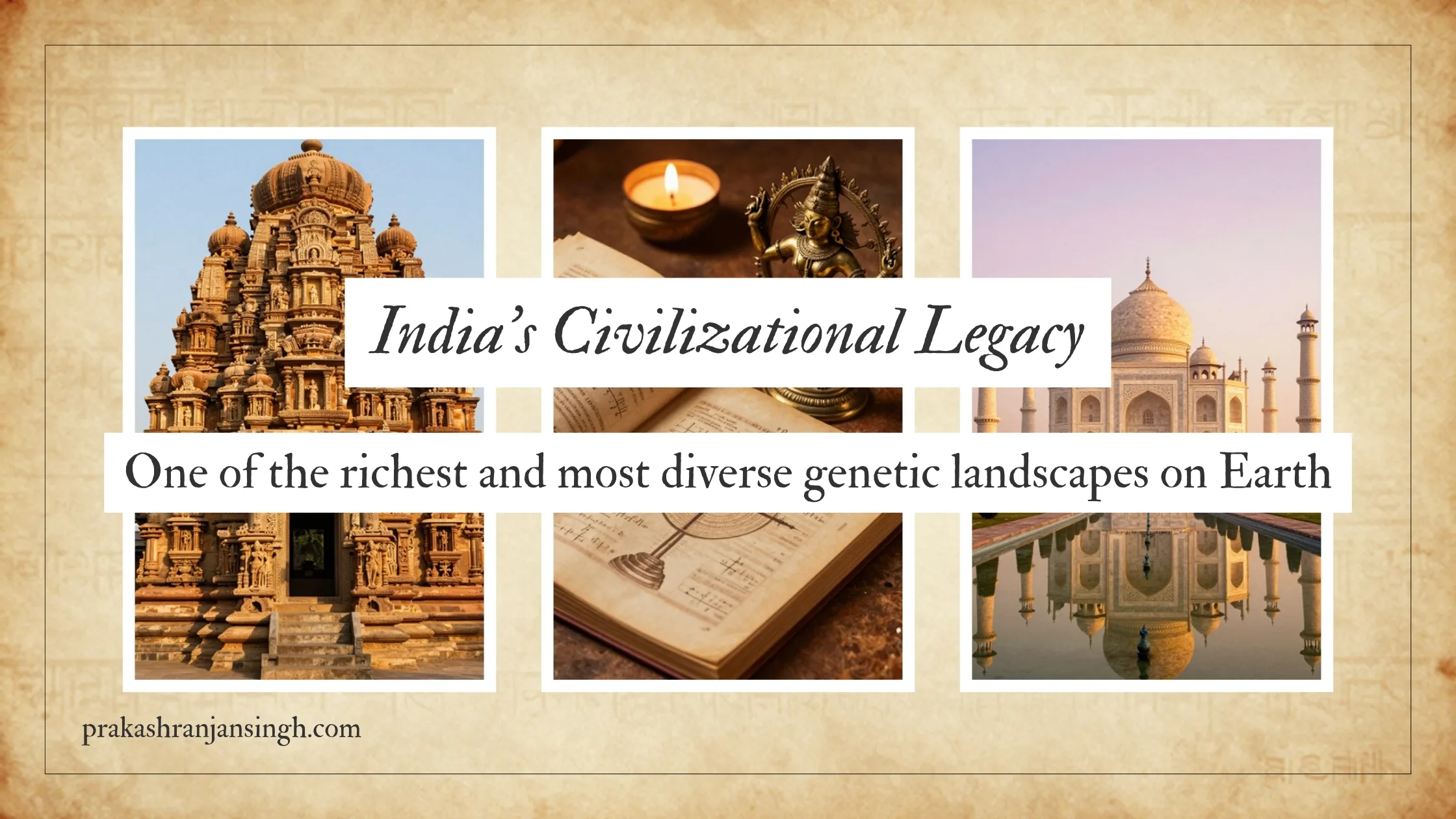
In an age where artificial intelligence, biotechnology, and genome sequencing are transforming our understanding of human history, one truth has become increasingly clear: every human being shares a common origin, and all populations are remarkably similar genetically. Yet, modern scientific research also reveals that the Indian subcontinent possesses one of the richest and most diverse genetic landscapes on Earth, reflecting tens of thousands of years of continuous human habitation and interaction.
Key Takeaways
- India holds one of the richest, most diverse genetic and civilizational landscapes on Earth, reflecting tens of thousands of years of continuous habitation.
- Indian ideas reached Southeast Asia and beyond through trade, scholarship, and spirituality — achieved through knowledge and culture, not conquest.
- The most actionable fix: young Indians should study this history to reclaim genuine pride and curiosity, not chauvinism.
Table of Contents
What Does Genetic Research Show About India’s Civilizational Legacy?
Large-scale genetic studies, including landmark research from the Harvard Medical School genetics team, have shown that India is home to extraordinary genetic diversity. This diversity is not a sign of division but of an ancient civilization that became a crossroads of human migration, adaptation, and cultural evolution. Rather than supporting notions of genetic superiority, science highlights India’s remarkable continuity and its role as one of the world’s oldest centers of civilization.
History complements these scientific findings. Long before the rise of many modern nations, India had flourishing cities, universities, philosophical traditions, advanced mathematics, astronomy, metallurgy, medicine, and systems of governance. The teachings of the Upanishads, the practice of Yoga, the principles of Ayurveda, and the philosophy of Vasudhaiva Kutumbakam—“the world is one family”—continue to resonate across cultures today.
How Far Did India’s Influence Actually Reach?
The influence of Indian civilization extended far beyond its borders. Through trade, scholarship, spirituality, and cultural exchange, Indian ideas reached Southeast Asia and beyond. Temples, inscriptions, languages, epics, and artistic traditions in several countries bear witness to these deep historical connections. India’s impact on the world was achieved not through conquest but through the enduring power of knowledge and culture.
Ironically, while scholars around the world study India’s ancient wisdom and scientific achievements, many young Indians remain unfamiliar with their own heritage. The digital age has connected us to the world, but it has also made many of us consumers of foreign narratives while neglecting the richness of our own civilization. Learning from other cultures is a strength, but forgetting our own roots is a loss.
What Genetics Does and Does Not Say About Indian Ancestry
It helps to be precise here, because this subject attracts both exaggeration and dismissal. Here is what peer-reviewed work actually reports.
- Two main ancestral streams. A 2009 study in Nature by David Reich, Kumarasamy Thangaraj, Lalji Singh and colleagues, which sampled 25 groups from 13 Indian states, found that most Indians descend from a mixture of two ancestral populations. One, called Ancestral North Indians, is genetically closest to western Eurasians. The other, Ancestral South Indians, is not closely related to any other population in the world. According to the Harvard Medical School summary, the Andaman Islanders descend exclusively from the second lineage.
- A later layer of ancient DNA. A 2019 study in Science, led by Vagheesh Narasimhan and colleagues, analysed ancient genomes. It found that modern South Asian ancestry comes from two main mixtures, one linked to the people of the Indus Valley Civilization and one linked to steppe pastoralists whose ancestry spread from around 4,000 years ago. How this should be read for language and culture is still debated among scholars, and this article does not take a side.
- Many small, isolated communities. The Harvard team described India as “many smaller isolated populations” instead of one large one. A 2017 paper in Nature Genetics identified 81 South Asian groups whose founder events were more extreme than those in Finns and Ashkenazi Jews, 14 of them with more than a million people. This is why India is so valuable for medical genetics, and why some communities carry higher risks of recessive genetic disorders.
What genetics does not say is just as important. It does not rank peoples, it does not prove any group is superior, and it does not show that any one community is “pure”. The real finding is the opposite: a long history of mixing, settlement and exchange. That is a legacy to study with curiosity, not to claim as a trophy.
5 Pieces of Evidence Beyond Genes That Show India’s Civilizational Reach
Genes are only one line of evidence. These five are documented in archaeology, manuscripts and heritage records.
- Planned Indus cities. Dholavira in Gujarat, a Harappan city, was inscribed as a UNESCO World Heritage Site in 2021, India’s 40th. Its planned layout and water management show urban engineering from the Bronze Age.
- The symbol for zero. Oxford’s Bodleian Libraries radiocarbon-dated the Bakhshali manuscript, written on birch bark, to as early as the 3rd or 4th century CE. It uses dots as a placeholder, the oldest recorded origin of the zero symbol. The manuscript contains material from at least three different periods, so scholars debate the exact dating. Placeholder zeros also existed in Maya and Babylonian systems; India’s distinct contribution was turning zero into a number, as in Brahmagupta’s text of 628 CE.
- Nalanda. The ruins of Nalanda Mahavihara in Bihar, one of the great ancient centres of learning, were inscribed as a UNESCO World Heritage Site in 2016.
- Scripts across Asia. Many Southeast Asian writing systems, including Khmer, Thai, Burmese and Javanese, descend from scripts of Indian origin. Language carries influence further than armies do.
- Temples abroad. Angkor Wat in Cambodia was built in the 12th century as a Hindu temple dedicated to Vishnu, and Prambanan in Indonesia is a Hindu temple complex. Both are UNESCO World Heritage Sites and show how Indian religious and artistic ideas travelled and were reinterpreted locally.
Notice what these have in common: none of them depends on a claim of superiority. They show curiosity, craft, learning and exchange, which is the spirit in which a civilization survives for millennia.
Why Should This Matter to Young Indians Today?
Scientific progress should encourage curiosity, not chauvinism. Genetics teaches us that humanity is one family, while history teaches us that civilizations thrive when they embrace knowledge, innovation, and openness. India’s greatness has never rested on the idea that its people are biologically superior. It has rested on the enduring values of inquiry, tolerance, resilience, and the pursuit of knowledge.
The youth of India must rediscover these strengths. They should study history with an open mind, appreciate the country’s scientific and cultural contributions, and carry forward the spirit of innovation that once made India a beacon of learning. Pride should arise from understanding, not from myths; from achievement, not from exclusion.
The future of India will not be secured by looking backward with nostalgia alone. It will be built by combining the wisdom of an ancient civilization with the creativity of a young generation. A nation that knows its history, values its diversity, invests in education, and embraces scientific thinking will always stand tall among the nations of the world.
India’s civilization has survived for millennia because it adapted without losing its identity. That is its true legacy. Let every young Indian take pride in that inheritance—not because science proves we are superior to others, but because history proves that our civilization has consistently contributed to the progress of humanity. The greatest tribute we can pay to our ancestors is not merely to celebrate their achievements but to surpass them through knowledge, integrity, innovation, and service to the world.
Frequently Asked Questions
What does genetic research actually show about India’s heritage?
Large-scale genetic studies, including landmark research from Harvard Medical School, show India is home to extraordinary genetic diversity reflecting tens of thousands of years of continuous human habitation, evidence of civilizational continuity, not genetic superiority.
How far did India’s civilizational influence actually reach?
Through trade, scholarship, spirituality, and cultural exchange, Indian ideas reached Southeast Asia and beyond, with temples, inscriptions, languages, and artistic traditions in several countries bearing witness to these connections, achieved through knowledge and culture, not conquest.
Why should this history matter to young Indians today?
Pride should arise from understanding, not myths. Young Indians should study this history with an open mind and carry forward the spirit of inquiry and innovation that once made India a beacon of learning, rather than chauvinism.
Do Indians come from two ancestral populations?
A 2009 Nature study found that most Indians descend from a mixture of Ancestral North Indians and Ancestral South Indians, and a 2019 Science study of ancient DNA described later mixtures linked to the Indus Valley people and to steppe pastoralists from around 4,000 years ago. Scholars still debate how to interpret this for language and culture.
Does genetic diversity make India superior to other nations?
No. Genetics does not rank peoples. India’s diversity reflects a long history of settlement, mixing and isolated communities, which is valuable for science and medicine, and is a reason for curiosity and respect, not superiority.
Related Reading
- Nationalism: The Strength That Makes a Nation Great
- The Invisible Burden of Unfulfilled Social Responsibilities: Why Strong Families Build Strong Nations
- Paper Leaks Are Stealing India’s Future
- Rudrabhishek: Where Faith Meets Science, Psychology and the Wisdom of Ancient India
- Are We Truly Free? Freedom of Nation Vs Freedom of a Mind and The Science Behind It

Leave a Reply