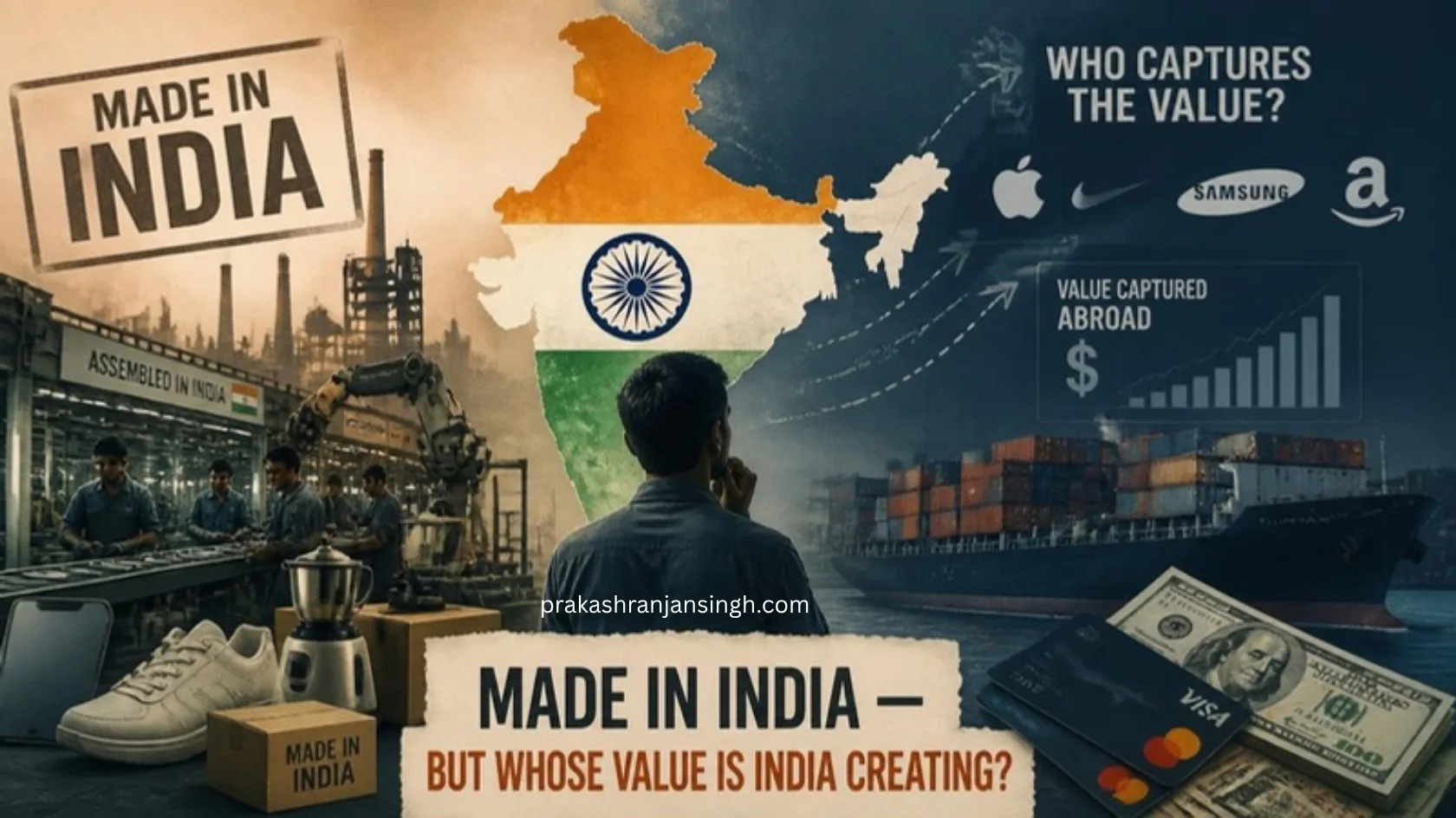
The hidden economic story behind India’s manufacturing boom, foreign brands, consumer temptation and easy credit
There is something fascinating happening in India.
A foreign brand launches a premium product. Millions of Indians queue up—physically or digitally—to buy it. The product carries a prestigious global name, is assembled partly or substantially in India, is sold through an Indian distribution network and is frequently purchased with an EMI or consumer loan.
At first glance, this appears to be a perfect example of economic progress.
A factory has come to India.
Jobs have been created.
Exports have increased.
Consumers have access to global technology.
The government can claim manufacturing success.
But there is another question that deserves equal attention:
How much of the final economic value is actually being created and retained in India?
This is not an argument against foreign investment, global brands or consumer choice. Nor is it an argument that every rupee spent on a foreign brand leaves India.
The question is much more fundamental:
When an Indian works hard, earns money, borrows money and buys a globally branded product, how much of that economic cycle strengthens India’s own productive capacity—and how much strengthens somebody else’s?
That is the question India must increasingly ask as it moves from a consumption economy toward a manufacturing economy — the shift from products merely made in India to value created in India.
Key Takeaways
- “Made in India” is not the same as value created in India — assembly has boomed, but the deeper value chain (design, IP, semiconductors, components) is still substantially foreign-owned.
- India’s electronics domestic value addition is estimated at only 18–23%, even as mobile-phone production rose from about ₹18,000 crore to ₹5.45 lakh crore in a decade.
- The most actionable fix: before a big EMI-financed purchase, ask what share of its value is actually created in India — and let policy measure ecosystems, not just factories.
Table of Contents
- 1. “Made in India” and “Created in India” Are Not the Same Thing
- 2. India Is Becoming the Factory—But the World Still Owns Much of the Ecosystem
- 3. The Consumer Is Not Merely Buying a Product—He Is Financing an Economic Ecosystem
- 4. The Foreign Stakeholder Sees a Complete Ecosystem—Not Just a Customer
- 5. Foreign Companies Are Not Doing Anything Unusual—They Are Doing Business Intelligently
- 6. The Real Policy Mistake Would Be to Measure Success Only by Factories and Employment
- 7. But There Is Another Player in This Story: the Indian Consumer
- 8. The Danger Is Not Foreign Consumption—It Is Consumption Financed by Fragile Household Economics
- 9. The Indian Policy Objective Should Move From “Made in India” to “Value Created in India”
- 10. India Should Not Reject Globalisation—It Should Negotiate Better With It
- 11. The Most Important Question: Where Does the Next Rupee Go?
- 12. The Consumer and the Government Both Have a Role
- The Bigger Picture
1. “Made in India” and “Created in India” Are Not the Same Thing
India has made extraordinary progress in electronics manufacturing.
Government data show that electronics production increased from about ₹1.9 lakh crore in 2014–15 to around ₹12 lakh crore in 2024–25. Mobile-phone production rose from approximately ₹18,000 crore to ₹5.45 lakh crore. Mobile-phone exports increased from about ₹1,500 crore to roughly ₹2 lakh crore. India has also moved from importing most of its mobile phones to manufacturing almost all phones sold domestically.
These are genuine achievements.
But manufacturing has several layers.
Design → intellectual property → semiconductor → component → sub-assembly → final assembly → logistics → distribution → retail → finance → after-sales service.
The country that controls only the final assembly does not necessarily capture the largest share of the economic value.
India’s electronics domestic value addition has been estimated at around 18–20% in one recent government assessment, while another 2026 government release put it at 23%. The exact number varies by methodology and period, but the broad message is clear: localisation is increasing, but the value chain is still far from completely Indian.
That distinction is crucial.
Assembly is manufacturing. But assembly alone is not industrial sovereignty.
2. India Is Becoming the Factory—But the World Still Owns Much of the Ecosystem
This is where the economics becomes interesting.
A multinational company does not necessarily need to transfer all of its technology to India merely because it manufactures here.
Its intellectual property may remain overseas.
Its global design centre may remain overseas.
Its key semiconductor suppliers may remain overseas.
Its operating system, patents, brand and global supply chain may remain under foreign control.
India can provide the factory, workforce, infrastructure, market and increasingly the export platform.
That is not inherently bad.
In fact, this is how industrialisation often begins.
China itself did not immediately develop every component, technology and brand. It first became an enormous manufacturing platform and gradually moved upward into components, technology, design and indigenous brands.
The real question for India is therefore not:
“Why are foreign companies manufacturing in India?”
It should be:
“How quickly are we moving from assembly to ownership of the value chain?”
That is a much more productive question.
3. The Consumer Is Not Merely Buying a Product—He Is Financing an Economic Ecosystem
Now comes the psychological dimension.
Consider the premium smartphone.
A person may earn ₹50,000 or ₹1 lakh a month but still desire a ₹1 lakh-plus phone.
The psychological barrier of paying ₹1 lakh in one shot is high.
But ₹4,000–₹5,000 per month for 24 months appears manageable.
This is where modern consumer finance has transformed purchasing psychology.
Price has gradually been replaced by monthly affordability.
The question changes from:
“Can I afford this phone?”
to:
“Can I afford this EMI?”
That is a profound psychological transformation.
A consumer who would never willingly part with ₹1,00,000 at once may happily sign a two-year commitment.
The smartphone industry understands this psychology extremely well.
So do financial institutions.
So do fintech platforms.
So do retailers.
This is not necessarily manipulation. It is the normal functioning of modern consumer capitalism.
But it creates a responsibility for the consumer:
EMI affordability is not the same as economic affordability.
4. The Foreign Stakeholder Sees a Complete Ecosystem—Not Just a Customer
This is perhaps the most fascinating part of the story.
Imagine the economic chain.
A foreign company develops a product.
It establishes or contracts manufacturing capacity in India.
It sells the product to Indian consumers.
Indian consumers use Indian income to purchase it.
A financial institution facilitates the purchase.
The retailer earns a margin.
The logistics company earns revenue.
Indian employees receive salaries.
The government receives taxes.
But the foreign ecosystem may simultaneously receive value through intellectual property, brand economics, imported components, technology-related payments, dividends, interest or other legitimate cross-border flows, depending upon the structure of the transaction.
Therefore, saying “the entire purchase money goes abroad” would be incorrect.
A substantial part of the money remains inside India.
But saying “because the product is made in India, almost all the economic value is Indian” would also be incorrect.
The reality lies somewhere between these two extremes.
That is precisely why domestic value addition matters more than the label on the product.
5. Foreign Companies Are Not Doing Anything Unusual—They Are Doing Business Intelligently
This should not be presented as a conspiracy.
A multinational company has a responsibility to its shareholders.
It naturally asks:
Where is the market?
Where is labour available?
Where are manufacturing costs competitive?
Where can supply chains be diversified?
Where are government incentives available?
Where is future demand likely to grow?
India offers something extraordinarily valuable:
a huge consumer market combined with a large labour force, improving infrastructure, expanding digital capability and increasing geopolitical importance.
The foreign company is therefore making a rational business decision.
The real strategic question is whether India is equally rational in negotiating what it receives in return.
Investment is not charity.
Foreign companies come to India because India offers them an economic opportunity.
India should therefore make sure that the opportunity works in both directions.
6. The Real Policy Mistake Would Be to Measure Success Only by Factories and Employment
Factories and jobs are important.
But they should not be the final destination.
Suppose India creates 10,000 assembly jobs.
That is valuable.
But suppose India simultaneously develops:
50 component manufacturers,
10 Indian design companies,
semiconductor packaging capability,
battery technology,
camera-module technology,
precision machinery,
industrial automation,
testing laboratories,
patents,
engineering talent,
Indian brands,
export-oriented suppliers.
Then the economic multiplier becomes much larger.
One assembly plant can employ thousands.
But an ecosystem can employ millions.
That is the difference between manufacturing capacity and industrial capability.
India’s latest policy direction recognises this challenge. The government approved a ₹62,500 crore Mobile Phone Manufacturing Scheme in July 2026, explicitly targeting deeper domestic value addition, supply-chain resilience, Indian brands, patents, design and R&D. The scheme also provides additional incentives linked to domestic sourcing of key components and sub-assemblies.
That shift—from “make the product here” to “build the ecosystem here”—is critical.
7. But There Is Another Player in This Story: the Indian Consumer
It is easy to blame foreign companies.
It is much harder to examine ourselves.
Why does a middle-class Indian sometimes spend several months of disposable income on a phone when an alternative costing one-fourth may perform most of the same daily functions?
The answer is not simply technology.
It is psychology.
A premium smartphone has become:
technology + status + identity + aspiration + social recognition + convenience.
The phone is no longer merely a communication instrument.
For many consumers, it has become a social symbol.
And this is where India’s economic psychology deserves serious discussion.
A country cannot become economically powerful merely by producing more goods.
Its citizens must also develop the ability to distinguish between:
need, convenience, aspiration and temptation.
8. The Danger Is Not Foreign Consumption—It Is Consumption Financed by Fragile Household Economics
Foreign products are not inherently bad.
Nor is premium consumption necessarily irrational.
A financially secure person buying an expensive phone from surplus income is one thing.
A person borrowing money at a significant cost to upgrade a perfectly functional phone every two years is another.
The distinction becomes even more important when multiple forms of credit accumulate:
credit card + personal loan + consumer EMI + BNPL + vehicle loan + housing loan.
Individually, each payment may look small.
Together, they can quietly consume a large part of household income.
This is where financial literacy must move beyond teaching people how to invest.
People must also learn how to resist unnecessary consumption financed by debt.
We cannot build a financially strong India if household aspirations continuously outrun household savings.
9. The Indian Policy Objective Should Move From “Made in India” to “Value Created in India”
This could become the next stage of India’s industrial policy.
Instead of asking only:
How many factories have been established?
we should ask:
How much of the product’s value is created domestically?
Instead of asking only:
How many phones are assembled?
we should ask:
How many components are manufactured in India?
Instead of asking:
How much foreign investment has arrived?
we should ask:
What technology, skills, patents, supplier networks and export capabilities have been created?
Instead of asking:
How many products are sold?
we should ask:
How much Indian intellectual property is embedded in those products?
And instead of celebrating consumption alone, we should ask:
Is Indian household income increasingly financing Indian productive capacity?
These are much deeper measures of economic progress — the real shift from “Made in India” to value created in India.
10. India Should Not Reject Globalisation—It Should Negotiate Better With It
There is a temptation to interpret this entire story as:
foreign companies versus India.
That would be a mistake.
India needs foreign capital.
India needs global technology.
India needs multinational companies.
India needs global supply chains.
India needs exports.
But India also needs:
Indian technology + Indian components + Indian capital + Indian brands + Indian patents + Indian R&D.
The objective should therefore not be isolation.
It should be strategic integration.
China’s experience demonstrates the importance of moving progressively upward in the value chain. India need not copy China’s model, but the lesson is relevant: assembling products is an entry point; controlling increasingly sophisticated parts of the value chain is what creates durable industrial power.
11. The Most Important Question: Where Does the Next Rupee Go?
Perhaps this is the simplest way to understand India’s economic challenge.
Imagine an Indian earning ₹1,000.
If he spends it on an imported product, most of the economic value associated with that product may accrue outside India, although taxes, distribution and other domestic services can still retain some portion.
If he buys a product assembled in India, more of the value remains domestically through wages, logistics, taxes and manufacturing activity—but some value may still depend heavily on imported components and foreign intellectual property.
If he buys an Indian-designed product made largely with Indian components, the domestic economic multiplier can be substantially greater.
And if an Indian company designs, manufactures and exports that product to the world, foreign consumers begin financing Indian production.
That is the ultimate transformation India should seek.
From Indians financing foreign value chains to the world financing Indian value chains.
12. The Consumer and the Government Both Have a Role
The responsibility cannot rest entirely with policymakers.
The government can create the ecosystem.
Industry can develop technology.
Financial institutions can lend responsibly.
But consumers ultimately decide where their money goes.
The consumer does not need to stop buying foreign brands.
He simply needs to understand what he is buying.
Before making a large purchase, five questions are useful:
1. Do I need it or merely want it?
2. Can I afford it without debt?
3. What proportion of its value is actually created in India?
4. Am I buying functionality or status?
5. Will this purchase strengthen my financial position—or merely increase my monthly commitments?
These five questions can change household economics.
And millions of financially conscious households can eventually influence national economics.
The Bigger Picture
India’s manufacturing story is neither a failure nor a finished success.
It is a transition.
We have moved from being overwhelmingly dependent on imported mobile phones to becoming a major global manufacturing and export base. Government data show that India produced about ₹5.45 lakh crore worth of mobile phones in FY2024–25 and exported around ₹2 lakh crore, while more than 300 mobile manufacturing units were operational.
That is real progress.
But the next question is much harder.
Can India move from:
assembly → components → technology → design → intellectual property → Indian brands → global leadership?
Can Indian consumers move from:
temptation → EMI → consumption
towards:
need → affordability → saving → investment → productive consumption?
And can Indian policy move from:
attracting factories
towards:
building entire industrial ecosystems?
The answers will determine whether India’s manufacturing revolution becomes merely a story of large factories producing products for a huge Indian market, or a much larger story in which Indian capital, Indian skills, Indian technology and Indian entrepreneurship capture an increasing share of global economic value.
The objective of Atmanirbhar Bharat should therefore not be that every product has an Indian label.
The deeper objective should be:
India should increasingly own the knowledge, technology, components, capital, brands and intellectual property behind the products it makes.
And there is an equally important lesson for the ordinary Indian household:
Every rupee is not merely a unit of consumption. It is a vote for the economic ecosystem that receives it.
A foreign company is expected to play intelligently.
A multinational investor is expected to maximise value.
A financial institution is expected to find profitable customers.
A retailer is expected to sell more.
There is nothing surprising about that.
The real challenge is whether India and its consumers will learn to play the same economic game with equal awareness and strategic wisdom.
Because the ultimate question is not simply:
“Was this product made in India?”
It is:
“How much of the value created by this product will ultimately belong to India?”
Frequently Asked Questions
What does “value created in India” mean, as opposed to “Made in India”?
Made in India means a product is assembled here; value created in India means the design, components, intellectual property and profits behind that product are also Indian, not just the final assembly step.
How much of India’s electronics manufacturing value is actually domestic?
Government assessments put India’s electronics domestic value addition at roughly 18–23%, even though mobile-phone production has grown from about ₹18,000 crore to ₹5.45 lakh crore over the past decade.
Why does EMI-financed consumption matter for India’s economy?
When consumers judge purchases by monthly EMI affordability rather than total cost, debt can quietly accumulate across credit cards, personal loans and BNPL, weakening household savings even as visible consumption looks healthy.
What is the ₹62,500 crore Mobile Phone Manufacturing Scheme?
Approved in July 2026, it is a government scheme explicitly aimed at deepening domestic value addition, supply-chain resilience, Indian brands, patents, design and R&D—not just assembly volumes.
What should Indian consumers ask before a big purchase?
Whether they need it or merely want it, whether they can afford it without debt, what proportion of its value is actually created in India, and whether the purchase strengthens or weakens their financial position.

Leave a Reply