

Agriculture contribution to India GDP is about 18% of gross value added, yet the sector employs roughly 46% of the workforce, according to PRS Legislative Research. That gap between output and jobs is why farm productivity and incomes sit at the centre of any growth plan.
Agriculture economic growth is India’s forgotten goldmine: the sector still feeds over 1.4 billion people but remains chronically undervalued: low productivity, fragmented land, and a growing disconnect between educated youth and farming are holding it back, and unlocking it needs technology-driven farming, better agricultural education, and profitable, modern farming models rather than treating it as mere welfare.
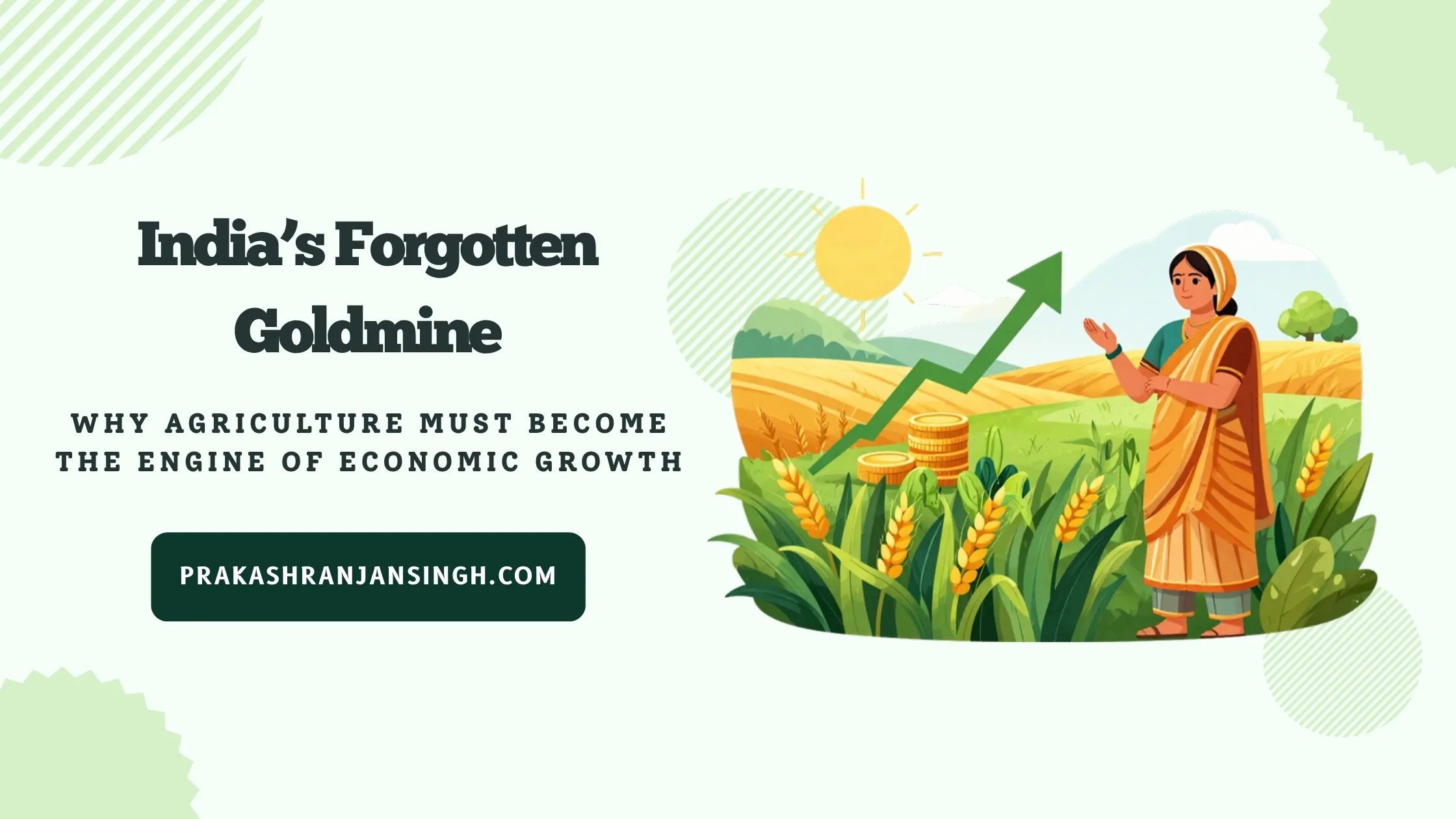
For decades, India’s economic aspirations have revolved around information technology, manufacturing, infrastructure, and services. These sectors have undoubtedly transformed the country’s global image. Yet, the sector that feeds more than 1.4 billion people and provides livelihoods to millions continues to receive far less attention than it deserves. Agriculture, the backbone of India’s civilization and economy, remains one of its most undervalued national assets.
Despite being among the world’s largest producers of rice, wheat, milk, fruits, vegetables, and spices, Indian agriculture suffers from low productivity, fragmented landholdings, inadequate mechanization, post-harvest losses, climate uncertainty, and unstable farm incomes. For many young Indians, farming is no longer viewed as a respectable or rewarding profession. This mindset poses a serious challenge to India’s ambition of becoming a developed nation by 2047.
The country must stop treating agriculture merely as a welfare sector. Agriculture economic growth should instead be recognized as a strategic priority capable of generating employment, exports, innovation, and sustainable growth.
Key Takeaways
- Agriculture is India’s forgotten goldmine — it still feeds over 1.4 billion people but remains chronically undervalued as a growth sector.
- India is among the world’s largest producers of rice, wheat, milk, fruits, vegetables, and spices, yet suffers from low productivity and fragmented landholdings.
- The most actionable fix: technology-driven farming, modern agricultural education, and profitable farming models like cooperatives and farmer-producer organizations.
Table of Contents
- Agriculture Contribution to India GDP: Why the Yield Gap Matters
- Agriculture Economic Growth: Why Are Young Indians Turning Away From Farming?
- What Would Make Farming an Attractive Career Again?
- What Investment Does Agriculture Still Need?
- Where Does the Agriculture Budget Actually Go?
- Can India Turn Its Farming Advantage Into Growth?
Agriculture Contribution to India GDP: Why the Yield Gap Matters
Agriculture and allied activities account for about 18% of India’s economic output, measured as a share of gross value added, but employ about 46% of the workforce, as the PRS analysis of the 2026-27 demand for grants notes using MoSPI data. A low agriculture contribution to India GDP per worker is the arithmetic result: many people share a modest slice of output.
PRS lists low crop productivity as a core issue. It cites the Commission for Agricultural Costs and Prices on the reasons for the yield gap: limited availability of inputs and services, fragmented landholdings, and a lack of farm mechanisation. The comparison below, taken from the same PRS analysis, shows how far India’s yields trail some major producers for three of four crops.
| Crop | India (kg per hectare) | Comparison country (kg per hectare) |
|---|---|---|
| Paddy | 4,229 | China: 7,076 |
| Wheat | 3,537 | China: 5,855 |
| Maize | 3,387 | USA: 10,880 |
| Sugarcane | 84,906 | Brazil: 73,393 |
Closing even part of that yield gap, rather than adding more welfare spending alone, is where the case for treating agriculture as a growth sector becomes concrete.
Agriculture Economic Growth: Why Are Young Indians Turning Away From Farming?
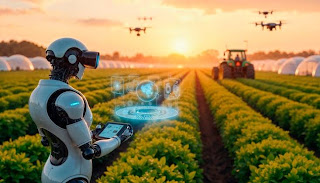
One of the biggest concerns is the growing disconnect between educated youth and farming, at a time when India’s fertility rate is already below replacement level and fewer young people are coming up. Talented young people migrate to cities in search of white-collar jobs, while villages lose their productive workforce. Agriculture must become a modern, technology-driven profession where knowledge of artificial intelligence, drones, precision farming, biotechnology, and data analytics is as valuable as traditional farming skills.
Corporate participation can play a constructive role if accompanied by strong safeguards for farmers’ land rights and fair contracts. Companies can bring investment, better supply chains, cold storage, food processing, quality standards, and access to domestic and international markets. Foreign investment in agricultural technology, research, irrigation, and food processing should also be encouraged under transparent regulations that protect national interests and farmer welfare.
What Would Make Farming an Attractive Career Again?
India also needs a revolution in agricultural education. Schools and universities should promote agribusiness, food technology, agricultural engineering, and rural entrepreneurship as attractive career choices. Young innovators should receive financial support to develop climate-resilient crops, smart irrigation systems, and digital marketplaces that directly connect farmers with consumers.
Equally important is creating profitable farming models. Farmers need assurance that modern agriculture can provide stable and dignified incomes. Cooperatives, farmer-producer organizations, integrated farming, organic agriculture where suitable, value-added food processing, and export-oriented production can transform rural prosperity.
What Investment Does Agriculture Still Need?
The government must also invest aggressively in irrigation, rural infrastructure, warehouses, logistics, scientific research, crop insurance, and market reforms. Technology should help farmers make better decisions based on weather forecasts, soil health, water availability, and market demand.
The scale of the gap is visible in the government’s own numbers. Agriculture and allied activities contribute roughly 18% of India’s Gross Value Added, yet the sector still employs about 46% of the workforce — a productivity mismatch confirmed by PRS Legislative Research’s analysis of the 2026-27 demand for grants. Between 2011-12 and 2024-25, agriculture grew at just 4% a year on average, against 6% for the overall economy. The FY2026-27 budget for the Ministry of Agriculture and Farmers Welfare was raised to ₹1,40,529 crore, a 5.4% increase over the previous year’s revised estimate — a step up, but still modest against the scale of the workforce it must support.
Where Does the Agriculture Budget Actually Go?
A closer look at the same PRS analysis shows how the money is split. PM-KISAN, the income-support scheme paying ₹6,000 a year, is allocated ₹63,500 crore in 2026-27, about 45% of the ministry’s budget. The Modified Interest Subvention Scheme gets ₹22,600 crore (16%) and crop insurance ₹12,200 crore (9%).
The items that most directly raise productivity are much smaller. The Department of Agricultural Research and Education is allocated ₹9,967 crore, 3% lower than the previous year’s revised estimate. The scheme for farmer-producer organizations gets ₹500 crore, 14% lower, and the Agriculture Infrastructure Fund ₹910 crore. PRS also points to a large gap for the Namo Drone Didi scheme, with a 2025-26 spending estimate of ₹100 crore against an allocation of ₹677 crore.
The growth gap sits inside agriculture too: to 2023-24, allied sectors such as livestock and fisheries grew about 5% a year, while crops grew only about 2%. On these numbers, most of the budget supports farm incomes and credit, while research, farmer organizations, and infrastructure, the levers for agriculture economic growth, receive a far smaller share.
Can India Turn Its Farming Advantage Into Growth?
India possesses one of the world’s largest cultivable land resources and diverse climatic conditions. Few countries enjoy such agricultural diversity. With proper planning, scientific innovation, and institutional support, India can not only achieve complete food security but also emerge as one of the world’s leading suppliers of high-quality agricultural products.
Agriculture is not a symbol of the past; it is the foundation of India’s future. A nation that neglects its farmers weakens its own economic security. But a nation that empowers agriculture builds resilience, creates employment, strengthens rural communities, and enhances global influence.
The dream of a developed India cannot be achieved by software parks and industrial corridors alone. It must also grow from fertile fields, empowered farmers, modern technology, and a new generation that once again sees agriculture as a profession of innovation, dignity, and prosperity.
Frequently Asked Questions
What is agriculture contribution to India GDP?
According to PRS Legislative Research, agriculture and allied activities account for about 18% of India’s economic output, measured as a share of gross value added (GVA), but employ about 46% of the workforce. That mismatch is why productivity and farm incomes are the central issue.
Why is agriculture growing slower than the rest of the economy?
Between 2011-12 and 2024-25, agriculture and allied activities grew about 4% a year against about 6% for the overall economy. Within agriculture, allied sectors grew about 5% a year while crops grew about 2% a year to 2023-24.
Where does the agriculture budget go?
Of the ₹1,40,529 crore allocated to the Ministry of Agriculture and Farmers Welfare for 2026-27, PM-KISAN takes ₹63,500 crore, about 45%, the interest subvention scheme ₹22,600 crore, and crop insurance ₹12,200 crore. Research and farmer-producer organization schemes receive far less.
Why are young Indians turning away from farming?
Talented young people migrate to cities for white-collar jobs, leaving villages short of productive workforce. Agriculture must become a modern, technology-driven profession where skills in AI, drones, precision farming, and data analytics are valued alongside traditional farming knowledge.
What would make agriculture profitable again?
Cooperatives, farmer-producer organizations, integrated farming, value-added food processing, and export-oriented production can transform rural incomes, backed by government investment in irrigation, warehouses, logistics, research, and crop insurance.
Related Reading
- India’s Youth Power: From Emotional Mobilization to Nation Building
- BRICS New Delhi: Is the World Witnessing the Beginning of a New Global Order?
- India’s Silent Inflation: When the Number on the Bill Hurts More Than the Number in the Newspaper
- The Invisible Burden of Unfulfilled Social Responsibilities: Why Strong Families Build Strong Nations
- Cost of Living: Changing Human Psychology in Modern Era

Leave a Reply