Table of Contents
- Rambola: A Story Waiting for the Screen
- Tulsidas: From Rambola to Mahakavi
- The Psychology Behind Tulsidas’ Transformation
- Why Repeating Ram Matters Psychologically
- Ram as a Psychological Ideal in Tulsidas’ Writing
- The Four Purusharthas: A Balanced Life, Not a Life of Rejection
- What Modern Families Can Learn From Tulsidas
- Why the Film Could Connect With the Common Man
- Could RamBola Become Another Blockbuster?
- The Social Impact Could Be Greater Than the Box Office
- Tulsidas and the Challenge of Modern India
- The Greatest Lesson: Transform Yourself Before Trying to Transform Society
- Frequently Asked Questions About Tulsidas and RamBola
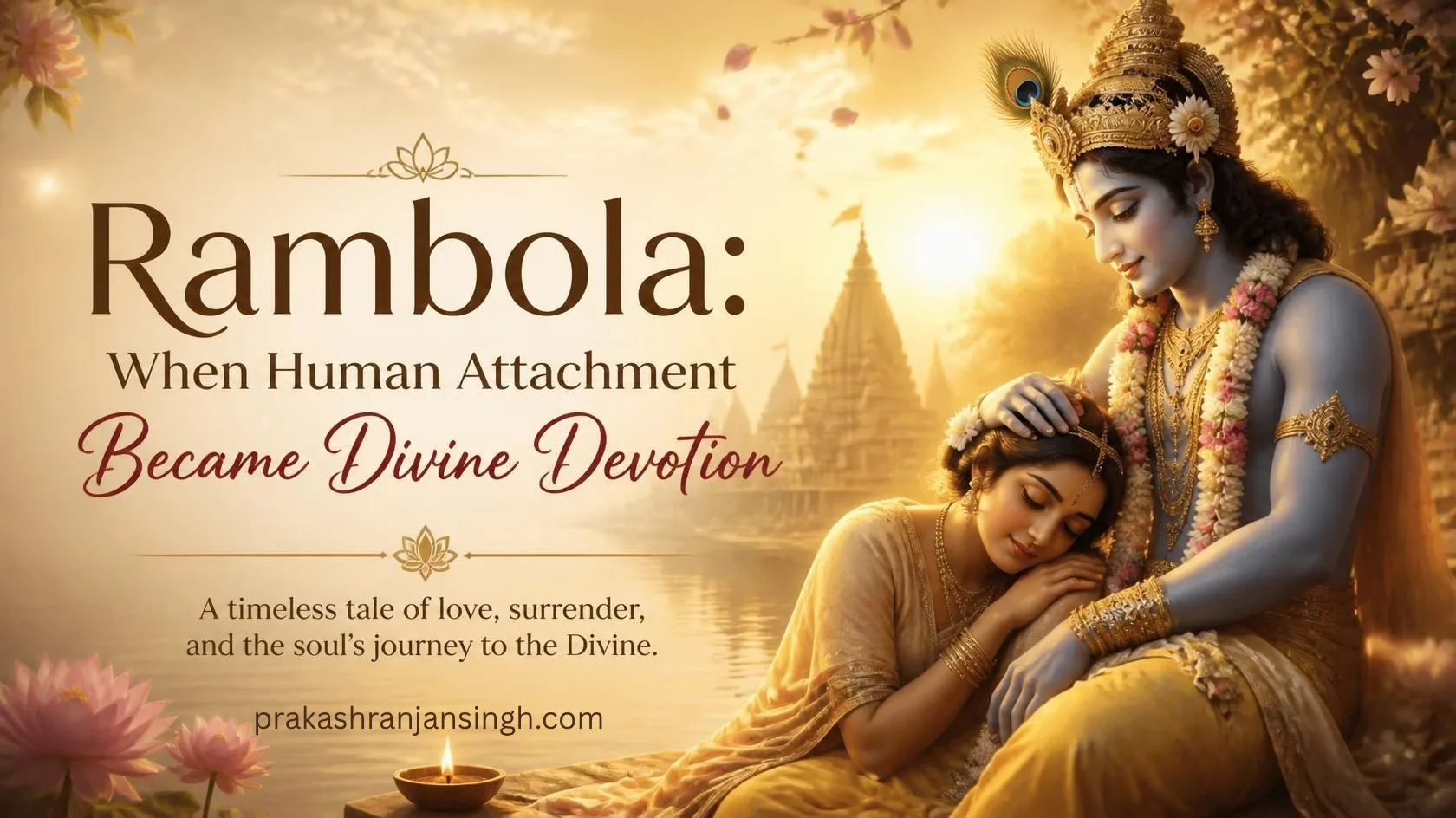
There are moments in human life when a single sentence changes the direction of an entire existence. For Goswami Tulsidas, tradition remembers exactly such a moment.
A man deeply attached to his wife is said to have received a powerful rebuke from her when he crossed extraordinary difficulties just to meet her. Her words, according to the traditional account, forced him to confront a painful question: if he could show such intensity of attachment to a human being, why could that same intensity not be directed towards God?
That emotional shock became a spiritual turning point.
The man known in tradition as Rambola eventually became Tulsidas—one of India’s most influential devotional poets. His Ramcharitmanas, Hanuman Chalisa, Vinaya Patrika, Kavitavali, Gitavali and other works have remained part of India’s religious and cultural consciousness for centuries.
And now, centuries later, the life of Tulsidas is returning to the public imagination through cinema.
Rambola: A Story Waiting for the Screen
In September 2026, filmmaker Vishal Chaturvedi announced RamBola, a film based on the life and legacy of Goswami Tulsidas, produced with Mahaveer Jain Films. The announcement follows the runaway success of Hanuman Ansh, another spiritually themed film by the same director, which became the third highest-grossing Hindi film of 2026 with a worldwide collection nearing ₹300 crore.
The timing is significant. The success of devotional cinema suggests that a section of today’s audience is looking beyond entertainment towards stories of faith, meaning, sacrifice, inner strength and moral direction. RamBola could therefore become much more than a historical biopic on Tulsidas.
If made sensitively, it can become a conversation between 16th-century India and 21st-century India. The central question would not simply be “Who was Tulsidas?” It would be: “What happens when a human being discovers a purpose greater than himself?”
Tulsidas: From Rambola to Mahakavi
Tulsidas is generally regarded as a 16th-century Vaishnava saint-poet, born Rambola Dubey. He is best known for composing the Ramcharitmanas, his devotional retelling of the Ramayana in Awadhi, and is traditionally credited with the immensely popular Hanuman Chalisa. His other important works include Vinaya Patrika, Kavitavali, Gitavali and Dohavali.
The extraordinary contribution of Tulsidas was not simply writing about Lord Ram. He made the story of Ram accessible to ordinary people through a language they could understand and remember. That was a cultural revolution.
Sacred knowledge was no longer confined to scholars who could read Sanskrit. Stories, values, dialogues and ideals could be heard in homes, villages, temples, gatherings and public recitations. The Ramcharitmanas therefore became simultaneously a literary work, a devotional text, a cultural memory and a source of moral instruction. Its influence has continued across generations, and contemporary public discussions frequently describe it as a source of spiritual, moral and social guidance.
The Psychology Behind Tulsidas’ Transformation
The most fascinating aspect of Tulsidas is psychological.
Human beings naturally develop attachments—to people, money, status, possessions, career, family and social recognition. Attachment itself is not necessarily bad. The problem begins when attachment becomes dependence. A person who makes another human being the complete centre of his emotional universe becomes vulnerable to fear, jealousy, disappointment and loss.
The traditional Tulsidas story offers another possibility: attachment can be transformed rather than merely suppressed. The emotional energy once directed towards an individual was redirected towards an ideal. This is psychologically powerful.
Instead of saying “I must stop loving,” the spiritual message becomes “Love more deeply, but direct that love towards something higher.”
That is one reason devotional traditions can be emotionally powerful. Prayer, chanting, storytelling and repeated remembrance provide a person with a structured way of managing emotion, hope and uncertainty.
Why Repeating Ram Matters Psychologically
Modern people sometimes underestimate repetition. But repetition is fundamental to human psychology. What we repeatedly hear, think and speak gradually becomes part of our mental environment.
The repeated chanting of a divine name can therefore function as a form of attention training. When the mind repeatedly returns to one sacred idea, it temporarily moves away from the endless stream of fear, anger, comparison, greed, resentment, insecurity and unnecessary desire.
This does not mean devotional practice is a substitute for medical or psychological treatment when someone has a serious mental-health condition. But as a cultural and spiritual practice, prayer can provide structure, emotional reassurance, community and a sense of meaning.
Tulsidas understood the extraordinary power of simple language, rhythm, narrative and repetition. That may partly explain why his verses travelled so successfully from one generation to another.
Ram as a Psychological Ideal in Tulsidas’ Writing
The greatness of Tulsidas’ Ram is not merely that Ram is worshipped as God. Ram is also presented through qualities that society can understand: duty, restraint, compassion, courage, truthfulness, responsibility and sacrifice.
This creates an important psychological mechanism. Instead of merely telling a person “Be good,” a narrative gives the person a character to observe and imitate. Children learn this way. Adults also learn this way. Stories provide behavioural models.
A society repeatedly exposed to narratives celebrating self-control, responsibility and compassion may find it easier to discuss those values across generations. That is why religious literature can also function as a form of civilisational education.
The Four Purusharthas: A Balanced Life, Not a Life of Rejection
One of the most useful ways to understand the broader Indian philosophical tradition that shaped Tulsidas is through the four Purusharthas.
- Dharma — righteous responsibility. Dharma provides moral direction. It asks: what is the right thing to do?
- Artha — legitimate prosperity. Artha recognises that human beings need economic security, wealth and material resources, and that a society cannot function without productive work and prosperity.
- Kama — legitimate desire and fulfilment. Indian philosophy does not pretend desire does not exist; it attempts to place desire within an ethical framework.
- Moksha — liberation. Moksha represents the highest spiritual aspiration: freedom from bondage and the deeper realisation of the self and ultimate reality.
This fourfold framework is remarkably relevant to modern life. The problem today is not that people seek Artha or Kama. The problem is that they can become disconnected from Dharma and Moksha. Money without ethics can become exploitation. Desire without restraint can become addiction. Success without purpose can become emptiness. And religion without compassion can become merely external ritual.
The devotional vision of Tulsidas can be read as an attempt to place human life within a larger moral and spiritual framework.
What Modern Families Can Learn From Tulsidas
Today’s family is facing a new psychological environment. Children grow up with smartphones. Young adults compare their lives with thousands of strangers on social media. Career competition has intensified. Consumerism constantly creates new desires. Credit makes immediate consumption easier. Loneliness can exist even inside crowded cities.
In such an environment, families need more than academic education—they need value education. This is where Tulsidas can become relevant again.
Reading or listening to the Ramcharitmanas need not mean forcing religious belief upon children. Parents can instead discuss its questions:
- What is duty?
- Why should power have limits?
- What happens when ego becomes excessive?
- Why is keeping a promise difficult but valuable?
- What is the difference between desire and responsibility?
- Can success exist without character?
These questions are universal.
Why the Film Could Connect With the Common Man
The story of Tulsidas contains something modern cinema often struggles to create: a genuine inner transformation. He was not presented as someone born with a complete understanding of his destiny. He experienced human emotions. He experienced attachment. He experienced pain. And according to devotional tradition, he ultimately transformed those experiences into spiritual energy.
That makes his journey relatable. A struggling employee can relate to disappointment. A parent can relate to attachment. A young person can relate to confusion. A person facing failure can relate to searching for meaning. An elderly person can relate to spiritual reflection.
The common man does not necessarily need a superhero. Sometimes he needs to see an ordinary human being who discovers extraordinary purpose.
Could RamBola Become Another Blockbuster?
It is too early to predict the commercial outcome. But the success of Hanuman Ansh has demonstrated that devotional and spiritually themed cinema can find a substantial audience—its box-office trajectory and strong word-of-mouth growth made it one of 2026’s biggest Hindi hits.
RamBola has one additional advantage: Tulsidas is not merely a religious figure; he is a storyteller. His own life is already structured like a screenplay:
Attachment → crisis → awakening → transformation → devotion → creation → legacy.
If the film concentrates only on miracles, it could become another devotional spectacle. But if it concentrates on human psychology, it could become something much more powerful.
The audience should see the conflict inside Rambola. They should see his emotional vulnerability. They should see his struggle between worldly attachment and spiritual aspiration. They should witness the loneliness of transformation. And finally, they should understand how a man’s inner revolution produced literature that outlived him by centuries.
The Social Impact Could Be Greater Than the Box Office
The real success of RamBola should not be measured only in crores. Imagine if a young viewer leaves the theatre and starts reading the Ramcharitmanas. Imagine if a family begins discussing the meaning of Dharma. Imagine if parents introduce children to Hanuman Chalisa while also explaining its values rather than treating it merely as a ritual. Imagine if someone going through personal failure discovers that disappointment can become the beginning of a new chapter.
That would be a cultural return on investment far greater than ticket sales.
Tulsidas and the Challenge of Modern India
India today possesses extraordinary technology but faces an equally extraordinary crisis of attention. People have more information but often less wisdom. More communication but sometimes less conversation. More entertainment but sometimes less meaning. More material opportunity but sometimes greater anxiety.
This is why India’s old literature deserves a fresh reading—not as unquestionable instruction, not merely as ritual, but as a repository of psychological, ethical and philosophical questions. Tulsidas belongs in that conversation.
His message can be interpreted as a movement: from attachment to love, from desire to discipline, from ego to humility, from confusion to purpose, from personal suffering to creative contribution.
The Greatest Lesson: Transform Yourself Before Trying to Transform Society
Perhaps the most powerful lesson from Tulsidas is simple: society does not change only through laws, it changes through people. A disciplined individual creates a disciplined family. A responsible family creates responsible children. Responsible citizens create stronger institutions. And ethical institutions create a stronger nation.
Tulsidas did not possess modern technology, television, social media or cinema. He possessed something else: a powerful idea, a deep devotion and the ability to communicate with ordinary people. His words travelled across centuries because they addressed something that technology cannot eliminate—the human search for love, meaning, identity, hope and God.
That is why the forthcoming RamBola may be more than another historical film. It could become an opportunity for India to ask itself an old but increasingly urgent question: in a world teaching us how to acquire more, who will teach us how to become more?
Perhaps the answer is waiting in the story of a man once known as Rambola, who transformed his deepest human attachment into devotion to Shri Ram—and then transformed that devotion into literature that continues to live in millions of hearts. That is the real story of Tulsidas. Not merely the story of a poet. Not merely the story of a saint. But the story of human transformation.
Key Takeaways
- Tulsidas, born Rambola Dubey, transformed a personal rebuke from his wife into the devotional energy that produced the Ramcharitmanas and the Hanuman Chalisa.
- Filmmaker Vishal Chaturvedi has announced RamBola, a biopic on Tulsidas, following the runaway success of his earlier film Hanuman Ansh.
- The story models a psychological shift—redirecting attachment towards a higher ideal—rather than simply suppressing emotion.
- The four Purusharthas (Dharma, Artha, Kama, Moksha) frame a balanced life rather than a life of renunciation or excess.
- The lasting lesson of Tulsidas is that personal transformation, not law alone, is what changes families, institutions and nations.
Frequently Asked Questions About Tulsidas and RamBola
Who was Tulsidas, and why is his birth name Rambola significant?
Tulsidas was a 16th-century Vaishnava saint-poet born Rambola Dubey. The name Rambola is significant because it represents the ordinary, attachment-driven man he was before a personal crisis redirected his devotion towards Ram—the transformation the new film RamBola is built around.
What is the RamBola film about?
RamBola is a film announced in September 2026 by director Vishal Chaturvedi and Mahaveer Jain Films, based on the life and spiritual transformation of Goswami Tulsidas. It follows Chaturvedi’s earlier hit, Hanuman Ansh.
Why did Hanuman Ansh succeed at the box office?
Hanuman Ansh became one of the highest-grossing Hindi films of 2026, with a worldwide collection nearing ₹300 crore, suggesting strong audience appetite for spiritually themed cinema built around faith, meaning and inner transformation.
What are the four Purusharthas in Tulsidas’ philosophical framework?
The four Purusharthas are Dharma (righteous responsibility), Artha (legitimate prosperity), Kama (legitimate desire and fulfilment) and Moksha (liberation)—together describing a balanced human life rather than one of rejection or excess.
Related Reading
- The Neem Karoli Baba Phenomenon: Divine Grace, Himalayan Energy and the Psychology of Faith
- Hanuman Ansh: Why Is the World Suddenly Looking Towards Neem Karoli Baba?
- Sunderkand: The Power of Faith, Sound and the Human Mind
- Rudrabhishek: Where Faith Meets Science, Psychology and the Wisdom of Ancient India
- Master Your Mind Before You Master Your Life
- Tulsidas — Wikipedia

Leave a Reply