

AI job cuts in India may be trading tomorrow’s growth for today’s profit: cutting headcount to cut costs also cuts household spending power, and since consumer demand drives the very growth companies are chasing, unchecked workforce reduction risks a slow economic cycle where lower employment feeds lower demand feeds slower business growth.
The impact of layoffs on the economy runs through household income. Every salary removed is demand removed: families delay EMIs, homes and purchases, and companies later feel it in their own sales. In India this matters because households account for roughly three out of five rupees of GDP, as the data below shows.
The rapid adoption of Artificial Intelligence (AI), automation, and digital technologies has become the defining trend of the modern corporate world. Across industries, organizations are announcing workforce reductions in the name of improving efficiency, reducing costs, and preparing for an AI-driven future. While technological advancement is inevitable and often beneficial, an uncomfortable question deserves serious attention: Can an economy continue to prosper if technology consistently replaces people faster than it creates new opportunities?
For decades, technology has transformed industries and improved productivity. History also shows that many technological revolutions eventually created new kinds of employment. However, the AI revolution is different in one important respect. Unlike earlier waves of automation that primarily replaced manual labour, AI has the potential to automate a significant share of knowledge-based and white-collar work as well. Banking, customer service, software development, finance, legal support, healthcare administration, media, and education are all witnessing unprecedented disruption.
Key Takeaways
- AI job cuts in India may be trading tomorrow’s growth for today’s profit — cutting headcount also cuts household spending power.
- Lower employment reduces consumption, which lowers demand, slowing production and investment in a cycle that ultimately hits corporate revenues.
- The most actionable fix: pair automation with investment in reskilling, lifelong learning, and workforce transition rather than relying solely on layoffs.
Table of Contents
- AI Workforce Reduction: Why Are Companies Cutting Jobs So Aggressively?
- How Do AI Job Cuts in India Become a Vicious Economic Cycle?
- Is AI Itself the Problem?
- What Does India Specifically Need to Get Right?
- What Is the Impact of Layoffs on the Economy? Why Household Spending Matters for India
- What Does the Evidence Say About AI, Jobs and Reskilling?
- What 5 Questions Should a Board Ask Before AI-Led Job Cuts?
AI Workforce Reduction: Why Are Companies Cutting Jobs So Aggressively?
Many corporations argue that reducing headcount is necessary to remain globally competitive. Investors often reward companies that report lower operating costs and higher productivity. Yet, this focus on short-term financial performance may overlook the long-term consequences for the economy itself.
A large-scale reduction in employment directly affects household income. When thousands of experienced professionals lose their jobs or face stagnant wages, their purchasing power inevitably declines. Families postpone buying homes, vehicles, consumer goods, and discretionary products. Spending on education, healthcare, travel, and entertainment also slows. Since consumer spending is one of the strongest drivers of economic growth, weaker demand eventually affects the very businesses that initially benefited from cost-cutting.
How Do AI Job Cuts in India Become a Vicious Economic Cycle?
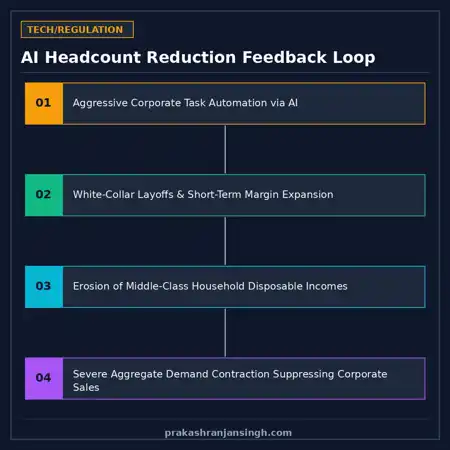
This creates a difficult economic cycle. Lower employment reduces consumption. Reduced consumption lowers demand. Lower demand slows production and investment. Slower business growth ultimately affects corporate revenues and profitability. In attempting to maximize efficiency today, companies may inadvertently weaken the customer base that sustains their business tomorrow.
The situation is equally challenging for employees who retain their jobs. Many professionals report increasing workloads, greater performance expectations, and continuous pressure to learn new technologies simply to remain employable. Continuous learning is valuable and necessary in a changing world, but when combined with unrealistic targets, constant restructuring, and fear of redundancy, it can contribute to stress, burnout, and declining morale. An organization that relies on a workforce under persistent anxiety may achieve short-term gains but risk losing creativity, loyalty, and institutional knowledge.
Another significant concern is the return on investment in AI itself. Implementing advanced AI systems requires substantial expenditure on infrastructure, software, cloud computing, cybersecurity, consulting, and employee training. These investments are often justified by expectations of future productivity gains. However, if economic growth slows because consumer demand weakens, companies may find that recovering these investments takes longer than anticipated. The challenge becomes even greater during periods of global economic uncertainty or recession, when customers reduce spending and businesses postpone expansion.
The scale of AI-linked job cuts in India is still being measured, and the data is patchy. One reported data point: an IANS report of 25 April 2026, citing company disclosures and NASSCOM, said the combined headcount of five large IT firms (TCS, Infosys, HCLTech, Wipro and Tech Mahindra) fell by 7,389 in FY26, after a net addition of 12,718 in FY25. Not every reduction is caused by AI, since weak client demand and restructuring play a part, but the direction matters for anyone reading about AI-linked layoffs and careers.
Is AI Itself the Problem?
This does not mean AI is harmful or that technological progress should be resisted. AI has enormous potential to improve healthcare, scientific research, agriculture, education, manufacturing, financial services, and public administration. It can eliminate repetitive tasks, improve accuracy, enhance safety, and enable workers to focus on higher-value activities. The issue is not AI itself but how societies choose to implement it.
The real challenge is ensuring that technological progress remains human-centred. Governments, corporations, educational institutions, and industry associations must work together to prepare the workforce for changing skill requirements. Investment in reskilling, lifelong learning, entrepreneurship, and new industries should accompany automation. Companies that benefit from productivity gains should also invest meaningfully in workforce transition rather than relying solely on layoffs as the primary strategy.
Corporate leadership must also reconsider how success is measured. Sustainable businesses are built not only on quarterly profits but also on experienced employees, loyal customers, innovation, and social trust. Experienced professionals possess institutional knowledge, mentorship capabilities, and problem-solving skills that cannot always be replicated by algorithms. Replacing them solely because newer employees are less expensive may produce accounting gains while weakening organizational resilience.

What Does India Specifically Need to Get Right?
India stands at a crucial stage of its economic journey. With aspirations of becoming a developed nation, the country needs both technological leadership and widespread employment. AI should become a tool that enhances human capability rather than one that excludes large sections of the workforce from economic participation. Growth that benefits only a limited segment of society cannot remain sustainable for long.
The future should not become a choice between technology and people. The true measure of progress lies in combining innovation with inclusion. AI should increase national productivity while creating new opportunities, strengthening consumer confidence, and improving quality of life. If policymakers and corporate leaders fail to maintain this balance, today’s efficiency gains could become tomorrow’s economic and social challenge.
Avoiding careless AI job cuts in India is central to this. The AI revolution should be guided by a simple principle: technology must serve humanity, not replace its economic foundation. Sustainable development is achieved when innovation creates prosperity that is broadly shared, ensuring that economic growth, corporate success, and social stability advance together rather than at each other’s expense.
What Is the Impact of Layoffs on the Economy? Why Household Spending Matters for India
Private final consumption expenditure was about 61.4% of India’s GDP in FY25 in nominal terms, up from 60.2% in FY24, according to the Ministry of Finance’s monthly economic report. In plain words, roughly three out of every five rupees of national output are bought by households. When a company cuts salaries from its cost base, it removes a small part of that demand, and if many companies do it together, the effect is no longer small.
As a banker, I look at this through credit. A salaried family’s home loan, car loan and credit card dues are serviced out of a monthly pay cheque. A job is, in effect, the collateral behind most retail loans. Sudden, large-scale job loss in a sector therefore does not only reduce spending. It also raises the risk of delayed EMIs, and lenders respond by tightening credit, which reduces demand further. This is the same loop described above, seen from the lender’s side.
What Does the Evidence Say About AI, Jobs and Reskilling?
The honest answer is that the evidence points in two directions. The World Economic Forum’s Future of Jobs Report 2025 projects about 170 million new roles and about 92 million displaced roles globally by 2030, a net gain of roughly 78 million. The same report says 41% of employers plan to reduce staff where AI can automate tasks, and that about 59 of every 100 workers will need reskilling or upskilling by 2030, with 11 of them unlikely to receive it.
Read together, these numbers say that AI may create more jobs than it removes over time, but the people who lose a job and the people who get the new one are often not the same, and they are not in the same city or age group. These are projections, not guarantees. The risk is in the transition, which is exactly where companies, banks and the State have to invest. The same logic applies to the fear that follows cost-cutting inside organisations.
What 5 Questions Should a Board Ask Before AI-Led Job Cuts?
In a credit committee, no proposal is approved without hard questions. The same discipline would help boards before they approve an AI-led reduction. Here are five I would insist on.
- Is the saving permanent? If the roles return later through contractors or rehiring, the saving was a one-off.
- Who can be redeployed or reskilled instead? Retraining an experienced employee is often cheaper than losing the knowledge.
- What happens to our own demand? If our customers are employees of companies doing the same thing, we are cutting our market.
- Which institutional knowledge are we losing? Mentors, client memory and process know-how rarely appear in a cost sheet.
- How will we measure the AI return in rupees after 12 months? If the benefit cannot be measured, the cut was a bet, not a plan.
Frequently Asked Questions
Why are companies cutting jobs so aggressively with AI?
Corporations argue that reducing headcount keeps them globally competitive, and investors often reward companies reporting lower operating costs and higher productivity, but this focus on short-term financial performance can overlook long-term consequences for the economy.
What is the impact of layoffs on the economy?
Lower employment reduces consumption, reduced consumption lowers demand, and lower demand slows production and investment — ultimately hurting the corporate revenues that cost-cutting was meant to protect.
Is AI itself the problem?
No — the issue is not AI itself but how it’s implemented. AI has enormous potential to improve healthcare, agriculture, and public administration; the real challenge is ensuring technological progress remains human-centred through reskilling and workforce transition investment.
How much of India’s GDP comes from household spending?
Private final consumption expenditure was about 61.4% of GDP in FY25 in nominal terms, up from 60.2% in FY24, according to the Ministry of Finance’s monthly economic report. That is why a large fall in household incomes would be felt across many sectors.
Will AI create more jobs than it destroys?
The World Economic Forum’s Future of Jobs Report 2025 projects about 170 million new roles and 92 million displaced roles globally by 2030, a net gain of about 78 million. It also says 41% of employers plan to reduce staff where AI automates tasks. These are projections, and the pain falls in the transition, which is why reskilling matters.
Related Reading
- The Leadership Pipeline Crisis: How Artificial Intelligence Could Reshape Human Experience, Creativity, and Economic Growth
- The Psychology of Survival in the Corporate World
- Master Your Mind Before You Master Your Life
- The AI Paradox: Are We Building Smarter Machines While Making Our Own Brains Less Active?
- The New Rules of Corporate Survival: How Employees Can Thrive in an Age of Layoffs, Artificial Intelligence, and Economic Uncertainty

Leave a Reply