

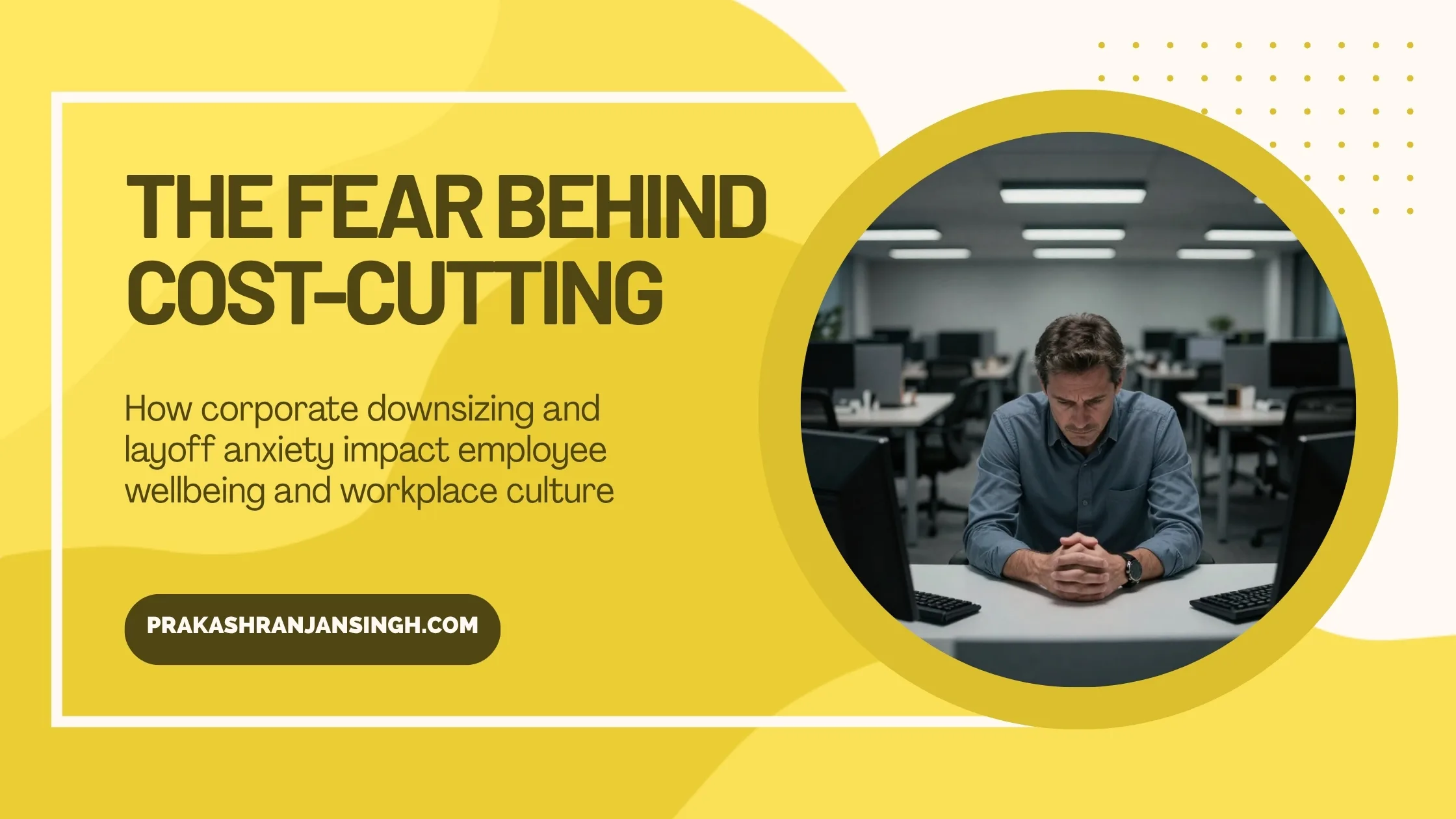
Layoff survivor syndrome is the anxiety, guilt and loss of trust that employees who keep their jobs feel after cost cuts, and it makes them more cautious, slower to decide and less committed. This post explains how it works, the five hidden costs it creates for companies, and a fairer way to restructure.
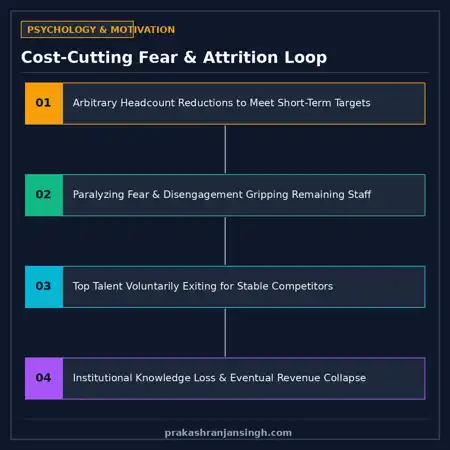
Cost cutting fear doesn’t just eliminate jobs — it quietly changes how the remaining employees think and act: fear pushes people toward caution over innovation, slower decisions, and defensive rather than creative work, and the savings companies book today often turn into hidden costs of lost institutional knowledge tomorrow.
Across the corporate world, the pursuit of efficiency has become one of the highest priorities. Every quarter, organizations are under pressure to improve profitability, reduce operational expenses, and satisfy shareholders. Cost control is undoubtedly an essential part of responsible management. However, when cost reduction becomes the primary objective, organizations may unintentionally create a workplace culture driven more by fear than by innovation.
Key Takeaways
- Cost cutting fear doesn’t just eliminate jobs – it quietly changes how remaining employees think and act, pushing them toward caution over innovation.
- During restructuring, senior employees are often targeted for their higher salaries, which can mean losing valuable institutional knowledge, mentorship, and operational experience.
- Restructuring should be accompanied by fairness, transparency, reskilling opportunities, and clear communication so employees understand and support difficult decisions.
Table of Contents
Why Are Experienced Employees Feeling More Anxious?
One of the most noticeable consequences of this trend is the growing anxiety among experienced employees. Many professionals who have devoted the most productive years of their lives to an organization increasingly feel that loyalty and long service no longer guarantee security. During restructuring exercises, senior employees often become the focus because of their comparatively higher salaries. While such decisions may provide immediate financial relief, they can also result in the loss of valuable institutional knowledge, mentorship, and operational experience.
The psychological impact of this uncertainty extends far beyond those who lose their jobs. Employees who remain in the organization frequently begin working under the constant fear that a single mistake, an unavoidable business loss, or an unexpected economic downturn could threaten their careers. This fear gradually changes workplace behaviour.
Cost Cutting Fear: How Does It Actually Change Day-to-Day Work?
Instead of encouraging initiative, employees may become excessively cautious. Decision-making slows down. Innovation declines because people avoid taking calculated risks. Many prefer following routine procedures rather than proposing new ideas that might fail. The organization may appear disciplined on the surface, but beneath that discipline lies a workforce operating in defensive mode instead of creative mode.
This phenomenon has important behavioural implications. Human beings perform at their best when they feel trusted, respected, and psychologically safe. Fear may improve short-term compliance, but it rarely produces long-term excellence. Employees begin documenting every action, seeking multiple approvals, and avoiding responsibility for difficult decisions. While these practices reduce individual risk, they also increase bureaucracy and delay execution.
What Does This Do to the Wider Economy?
The financial implications are equally significant. Employees worried about job security often reduce discretionary spending, postpone major purchases, and increase precautionary savings. When millions of middle-class households simultaneously become more conservative in their spending, demand for goods and services may weaken. Household spending is the largest component of India’s GDP, at about 61.5 percent in 2025-26 according to reporting on the Economic Survey 2026. A prolonged decline in consumer confidence can therefore affect multiple sectors, from housing and automobiles to retail, travel, and hospitality.
The social consequences deserve equal attention. Job insecurity creates stress not only for employees but also for their families. Parents become anxious about education expenses, healthcare costs, housing loans, and retirement planning. Prolonged uncertainty may affect mental well-being, family relationships, and overall quality of life. Young professionals observing such trends may also begin questioning the value of long-term commitment to any single employer, leading to declining organizational loyalty.
Can Cost-Cutting Actually Backfire on the Organization Itself?
From an organizational perspective, excessive cost-cutting may sometimes become self-defeating. Experienced employees possess deep customer knowledge, technical expertise, and an understanding of internal systems that cannot be replaced overnight. When such employees leave, organizations often spend years rebuilding capabilities through recruitment, training, and correcting avoidable mistakes. What appears as a saving today may become a hidden cost tomorrow.
Political leaders and policymakers also have an interest in this issue. A country’s economic ambitions depend not only on investment and infrastructure but also on the confidence of its workforce. If widespread employment insecurity discourages initiative and productivity, economic momentum could be affected. Although many factors influence GDP—including technology, trade, government policy, and global conditions—a workforce operating under persistent fear may contribute to slower productivity growth.
So What’s the Better Way to Restructure?
This does not imply that organizations should avoid restructuring altogether. Markets evolve, technologies change, and businesses must remain competitive. However, restructuring should be accompanied by fairness, transparency, reskilling opportunities, and clear communication. Employees are more likely to support difficult decisions when they understand the reasons behind them and believe they are being treated with dignity.
Leaders can also strengthen psychological safety by distinguishing between genuine negligence and honest mistakes made while performing one’s duties. Organizations that encourage responsible risk-taking, continuous learning, and open communication are generally better positioned to innovate than those governed primarily through fear.
Employees, too, have a responsibility to adapt. Continuous learning, digital upskilling, ethical conduct, collaboration, and resilience have become essential professional qualities. In an evolving business environment, employability increasingly depends on the willingness to learn and contribute beyond traditional job descriptions.
The future of corporate success lies in achieving a balance between financial discipline and human capital. Profitability and employee confidence are not opposing goals; they are complementary. Organizations that protect trust while pursuing efficiency often retain talent, improve innovation, and build stronger long-term competitiveness.
A nation aspiring to become a global economic powerhouse cannot rely solely on investment, technology, or policy reforms. Its greatest strength remains its people. When employees work with confidence rather than fear, they make quicker decisions, solve problems creatively, serve customers better, and contribute more effectively to economic growth.
Cost control is necessary. But confidence is equally valuable. Sustainable growth will come not from creating fearful workplaces, but from building organizations where financial prudence and human dignity progress together.
What Is Layoff Survivor Syndrome? Research and Real Examples
The pattern is well documented. Researchers who study layoffs describe “survivor syndrome”: employees who keep their jobs often feel anxiety, guilt and lower trust in management, and respond by becoming more cautious and less committed. In a 2004 study in Administrative Science Quarterly, Joel Brockner and colleagues found that layoffs lowered survivors’ organizational commitment and, where survivors felt highly threatened, their job performance, and that a high sense of control softened both effects (Columbia Business School summary). Layoff survivor syndrome is therefore a measurable effect, not just a mood. Google’s long-running study of its own teams, published on its re:Work site, found psychological safety, the belief that you will not be punished for speaking up or making an honest mistake, to be the most important dynamic of effective teams. Fear does the opposite.
India has seen the senior-employee concern play out in public. In July 2025, TCS announced that it would reduce about 2 percent of its workforce, roughly 12,000 people, mostly at mid and senior levels, as The Week reported. Whatever the business logic, such announcements unsettle everyone who stays, which is why the myth of job security keeps getting tested.
5 Hidden Costs Companies Miss When Fear Drives Cost Cutting
- Lost institutional knowledge. Senior people carry customer history, workarounds and the reasons behind old decisions. None of it sits in a spreadsheet.
- Slower decisions. When a mistake can end a career, every file needs three approvals. Speed, which cost cutting was meant to improve, falls.
- Less innovation. People stop proposing ideas that might fail, so the organisation stops learning.
- Rehiring and retraining bills. Good people with options leave first. Recruiting, onboarding and correcting avoidable errors can cost more than the salary that was saved.
- Weaker household demand. When insecure families postpone purchases and save more, the shortfall eventually returns to companies as lower sales.
To limit layoff survivor syndrome, before approving any cut, leaders can ask four simple questions. Whose knowledge are we losing? Who will decide faster or slower afterwards? Have we explained the reason honestly? And what is the plan to rebuild skills for those who stay? Our post on the second half of a career looks at the same issue from the employee’s side.
Frequently Asked Questions
How does cost cutting fear change day-to-day work?
Instead of encouraging initiative, fear makes employees excessively cautious. Decision-making slows down, innovation declines as people avoid calculated risks, and employees begin documenting every action and seeking multiple approvals, which increases bureaucracy and delays execution.
Can excessive cost-cutting actually backfire on a company?
Yes. Experienced employees carry deep customer knowledge, technical expertise, and understanding of internal systems that cannot be replaced overnight. When they leave, organizations often spend years rebuilding those capabilities, turning today’s savings into tomorrow’s hidden cost.
What is a better way for companies to restructure?
Restructuring should be accompanied by fairness, transparency, reskilling opportunities, and clear communication, since employees are more likely to support difficult decisions when they understand the reasons and are treated with dignity. Distinguishing genuine negligence from honest mistakes also helps preserve psychological safety.
What is layoff survivor syndrome?
Employees who keep their jobs after layoffs often feel anxiety, guilt and reduced trust in management, and respond by becoming more cautious and less committed. Researchers call this layoff survivor syndrome, and it is one reason cost cuts can reduce productivity instead of improving it.
Why does job insecurity matter for the Indian economy?
Household spending is the largest part of India’s GDP, at about 61.5 percent in 2025-26 according to reporting on the Economic Survey 2026. When insecure families postpone purchases and save more, demand weakens across housing, autos, retail and travel.

Leave a Reply