

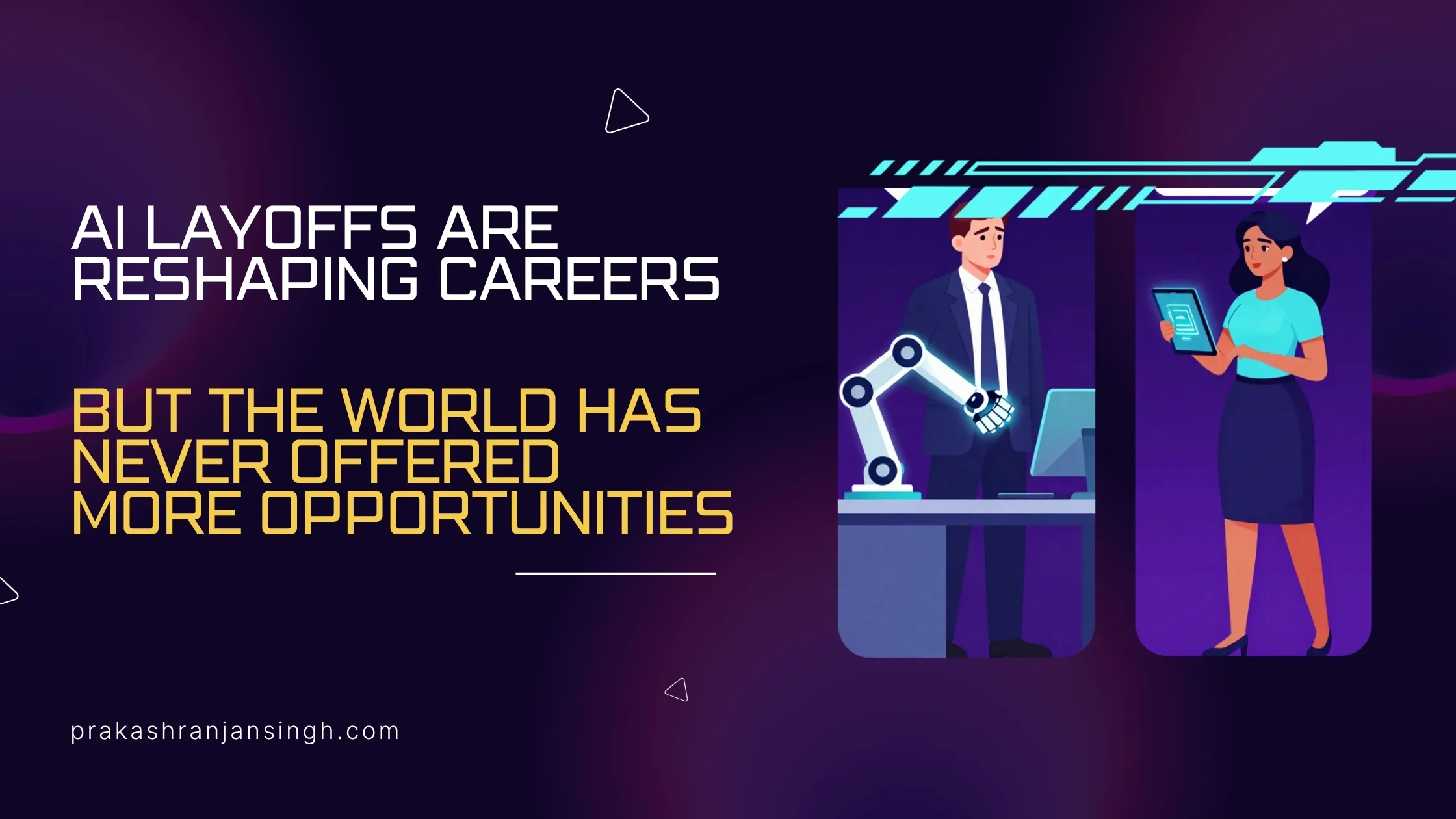
AI layoffs are reshaping careers at major tech companies and creating real fear, but history shows every technological revolution destroys some jobs while creating new ones — remote-first hiring, global talent platforms, and new fields like prompt engineering and AI governance mean the real employability question has shifted from “who will hire me” to “what value can I deliver.”
How to protect your job from AI layoffs in India: start with the tasks you do, not your job title. Automate one task with an AI tool, build two or three proofs of work, keep a cash cushion and add a skill that AI is slow to copy. The full plan is in the six steps below, and the World Economic Forum data on jobs created and displaced is in the data section.
Artificial Intelligence has become one of the most disruptive technologies of the 21st century. Across industries, companies are automating repetitive tasks, redesigning workflows, and improving productivity through AI. While these advances are driving innovation, they have also resulted in layoffs and workforce restructuring across several large technology companies as they adapted to changing business priorities and increased investments in AI.
These headlines have understandably created fear among professionals. Many employees worry that AI will replace their jobs and make their experience obsolete. However, history tells a different story. Every major technological revolution has eliminated some roles while creating entirely new industries and professions. The AI revolution is following the same pattern.
The biggest mistake a professional can make today is to think that the old employment model will return. Instead of resisting change, individuals must adapt to the new reality. The future belongs to those who continuously learn, upgrade their skills, and remain open to new ways of working.
Key Takeaways
- AI layoffs are reshaping careers at major tech companies, but history shows every technological revolution destroys some jobs while creating new ones.
- New fields like prompt engineering, AI governance, and machine learning operations are among the fastest-growing careers created directly by the AI revolution.
- The most actionable fix: the real employability question has shifted from “who will hire me” to “what value can I deliver.”
Table of Contents
- How Has Remote Work Changed the Global Job Market?
- What Do Employers Actually Look for Now?
- What Does This Mean Specifically for India?
- What Does the Data Say About Jobs Lost and Jobs Created?
- How Are AI Layoffs Reshaping Careers Into New Opportunities?
- How to Protect Your Job from AI Layoffs: 6 Steps for the Next 90 Days
How Has Remote Work Changed the Global Job Market?
One of the most significant transformations is the rapid growth of remote employment. The COVID-19 pandemic accelerated remote work, but even after the pandemic, many organizations discovered that distributed teams could operate efficiently and access talent from across the globe. Today, thousands of companies hire professionals regardless of where they live.
Several global organizations have adopted remote-first or fully distributed work models, while many other well-known technology and consumer companies have introduced flexible hybrid work policies. These organizations are proving that talent is no longer limited by geography.
As a result, dedicated remote hiring platforms have flourished, connecting professionals with employers seeking talent from around the world. Every day, thousands of remote positions are posted in software development, customer support, finance, marketing, design, data analytics, cybersecurity, consulting, education, and content creation.
What Do Employers Actually Look for Now?
The hiring process itself has also changed dramatically. A traditional résumé alone is often no longer enough. Recruiters increasingly look for evidence of practical ability. They want to see completed projects, portfolios, certifications, code repositories, writing samples, case studies, client testimonials, measurable achievements, and proof that a candidate can solve real business problems.
This shift demands a new psychology. Instead of asking, “Who will employ me?”, professionals should ask, “What value can I deliver?” The answer to that question determines employability in the AI era.
Remote work offers numerous advantages. It reduces geographical barriers, eliminates the need for relocation in many roles, saves commuting time, and allows professionals to compete in a global marketplace. Skilled individuals may also diversify their income through consulting, freelancing, or contract work, reducing dependence on a single employer.
Success in this environment, however, requires more than technical expertise. Personal branding, communication skills, negotiation, networking, consistency in applying for opportunities, and a willingness to continuously learn are equally important. Building a strong professional profile, maintaining an online portfolio, contributing to open-source projects, publishing articles, or showcasing professional achievements can significantly improve visibility among recruiters.
What Does This Mean Specifically for India?
For India, this transformation represents a historic opportunity. India has one of the world’s largest pools of educated young professionals, with strong capabilities in technology, finance, engineering, customer support, and digital services. As organizations increasingly embrace global remote hiring, Indian professionals can contribute to international companies without leaving the country. This can generate employment, increase foreign income, and strengthen India’s position as a global knowledge hub.

What Does the Data Say About Jobs Lost and Jobs Created?
Headlines about layoffs are loud, and data is quiet, so it helps to look at the numbers. The World Economic Forum’s Future of Jobs Report 2025, based on employer surveys, projects that 170 million new roles will be created by 2030 while 92 million are displaced, a net gain of 78 million. That is not a promise, and the transition will be uneven, but it is a very different picture from “AI will end work”.
- Employers are split but leaning to upskilling. The same report finds that 41% of employers plan to reduce staff where AI can automate tasks, while 77% plan to upskill their workforce.
- Skills are changing fast. Nearly 40% of on-the-job skills are expected to change by 2030, and the WEF estimates that 59 of every 100 workers will need reskilling or upskilling, with 11 of them unlikely to get it.
- Some roles shrink. Cashiers, administrative assistants and graphic designers are among the fastest-declining jobs in the report. Fast-growing ones include AI and big data specialists, cybersecurity, and also care roles such as nursing, where human presence matters.
India feels this directly. In July 2025, TCS announced it would cut about 12,000 roles, roughly 2% of its workforce and mainly in middle and senior management. The company described it as a restructuring toward AI-driven services, and it also came amid weak quarterly results and cautious client spending. So it is wise not to blame every layoff on AI alone. Budget pressure, slower demand and a changing business model are often mixed together.
The wider labour data shows why skills matter. MoSPI’s Periodic Labour Force Survey Annual Report 2025 puts overall unemployment at 3.1% but youth (15 to 29 years) unemployment at 9.9%, and notes that 67.8% of adults aged 15 and above have at least secondary education. Education is widespread. What separates people in the market is demonstrable skill.
How Are AI Layoffs Reshaping Careers Into New Opportunities?
Artificial Intelligence is also creating entirely new career paths. Prompt engineering, AI implementation, cloud computing, cybersecurity, AI governance, machine learning operations, automation consulting, digital marketing, data science, and AI-assisted content creation are among the fastest-growing fields. Rather than eliminating work altogether, AI is changing the nature of work and increasing demand for people who can collaborate effectively with intelligent technologies.
The greatest challenge, therefore, is not AI itself but human psychology. Fear of change often prevents people from seeing new possibilities. Professionals who spend their time worrying about layoffs may miss the opportunities emerging around them. Those who embrace lifelong learning, remain adaptable, and continuously upgrade their skills will be better positioned to thrive.
How to Protect Your Job from AI Layoffs: 6 Steps for the Next 90 Days
Fear is useless unless it turns into a plan. Here is a practical sequence I would give anyone worried about their job, whatever their field.
- List your tasks, not your job title. Write down what you actually do in a week and mark which tasks an AI tool could already do reasonably well. This tells you where you are exposed.
- Automate one task with AI this month. Pick a report, a draft or a data cleanup in your current work and do it with an AI tool, then check the result yourself. Becoming the person who uses the tool well is safer than competing against it.
- Build two or three proofs of work. A short case study, a spreadsheet model, a dashboard, a written analysis. Recruiters now look for evidence, not only a résumé.
- Strengthen your cash cushion. From a banker’s point of view, the biggest damage in a layoff comes from forced decisions. A reserve covering several months of expenses, kept in liquid savings, and manageable EMIs give you time to choose well.
- Make your work visible. Update your professional profile, share what you are learning, and talk to people in the field you want to move into. Many openings are filled through people who already know your work.
- Add a second skill that AI does not replace. Communication, negotiation, domain judgement and client handling are slow for machines to copy. Combine one of them with a technical skill.
None of this requires a new degree. It requires consistency, and a willingness to be a beginner again.
AI layoffs are reshaping careers, not ending them. They should be viewed as a reminder that learning never stops. In today’s world, employability depends less on the employer and more on the individual’s ability to create value.
The AI age is not an age of unemployment—it is an age of transformation. Those who refuse to adapt may struggle, but those who embrace change will discover opportunities that previous generations could never have imagined.
The message is clear: build skills, create a portfolio, strengthen your communication, develop a global mindset, and never stop learning. The world is no longer your local job market—it is your workplace.
The future belongs to those who transform uncertainty into opportunity and see every technological disruption not as a threat, but as an invitation to reinvent themselves.
Frequently Asked Questions
How can I protect my job from AI layoffs in India?
Audit which of your weekly tasks AI could already do, automate one yourself, build two or three proofs of work, keep several months of expenses in liquid savings and add a skill AI copies slowly, such as negotiation or client handling. Remote hiring platforms also let Indian professionals apply for global roles.
What do employers actually look for now?
A traditional resume alone is often no longer enough. Recruiters increasingly look for evidence of practical ability like completed projects, portfolios, certifications, and proof that a candidate can solve real business problems.
What new careers is AI actually creating?
Prompt engineering, AI implementation, cloud computing, cybersecurity, AI governance, machine learning operations, and AI-assisted content creation are among the fastest-growing fields created directly by the AI revolution.
Will AI create more jobs than it destroys?
The World Economic Forum’s Future of Jobs Report 2025 projects 170 million new roles and 92 million displaced roles by 2030, a net gain of 78 million. These are employer-survey projections, and the transition will be uneven across roles and regions.
What should I do first if I fear an AI layoff?
List the tasks you do in a week and mark which an AI tool could already do. Then automate one of them yourself, build two or three proofs of work, and strengthen your cash cushion so that you are not forced into rushed decisions.
Related Reading
- The New Rules of Corporate Survival
- Justice Delayed Is Justice Denied
- Will Technology Be Controlled by Humanity
- The Leadership Pipeline Crisis: How Artificial Intelligence Could Reshape Human Experience, Creativity, and Economic Growth
- The AI Paradox: Are We Building Smarter Machines While Making Our Own Brains Less Active?

Leave a Reply