



Positive cash flow in personal finance—spending consistently less than you earn—is the one personal finance skill schools never teach, and its absence is quietly turning a generation of high earners into a generation of high borrowers.
In today’s digital economy, earning money has become easier than ever before. A smartphone, internet connection, and a few apps can provide instant income opportunities. Ironically, borrowing money has become even easier. A few taps on a mobile screen can unlock instant credit, Buy Now Pay Later (BNPL) offers, personal loans, and credit card limits within minutes.
The result is a generation that often experiences cash abundance today but financial scarcity tomorrow.
One of the most important life skills—maintaining a positive cash flow and practicing financial discipline—is gradually disappearing, particularly among a section of Gen Z. If this trend continues unchecked, society risks creating a generation that inherits debt instead of wealth, liabilities instead of assets, and financial anxiety instead of financial freedom.
Key Takeaways
- Positive cash flow means income consistently exceeds expenses—it’s the foundation of financial stability that schools rarely teach.
- The RBI Financial Stability Report has repeatedly flagged rising unsecured retail credit as a risk to household balance sheets.
- The real fix is discipline, not income: spend less than you earn, save before you spend, and invest for the future instead of spending tomorrow’s income today.
Table of Contents
- 1. What is positive cash flow in personal finance?
- 2. How has instant gratification become the new culture?
- 3. How does the debt trap actually begin?
- 4. What is the hidden health cost of debt?
- 5. What does the real balance sheet of life look like?
- 6. Why must financial education begin early?
- 7. What role do parents play in shaping money habits?
- 8. Why is this a national issue, not just a personal one?
- 9. What is the real measure of financial success?
1. What is positive cash flow in personal finance?
Positive cash flow in personal finance simply means that your income consistently exceeds your expenses, including every EMI, BNPL dues and card payment.
This simple principle is the foundation of financial stability. It allows a person to save, invest, handle emergencies, and live with confidence. Negative cash flow, on the other hand, forces people to depend on loans to maintain their lifestyle, creating a cycle that becomes increasingly difficult to escape.
A worked example of positive cash flow in personal finance
Take a hypothetical young professional with a take-home salary of Rs 60,000 a month. This is an illustration, not a statistic. The first column shows a typical pattern of easy credit. The second shows the same person after cutting two instalments, using a simple 50/30/20 split as a guide.
| Item (per month) | Negative cash flow | Positive cash flow |
|---|---|---|
| Take-home salary | Rs 60,000 | Rs 60,000 |
| Rent, food, transport, bills | Rs 30,000 | Rs 30,000 |
| EMIs, BNPL and card dues | Rs 22,000 | Rs 8,000 |
| Shopping, outings, subscriptions | Rs 12,000 | Rs 10,000 |
| Savings or investment | Rs 0 | Rs 12,000 |
| Balance | Minus Rs 4,000 | Rs 0 spare, Rs 12,000 saved |
In the first column the shortfall of Rs 4,000 is quietly covered by another BNPL purchase or a card rollover. That is how negative cash flow feeds itself. In the second column the savings are 20 percent of take-home pay, which matches the popular 50/30/20 rule of thumb (50 percent needs, 30 percent wants, 20 percent savings and debt repayment). It is a guide, not a regulation.
2. How has instant gratification become the new culture?
Modern technology has transformed consumer behavior.
Social media encourages people to display luxurious lifestyles. Influencers promote expensive gadgets, fashion, vacations, and premium experiences. Algorithms continuously create a fear of missing out (FOMO), making young people believe that happiness comes from owning more.
Easy digital credit fuels this mindset. Instead of asking, “Can I afford this?” many people now ask, “Can I pay the EMI?” The psychology of consumption has quietly replaced the discipline of financial planning.
3. How does the debt trap actually begin?
A debt trap rarely begins with one large loan. It usually starts with small monthly commitments. One EMI becomes two. A credit card balance is paid using another loan. BNPL finances everyday purchases. Salary arrives only to disappear into repayments.
Eventually, a significant portion of monthly income goes toward servicing past spending rather than building future wealth. The individual appears financially active but is actually moving backwards. The RBI Financial Stability Report has repeatedly flagged rising unsecured retail credit as a risk to household balance sheets. Media coverage of the June 2026 report reported household debt at 45.5 per cent of GDP, with non-housing retail loans making up about 58.4 per cent of household borrowing as of March 2026.
4. What is the hidden health cost of debt?
Financial stress does not remain inside a bank account. It enters the mind.
Continuous debt often leads to anxiety and constant financial worry, low mood and hopelessness, insomnia and poor sleep quality, stress-related illnesses such as hypertension, reduced workplace productivity, family conflicts and relationship strain, and loss of confidence and self-esteem. Financial instability gradually becomes a mental health issue.
5. What does the real balance sheet of life look like?
Every individual has an invisible balance sheet. Assets include skills, education, good health, savings, investments, strong relationships, and reputation. Liabilities include high-interest debt, impulsive spending habits, financial indiscipline, unnecessary lifestyle inflation, and poor financial decisions.
A healthy life is built by increasing assets while reducing liabilities—not just in finance but in character and habits as well.
6. Why must financial education begin early?
Schools teach mathematics, science, and history, yet many students enter adulthood without learning how to prepare a budget, understand interest rates, build an emergency fund, or invest wisely.
Financial literacy should become a core life skill. Young people should learn budgeting before borrowing, saving before spending, investing before upgrading lifestyles, and building assets before accumulating liabilities. These lessons may be more valuable than many academic subjects because they directly affect quality of life.
7. What role do parents play in shaping money habits?
Children often imitate financial behavior more than they follow financial advice. If parents spend wisely, save regularly, and discuss money responsibly, children naturally develop healthy financial habits.
Pocket money should not merely be given—it should become an opportunity to teach budgeting, delayed gratification, and responsible decision-making.
8. Why is this a national issue, not just a personal one?
India has one of the world’s youngest populations. This demographic advantage can become either our greatest strength or our biggest vulnerability.
A financially disciplined young population will create wealth, innovation, entrepreneurship, and economic resilience. A debt-dependent young population may struggle with low savings, reduced productivity, rising financial stress, and slower long-term economic growth.
Financial discipline is therefore not just a personal virtue—it is a national asset.
9. What is the real measure of financial success?
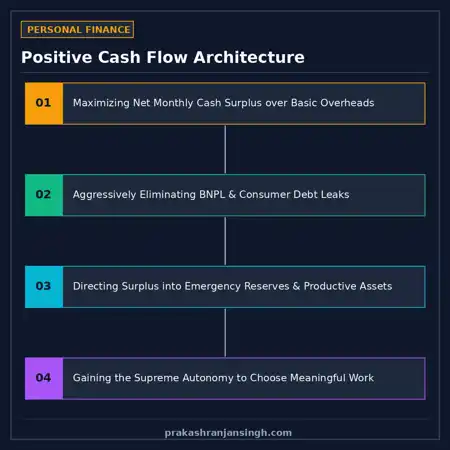
The greatest financial success is not earning the highest salary. It is consistently maintaining a positive cash flow, living below one’s means, and allowing money to work for the future instead of spending tomorrow’s income today.
As India moves towards its Vision 2047, we must ensure that the next generation inherits not merely digital payment systems and instant credit, but also the wisdom to manage money with discipline.
A strong nation is built by financially responsible citizens. The journey toward prosperity begins with one simple principle: spend less than you earn, save before you spend, invest for the future, and protect your positive cash flow.
Because in the end, cash flow is not just a financial statement—it is a reflection of life’s discipline, stability, and freedom.
Five habits that keep your cash flow positive
- Pay yourself first. Move a fixed amount to savings or an investment on the day your salary arrives, before any spending.
- Track every rupee for 30 days. Your UPI and bank statements show where small spends are leaking.
- Add up your EMIs and BNPL dues before any new one. Do not start a new instalment until you can pay it from your surplus.
- Pay the full credit card bill every month. Paying only the minimum turns a purchase into expensive debt.
- Build an emergency fund. A common rule of thumb is three to six months of expenses, kept in a separate account.
Frequently Asked Questions
What is positive cash flow in personal finance?
Positive cash flow means your income consistently exceeds your expenses and debt repayments. The surplus is what you can save, invest and use for emergencies. Negative cash flow forces people to borrow to maintain their lifestyle, which starts the cycle of EMIs and credit card rollovers.
How do I calculate my monthly cash flow?
Add up your take-home income for the month, then subtract every expense: rent, food, transport, bills, EMIs, BNPL dues, card payments and discretionary spending. If the result is above zero, your cash flow is positive. Check your UPI and bank statements for the last 30 days to avoid missing small spends.
How does a debt trap typically begin?
It rarely starts with one large loan. It starts with small monthly commitments: one EMI becomes two, a credit card balance gets paid with another loan, and BNPL finances everyday purchases. Eventually a large share of income goes toward servicing past spending instead of building future wealth.
How much of my salary should I save each month?
There is no legal or RBI rule. A popular rule of thumb is 50/30/20: about half of take-home pay for needs, 30 percent for wants and 20 percent for savings or extra debt repayment. Treat it as a starting point and adjust it to your rent, family responsibilities and existing EMIs.
How can Gen Z avoid the EMI trap?
Add up all fixed repayments before taking any new EMI, and do not start a new one until you can pay it from your surplus. Pay credit card bills in full, treat BNPL as a loan rather than free money, and move your savings out on salary day before spending.
Related Reading
- Investment Psychology: Why Young Investors Must Choose Wisdom Over FOMO
- The Salary Investor’s Dilemma: How to Grow Wealth Without Gambling With Your Future
- The Psychology of Easy Money: How Fintech Is Changing India’s Borrowing Pattern
- The Hidden Cost of Living: How Psychological Management Can Change It
- The Psychology of Financial Comfort: Building Stability at Every Stage of Life

Leave a Reply