

Quick summary: The power of words carries more weight than physical weapons — a single sentence can end a friendship, start a war, or change someone’s life forever, yet we’re never taught how to use them responsibly.
🚨 CONTROVERSIAL OPINION: The world’s most dangerous weapon is NOT a gun, a missile, or AI… It’s a WORD.
Read that again.
The advice to think before you speak is old, but it matters more now. A spoken or typed sentence cannot be taken back, and research suggests the brain treats painful social words much like other kinds of pain. The simplest protection is a short pause and four questions, set out below.
Key Takeaways
- A single word has ended friendships, started wars, saved marriages, or inspired someone to become extraordinary — words carry more weight than physical weapons.
- Psychological research on self-talk confirms the words we hear and repeat to ourselves genuinely shape confidence, focus, and emotional resilience.
- Before speaking, ask four questions: Is it true? Is it necessary? Is it respectful? Will it make someone’s life a little better?
Table of Contents
The Power of Words in a Single Sentence
A single word has ended friendships. A single word has started wars. A single word has saved marriages. A single word has stopped someone from giving up. A single word has inspired ordinary people to become extraordinary.
Yet, schools teach us physics, chemistry, mathematics, and coding—but almost nobody teaches us how to use words responsibly. Psychological research on self-talk confirms that the words we hear and repeat to ourselves genuinely shape confidence, focus and emotional resilience.
Words are invisible, but their impact is not.
Some words burn like fire. Some calm like cool rain. Some spread like the wind. Some become the foundation on which trust, confidence, and leadership are built.
Think about it…
How many people are still carrying the pain of one insulting sentence spoken years ago?
And how many successful people are where they are today because one teacher, one parent, one friend, or one mentor simply said:
“I believe in you.”
The greatest leaders are not remembered only for what they did—they are remembered for what they said.
Think Before You Speak: Ask Yourself These 4 Questions
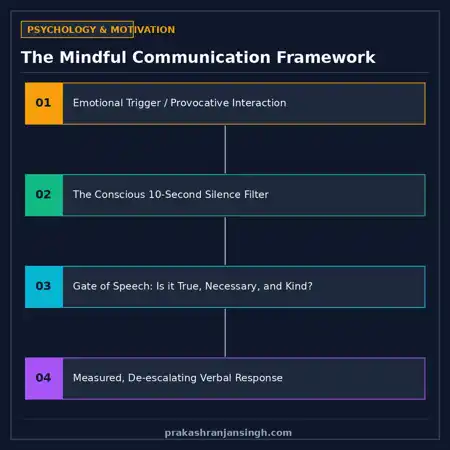
Before speaking, ask yourself four simple questions:
The meaning of “think before you speak” is simple: leave a short gap between a feeling and the words that follow it. The four questions fill that gap:
- Is it true? Check facts, not just feelings. In anger we often say what we assume, not what we know.
- Is it necessary? Some things are true but add nothing. If the sentence only wins the argument, it can usually wait or go unsaid.
- Is it respectful? Imagine the person’s family hearing you. Disagree with the idea, not with the person’s worth.
- Will it make someone’s life a little better? Even hard feedback should help the person fix something or feel understood.
In an age where one social media post can reach millions within minutes, choosing the right words is no longer just good manners—it’s a life skill.
The power of words means your words can become someone’s biggest wound… or someone’s biggest strength.
So choose them wisely.
Why Do Words Hurt? What Research Says
The claim that words can hurt is not only poetry. In a 2003 study in Science, Naomi Eisenberger, Matthew Lieberman and Kipling Williams scanned participants’ brains while they played a virtual ball-tossing game and were then left out of it. The anterior cingulate cortex was more active during exclusion, and its activity rose with reported distress. The authors concluded that social pain and physical pain share similar brain mechanisms. This study tested exclusion, not insults, but it is the closest laboratory evidence for why a cruel sentence can sting for years.
The same research group also found a way the brain calms itself. In a 2007 study, putting feelings into words reduced amygdala responses to negative images. In plain terms, naming what you feel (“I am angry”) before you speak can lower the heat. Both findings come from small laboratory studies, so treat them as support for Prakash’s argument, not as a guarantee.
Words also work in the other direction. The same sentence, “I believe in you”, can become the push someone remembers for decades. The point is not to speak less, but to speak on purpose. If you want the deeper side of choosing not to speak at all, read the power of silence.
Three Everyday Moments to Think Before You Speak
The four questions sound simple. They are hardest in ordinary, tired, irritated moments. Here are three illustrative scenarios, where the first reaction fails the test and a better sentence passes it.
At home. A child brings home a poor exam result and a tired parent says, “You will never amount to anything.” Is it true? No. Is it necessary? The real concern is the marks, not the child’s worth. Is it respectful? No. A better sentence: “I am worried about these marks. Let us find out what went wrong and make a plan.”
At work. A manager reviews a report in a meeting and says, “This is the worst report I have seen.” It is unlikely to be true, it embarrasses a colleague in public, and it does not tell the person what to fix. A better sentence: “Sections two and three do not yet answer the client’s question. Can we correct them by Thursday?”
In the family WhatsApp group. A heated argument is under way and a sharp reply is already typed. Typed words travel faster and stay longer than spoken ones. Before sending, ask whether it is true, whether it is necessary, and whether the person will still be hurt tomorrow. Often the right move is to send nothing, or to call the person privately.
How to Build a Pause Habit
Thinking before speaking is a habit, not a talent. A practical way to start:
- Take one slow breath before replying, especially when you feel angry or defensive.
- Name the feeling silently (angry, embarrassed, worried).
- Run the four questions: true, necessary, respectful, helpful.
- Rewrite the sentence in a calmer form, or choose to say nothing for now.
Hindi has an old saying for this: pehle tolo, phir bolo (weigh your words first, then speak). Practise it for one week in one setting, such as meetings or family chats, and notice how many sentences you decide not to say.
Tell Us: What Words Changed Your Life?
💬 Now tell me honestly…
What is one sentence—positive or negative—that changed your life forever?
Let’s read those life-changing words in the comments. They may inspire someone who needs them today.
Frequently Asked Questions
Why are words described as more dangerous than physical weapons?
This is Prakash’s opinion, not a literal claim. A single sentence can end a friendship, start a conflict, save a marriage or stop someone from giving up, and we are rarely taught how to use that power responsibly. Schools teach physics, chemistry and coding, but almost nobody teaches how to speak with care.
What does research say about the words we use on ourselves?
Psychological research on self-talk suggests that the words we hear and repeat to ourselves shape confidence, focus and emotional resilience. The power of words applies to how we speak to ourselves, not just to others.
What four questions should you ask before speaking?
Ask yourself: Is it true? Is it necessary? Is it respectful? Will it make someone’s life a little better? When a single social media post can reach millions of people within minutes, choosing words carefully has become a genuine life skill.
What does “think before you speak” actually mean?
It means pausing long enough to check whether what you are about to say is true, necessary, respectful and helpful. The pause can be a single breath. The goal is not to stay silent, but to choose your words on purpose instead of reacting to anger, embarrassment or pressure.
How can I stop saying hurtful things when I am angry?
Take one slow breath, name the feeling to yourself, and run the four questions before replying. If you are still angry, delay the conversation or choose to say nothing for now. Rewrite harsh sentences into a specific, calm request. With practice the pause becomes automatic.
Related Reading
- Life Is Short. Roles Are Many. Self-Motivation Is the Real Superpower
- WE MAY BE CREATING A GENERATION THAT IS ADULT BEFORE IT IS READY
- The Opportunity You Missed Is Not Your Real Loss
- Master Your Mind Before You Master Your Life
- The Extraordinary Power of Small Acts of Kindness: Why Tiny Gestures Can Transform Society

Leave a Reply