

Society isn’t built by billionaires’ philanthropy or grand government schemes — it’s held together by ordinary people, and small acts of kindness examples are everywhere: closing a lift door properly, turning off a leaking tap, helping someone cross the road, and these tiny gestures, repeated by millions, do more for a society’s fabric than any single grand act.
In today’s fast-paced world, people often believe that only extraordinary achievements create a meaningful impact. We admire billionaires for their philanthropy, social activists for their movements, and governments for their welfare schemes. Yet, the true foundation of a civilized society is not built by extraordinary people doing extraordinary things. It is built by ordinary people performing ordinary acts with extraordinary sincerity.
Every day, we encounter countless opportunities to make someone else’s life a little easier. Closing the lift door properly so that the next person can use it without inconvenience, turning off a roadside water tap to prevent precious water from being wasted, helping an elderly or visually impaired person cross the road, guiding a stranger to the correct address, teaching a child a difficult lesson, or taking a lost child to the nearest police station—none of these acts require money. They require only awareness, compassion, and a few minutes of our time.
These gestures may appear insignificant, but their value is immeasurable.
Key Takeaways
- Society is held together by ordinary people doing small acts of kindness – closing a lift door, turning off a leaking tap, helping someone cross the road – not by billionaires’ philanthropy or grand government schemes.
- Helping others triggers a real neurochemical reward, the “helper’s high,” as the brain releases dopamine and oxytocin, creating happiness and satisfaction.
- Make kindness a daily habit rather than a one-time event – one selfless act performed by every citizen every day would ripple through families, workplaces, and communities.
Table of Contents
Small Acts of Kindness Examples: 7 Everyday Ways to Help
If you are looking for small acts of kindness examples that cost nothing, start with this list. Each one takes only a few minutes and needs awareness, not money:
- Close the lift door properly so the next person is not delayed.
- Turn off a leaking or running public tap to save water.
- Help an elderly or visually impaired person cross the road.
- Guide a lost stranger to the correct address instead of pointing vaguely.
- Take a lost child to the nearest police station or a responsible adult.
- Carry groceries for an elderly neighbour.
- Teach someone how to use digital payments or spot an online scam.
Small acts of kindness make a big difference because they add up and because they spread: a person who receives help is more likely to help someone else. Research points the same way. Researchers at the Harvard T.H. Chan School of Public Health have linked regular volunteering and acts of kindness with lower levels of physical pain, a lower risk of mortality and better physical functioning into old age (Harvard Chan School, January 2025). These are associations, not proof that kindness alone causes better health, but they fit what this essay argues: small, repeated acts matter.
How Can You Start Practising Small Acts of Kindness Today?
Treat kindness as a daily habit rather than a one-time event. Pick one act from the list above and do it today without announcing it. Do the same tomorrow, and ask one family member or colleague to join you. Children learn fastest by watching adults do these things, so let them see you close the lift door and turn off the tap.
Why Does Helping Others Feel So Good — and Why Do We Still Hesitate?
Interestingly, most human beings possess an innate desire to help others. Modern psychology, including work summarized by the Harvard Health blog, refers to this as prosocial behavior—the natural tendency to act in ways that benefit others. When we help someone, our brain releases chemicals such as dopamine and oxytocin, creating feelings of happiness, satisfaction, and emotional well-being. This phenomenon is often called the “helper’s high.”
Despite this natural tendency, many people hesitate to help. The answer lies in human psychology. People often fear that their efforts will go unnoticed or unappreciated. Some worry that others may misunderstand their intentions. Many believe that helping is someone else’s responsibility. Others have become emotionally detached after repeatedly witnessing selfish behavior around them.
Another reason is the modern culture of recognition. Society frequently celebrates people who donate millions but rarely acknowledges someone who quietly helps an elderly person carry groceries or saves hundreds of litres of water by closing leaking taps. Since these small acts rarely receive appreciation, many individuals gradually stop making the effort. Unfortunately, this creates a silent loss for society.
Small Acts of Kindness: What Is the Ripple Effect?
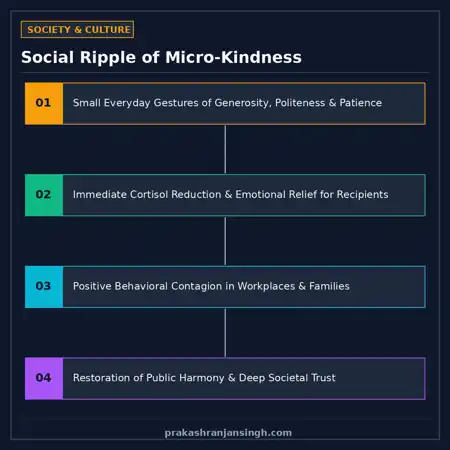
Every act of kindness creates a chain reaction. A person who receives unexpected help often develops a desire to help someone else. This cycle gradually spreads throughout families, workplaces, schools, and communities.
Imagine a society where every citizen performs just one selfless act every day. Roads would become safer. Public places would become cleaner. Water would be conserved. Children would receive guidance. Senior citizens would feel respected. Lost individuals would find help instead of fear.
The overall quality of life would improve—not because of large government budgets, but because of millions of responsible citizens.
Can Sharing Knowledge Also Be an Act of Kindness?
Helping does not always involve physical assistance. In today’s digital age, knowledge itself is one of the greatest gifts.
Many people struggle simply because they are unfamiliar with modern technology. Teaching someone how to use digital payments, online banking, smartphones, government portals, artificial intelligence tools, or internet safety can completely change their life.
When knowledge is shared, it multiplies. An informed person becomes capable of helping many others. A society grows stronger when knowledge flows freely rather than remaining confined to a few individuals.

Who Really Benefits Most From Kindness?
Ironically, the greatest beneficiary of kindness is often the person who offers it.
Every selfless act strengthens qualities such as empathy, patience, humility, and emotional maturity. It gradually transforms our personality.
Helping others reduces excessive self-centeredness and gives life a deeper sense of purpose. It reminds us that success is not measured only by wealth, position, or power, but also by the positive difference we make in the lives of others.
These experiences cultivate gratitude—the realization that we are fortunate enough to be in a position to help someone else. Gratitude is one of the most valuable human emotions. It improves mental well-being, reduces stress, strengthens relationships, and brings lasting inner peace.
Should Recognition Be the Motive for Helping?
Recognition is pleasant, but it should never become the purpose of helping.
History remembers many great personalities not because they sought applause, but because they served humanity without expecting anything in return.
The most beautiful acts of kindness are often those that remain anonymous. A smile from a stranger, a child safely reunited with parents, a thirsty traveller finding water because someone closed a leaking tap, or an elderly person reaching home safely—these moments rarely make headlines, yet they make humanity stronger.
How Can Society Build a Culture of Everyday Kindness?
If schools encourage students to perform one act of kindness each day, if workplaces recognize employees for acts of social responsibility, and if families teach children that helping others is a duty rather than an option, society can undergo a remarkable transformation.
Progress is not measured only by skyscrapers, highways, or technological advancement. It is also measured by how willingly people help one another without expecting rewards.
Conclusion
Small acts may seem too ordinary to matter, but they are the invisible threads that hold society together.
The world does not always need grand heroes. It needs millions of ordinary individuals who choose kindness over indifference, responsibility over convenience, and compassion over selfishness.
A few seconds spent closing a lift door, turning off a leaking tap, guiding a stranger, teaching a child, or helping someone in distress may appear insignificant. Yet these simple actions create a culture of trust, gratitude, and mutual respect.
When kindness becomes a habit rather than an event, humanity flourishes.
This is why small acts of kindness matter more than grand gestures: the true measure of a person’s greatness is not how much wealth they accumulate, but how many lives they make a little easier through small, selfless acts that ask for nothing in return.
Frequently Asked Questions
What are some small acts of kindness examples?
Closing a lift door properly, turning off a leaking tap, helping an elderly person cross the road, guiding a stranger to the right address, taking a lost child to the police station, carrying groceries for a neighbour, and teaching someone to use digital payments. None needs money, only awareness and a few minutes.
Why do small acts of kindness matter more than grand gestures?
The true foundation of a civilized society is built by ordinary people performing ordinary acts with extraordinary sincerity, not by extraordinary people doing extraordinary things. Millions of small gestures like closing a lift door or turning off a leaking tap do more for the fabric of society than a single grand act.
Why does the brain reward us for helping others?
When we help someone, the brain releases dopamine and oxytocin, creating feelings of happiness and satisfaction, a phenomenon often called the “helper’s high.” This is part of prosocial behavior, the natural human tendency to act in ways that benefit others.
Can sharing knowledge count as an act of kindness?
Yes. Helping does not always require physical assistance or money. Teaching someone how to use digital payments, online banking, or government portals can completely change their life, and when knowledge is shared it multiplies as an informed person becomes capable of helping many others.
Is being kind good for your health?
Harvard T.H. Chan School of Public Health researchers have linked regular volunteering and acts of kindness with lower physical pain, lower mortality risk and better physical functioning in old age. These are associations rather than proof of cause, but kindness may also buffer stress and ease loneliness.

Leave a Reply