

Social media isn’t just influencing what people buy anymore — it’s rewiring our financial psychology, changing how they think about money itself: viral “get rich before 30” content amplifies FOMO and herd behaviour while hiding the losses, and building real financial security still comes down to unglamorous basics — saving, diversified investing, and patience — not the next trending strategy.
How does social media affect financial decisions? In three ways. It normalises extreme returns by showing winners and hiding losers, it triggers herd behaviour and FOMO, and it blurs genuine advice with paid promotion. The sections below explain each one, and what SEBI, India’s markets regulator, now says about it.
The rise of social media has democratized access to financial information like never before. A smartphone and an internet connection are enough to expose millions of people to investment ideas, personal finance lessons, market analysis, and entrepreneurship stories. This transformation has undoubtedly increased financial awareness among the public. However, it has also created a parallel ecosystem where misinformation, exaggerated claims, and unrealistic expectations spread faster than genuine financial education.
Today, social media is no longer merely influencing what people buy—it is influencing how they think about money itself.
Key Takeaways
- Social media is rewiring our financial psychology — viral “get rich before 30” content amplifies FOMO and herd behaviour while hiding the losses.
- The average working life spans only about 25 to 35 years, so every financial mistake made during these productive years can have consequences that last decades.
- The most actionable fix: real financial security still comes from unglamorous basics — saving, diversified investing, and patience — not the next trending strategy.
Table of Contents
How Does Viral Financial Content Distort Reality?
Every day, users are bombarded with content promising “financial freedom before 30,” “guaranteed multibagger stocks,” “double your wealth in months,” “quit your job through passive income,” or “become a crorepati with one simple strategy.” These messages are often supported by selective success stories, luxury lifestyles, and emotionally appealing narratives. What is rarely shown are the failures, the risks, the years of disciplined investing, or the losses suffered by those who followed similar advice without adequate knowledge.
The result is a silent transformation in financial psychology.
Behavioural economists have long demonstrated that human beings are not perfectly rational investors. Our decisions are shaped by emotions, social influence, overconfidence, confirmation bias, herd behaviour, and the fear of missing out (FOMO). Social media magnifies each of these psychological tendencies. When thousands of people appear to be making extraordinary returns from a particular stock, cryptocurrency, or trading strategy, many others feel compelled to imitate them without understanding the associated risks.
This psychological pressure often replaces rational financial planning with emotional decision-making. It is a clear example of social media rewiring our financial psychology in real time.
Why Do Financial Decisions Matter More When Earning Years Are Short?
For the average individual, life expectancy is roughly 70 years, while the primary earning period generally spans only about 25 to 35 years. Within this limited working life, one must build savings, invest for retirement, educate children, purchase a home, manage healthcare costs, and create financial security for future generations. Every financial mistake made during these productive years can have consequences that last decades.
Unfortunately, social media often glorifies speed over patience. It celebrates speculation instead of disciplined investing, instant gratification instead of delayed rewards, and extraordinary returns instead of realistic financial planning. Such messaging can tempt individuals to abandon carefully constructed investment strategies in pursuit of quick profits.
Are Financial Influencers Actually on Your Side?
Another emerging concern is the commercialization of financial content. Many online creators generate income through sponsorships, affiliate marketing, referral commissions, or paid promotions. While numerous educators provide valuable and responsible guidance, others may have financial incentives that are not always aligned with the interests of their audience. Viewers often mistake promotional content for impartial advice, increasing the risk of unsuitable financial decisions.
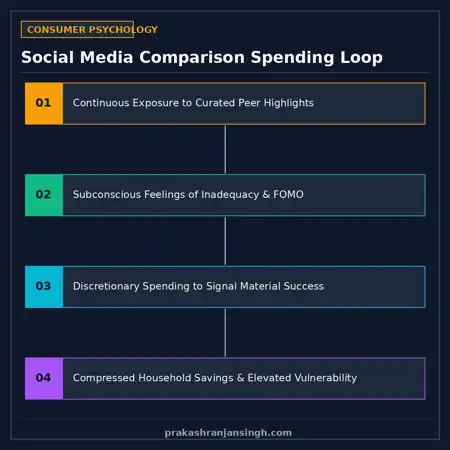
The influence of social media extends beyond investing. It also shapes spending behaviour. Constant exposure to luxury lifestyles, expensive vacations, premium gadgets, and designer brands creates social pressure to display success rather than build it. Easy access to credit cards, instant personal loans, and “buy now, pay later” facilities further encourages consumption beyond one’s financial capacity. Many families unknowingly exchange long-term financial stability for short-term social validation.

So What Actually Builds Lasting Financial Security?
Financial freedom is rarely achieved through shortcuts. History consistently shows that sustainable wealth is built through regular saving, diversified investing, prudent borrowing, continuous learning, and the power of compounding over long periods, as explained in the Investopedia’s explanation of compound interest. These principles may appear less exciting than viral investment trends, but they have stood the test of time.
Therefore, financial decisions should never be outsourced to algorithms or influencers alone. Every recommendation encountered online should be examined critically. Investors should ask whether the advice suits their own financial goals, income, risk tolerance, and time horizon rather than blindly following what is popular.
The responsibility does not rest solely with individuals. Regulators, educational institutions, financial firms, digital platforms, and content creators all have an important role in improving financial literacy and reducing the spread of misleading financial claims. Transparent disclosures, ethical standards, and stronger investor education can help create a healthier financial ecosystem.
Ultimately, the most valuable asset any person possesses is not a trending stock or a viral investment strategy—it is sound financial judgement. Markets will continue to rise and fall, new products will emerge, and social media trends will constantly change. However, disciplined financial behaviour, emotional control, and long-term planning remain the strongest foundations of lasting prosperity.
Social media is a remarkable tool when used for learning. But when it becomes the primary guide for financial decision-making, it can quietly reshape behaviour in ways that undermine years of hard work and sacrifice. Financial security is not created by chasing every online opportunity; it is created by making informed, disciplined, and patient decisions throughout one’s earning life.
The greatest financial freedom is not becoming rich overnight. It is building enough security that your family’s future never depends on the next viral investment trend.
What Does SEBI Say About Finfluencers?
Indian regulators have begun to address unregulated financial advice online. In a circular dated 22 October 2024, SEBI told regulated entities such as stock exchanges, clearing corporations and depositories, and their agents, not to associate directly or indirectly with anyone who gives advice or recommendations on securities without being registered or permitted by SEBI, or who claims returns without SEBI’s permission. The circular clarifies that persons engaged in investor education fall outside this restriction, provided they do not give such advice or make such claims.
In practice, regulated firms are barred from partnering with finfluencers who give securities advice or promise returns without permission. This is a summary of one circular, not legal advice, and SEBI’s rules continue to evolve, so check SEBI’s website for the latest position.
How Does Social Media Affect Financial Decisions? 5 Checks Before You Act
Knowing how social media affects financial decisions is useful only if you act differently. Before you follow any money advice you see online, run it through these five checks.
- Is the person registered? If someone recommends specific securities, confirm on SEBI’s website that they are a registered investment adviser or research analyst.
- Do they promise or imply returns? Guaranteed or very high returns, especially within months, are a warning sign, not a selling point.
- Who is paying? Look for sponsorship, affiliate links or referral codes, and ask whether the advice would change if there were no commission.
- Do they show the losses too? Real investing includes drawdowns. If only winning trades appear, you are watching a highlight reel.
- Does it fit your goals and time horizon? A strategy that suits a full-time trader may not suit a salaried person with a home loan and children’s fees ahead.
None of this requires expertise. It requires the pause that fast-moving feeds rarely encourage.
Frequently Asked Questions
Related Reading
- The Psychology of the Losing Investor: Why Chasing Losses Often Creates Bigger Losses
- The Mis-Selling of Dreams: How Aggressive Investment Selling Is Weakening Financial Security
- Investment Psychology: Why Young Investors Must Choose Wisdom Over FOMO
- ⚠️ Controversial Opinion: We are not raising a “Digital Generation”… we may be raising a “Debt Generation.”
- Positive Cash Flow: The Life Skill Gen Z Cannot Afford to Ignore

Leave a Reply