

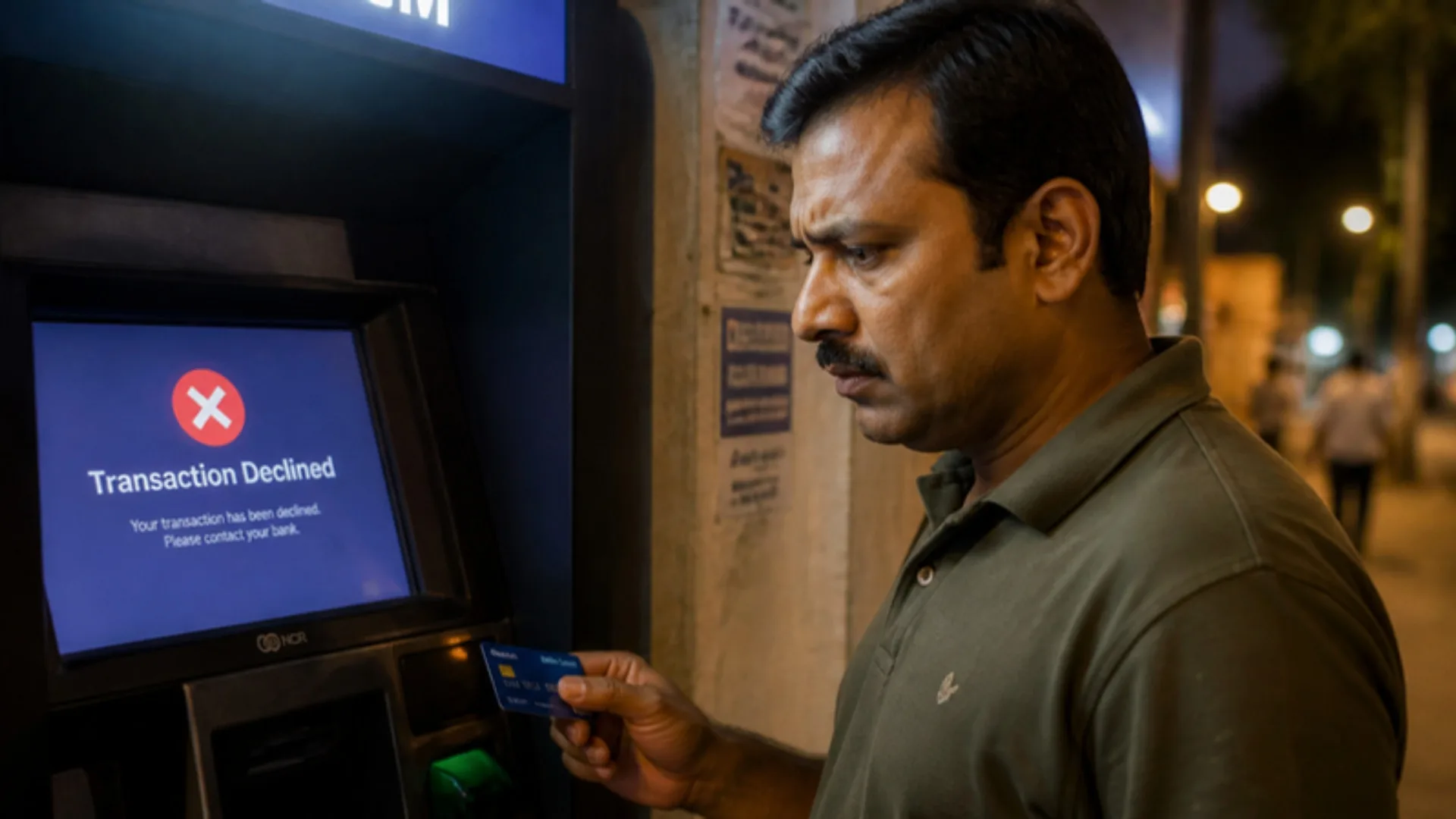
A NEW BANKING REALITY: YOUR TRANSACTION MAY FAIL, BUT THE BANK’S INCOME WILL NOT!
When banks start charging customers even for transactions that never happen, is customer trust becoming a revenue model?
Banking has traditionally been built around a simple promise: customers deposit their hard-earned money with a bank, and the bank provides safe custody, payment facilities and financial services in return. Over time, this relationship has evolved. Banks now offer digital convenience, instant payments, debit cards, mobile applications and round-the-clock access to money.
But there is an uncomfortable question emerging in this increasingly digital banking environment:
Should a customer pay for a transaction that never actually happened?
IndusInd Bank’s revised service charges, effective November 1, 2026, bring this question into focus. The changes may appear small in monetary terms, but their implications for customer psychology, banking competition and the future of retail banking deserve wider attention.
Key Takeaways
- From 1 November 2026, IndusInd Bank charges ₹25 (plus GST) for an ATM or POS transaction declined for insufficient funds, and ₹50 for a cheque returned for a non-financial reason, on four named savings variants (Indus Delite, Indus Digi-start, Indus Online with minimum balance, and Indie).
- This is not a system-wide rule — it applies to specified accounts, and RBI’s ATM instructions say failures caused by technical problems must not be counted or charged as customer transactions.
- The practical defence is simple — check your balance first, do not retry a declined transaction, and read your account’s schedule of charges at least once a year.
Table of Contents
- 1. What Exactly Is Changing?
- 2. The Psychology Behind a Small Banking Charge
- 3. Why Are Banks Moving Towards More Granular Service Charges?
- 4. The Customer Is Gradually Becoming Responsible for Managing Banking Costs
- 5. Will Other Banks Follow the Same Approach?
- 6. Impact on Different Stakeholders
- 7. The Hidden Danger: Banking Charges Can Create Financial Exclusion
- 8. What Should Banks Do Differently?
- 9. What Should Customers Learn From This Development?
- 10. The Future of Banking: From Relationship Banking to Transaction-Based Pricing?
- The Final Question: Who Should Pay for Banking Mistakes?
- Frequently Asked Questions
1. What Exactly Is Changing?
According to the reported revision, the following charges have been introduced for specified savings account variants, including Indus Delite, Indus Digi-start, Indus Online-Min Bal Required and INDIE Star, Superstar and Megastar accounts.
| Transaction or service | Revised charge |
|---|---|
| ATM transaction declined due to insufficient funds | ₹25 + GST |
| POS transaction declined due to insufficient funds | ₹25 + GST |
| Cheque returned for non-financial reasons | ₹50 per cheque |
Charges are shown exclusive of GST, as stated in the bank’s notice, and the declined-ATM charge applies to transactions at IndusInd Bank ATMs. The bank has also revised some debit card terms separately, so check your own card’s conditions on the bank’s website.
There is an important distinction here: these charges are not being imposed on every customer or every unsuccessful transaction across the banking system. They relate to specified account and card categories and particular reasons for transaction failure.
A technical failure caused by the bank, ATM or service provider is fundamentally different from a customer-initiated transaction declined because of insufficient funds. Customers should not be penalised for failures beyond their control.
2. The Psychology Behind a Small Banking Charge
Consider a customer standing at an ATM after a long working day. He needs ₹2,000 urgently. He inserts his card, enters the amount and discovers that his balance is insufficient.
Until now, the unsuccessful transaction may have caused embarrassment or inconvenience, but it did not necessarily cost him anything.
Now imagine that the same unsuccessful attempt results in a charge.
The amount may be just ₹25 plus GST. But the customer’s emotional reaction may be much larger than the financial impact.
Why?
People react differently to paying for a service and paying for something they never received.
When a customer pays ₹25 for a successful service, he can understand the transaction. When he pays ₹25 for a failed transaction, his mind asks a different question: What exactly did I receive in return?
This is the psychology of perceived fairness.
Five Psychological Reactions That May Emerge
1. The feeling of being penalised
A customer may interpret the charge as punishment for having insufficient money. For a middle-class household managing expenses from salary to salary, even a small deduction can create irritation.
2. Loss of control
Customers increasingly expect their money to remain accessible whenever they need it. Charges on failed transactions can create the feeling that banking is becoming a system in which every mistake has a financial consequence.
3. The accumulation effect
A single ₹25 charge may look insignificant. But repeated attempts can multiply the cost.
For example, four failed transactions at ₹25 each mean ₹100 before applicable GST. The customer may then begin to question whether the bank is earning additional income from ordinary mistakes.
4. Loss of trust
Customers do not evaluate banks only through interest rates. They also evaluate them through transparency, convenience, dignity and the feeling that the institution stands with them during financial difficulties.
A customer who feels unfairly charged may begin considering another bank.
5. The fear of hidden charges
Once customers encounter an unfamiliar deduction, they may become suspicious of other charges relating to debit cards, minimum balances, SMS alerts, cash withdrawals and account maintenance.
One small charge can therefore influence the customer’s perception of the entire banking relationship.
3. Why Are Banks Moving Towards More Granular Service Charges?
There is another side to this development.
Banking is no longer a simple business of accepting deposits and providing loans. It is an extensive technology-driven service industry.
Every ATM, POS terminal, debit card, mobile banking application, payment gateway, cybersecurity system, transaction monitoring platform and customer-support operation involves investment.
Banks have to maintain infrastructure even when customers do not complete transactions.
From a bank’s perspective, introducing charges for certain failed transactions can be viewed as an attempt to recover costs and discourage avoidable transaction attempts.
There are several commercial and operational considerations:
- Infrastructure costs: ATMs, payment networks, technology platforms and transaction-processing systems require continuous investment.
- Operational efficiency: Repeated unsuccessful transactions consume system capacity and may generate customer-service enquiries.
- Customer discipline: Charges may encourage customers to check their balances before initiating transactions.
- Revenue diversification: Banks increasingly examine fee-based income rather than depending entirely on interest income.
- Product segmentation: Banks differentiate between ordinary, premium and relationship-based customers through different service packages and pricing structures.
However, there is an important qualification.
The existence of a cost does not automatically establish that every charge is reasonable. Banks must ensure that their charges are justified, proportionate, transparent and consistent with regulatory requirements.
RBI’s Responsible Business Conduct Directions, 2025, place emphasis on reasonable service charges, protection of basic banking customers and advance communication of changes. They also expect banks to communicate changes in charges to customers in advance. The exact notice period and any right to exit should be checked in the Directions and your bank’s terms.
4. The Customer Is Gradually Becoming Responsible for Managing Banking Costs
An interesting change is taking place in the banking industry.
Earlier, customers were primarily expected to maintain sufficient balances, repay loans and follow banking procedures. Banks were responsible for delivering services.
Today, customers are increasingly expected to understand the cost of every banking activity.
They must monitor:
- Minimum average balance requirements.
- Debit card annual and replacement fees.
- ATM transaction limits and charges.
- Failed POS and online transactions.
- Cheque return charges.
- SMS and account maintenance fees.
- Premium account eligibility conditions.
- Charges applicable when an account is downgraded.
This creates a new responsibility for financial literacy.
A customer who opens a savings account because of an attractive advertisement may not understand the conditions attached to the product. A few months later, he may discover that the account carries charges that were never part of his original understanding.
The problem is not necessarily the existence of charges. The problem is the information gap between the bank selling a product and the customer understanding its actual cost.
Banking convenience without financial awareness can become an expensive convenience.
5. Will Other Banks Follow the Same Approach?
This is perhaps the most important industry-level question.
It would be premature to conclude that all banks will introduce identical charges. Every bank has its own customer acquisition strategy, operating costs, product positioning and competitive priorities.
However, IndusInd Bank’s revision highlights a possible direction in retail banking: more granular pricing of services.
There are several reasons why other banks may examine similar possibilities.
A. The pressure to improve fee-based income
Banks face pressure to improve profitability while investing heavily in digital infrastructure, cybersecurity, compliance and customer service.
Service charges are one possible source of non-interest income.
B. The economics of digital banking
Digital transactions are often advertised as inexpensive and convenient. But behind every transaction is a complex network of technology, authentication, security and settlement.
Banks may increasingly examine whether particular services should remain free or become chargeable.
C. The premium banking model
Banks are increasingly differentiating customers through account variants.
A premium customer may receive free debit cards, preferential services and relaxed transaction charges, while an ordinary account holder may have to pay separately.
This creates a possibility of two different banking experiences: one based on the ability to maintain a higher relationship value and another based on basic banking needs.
D. Competitive imitation
When one bank introduces a new pricing structure and it proves commercially successful without significantly affecting customer retention, competitors may examine similar models.
But there is an important counterforce: competition.
A bank that imposes excessive charges may lose customers to another institution offering more transparent and economical services.
Therefore, the future will not be determined by charges alone. It will be determined by how customers value the overall banking relationship.
6. Impact on Different Stakeholders
The implications extend beyond the individual account holder.
| Stakeholder | Possible impact |
|---|---|
| Ordinary customers | Higher awareness of transaction costs and greater need to maintain sufficient balances |
| Senior citizens | Risk of confusion and accidental charges due to unfamiliar digital processes |
| Low-income households | Greater sensitivity to even small deductions |
| Banks | Potential fee income, but also customer complaints and reputational risks |
| Bank employees | More explanations, disputes and customer-handling responsibilities |
| Fintech companies | Greater opportunity to attract customers through transparent and low-cost payment experiences |
| Regulators | Greater responsibility to monitor fairness, disclosure and customer protection |
| Banking industry | Increasing differentiation between basic and premium banking services |
The Special Vulnerability of Senior Citizens
Imagine an elderly pensioner who attempts to withdraw money several times because he does not remember his exact account balance.
For a digitally confident customer, checking the balance through a mobile application is easy.
But for a senior citizen who depends on ATM transactions, a failed withdrawal can be a source of anxiety.
If every unsuccessful attempt carries a charge, the customer may feel discouraged from using banking facilities.
Banks should therefore consider the practical difficulties of different customer groups while designing their pricing policies.
The purpose of technology should be to make banking inclusive, not to make it financially intimidating.
The Challenge for Bank Employees
There is another stakeholder who is often overlooked: the frontline banking employee.
Customers rarely distinguish between a bank’s board-approved pricing policy and the employee sitting behind the counter.
When an unexpected charge is deducted, the branch manager or customer-service officer becomes the first person to face the customer’s frustration.
The employee may have no authority to reverse the charge, yet must explain and defend the bank’s decision.
As banks introduce more charges, they must also invest in employee education, clear communication and efficient grievance redressal.
Otherwise, the cost of a pricing decision may ultimately be transferred to customer relationships and employee morale.
7. The Hidden Danger: Banking Charges Can Create Financial Exclusion
India has made considerable progress in financial inclusion through Jan Dhan accounts, digital payments, Aadhaar-enabled services and mobile banking.
Millions of people have entered the formal banking system.
But financial inclusion should not mean merely opening an account.
It should mean that people can actually use that account confidently and affordably.
There is a difference between having a bank account and having meaningful access to banking.
A daily wage worker, a pensioner or a small shopkeeper may not maintain a large balance throughout the month. Their banking requirements are different from those of a salaried professional or a wealthy customer.
If banking becomes increasingly dependent on the customer’s ability to maintain balances and pay multiple service fees, the industry risks creating a perception that banking is becoming more expensive for those who can least afford it.
This is why the distinction between basic banking services and premium value-added services is so important.
RBI’s framework recognises this distinction. It requires banks to provide basic services at reasonable charges and to offer more liberal terms to certain customer categories, including rural customers, pensioners and senior citizens. Basic Savings Bank Deposit Accounts also retain prescribed free minimum facilities.
8. What Should Banks Do Differently?
Banks have a legitimate commercial interest in recovering costs and maintaining profitability. Customers also have a legitimate expectation of fair treatment.
These two interests need not conflict.
A more customer-friendly approach would include the following measures:
- Advance alerts: Before a customer attempts a transaction that may attract a charge, provide a clear balance or eligibility warning wherever technically possible.
- First-time education: Explain the revised charges through SMS, email, mobile applications and branch communication in simple language.
- Reason-based classification: Clearly distinguish customer-related failures from technical failures attributable to the bank or payment service provider.
- Grace mechanisms: Consider a limited warning or grace facility for occasional mistakes, especially for vulnerable customers.
- Transparent account comparison: Make it easy for customers to compare basic, regular and premium account costs.
- Simple grievance redressal: Provide an easy process to dispute incorrect or unjustified deductions.
- Responsible pricing: Ensure that charges reflect legitimate service costs and do not become an instrument for exploiting customers’ lack of awareness.
The banking industry’s long-term strength comes not merely from earning fees but from retaining public confidence.
9. What Should Customers Learn From This Development?
Customers must also adapt to the changing banking environment.
The following simple precautions can prevent unnecessary deductions:
- Check the available balance before withdrawing cash or making a card payment.
- Avoid repeatedly attempting a transaction after it has been declined.
- Maintain a small emergency balance wherever possible.
- Understand the minimum balance and debit card conditions attached to your account.
- Check the cheque date, signature and other details before issuing a cheque.
- Review the latest schedule of charges at least once a year.
- Do not assume that a service offered free today will remain free forever.
- Examine whether a premium account is genuinely beneficial or simply more expensive.
- Report a technical failure or incorrect charge to the bank promptly.
Most importantly, customers should learn to distinguish between a legitimate service charge and an incorrect deduction.
If a transaction fails because of a bank-side technical problem, a customer should not automatically accept a charge. RBI’s ATM instructions say that a failed transaction caused by technical reasons must not be counted as a valid transaction for the customer’s free-transaction limit, so check any such charge with the bank.
10. The Future of Banking: From Relationship Banking to Transaction-Based Pricing?
There is a larger philosophical question behind these developments.
Traditionally, banking was a relationship-driven business. Customers maintained accounts for decades, deposited their salaries, kept savings, took loans and built their financial lives around a trusted institution.
The bank earned from the overall relationship.
Today, banking is increasingly becoming a technology-driven, product-segmented and transaction-priced business.
A customer may receive free digital banking but pay for a particular service. He may receive a complimentary debit card but pay an annual fee if he no longer meets the eligibility conditions. He may be offered a premium account but discover that maintaining the relationship requires a certain financial commitment.
This is not necessarily wrong. Businesses must remain commercially sustainable.
However, banks should not forget that deposits are not merely a source of funding. They represent the savings, security and financial confidence of millions of households.
A bank may earn an additional few rupees through a service charge, but it may lose something much more valuable if customers begin to believe that every interaction is an opportunity to collect money.
The future of banking will depend on maintaining the right balance between profitability and public trust.
THE FINAL QUESTION: WHO SHOULD PAY FOR BANKING MISTAKES?
A customer should be responsible for maintaining sufficient funds, checking transaction details and understanding the terms of the account.
A bank should be responsible for maintaining reliable technology, transparent pricing, efficient service and fair grievance redressal.
A payment service provider should be accountable for failures within its own systems.
And the regulator should ensure that the commercial interests of banks do not undermine the larger objective of financial inclusion.
A failed transaction may be worth ₹25 to a bank, but the customer’s trust is worth much more.
India’s banking industry is moving towards a more sophisticated, technology-intensive and commercially competitive future. But sophistication should not come at the cost of simplicity, transparency and affordability.
A good bank is not one that finds more opportunities to charge its customers. It is one that makes customers feel confident about depositing, saving and using their money.
After all, people do not open bank accounts merely to conduct transactions. They open them to secure their financial lives.
And that trust is the most valuable deposit a bank ever receives.
EDITORIAL NOTE
This article examines the wider customer and industry implications of IndusInd Bank’s November 2026 revision. The announced charges apply to specified account and card categories, not universally to all customers. The bank’s latest official schedule of charges should be consulted before any individual account decision.
Reference material
- IndusInd Bank – Official Schedule of Charges: https://www.indusind.bank.in/in/en/personal/schedule-of-charges.html
- IndusInd Bank – Debit Card Changes: https://www.indusind.bank.in/in/en/personal/offers/debit-card-offer-changes.html
- RBI – Responsible Business Conduct Directions, 2025.
- RBI – ATM Failed Transaction Clarification.
Frequently Asked Questions
Does IndusInd Bank charge for failed ATM transactions?
From 1 November 2026, IndusInd Bank charges ₹25 (plus GST) when an ATM transaction at its ATMs is declined for insufficient funds, but only on four savings variants: Indus Delite, Indus Digi-start, Indus Online (with minimum balance) and Indie accounts. Check your own account’s schedule of charges on the bank’s website.
Is there a charge for a declined POS or card payment?
On the same four variants, IndusInd Bank charges ₹25 (plus GST) for a POS transaction declined for insufficient funds from 1 November 2026. A decline caused by a technical problem on the bank’s or merchant’s side is a different matter and should be raised with the bank.
What is the cheque return charge for non-financial reasons?
IndusInd Bank’s notice lists ₹50 per cheque (plus GST) for a cheque returned for a non-financial reason on the same four variants. Non-financial reasons are errors such as a missing signature, a stale or post-dated cheque, or a mismatch in the details written on it.
Do all banks charge for failed transactions?
No. These charges apply to specified account types of one bank. Every bank has its own schedule of charges, which can change with advance notice, so read your own bank’s current schedule rather than assuming a rule applies to every account.
What does RBI say about failed ATM transactions?
RBI’s ATM instructions say a failed transaction caused by technical reasons, such as hardware or communication problems, must not be counted as a valid transaction for the customer’s free-transaction limit. If you believe you were charged for a bank-side failure, ask the bank to reverse it and escalate through its grievance process if needed.
How can I avoid charges on declined transactions?
Check your available balance in the mobile app before withdrawing cash or paying by card, do not retry a declined transaction repeatedly, keep a small cushion in the account and review your bank’s schedule of charges at least once a year.
Will I get my money back after a failed transaction?
If money is debited but the transaction fails, for example a UPI payment, an ATM withdrawal where cash is not dispensed, or a card payment, RBI’s turnaround-time framework requires the bank to reverse the amount within a fixed timeline. If the reversal is delayed beyond that timeline, the bank must pay compensation to the customer. Check the current timelines and compensation on RBI’s website or ask your bank, and raise a complaint if the amount is not returned.
How much do cheque return charges cost?
There is no single rate. Each bank sets its own charges, and they depend on the reason for the return. Cheques returned for insufficient funds usually cost more than those returned for non-financial reasons such as a signature mismatch or a stale date. IndusInd Bank’s notice lists Rs 50 per cheque (plus GST) for non-financial returns on four savings variants. Check your own bank’s schedule of charges.
Why does an ATM transaction get declined?
Common reasons include insufficient balance, a wrong PIN, exceeding the daily or per-transaction limit, a blocked or expired card, or a technical problem at the ATM or in the bank’s network. Only a decline for insufficient funds is the type that attracts a charge under IndusInd’s revised schedule, and only on the specified account variants.
What are NACH return charges?
NACH return charges are fees a bank may levy when an auto-debit, such as a loan EMI or SIP instalment, fails, usually because the account has insufficient balance. The amount varies by bank and product and is generally a few hundred rupees plus GST, so check your bank’s or lender’s schedule of charges. Keeping enough balance before the due date avoids it.
What should I do if I find a wrong charge on my account?
Ask the bank for a written explanation of the charge, compare it with the schedule of charges for your account variant, and raise a complaint through the bank’s grievance mechanism. If it remains unresolved, you can approach the RBI Integrated Ombudsman.
Related Reading
- Is Banking System Really Playing With Public Money?
- UPI Enters Its Next Phase: Will MDR Create a New Digital Financial Economy?
- The Credit Card Trap: How a Small Piece of Plastic Is Quietly Rewiring Our Psychology
- The Five-Minute Decision That Can Save Your Family From Years of Financial Trouble
See more of our stories on Google Search

Leave a Reply