

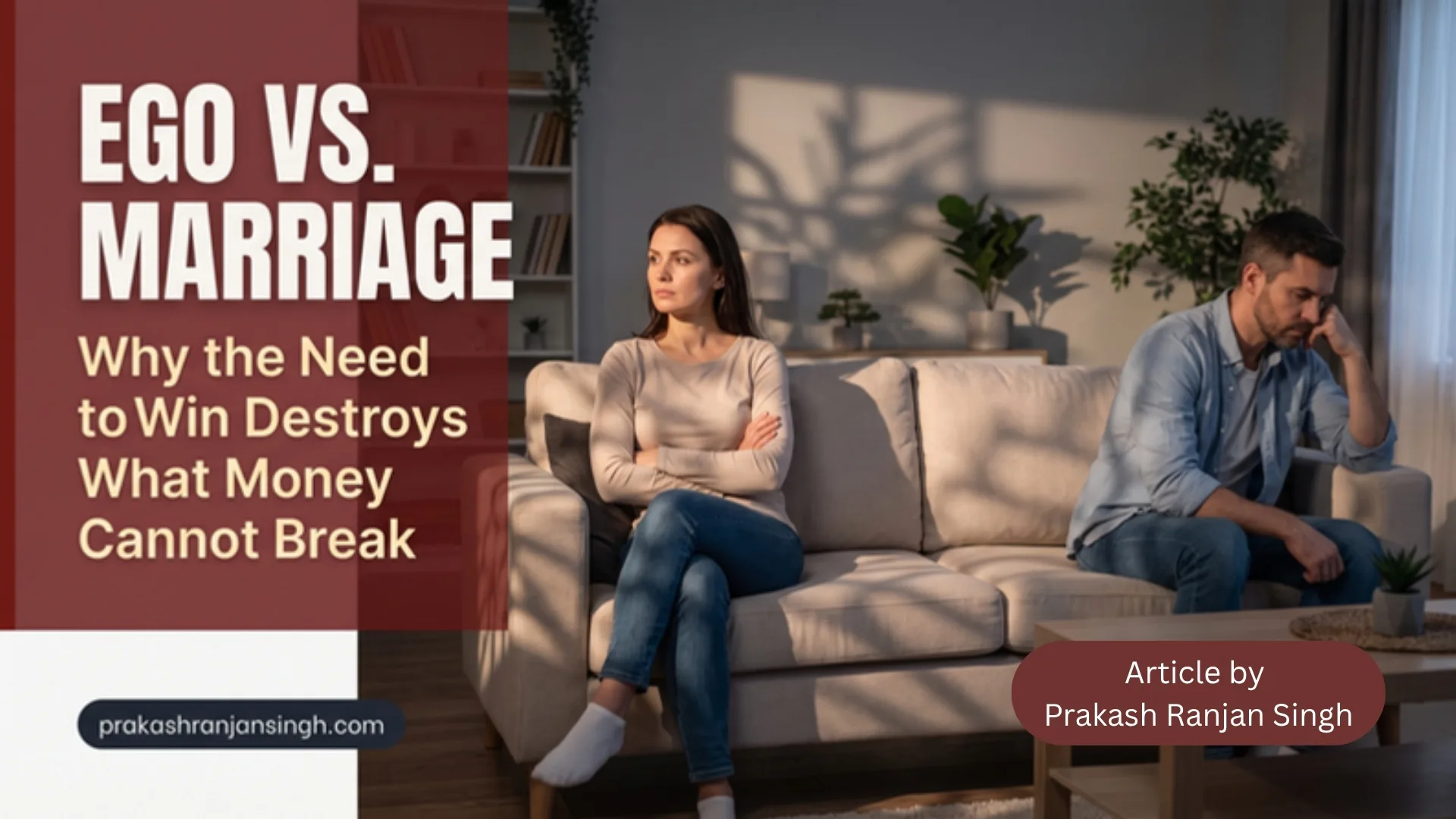

Ego is a bigger threat to marriage than money will ever be — most marriages don’t collapse from a lack of love or money—they collapse because two people refuse to say one simple sentence: “I was wrong.”
Read that again.
Ego issues in marriage are the habit of treating every disagreement as a contest to win: refusing to apologise, keeping score, and protecting pride before protecting the relationship. The Gottman Institute, which has studied couples for decades, lists defensiveness as one of the Four Horsemen, communication patterns that its research links to the end of a relationship.
Key Takeaways
- Most marriages don’t collapse from a lack of love or money — they collapse because two people refuse to say “I was wrong.”
- Research from The Gottman Institute found that couples who stay together aren’t the ones who avoid conflict, but the ones who repair quickly after it.
Table of Contents
Today’s generation is highly educated. They know how to earn money. They know how to use AI. They know how to build careers. But many never learn how to manage their own ego.
1. Why Are Ego Issues in Marriage a Bigger Threat Than Money?
Every argument becomes a battle. Every disagreement becomes a competition. Everyone wants to be right. Very few want to keep the relationship right.
The saddest part? The biggest victims are often the children, who silently grow up believing that anger, silence, and ego are “normal.”
A promotion can wait. A new car can wait. The next vacation can wait. But a relationship neglected by ego slowly breaks from within — proof that ego is a bigger threat to marriage than any bank balance.
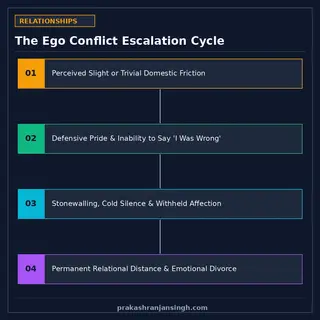
None of this means money is unimportant. Financial stress is real, and it can fuel arguments in any household. The point of this essay is that money problems can be solved by two people working as a team, while ego is the thing that stops the team from forming. A couple that cannot say sorry will struggle to agree on a budget, a loan, or how to support ageing parents, however much they earn.
2. Does Saying “Sorry” Mean You’ve Lost the Argument?
Here’s a question that may make many uncomfortable: if saying “Sorry” to your spouse feels like losing… have you already lost something much bigger?
A successful marriage isn’t built by the person who wins every argument. Decades of research by The Gottman Institute found that the couples who stay together aren’t the ones who avoid conflict — they’re the ones who repair quickly after it, choosing connection over being right. It is built by the couple who chooses love over pride, understanding over assumptions, and partnership over ego.
3. What Are the Warning Signs of Ego Issues in Marriage?
Ego issues rarely announce themselves. They show up as small habits that repeat until they become the pattern of the marriage. Watch for these five signs:
- Every disagreement becomes a contest, and the goal is to win rather than to understand.
- Saying sorry feels like losing, so apologies are delayed, diluted or never offered.
- Defensiveness replaces listening: a concern is met with an excuse or a counter-accusation. The Gottman Institute describes defensiveness as a response to criticism that often reverses the blame onto the partner.
- Score-keeping: who sacrificed more, who earns more, who gave in last time.
- Silent withdrawal: cold silence after a fight instead of a move to reconnect. The Gottman Institute calls this stonewalling.
If two or three of these sound familiar, the problem is probably not the bank balance. It is the unwillingness to be the first to soften.
Here is an illustration of how it plays out. A couple argues about whether to spend savings on a family function. The husband says, “You never respect my decisions.” The wife replies, “You never listen.” Within minutes the original question is forgotten, and the argument is about who is more disrespected. Neither is wrong to feel hurt, but both are now protecting pride instead of solving the problem. A single sentence such as “I got defensive, I am sorry, let us start again” would have changed the evening.
4. How Can Couples Fix Ego Issues in Marriage?
Ego issues in marriage can be softened with a few deliberate habits:
- Pause before you reply. If voices are rising, take a short break and return to the conversation calmer.
- Make a complaint, not a criticism. The Gottman Institute separates a complaint about a specific event (“I was scared when you were running late and did not call”) from criticism that attacks character (“you are selfish”).
- Say the sentence. “I was wrong” is a repair attempt, which Gottman defines as any statement or action that prevents negativity from escalating out of control.
- Ask before explaining. “What do you need from me right now?” opens the conversation faster than a defence does.
- Keep money and ego separate. When finances come up, sit on the same side of the table and treat the problem, not your partner, as the opponent.
It helps to replace the ego reflex with a repair response in advance. A few examples:
| In the heat of the moment | A repair response |
|---|---|
| “You always do this.” | “I felt hurt when this happened. Can we talk about it?” |
| “It is not my fault.” | “I can see how my part made this harder. I was wrong about that.” |
| Cold silence | “I need ten minutes to calm down, and then I want to talk.” |
| “Look at everything I do for this family.” | “I appreciate what you do for this family too.” |
| “I will not apologise first.” | “I would rather fix this than win it.” |
Setting aside ten minutes once a week to ask each other what went well and what felt hard keeps small resentments from piling up into ego battles.
If the same fight keeps returning, a qualified couples counsellor can help. This article is an opinion essay and not professional advice.
Debate Time: Do you agree with this statement? “Ego is a bigger threat to modern marriages than financial problems.” Yes or No?
Tell us why in the comments. Let’s have a respectful discussion that helps the younger generation build stronger families.
Frequently Asked Questions
What are ego issues in marriage?
Ego issues in marriage mean treating every disagreement as a contest to win: refusing to apologise, getting defensive, keeping score and protecting pride before the relationship. The essay argues that this, more than money, slowly breaks a marriage from within.
Why are ego issues in marriage a bigger threat than money?
Because every argument becomes a battle to be won rather than a relationship to be protected. The essay argues that a promotion, a new car or a vacation can all wait, but a relationship neglected by ego slowly breaks from within. This is the author’s opinion, not a statistic.
Does saying sorry mean you have lost the argument?
No. Research from the Gottman Institute, as the essay summarises it, found that couples who stay together are not the ones who avoid conflict but the ones who repair quickly after it, choosing connection over being right.
What are the warning signs of ego problems in a marriage?
Common signs are treating every disagreement as a contest, feeling that saying sorry is losing, answering concerns with excuses or counter-blame, keeping score of sacrifices, and going silent after a fight. The Gottman Institute names defensiveness and stonewalling among its Four Horsemen of relationship breakdown.
How can couples fix ego issues in marriage?
Pause before replying, raise a specific complaint instead of criticising your partner’s character, say ‘I was wrong’ when you are, and make repair attempts early. Setting aside ten minutes a week to talk helps. If the pattern keeps repeating, a qualified couples counsellor can help.
Related Reading
- The Most Important Investment in Life Is Not Money—It Is Your Marriage
- Positive Cash Flow: The Life Skill Gen Z Cannot Afford to Ignore
- Controversial Opinion: Digital Generation or Debt Generation
- Investment Psychology: Why Young Investors Must Choose Wisdom Over FOMO
- The Psychology of Financial Comfort: Building Stability at Every Stage of Life

Leave a Reply