

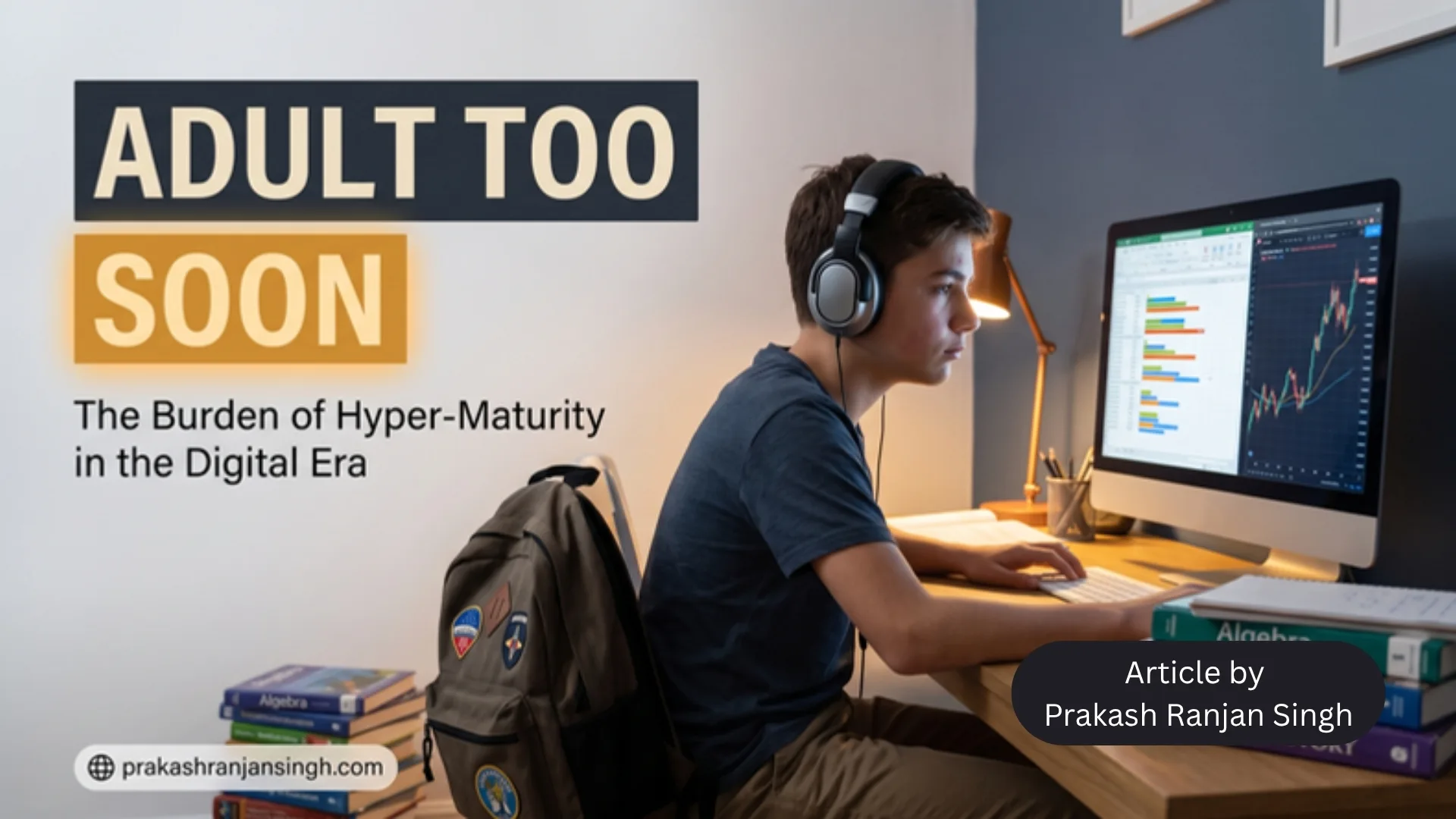
Why are kids growing up too fast? This is a generation adult too soon: biological adulthood is arriving earlier while financial independence and marriage keep arriving later, leaving young people to navigate love, sexuality, and money largely on their own — often guided by algorithms instead of parents. This growing gap between physical maturity and life-readiness is quietly reshaping how a generation forms relationships and enters adulthood.
The Growing Gap Between Adulthood and Marriage: An Invisible Crisis We Are Ignoring
And nobody seems to be talking about it.
A child today can access adult content before reaching adulthood.
A teenager can learn about relationships, sexuality, money, luxury, dating and lifestyle from a smartphone.
But the same teenager may have no idea how to handle rejection, loneliness, emotional attachment, financial pressure or a real-life relationship.
And here is the paradox:
We are exposing children to adulthood earlier… while pushing marriage and financial independence further and further away.
Welcome to one of the biggest social experiments of our time.
Key Takeaways
- Biological adulthood is arriving earlier while financial independence and marriage keep arriving later, leaving young people to navigate love, sexuality and money largely on their own.
- A UNICEF India guidance note reports that the large majority of Indian adolescents already have home access to a smartphone, most often used for social media—often becoming the default teacher on relationships and sexuality.
- Parents and schools need to become approachable enough to discuss uncomfortable subjects directly, rather than leaving algorithms and pornography to fill that gap.
Table of Contents
- Why Are Kids Growing Up Too Fast? Three Gaps Behind It
- Has the Internet Become the New Parent?
- Is Information Arriving Faster Than Maturity?
- Why Are Relationships Failing?
- Then Comes the Second Problem: Money
- This Is Where the Invisible Pressure Begins
- Parents Also Need to Change
- Education Also Needs a Reboot
- Please Don’t Blame Gen Z
- Are We Raising a Generation Adult Too Soon?
⏳ Why Are Kids Growing Up Too Fast? Three Gaps Behind It
When people ask why kids are growing up too fast, they usually point to the smartphone. That is only part of the answer. Three gaps are opening up at the same time, and each one deserves a closer look.
🔥 Gap 1: Biological Adulthood Is Coming Earlier
Many doctors and researchers report that girls are reaching puberty earlier than their mothers did. One study of 400 women in 26 villages of Chandauli district, Uttar Pradesh, found that the average age at first period was about 14.9 years among women over 40, 14.5 among those aged 20 to 40, and 13.2 among those under 20 (BMC Women’s Health, 2025). The authors themselves caution that this is one block, based on recall, so it cannot be assumed to describe all of India. But the direction is worth noticing: the body is maturing earlier, while the rest of life is not.
💰 Gap 2: Financial Adulthood Is Coming Later
Independence now takes longer to earn. The latest Periodic Labour Force Survey reports that the unemployment rate for young people aged 15 to 29 was 9.9% in 2025, slightly lower than 10.3% in 2024, but still about 13.6% for urban youth (PIB, PLFS Annual Report 2025). In plain words, roughly one in ten young people who want work cannot find it, and those who do find work are often early in their careers, on modest pay, with city rents to cover.
💍 Gap 3: Marriage Is Coming Even Later
The National Family Health Survey (NFHS-5, 2019-21) puts the median age at first marriage at about 19.2 years for women and 24.9 for men, up only slightly from the previous round. For women with 12 or more years of schooling it is around 22.8 years. Marriage is clearly not the problem; the point is the long stretch between a body that is ready, a phone that shows everything, and a life that is not yet settled. For an educated urban youngster, that stretch can run ten years or more.
So what happens in between?
That is the uncomfortable question we don’t want to ask.
Attraction between young people is natural.
Relationships are natural.
The desire for companionship is natural.
But when emotional and biological development happens years before financial stability, marriage and family formation, where does society expect young people to learn how to manage these powerful emotions?
Parents?
Schools?
Social media?
Pornography?
Friends?
Algorithms?
Unfortunately, the last three are often becoming the teachers.
And that should worry us.
📱 Has the Internet Become the New Parent?
Previous generations learned about relationships by observing parents, grandparents, relatives and society.
The joint family had plenty of problems—but it also provided an informal university of life.
Children watched adults argue.
They watched them compromise.
They saw responsibility.
They saw marriage.
They saw ageing.
They saw sacrifice.
Today, many children grow up in nuclear families where both parents are busy fighting their own battles.
And when the child has questions about relationships, attraction or sexuality, the smartphone is often available 24 hours a day. A UNICEF India guidance note reports that the large majority of Indian adolescents already have home access to a smartphone, most often used for social media.
The internet answers every question—even the questions children were never emotionally prepared to ask. This is a big reason kids are growing up too fast: they learn the language of adulthood long before they learn its responsibilities.
⚠️ Is Information Arriving Faster Than Maturity?
This may be the real crisis.
Today’s youngsters are not necessarily less intelligent.
In fact, Gen Z may be among the most informed, adaptable and technologically capable generations ever produced.
But information is not wisdom.
Knowing something doesn’t mean knowing how to handle it.
A 16 years old may understand relationships better than a 40 years old did at that age.
But does that 16 Years old necessarily have the emotional maturity to handle heartbreak?
Does he or she understand consent?
Boundaries?
Manipulation?
Emotional dependency?
Financial consequences?
Digital footprints?
The answer is obviously not always yes.
💔 Why Are Relationships Failing?
Maybe we should ask a different question.
Did we teach the younger generation how to build relationships—or only teach them how to find them?
Dating apps can help people meet.
Social media can help people connect.
Technology can bring people closer.
But none of these automatically teach:
commitment, patience, compromise, responsibility and emotional maturity.
Those still have to be learned.
💰 Then Comes the Second Problem: Money
We tell young people:
“First study.”
“Then get a good job.”
“Then build your career.”
“Then become financially independent.”
“Then buy a house.”
“Then think about marriage.”
Nothing is wrong with these expectations.
But career establishment can now take years.
Competition is brutal.
Employment is uncertain.
Housing is expensive.
And financial independence is increasingly difficult.
Meanwhile, emotional and biological development doesn’t follow the career timetable.
The heart doesn’t wait for the salary slip.
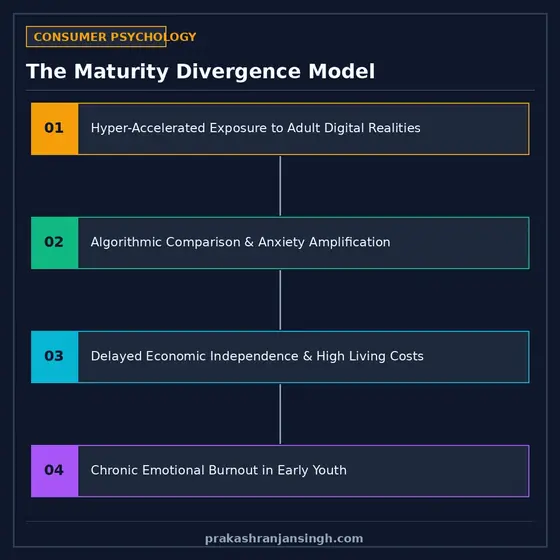
🧠 This Is Where the Invisible Pressure Begins
A young person can be:
✔ biologically mature
✔ digitally exposed
✔ emotionally curious
✔ socially pressured
…but still:
❌ financially dependent
❌ professionally uncertain
❌ emotionally inexperienced
❌ socially isolated
That is a dangerous combination.
And if society refuses to acknowledge it, the consequences may appear through loneliness, anxiety, unhealthy relationships, emotional dependency and difficulty forming stable families.
Not necessarily tomorrow.
But gradually.
And perhaps we are already seeing the early signs.
👨👩👧 Parents Also Need to Change
Parenting cannot remain:
“Because I said so.”
Modern children need something different:
“Let’s talk about it.”
Parents must become approachable enough for their children to discuss uncomfortable subjects.
Relationships.
Attraction.
Sexuality.
Pornography.
Money.
Career.
Failure.
Loneliness.
Mental health.
Social media.
If parents cannot discuss these subjects, someone else will.
And the question is:
Who do you want educating your child—the family or the algorithm?

🎓 Education Also Needs a Reboot
We teach children mathematics.
Science.
History.
Technology.
But where is the curriculum for:
emotional intelligence?
financial discipline?
relationship management?
digital responsibility?
handling rejection?
communication?
conflict resolution?
career resilience?
A person can score 95% in an examination and still fail spectacularly at life.
Academic intelligence without emotional intelligence is incomplete education.
🔥 Please Don’t Blame Gen Z
This is important.
Gen Z did not create this environment.
We did.
Adults created the technology.
Adults created the algorithms.
Adults created the economic system.
Adults created the education system.
Adults created the social expectations.
And then we complain that young people are different.
Perhaps they are not becoming worse.
Perhaps they are simply becoming different faster than society can understand.
Gen Z doesn’t need constant lectures.
It needs direction.
It needs skills.
It needs mentors.
It needs financial opportunities.
It needs healthy conversations.
And above all, it needs adults who understand the world in which they are growing up.
🚨 Are We Raising a Generation Adult Too Soon?
The real danger is a generation adult too soon — caught in the gap between the two.
This generation adult too soon dynamic plays out in plain sight: young people are entering the psychological world of adulthood earlier.
But economic independence, stable careers and marriage are arriving later.
Who will guide them through the gap?
If parents remain silent…
If schools avoid uncomfortable conversations…
If society continues moral policing…
If technology continues educating children without responsibility…
and if economic opportunities remain inadequate…
then we should not be surprised if the next generation faces psychological and relationship challenges that we are currently unable to imagine.
SO HERE IS THE QUESTION:
Should we be worried about children growing up too fast—or should we be worried that society is preparing them too slowly?
And perhaps an even more uncomfortable question:
👇 Are today’s parents raising their children—or are smartphones, social media and algorithms doing it for them?
What do you think? Please comment…
Frequently Asked Questions
Why are kids growing up too fast?
Biological adulthood and digital exposure to adult topics are arriving earlier, while financial independence, stable careers and marriage keep arriving later. Young people enter the psychological world of adulthood early but lack the guidance to navigate the gap in between.
Who is teaching young people about relationships and sexuality today?
Increasingly, social media, pornography, friends and algorithms fill the role parents and schools traditionally played. A UNICEF India guidance note reports that the large majority of Indian adolescents already have smartphone access at home, most often used for social media.
Is this generation’s behavior really its own fault?
No. Gen Z did not create this environment – adults created the technology, algorithms, economic system and education system it grew up inside. The solution is direction, skills, mentors and healthy conversations, not blame or constant lectures.
Are Indian girls reaching puberty earlier than before?
Some studies suggest so. A 2025 study in BMC Women’s Health of 400 women in Chandauli district, Uttar Pradesh, found the average age at first period was lower for younger generations. The authors note it covers one block and relies on recall, so it cannot be generalised to all of India.
What can parents do when children grow up too fast?
Become approachable enough that children can discuss relationships, money, loneliness and social media without fear of a lecture. Talk early, listen first, and teach emotional and financial skills at home, because if parents stay silent, algorithms will answer instead.
Related Reading
- Life Is Short. Roles Are Many. Self-Motivation Is the Real Superpower
- The Opportunity You Missed Is Not Your Real Loss
- CONTROVERSIAL OPINION: The world’s most dangerous weapon
- The Fire Inside Gen Z: How Decades of Change Created an Impatient Generation
- The Psychology of Influence: Why Unemployed Youth Are Vulnerable to Manipulation and Why Society Must Respond


Leave a Reply