

Social media algorithms don’t control humanity directly — the risk is subtler: by repeatedly showing emotionally charged content that keeps people engaged, they gradually narrow exposure to diverse viewpoints and strengthen confirmation bias, and the strongest safeguard isn’t quitting technology but building critical thinking and digital literacy.
How do you reset your social media algorithm? Switch to the Following or chronological feed, turn off autoplay, pause your watch history, mute outrage accounts and follow a few credible sources you disagree with. The full seven-step reset is further down this page. It works because the feed decides what you see, although a 2023 study in Science on Facebook and Instagram feeds found that changing the feed alone did not quickly change people’s beliefs.
The rise of social media has transformed the way people communicate, learn, express opinions, and participate in society. Billions of people now rely on digital platforms as their primary source of news, entertainment, and social interaction. While these technologies have democratized access to information, they have also introduced a subtle but powerful force that shapes human thinking—the social media algorithm.
Algorithms are designed to maximize user engagement by showing content that users are most likely to watch, like, comment on, or share. Although this improves the user experience from a business perspective, it also creates an environment where people’s emotions, beliefs, and decisions can be influenced in ways they may not consciously recognize.
This growing dependence raises an important question: Could humanity gradually surrender its independent thinking to artificial intelligence-driven recommendation systems?
Key Takeaways
- Social media algorithms don’t control humanity directly – the risk is subtler: they gradually narrow exposure to diverse viewpoints and strengthen confirmation bias.
- Emotional content that evokes anger, fear, or outrage typically generates higher engagement and is therefore more likely to be promoted by algorithms.
- The strongest safeguard isn’t quitting technology but building critical thinking and digital literacy – read from multiple credible sources and verify claims before sharing.
Table of Contents
How Do Social Media Algorithms Actually Work?
Every click, search, like, comment, share, and even the amount of time spent viewing a post is recorded. These digital footprints help algorithms create highly detailed behavioral profiles of users.
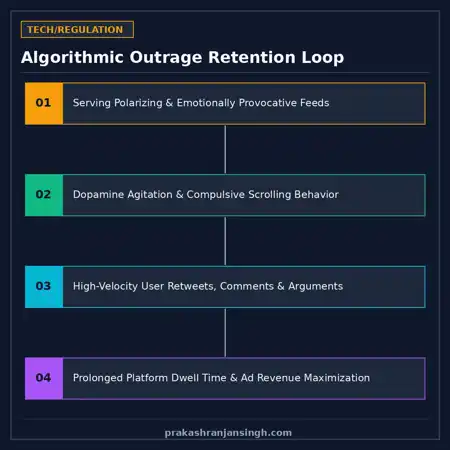
Instead of presenting a balanced variety of viewpoints, algorithms often prioritize content that is most likely to capture attention. Emotional content—especially material that evokes anger, fear, excitement, or outrage—typically generates higher engagement and is therefore more likely to be promoted.
Over time, users begin seeing more of what aligns with their previous interests and reactions. This creates a personalized digital environment that may gradually narrow their exposure to diverse perspectives.
Do Social Media Algorithms Create Echo Chambers?
Human beings naturally seek information that confirms their existing beliefs, a tendency known in psychology as confirmation bias.
Social media algorithms unintentionally strengthen this bias by repeatedly presenting similar content. As users consume more of one type of information, they become increasingly confident that their viewpoint represents the majority opinion. That feedback loop is why social media algorithms create echo chambers rather than open debate.
This is how social media algorithms create echo chambers where similar opinions dominate, polarization between different social groups, emotional rather than rational decision-making, and increased resistance to alternative viewpoints. The result is not necessarily misinformation alone, but a reduction in balanced and independent thinking.
How Does Emotional Manipulation Actually Play Out?
Algorithms do not possess emotions, but they learn which emotions keep people engaged.
Research in behavioral science, including the MIT Sloan study on false news, suggests that emotionally charged content spreads faster than neutral information. Consequently, sensational headlines, controversial opinions, and dramatic narratives often receive greater visibility than calm, evidence-based discussions.
Continuous exposure to emotionally stimulating content may contribute to increased anxiety and stress, social anger and hostility, fear-driven public reactions, and reduced patience for nuanced discussions. While these effects vary among individuals, the overall digital environment can encourage emotional rather than reflective responses.

What About Public Opinion and Democratic Processes?
In recent years, observers have debated the role of social media in influencing public opinion, social movements, and election campaigns in many countries.
Algorithms themselves do not determine election outcomes or social movements. However, they can amplify particular messages, increase the visibility of certain narratives, and rapidly spread information—or misinformation—to millions of people.
When combined with targeted political advertising, coordinated online campaigns, or large-scale misinformation efforts, algorithmic amplification can significantly shape public discourse. This highlights the importance of digital literacy, transparency, and responsible platform governance.
What is the Real Risk of Algorithmic Dependence?
One of the greatest long-term concerns is not that algorithms “control” humanity directly, but that people may increasingly outsource their attention, opinions, and decisions to automated recommendation systems.
Potential risks include reduced independent critical thinking, increased societal polarization, manipulation through emotionally targeted content, declining trust in institutions and experts, weakening of healthy public debate, and greater vulnerability to misinformation.
If left unchecked, societies may become increasingly reactive, with public opinion shifting rapidly according to digital trends rather than careful reasoning.
How Can People Protect Their Independent Thinking?
Technology itself is neither inherently good nor bad; its impact depends on how it is designed and used.
Individuals can strengthen their independence by reading information from multiple credible sources, verifying important claims before sharing them, following people with diverse viewpoints, limiting excessive social media consumption, developing critical thinking and media literacy, and reflecting before reacting emotionally to viral content.
Educational institutions should also teach digital literacy as a core life skill, enabling future generations to recognize algorithmic influence and evaluate information objectively.
What Responsibility Do Tech Companies Have?
Technology companies play a central role in shaping digital experiences. Greater transparency regarding recommendation systems, stronger protections against coordinated misinformation, and giving users more meaningful control over what they see can help reduce harmful outcomes.
Balancing innovation, freedom of expression, user engagement, and public well-being remains one of the defining challenges of the digital age.
What Does the Research Really Say About Algorithms and Polarization?
As a banker, I trust evidence over slogans, so it is worth separating what is well established from what is still debated.
The best-known finding comes from a 2018 study in Science by Soroush Vosoughi, Deb Roy and Sinan Aral of MIT. Analysing about 126,000 rumour cascades spread on Twitter, they found that false news was about 70 percent more likely to be retweeted than true news, and that true stories took roughly six times longer to reach 1,500 people. Notably, the researchers found that humans, not bots, were mainly responsible for the faster spread. The cause was novelty and emotional surprise, which is exactly what engagement-driven ranking rewards.
The other side of the story is equally important. In 2023, a group of academics worked with Meta on studies of the 2020 US election published in Science and Nature. In one experiment, some Facebook and Instagram users were moved from the algorithmic feed to a plain chronological feed for three months. They spent less time on the platforms and saw less untrustworthy content, but their measured political polarization and beliefs did not change significantly in that period. The authors cautioned that three months is short and that the results do not prove algorithms are harmless over years.
The honest reading is this: algorithms clearly decide what gets attention, but they are one factor among many, including our own choices, our friends, and the offline media we consume. That is why the answer to “do social media algorithms create echo chambers?” is “they can deepen them, mostly by amplifying what we already lean towards”, not “they alone create them”.
How to Reset Your Social Media Algorithm: A 7-Step Feed Audit
A bank reviews its books every quarter. Your information diet deserves the same discipline. Here is a practical way to reset your social media algorithm in seven steps, which you can finish in one evening.
- Switch to the non-algorithmic view. Most major apps offer a “Following” or chronological option alongside the recommended feed. Use it as your default.
- Turn off autoplay. Endless autoplay is the cheapest way for a platform to extend your session without your decision.
- Clear or pause your watch and search history. This weakens the behavioural profile that drives recommendations.
- Follow at least five credible sources you disagree with. Not to be convinced, but to see how the other side argues.
- Mute outrage accounts. If a page makes you angry every time and teaches you nothing, mute it.
- Set a daily time limit. Use the built-in screen-time tools and treat the limit as a budget.
- Apply a 10-minute rule before sharing. If a post triggers a strong emotion, wait ten minutes and check one reliable source before forwarding it to a family WhatsApp group.
None of these steps needs special skills, and none requires leaving social media. They simply move some control from the platform back to you.
Are There Rules for Algorithms in India and Abroad?
Regulation is catching up, unevenly. In the European Union, the Digital Services Act requires very large online platforms to explain the main parameters of their recommender systems and, under Article 38, to offer users at least one recommendation option that is not based on profiling. Users in the EU can therefore choose a feed that is not tuned to their behavioural data.
In India, platforms are mainly governed by the Information Technology Act, 2000 and the Information Technology (Intermediary Guidelines and Digital Media Ethics Code) Rules, 2021, which set due-diligence and grievance-redressal duties. The Digital Personal Data Protection Act, 2023 adds rules on how personal data may be collected and used. I could not find a standalone Indian rule that requires platforms to disclose how their recommendation algorithms rank content, which is why individual digital literacy matters even more here.
As a citizen, the practical takeaway is simple: know your rights over your data, read the privacy and ad-personalisation settings of every app you use, and report harmful content through the platform’s grievance officer when needed.
Social media algorithms are among the most powerful technological inventions of the twenty-first century. They have connected people across the globe, expanded access to information, and created unprecedented opportunities for communication.
At the same time, these systems can influence attention, emotions, and perceptions in ways that deserve careful public discussion.
The future of humanity should not be determined solely by algorithms designed to maximize engagement. It should be guided by informed citizens capable of critical thinking, respectful dialogue, and independent judgment.
Technology should remain a tool that empowers human intelligence—not a force that quietly shapes it without our awareness.
Ultimately, the greatest safeguard against algorithmic influence is not abandoning technology, but strengthening human wisdom.

Leave a Reply