

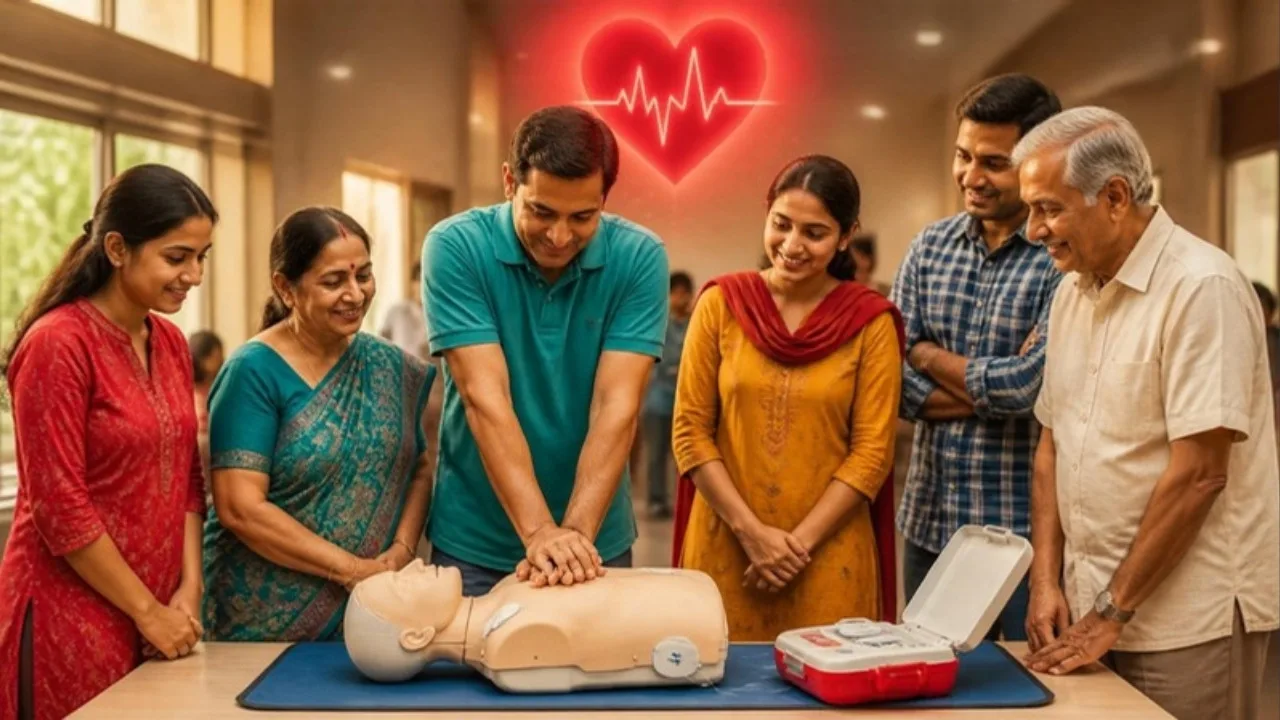
Heart attack first aid comes down to a short chain of actions: recognise the warning signs, call 112 at once, keep the person resting, start CPR if they collapse and stop breathing normally, and use an AED as soon as one arrives. Those first five minutes can decide whether a family gets its loved one back or receives devastating news.
Imagine a father suddenly clutching his chest at the dinner table. His family gathers around him. Someone says, “It may be gas.” Another brings water. Someone searches for a medicine. Another calls a relative.
Five minutes pass. Nobody calls an ambulance. Nobody knows CPR. Nobody knows what to do if he stops breathing. And sometimes, those five minutes become the difference between a family receiving its loved one back from the hospital, or receiving devastating news.
This is the uncomfortable reality of modern life: we have learned how to operate smartphones, make digital payments and use artificial intelligence, but many of us still do not know how to respond when a human being suddenly collapses in front of us.
A heart attack can occur at home, in an office, on a road, in a gym or in a restaurant. It does not necessarily announce itself with dramatic pain. It may begin with pressure in the chest, breathlessness, sweating, nausea, unusual weakness or discomfort that people mistakenly dismiss as acidity.
And when a person suddenly becomes unconscious and stops breathing normally, the emergency changes completely. At that moment, waiting for the doctor is not enough. Someone nearby must act.
Key Takeaways
- Call 112 first. Do not dismiss chest discomfort as gas, do not make the person walk or drive, and never delay the emergency call while searching for medicines.
- Start CPR without fear. If an adult is unresponsive and not breathing normally, push hard and fast at 100 to 120 compressions a minute; hands-only CPR is far better than doing nothing.
- Prepare before it happens. Every family needs a heart emergency plan, at least one member trained in CPR, and awareness that young age is not a guarantee of safety.
Table of Contents
- Heart attack first aid: would you know what to do in the first five minutes?
- Step 1: Recognise the warning
- Step 2: Stop the person from exerting themselves
- Step 3: Call 112
- Step 4: Keep the person under observation
- Step 5: Medicines, do not experiment
- Step 6: The moment everything changes
- Step 7: Start CPR
- Step 8: Find the AED
- Step 9: Do not stop too early
- Step 10: Even if the person feels better, do not ignore it
- The golden rule of heart attack first aid
- What not to do
- COVID-19 and the new heart-health conversation
- Young age is not a guarantee of safety
- Every family should have a heart emergency plan
- The real meaning of first aid
- India needs a culture of CPR
- The five-minute promise
- Emergency CPR card
Heart attack first aid: would you know what to do in the first five minutes?
If a person next to you suddenly develops severe chest discomfort tonight, would you know what to do in the first five minutes?
If the answer is “No”, this is something worth learning today. Because first aid is not about becoming a doctor. It is about keeping someone alive until the doctor arrives.
Step 1: Recognise the warning
A possible heart attack may cause:
- Pressure, heaviness, squeezing or discomfort in the chest
- Pain spreading to an arm, shoulder, back, neck or jaw
- Breathlessness
- Cold sweating
- Nausea or vomiting
- Dizziness
- Sudden weakness or unusual tiredness
The symptoms can vary considerably. Women, older adults and people with diabetes may sometimes experience less typical symptoms.
Never make this mistake: “It is probably gas.” If symptoms are concerning, treat them seriously and seek emergency medical help.
Step 2: Stop the person from exerting themselves
Help the person sit comfortably and rest. Keep them calm. Do not ask them to:
- Walk around
- Climb stairs
- Exercise
- Drive themselves to hospital
Do not waste valuable time trying home remedies.
Step 3: Call 112
This should be one of the first actions. Call 112, India’s emergency response number. Tell the operator clearly: “The person may be having a heart attack.” Provide the exact location, nearby landmark, symptoms and when they started. If possible, put the phone on speaker.
Why this matters. An ambulance is not merely transportation. Emergency medical personnel can begin assessment and treatment while the patient is being transported. Do not wait for a family member to arrive before calling.
Step 4: Keep the person under observation
Do not leave them alone. Watch these three things:
- Are they conscious?
- Are they breathing normally?
- Are their symptoms getting worse?
Keep their medical information and prescribed medicines available for the emergency team.
Step 5: Medicines, do not experiment
If the person has a medicine specifically prescribed for their heart condition, help them use it according to their existing medical instructions or emergency medical advice.
Never give:
- Someone else’s prescription medicine
- An unknown tablet
- Multiple medicines randomly
- Home remedies as a substitute for emergency treatment
What about aspirin? Aspirin may be appropriate for some alert adults with suspected acute heart attack, because it can reduce clotting. However, it is not suitable for everyone. It should not be given to someone who is unconscious or unable to swallow safely, and people with aspirin allergy, significant bleeding or a medical instruction to avoid it should not take it.
Call 112 first and follow the emergency operator’s advice. Most importantly: never delay the emergency call while searching for aspirin.
Step 6: The moment everything changes
Suppose the person suddenly collapses. You call their name. There is no response. You check. They are not breathing normally, or they are only gasping.
This is now a cardiac arrest emergency. Do not stand frozen. Do not wait for someone else. Shout: “CALL 112! BRING AN AED!”
Step 7: Start CPR
- Place the person on their back on a firm surface.
- Place the heel of your hand in the centre of the chest, on the lower half of the breastbone.
- Place the other hand over it and keep your arms straight.
- Push hard and fast: aim for 100 to 120 chest compressions per minute.
- Allow the chest to recoil completely between compressions.
If you are untrained in rescue breathing, hands-only CPR is far better than doing nothing. If you are trained and willing to give rescue breaths, use standard CPR with compressions and breaths according to your training.
Do not be afraid of starting CPR. Many people hesitate because they fear doing something wrong. But when an adult is unresponsive and not breathing normally, doing nothing can be far more dangerous. Continue until the person shows signs of life, professional rescuers take over, or you are physically unable to continue.
Step 8: Find the AED
An AED, or Automated External Defibrillator, can analyse the heart’s rhythm and deliver a shock when appropriate. It is specifically designed to provide instructions to rescuers. When it arrives:
- Turn it on.
- Expose the person’s chest.
- Attach the pads as shown on the device.
- Allow the AED to analyse the heart rhythm.
- Nobody should touch the patient during analysis.
- If the AED advises a shock, make sure everyone is clear.
- Deliver the shock according to the device’s instructions.
- Immediately resume CPR when instructed.
An AED does not automatically shock every patient. It determines whether a shock is appropriate.
Step 9: Do not stop too early
One of the biggest mistakes is stopping CPR because the rescuer becomes tired, frightened or assumes the patient is beyond help. Continue following the AED’s instructions. If another trained person is available, take turns performing compressions to maintain quality.
When professional medical personnel arrive, give them a clear account of:
- When symptoms began
- When the patient collapsed
- When CPR started
- Whether an AED was used
- Whether a shock was delivered
- What medicines were taken
Step 10: Even if the person feels better, do not ignore it
Perhaps the chest discomfort disappears. Perhaps the person says: “I am fine now.” That does not automatically mean the danger has passed. A suspected heart attack requires urgent professional medical assessment.
Do not cancel the medical response simply because symptoms improve.
The golden rule of heart attack first aid
Remember this sequence:
- Recognise. Know the warning signs.
- Call. Dial 112.
- Rest. Keep the person comfortable and calm.
- Monitor. Watch consciousness and breathing.
- CPR. If unresponsive and not breathing normally, start CPR.
- AED. Use it as soon as available.
- Handover. Give the ambulance team the complete information.
What not to do
- Do not dismiss chest discomfort as gas.
- Do not wait for severe pain.
- Do not make the person walk.
- Do not give random medicines.
- Do not give food or water to an unconscious person.
- Do not put tablets or liquids into an unconscious person’s mouth.
- Do not waste time taking photographs or making unnecessary calls.
- Do not leave the patient alone.
- Do not wait for someone else to start CPR.
COVID-19 and the new heart-health conversation
The concern about heart attacks among younger people has become particularly intense since the COVID-19 pandemic. COVID-19 infection can cause cardiovascular complications in some patients, and researchers continue to study its longer-term effects. But it would be scientifically irresponsible to attribute every heart attack or sudden cardiac event to COVID-19 or vaccination without evidence.
The broader lesson is more important. Modern cardiovascular risk, as the WHO’s cardiovascular disease fact sheet also explains, is influenced by multiple factors:
sedentary lifestyle + smoking/tobacco + diabetes + high blood pressure + cholesterol + obesity + poor sleep + chronic stress + genetics + other medical conditions.
Therefore, the answer is not fear. The answer is awareness.
Young age is not a guarantee of safety
For generations, heart attacks were psychologically associated with the elderly. That assumption can be dangerous. A young person can have risk factors that are invisible from the outside. Someone may appear physically fit while having:
- High blood pressure
- High cholesterol
- Diabetes
- A strong family history
- Smoking or tobacco exposure
- Obesity
- Poor sleep
- Chronic stress
- Insufficient physical activity
Therefore, never judge cardiovascular risk by age or appearance alone.
Every family should have a “heart emergency plan”
Before an emergency occurs, every family should know:
- Emergency number: 112
- Nearest emergency hospital: __________
- Family member’s medical history: __________
- Known allergies: __________
- Current medicines: __________
- Emergency contact: __________
And at least one person in the family should learn CPR. Residential societies, schools, colleges, offices, banks, factories and public institutions should consider regular CPR/AED awareness and training programmes.
The real meaning of first aid
First aid is not about replacing doctors. It is about buying time. When the heart stops effectively pumping blood, every passing minute matters. CPR helps maintain circulation, while an AED can potentially restore an effective heart rhythm in appropriate cardiac arrests.
The person who acts first may have no medical degree. They may be a spouse, a son, a daughter, a colleague, a security guard, a neighbour, or a complete stranger. But in that moment, their knowledge can become the bridge between an emergency and survival.
India needs a culture of CPR
We often discuss healthcare in terms of hospitals, doctors, technology and expensive equipment. But there is another part of healthcare that costs very little: public knowledge.
- What if every school student learned basic CPR?
- What if every office had someone trained in first aid?
- What if every large residential society knew where its nearest AED was?
- What if families practised their emergency response before an emergency happened?
The healthcare system would still need doctors and hospitals. But society would become the first responder rather than a helpless spectator.
The five-minute promise
Nobody knows when an emergency will enter their home. Nobody knows whether the next call for help will come from a parent, spouse, child, friend or stranger. But everyone can make one simple promise:
“If someone collapses in front of me, I will not simply stand and watch. I will call for emergency help, begin lifesaving first aid and do everything within my ability until professional help arrives.”
Because sometimes the most important medical equipment is not inside an ambulance. Sometimes it is the knowledge inside the person standing beside the patient.
Remember these seven words: Recognise. Call. Rest. Monitor. CPR. AED. Handover. Learn them before you need them. Because when a heart stops, there may be no time to learn.
Emergency CPR card
When someone collapses, act, do not wait.
- Check. Is the person responsive? Tap the shoulders and shout “Can you hear me?” If there is no response, check breathing.
- Call 112 immediately. Say: “A person is unconscious and not breathing normally. Send emergency medical help.” Ask someone to bring an AED if one is available.
- No normal breathing? Start CPR. Lay the person on their back on a firm surface, place both hands in the centre of the chest and push hard and fast at 100 to 120 compressions a minute. Let the chest come fully back up after every compression and do not stop unnecessarily. If you are not trained in rescue breathing, hands-only CPR is better than doing nothing.
- AED arrives? Turn it on. Follow its voice instructions, expose the chest and attach the pads as shown. Do not touch the person while the AED analyses. If a shock is advised, make sure everyone is clear and deliver it as instructed, then resume CPR when told.
- Keep going. Continue CPR and follow the AED instructions until the person shows signs of life, professional rescuers take over, or you are physically unable to continue.
If the person is conscious and shows possible heart-attack symptoms (chest pressure, breathlessness, cold sweat, nausea, pain to the arm, jaw or back, sudden weakness):
- Call 112.
- Keep the person resting comfortably.
- Do not make them walk or drive themselves.
- Use only their prescribed heart medicine according to medical instructions.
- Follow the emergency operator’s advice regarding aspirin.
- Do not give random medicines or home remedies.
Never do this: assume it is gas, wait for the pain to become severe, give food or water to an unconscious person, put tablets or liquids into an unconscious person’s mouth, leave the patient alone, or wait for someone else to act.
Remember: Check, Call 112, CPR, AED, Continue. Your hands may be the first lifesaving equipment available. Learn CPR. Teach your family. Save a life.
Emergency guidance should not replace professional medical care. In an emergency, call 112 and follow the emergency operator’s instructions.
Further reading from authoritative sources: American Heart Association: Hands-Only CPR and the WHO cardiovascular diseases fact sheet. Aspirin is not right for everyone; follow the 112 operator’s or a doctor’s advice.
Frequently Asked Questions
What should you do first when someone has a heart attack?
Call 112 immediately, tell the operator the person may be having a heart attack, give the exact location, and help the person sit and rest. Do not make them walk or drive, and do not delay the call to search for medicines.
How do you do CPR on an adult?
Lay the person on their back on a firm surface, place the heel of one hand on the lower half of the breastbone with the other hand on top, keep your arms straight and push hard and fast at 100 to 120 compressions a minute, letting the chest recoil fully each time.
Should you give aspirin during a heart attack?
Aspirin may suit some alert adults because it can reduce clotting, but it is not safe for everyone, including anyone unconscious, allergic to aspirin or bleeding significantly. Call 112 first and follow the operator’s advice, and never delay the call while looking for aspirin.
What is hands-only CPR and when is it enough?
Hands-only CPR means chest compressions without rescue breaths. If you are not trained in rescue breathing, it is far better than doing nothing when an adult is unresponsive and not breathing normally.
Can a young person have a heart attack?
Yes. Young age is not a guarantee of safety, because risk factors such as high blood pressure, cholesterol, diabetes, tobacco use, poor sleep and chronic stress can be invisible from the outside.
What are the warning signs of a heart attack?
Common signs include chest pain or pressure, pain spreading to the arm, jaw or back, shortness of breath, sweating, nausea and unusual tiredness. Symptoms can be milder in women, older adults and people with diabetes. Do not wait for them to go away: call emergency services.
Why call 112 instead of driving the person to hospital?
An ambulance brings trained staff and equipment, can begin treatment on the way and alerts the hospital in advance. Driving can waste time and leaves no one to help if the person collapses. This article is general information, not medical advice.
Related Reading
- Cyber Fraud in the Digital Age: 7 Rules to Stay Safe
- The Second Half of the Career: Thriving After 40 and 50
- Strong Families Build Strong Nations: 5 Truths We Forget
- Psychology of Enjoying Life: 8 Keys to Real Happiness
- 7 Small Acts of Kindness With Extraordinary Power
See more of our stories on Google Search

Leave a Reply