

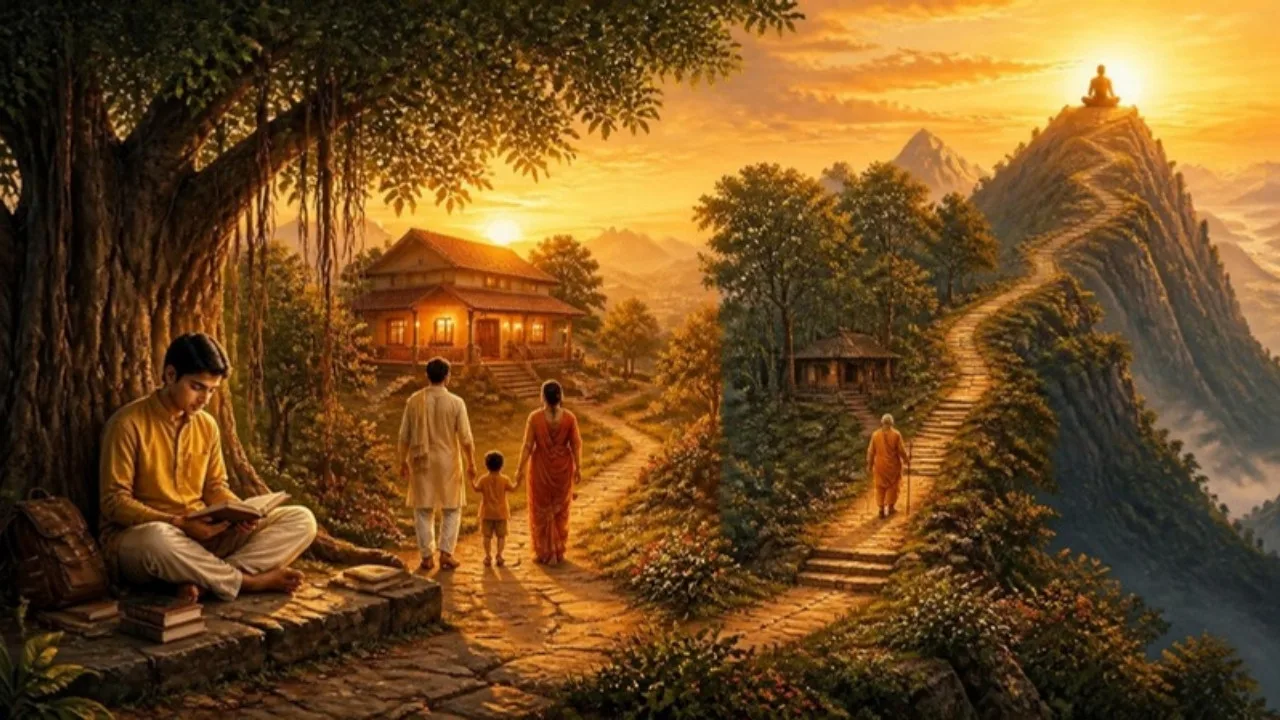
The four ashramas—Brahmacharya, Grihastha, Vanaprastha and Sannyasa—are ancient India’s framework for the psychology of a complete life. They treat learning, family responsibility, gradual withdrawal and spiritual liberation as different orientations suited to different phases, with the central lesson that human beings change and the purpose of life must evolve with them. This is a civilization that understood that people do not remain the same throughout life.
Modern society talks constantly about mental health, work-life balance, sexual psychology, family responsibility, ageing, retirement and spiritual wellbeing.
But centuries ago, Indian civilization had already developed a remarkably comprehensive framework for organising human life: Brahmacharya, Grihastha, Vanaprastha and Sannyasa.
The four āśramas were not simply four religious labels. They represented four broad orientations of life—learning, family and worldly responsibility, gradual withdrawal and finally spiritual liberation.
The commonly presented age division of 0–25, 25–50, 50–75 and 75+ is a useful modern way of explaining the framework, although traditional Hindu sources do not uniformly impose these exact numerical boundaries.
The deeper message is more important than the arithmetic.
Human beings change. Their bodies change. Their responsibilities change. Their psychological needs change. And therefore, the purpose of life must also evolve.
Perhaps this is one of the most important lessons that modern spiritual discourse needs to rediscover.
Key Takeaways
- Learn, build, release, realise. The four ashramas give a sequence for life: Brahmacharya develops knowledge, Grihastha responsibility, Vanaprastha detachment and Sannyasa spiritual inquiry.
- Desire needs Dharma. Kama is a legitimate purushartha, but desire cannot become the ruler of life; discipline of desire is different from suppression, and education about relationships and consent matters more than silence.
- Timing is the lesson. Many modern problems are failures of transition, such as parents who never move from control to guidance; the wisdom is not renunciation but knowing where you are in life and what that stage demands.
Table of Contents
- The Four Ashramas Begin Here: A Human Being Is Not Only a Body—and Not Only a Soul
- Brahmacharya: The age of learning before the age of possession
- But does Brahmacharya mean denying every natural desire?
- Grihastha: The stage where desire meets responsibility
- Kama was not necessarily the enemy—uncontrolled kama was
- Vanaprastha: The psychology of gradually letting go
- The greatest parenting lesson may be learning when to step back
- Sannyasa: When identity moves beyond possession
- The four ashramas resemble a psychological journey
- What happens when every age is forced to behave like every other age?
- Suppression and self-control are not the same thing
- Sexuality needs maturity—not silence
- Freedom without Dharma is not freedom
- What should a modern Dharmaguru teach?
- The danger of turning spirituality into one-size-fits-all advice
- The modern crisis may be a crisis of transition
- What can today’s young generation learn from the four ashramas?
- Perhaps the real conflict is not between body and soul
- From individual psychology to social health
- Ancient wisdom does not need to fight modern science
- The real message of the four ashramas is not “deny life”
- The guru of the future must understand both the human being and the human age
- Conclusion: Perhaps the forgotten wisdom is not renunciation—but timing
1. The Four Ashramas Begin Here: A Human Being Is Not Only a Body—and Not Only a Soul
Indian philosophy has never viewed a human being as merely a biological machine.
The human experience contains body, senses, mind, intellect, emotions, desires, relationships and spiritual aspiration. These dimensions do not always move in the same direction.
- The body may seek pleasure.
- The mind may seek excitement.
- The heart may seek affection.
- The intellect may seek achievement and recognition.
- And spiritual wisdom may seek something beyond temporary worldly satisfaction.
This creates an extraordinary internal conversation within human beings.
A young person may simultaneously want love, sexual intimacy, career success, social recognition, independence and spiritual meaning. There is nothing inherently abnormal about this complexity.
The question is: how should these different forces be organised rather than violently suppressed?
The āśrama framework offers one philosophical answer.
2. Brahmacharya: The age of learning before the age of possession
Brahmacharya is commonly associated with celibacy, but reducing it entirely to “no sex” misses its broader meaning.
Traditionally, it represents a disciplined period of learning, character formation, self-control and preparation for life.
The child and young person have enormous learning potential. Modern developmental science also recognises that childhood and adolescence involve major changes in the brain, learning capacity, emotional regulation and social development.
This makes the traditional emphasis on education and discipline particularly interesting.
The young person is not expected to have already mastered the entire world. He or she is expected to prepare for it.
Knowledge first. Character first. Discipline first. Skills first. Then responsibility.
This is a profound principle even in the twenty-first century.
3. But does Brahmacharya mean denying every natural desire?
This is where modern interpretation requires care.
Sexual attraction is a normal part of human development. Puberty brings major biological and psychological changes, and attraction does not disappear simply because someone is told that desire is spiritually undesirable.
Therefore, education about sexuality, relationships, consent and responsibility is far more useful than simply pretending that attraction does not exist.
There is an enormous difference between suppression of desire and discipline of desire.
Indian philosophy repeatedly emphasises dama, samyama and control of the senses. Control does not necessarily mean hatred of the senses. It means learning not to become their slave.
A young person does not need to be taught that natural human feelings are sinful merely because they exist. The person needs to be taught: “Your desires are real—but you are responsible for how you act upon them.”
That distinction is extremely important today.
4. Grihastha: The stage where desire meets responsibility
The second āśrama is Grihastha—the householder’s life.
Here the individual participates fully in society. Marriage, family, children, livelihood, economic activity, social obligations and relationships become central.
This is significant because Indian philosophy did not traditionally describe worldly life itself as a spiritual failure. The householder supported not only his own family but, traditionally, the wider social and religious structure.
This stage recognises something modern psychology also repeatedly encounters: human beings need relationships, attachment, belonging and meaningful responsibility.
Marriage and family therefore cannot be understood merely as mechanisms for satisfying sexual desire. They create responsibility. They demand compromise. They require emotional maturity. They transform individual desire into a relationship governed by duty.
That is why the traditional framework connects Kama with Dharma rather than treating desire as an isolated objective.
5. Kama was not necessarily the enemy—uncontrolled kama was
One of the most misunderstood aspects of Indian philosophy is the treatment of desire.
The classical Hindu framework recognises Kama as one of the purusharthas, alongside Dharma, Artha and Moksha. Desire is therefore not automatically rejected.
But desire without Dharma can become destructive.
- Money without ethics can become exploitation.
- Power without responsibility can become oppression.
- Sexual desire without consent and responsibility can become abuse.
- Ambition without limits can become greed.
The philosophical principle can therefore be expressed simply: Human desire may have a legitimate place in life, but desire cannot become the ruler of life.
This distinction is highly relevant to the modern generation.
6. Vanaprastha: The psychology of gradually letting go
After decades of earning, raising children and building a household, the traditional framework introduces Vanaprastha.
It is often described as “retirement,” but that translation is incomplete. It represents a gradual movement away from exclusive attachment to worldly responsibilities.
The person begins asking different questions.
- Not merely “How much more can I earn?” but “What should I leave behind?”
- Not merely “What can my children give me?” but “How can I guide them without controlling them?”
- Not merely “What else do I possess?” but “What can I release?”
This has remarkable relevance to modern family life. Parents sometimes continue controlling adult children long after the children have become capable of making their own decisions.
Vanaprastha offers another possibility: responsibility gradually changes into guidance, and guidance gradually changes into detachment.
7. The greatest parenting lesson may be learning when to step back
Modern parents spend enormous emotional energy trying to protect their children. That is natural.
But protection can become control. A child eventually becomes an adult. The parent’s responsibility therefore has to evolve.
- During childhood: “I will decide for you.”
- During adolescence: “I will guide you.”
- During adulthood: “I will advise you when you need me.”
- Eventually: “I trust your wisdom.”
This psychological transition is remarkably close to the spirit of Vanaprastha.
The parent does not abandon the family. The parent changes the form of attachment.
8. Sannyasa: When identity moves beyond possession
The fourth stage is Sannyasa.
It represents renunciation—not merely of physical possessions, but of excessive attachment to identity, status, wealth, ego and worldly achievement.
A person who has spent decades saying “This is my house,” “This is my money,” “This is my position,” “These are my achievements,” eventually confronts a fundamental truth: none of these identities are permanent.
Sannyasa therefore represents the movement towards liberation—Moksha.
The final question becomes: Who am I beyond everything I possess?
This is not necessarily a rejection of society. It is a transformation of one’s relationship with society and oneself.
9. The four ashramas resemble a psychological journey
The beauty of the framework becomes clearer when viewed as a progression:
- Brahmacharya → Learn
- Grihastha → Build
- Vanaprastha → Release
- Sannyasa → Realise
The first stage develops knowledge. The second develops responsibility. The third develops detachment. The fourth develops spiritual inquiry.
The human being is therefore not expected to pursue the same objective from childhood until death.
That may be one of the deepest lessons of the system.
10. What happens when every age is forced to behave like every other age?
Modern society has created an unusual situation.
- Children are sometimes pushed into adult competition too early.
- Young people are sometimes expected to suppress normal emotional development.
- Adults remain trapped in endless economic competition.
- Parents remain excessively attached to adult children.
- Older people continue defining their identity entirely through money, position and social status.
The result can be psychological tension.
The problem is not necessarily desire itself. The problem can be desire without an appropriate place in the architecture of life.
Ancient Indian philosophy attempted to give different desires different places.
11. Suppression and self-control are not the same thing
This distinction deserves special attention.
Suppression says: “I must not have this feeling.”
Self-control says: “I have this feeling, but I decide how to respond to it.”
Suppression can sometimes push uncomfortable emotions underground without resolving them. Self-regulation involves recognising the emotion and responding appropriately.
Modern psychology places considerable emphasis on emotional regulation, impulse control, delayed gratification and healthy relationships. These ideas are not identical to Hindu philosophy, but there are meaningful areas of conceptual overlap.
Therefore, spiritual teaching should ideally help people understand themselves rather than make them frightened of their own humanity.
12. Sexuality needs maturity—not silence
This is particularly important for today’s young generation.
Young people are exposed to sexual content through smartphones, social media, films, pornography and online communities much earlier than previous generations.
Simply saying “do not think about sex” does not solve the problem. They need education about:
- biology and puberty;
- consent;
- emotional attachment;
- responsible relationships;
- contraception and reproductive health;
- pornography and unrealistic expectations;
- digital privacy;
- sexual exploitation;
- respect for another person’s boundaries;
- consequences of impulsive decisions.
Spirituality can contribute another dimension: desire does not give anyone the right to violate another human being.
That is where Dharma becomes practically meaningful.
13. Freedom without Dharma is not freedom
Indian civilization has traditionally given considerable space to philosophical inquiry. Different schools debated God, the self, consciousness, reality, liberation and the nature of knowledge.
But freedom was not supposed to mean: “I can do anything I want.”
A more mature formulation is: “I have freedom of thought and choice, but my choices operate within Dharma.” That means responsibility towards oneself and others.
A person can choose a career. Choose a partner. Choose a spiritual path. Choose simplicity. Choose ambition. Choose family life. Choose renunciation.
But every choice carries consequences.
Freedom without responsibility becomes impulse. Freedom with Dharma becomes civilisation.
14. What should a modern Dharmaguru teach?
The role of a spiritual teacher should not be reduced to giving identical instructions to every human being.
A 15-year-old student, a 30-year-old married person, a 55-year-old parent and an 80-year-old retired person do not necessarily require the same guidance. Their responsibilities are different. Their psychological circumstances are different. Their physical circumstances are different. Their social roles are different. Their questions are different.
Therefore, spiritual education should recognise stage, age, temperament and circumstance.
The message should not simply be: “Give up everything.” For someone responsible for young children, such advice may be unrealistic.
Nor should the message always be: “Acquire more, enjoy more and achieve more.” For someone approaching old age, that may perpetuate attachment rather than wisdom.
The deeper teaching is: Know where you are in life—and understand what that stage demands from you.
15. The danger of turning spirituality into one-size-fits-all advice
Every generation produces spiritual teachers. Some provide valuable guidance. But spiritual authority itself should not replace personal discrimination.
The Bhagavad Gita repeatedly emphasises the importance of Buddhi—discriminative understanding.
A genuine spiritual education should therefore encourage questions. It should not make followers psychologically dependent on the teacher.
A guru can provide direction. But ultimately the individual has to develop Viveka—the capacity to distinguish between right and wrong, temporary and permanent, desire and duty, attachment and love.
That is perhaps the difference between blind following and spiritual maturity.
16. The modern crisis may be a crisis of transition
One of the most interesting applications of the āśrama concept today is the transition between stages.
- A young person may remain psychologically stuck in adolescence.
- A successful professional may remain permanently trapped in the Grihastha mentality of accumulation.
- A parent may never transition from control to guidance.
- An elderly person may remain obsessed with status and possessions.
The body has moved forward. But the psychological identity has not.
This creates a mismatch between biological age, social responsibility and psychological maturity.
The ancient framework can therefore be read as a philosophy of psychological transition.
17. What can today’s young generation learn from the four ashramas?
The answer is not that young people should mechanically reproduce ancient lifestyles. The modern world is different. But the principles remain relevant.
- Learn before you chase status.
- Build relationships responsibly.
- Earn ethically.
- Enjoy life without becoming a slave to pleasure.
- Control impulses rather than pretending they do not exist.
- Accept responsibility for consequences.
- Gradually reduce unnecessary attachment.
- Prepare for ageing before ageing arrives.
- Develop an inner life beyond social-media validation.
And eventually: learn how to live without constantly needing the world to prove your worth.
18. Perhaps the real conflict is not between body and soul
It is tempting to describe human life as a permanent war between the body and the soul. But perhaps the Indian philosophical tradition offers a subtler interpretation.
The objective is not necessarily to destroy the body. Nor is it to surrender completely to the senses. Nor is it to eliminate the mind.
The challenge is to bring body, mind, intellect, desire and spiritual aspiration into an ethical order.
The body has its requirements. The heart has its emotions. The mind has its desires. The intellect has its discrimination. And spiritual wisdom searches for the permanent.
A mature life does not necessarily silence all these voices. It learns which voice should lead at which moment.
19. From individual psychology to social health
This is where the subject becomes much larger than religion.
Families are collections of individuals. Societies are collections of families. Nations are collections of societies.
If individuals cannot manage desire, anger, attachment, ambition and responsibility, the consequences eventually appear outside the individual.
- Family conflict increases.
- Relationships become unstable.
- Parent-child conflicts intensify.
- Workplaces become excessively competitive.
- Social trust declines.
- Unethical behaviour becomes easier to justify.
Therefore, personal discipline is not merely a private spiritual matter. It has social consequences.
A civilization that teaches individuals how to manage themselves is also indirectly teaching society how to remain stable.
20. Ancient wisdom does not need to fight modern science
There is no need to prove that every ancient statement was literally a modern scientific discovery. That approach can actually weaken the credibility of Indian knowledge.
Instead, we can ask a more meaningful question: What human observations did ancient thinkers make, and which of those observations remain useful today?
The āśrama system clearly reflects an understanding that human life involves changing responsibilities and changing priorities. Modern psychology, neuroscience, medicine and sociology provide additional ways of understanding those changes.
The two need not be placed in a competition.
Ancient philosophy can provide a framework of meaning. Modern science can investigate mechanisms and evidence. Together, they can help human beings understand themselves more deeply.
21. The real message of the four ashramas is not “deny life”
It is complete life.
Learn. Love. Work. Create. Raise a family if that is your path. Serve society. Fulfil responsibilities. Enjoy legitimate pleasures responsibly. Then gradually release attachment. And finally turn inward.
This is very different from teaching a young person that spirituality requires hatred of ordinary human life. It is also different from telling an elderly person that life is still only about accumulating money and status.
The four āśramas provide a philosophical sequence:
- Desire needs Dharma.
- Achievement needs responsibility.
- Responsibility eventually needs detachment.
- And detachment opens the door to spiritual inquiry.
22. The guru of the future must understand both the human being and the human age
India does not need spirituality to become weaker. It needs spiritual education to become deeper, more responsible and more intellectually honest.
A spiritual teacher addressing today’s generation must understand smartphones, social media, loneliness, sexuality, career anxiety, consumerism, artificial intelligence, changing family structures and the psychology of instant gratification.
At the same time, the teacher must understand Dharma, Karma, Purushartha, Viveka, Vairagya and Moksha.
The future Dharmaguru therefore cannot merely repeat slogans. He must help people understand themselves.
Conclusion: Perhaps the forgotten wisdom is not renunciation—but timing
The greatest lesson of the four āśramas may be hidden in one simple principle: everything has its appropriate time.
There is a time to learn. A time to build. A time to serve. A time to let go. And a time to search for the ultimate meaning of existence.
The mistake of modern life may be that we try to do everything simultaneously. We want the knowledge of youth, the wealth of middle age, the freedom of retirement and the peace of old age—all at once.
The ancient Indian framework offered a different rhythm. First prepare yourself. Then participate in the world. Then gradually detach from it. Finally, discover what remains when the world no longer defines you.
That is not necessarily a rejection of human desire. It is an attempt to put desire in its proper place.
And perhaps this is the message that both spiritual teachers and modern society need to rediscover:
Human beings do not become complete by destroying their desires. They become mature by understanding them, disciplining them, fulfilling legitimate responsibilities through them—and eventually learning when to let them go.
If India can explain this wisdom to the modern generation in the language of psychology, science, family life and human dignity, the ancient āśrama system may cease to look like an old religious arrangement.
It may once again be understood as what it was intended to be: a philosophy for navigating the complete journey of human life.
Frequently Asked Questions
What are the four ashramas?
The four ashramas are Brahmacharya (learning), Grihastha (family and worldly responsibility), Vanaprastha (gradual withdrawal) and Sannyasa (spiritual liberation). They describe four broad orientations of life rather than mere religious labels.
What are the age limits of the four ashramas?
The commonly presented division of 0 to 25, 25 to 50, 50 to 75 and 75 plus is a useful modern way of explaining the framework. Traditional Hindu sources do not uniformly impose these exact numerical boundaries.
Does Brahmacharya mean denying all desire?
No. Brahmacharya is a disciplined period of learning, character formation and self-control. It teaches discipline of desire, not hatred of it: desires are real, but a person is responsible for how they act on them.
What is the difference between suppression and self-control?
Suppression says “I must not have this feeling”, which can push emotions underground. Self-control says “I have this feeling, but I decide how to respond”, which involves recognising the emotion and responding appropriately.
What is Vanaprastha and how does it apply to modern parents?
Vanaprastha is the stage of gradually letting go of exclusive attachment to worldly responsibilities, often described as retirement. For parents it means moving from control to guidance and then to trust, changing the form of attachment without abandoning the family.
Is Kama rejected in Indian philosophy?
No. Kama is recognised as one of the four purusharthas alongside Dharma, Artha and Moksha. Desire is not rejected, but desire without Dharma can become destructive, so it cannot be allowed to rule life.
What are the four stages of life in Hinduism?
They are Brahmacharya (student life), Grihastha (householder life), Vanaprastha (gradual withdrawal) and Sannyasa (renunciation). Together they describe a life of learning, building, releasing and realising.
Are the four ashramas still relevant today?
The rigid age limits may not fit modern life, but the underlying idea is useful: each phase of life has its own purpose, and trying to stay in one phase forever causes stress. Learning, responsibility, mentoring and inner growth still matter at different times.
What is the Grihastha stage?
The article describes Grihastha as the householder’s life, in which marriage, family, children, livelihood, economic activity and social obligations become central. It says Indian philosophy did not traditionally describe worldly life itself as a spiritual failure, and that marriage and family create responsibility, demand compromise and transform individual desire into a relationship governed by duty.
Why is education about relationships and consent better than silence?
According to the article, sexual attraction is a normal part of human development, and attraction does not disappear because someone is told that desire is spiritually undesirable. Education about sexuality, relationships, consent and responsibility is therefore far more useful than pretending attraction does not exist, and a young person should be taught that their desires are real but they are responsible for how they act on them. This is general information, not medical or counselling advice.
What does a crisis of transition mean?
The article’s takeaway is that many modern problems are failures of transition, such as parents who never move from control to guidance, and that the wisdom is not renunciation but knowing where you are in life and what that stage demands. It adds that human beings change, so the purpose of life must also evolve.
Related Reading
- When Spirituality Creates Conflict: Are Modern Dharmagurus Teaching the Complete Wisdom of Sanatan Dharma?
- The Second Half of the Career: How Employees in Their 40s and 50s Can Survive and Thrive in the New Corporate World
- Understanding Gen Z: 7 Traits Shaping a Generation
- The Bhagavad Gita: An Ancient Manual for Rewiring the Modern Mind
- Psychology of Prayer: 10 Powerful Lessons for a Stronger Mind
See more of our stories on Google Search

Leave a Reply