


How much salary should go to EMI? A common rule of thumb is to keep total EMIs below about 40% of net monthly income. Aditya Birla Capital describes a fixed-obligation-to-income ratio below 40% as ideal and above 50% as high risk. This is a lender guideline, not an RBI limit for households.
India’s household debt reached about 41.3% of GDP by end-March 2025 as personal loans and lifestyle spending outpace savings — a clear sign that the rising cost of living is reshaping household behaviour — and this isn’t just an economic trend — it’s feeding a stress cycle linked to rising burnout, anxiety, and hypertension, which requires financial discipline, workplace reform, and treating mental health as an economic issue, not a personal one.
The problem is not only inflation; it is also a change in expectations. People increasingly want faster upgrades in housing, gadgets, travel, education, weddings, and day-to-day comfort, while loans and digital credit make these purchases feel easy and immediate. As borrowing becomes normal, many households start living beyond their current earning capacity, which creates a long repayment tail and reduces future flexibility.
Key Takeaways
- India’s household debt reached about 41.3% of GDP by end-March 2025 as personal loans and lifestyle spending outpace savings.
- This isn’t just an economic trend – it’s feeding a stress cycle linked to rising burnout, anxiety, and hypertension.
- Build emergency savings before taking lifestyle loans and separate needs from status-based wants – the fix requires financial discipline, workplace reform, and treating mental health as an economic issue.
Table of Contents
How Has Family Structure Changed the Financial Cushion?
At the same time, family structure has changed. Research using NFHS data shows that single-person and nuclear-pair households have increased over the last three decades, while several extended family forms have declined, which reduces the traditional cushioning effect of shared income, shared expenses, and collective decision-making. This means the burden of rent, EMIs, caregiving, and emergencies often sits on fewer shoulders.
How Bad Is the Debt and Savings Pressure Right Now?
India’s household debt has risen notably in recent years, with reporting citing debt at about 41.3 percent of GDP by end-March 2025 and personal loans taking a growing share of household borrowing, as reported from the RBI’s Financial Stability Report (December 2025 edition). The same direction appears in other reports, which note that consumption loans and personal loans have expanded faster than savings, while net household financial savings remain below pre-pandemic levels.
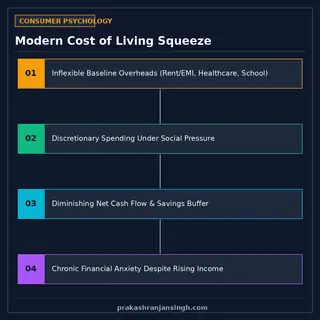
This matters because debt is not dangerous only when it is large; it becomes risky when it is used to fund lifestyle consumption rather than productive assets or genuine emergencies. A family that takes loans for school fees, health care, house repairs, or a vehicle may still be managing risk, but a family that uses credit to maintain social appearance, instant gratification, or status-based spending can slide into a cycle of refinancing and stress.

What Is This Doing to People Psychologically and Physically?
Financial pressure does not stay in the wallet; it moves into the body and mind. Recent reporting shows elevated burnout in India, and workplace stress is being linked to anxiety, disengagement, and lower productivity. Broader mental health data also indicate a large national burden of depression and anxiety, while recent hypertension research confirms that high blood pressure remains a major public-health concern and is rising in younger groups as well.
The real danger is cumulative. When a person feels constant pressure to earn more, spend more, repay more, compare more, and maintain more, the nervous system stays in a prolonged state of alert. Over time this can contribute to poor sleep, irritability, low patience, reduced concentration, and emotional exhaustion.
Why Does Society Itself Feel Less Stable Because of This?
These changes affect public life because stress spreads across institutions. Overworked and financially strained people tend to become less tolerant, less collaborative, and more reactive in families, workplaces, and public spaces. Burnout also reduces decision quality and consistency, which lowers productivity and increases absenteeism and turnover.
There is also a cultural layer. Social media, peer comparison, consumer advertising, and the fear of being “left behind” encourage people to judge themselves by visible markers of success rather than long-term well-being. When this mindset combines with easy credit, it creates a powerful push toward overspending and under-saving.
What Role Is the Rising Cost of Living Playing in the Broader Economy?
Inflation adds fuel to the fire by making essentials costlier, so households need to spend more just to maintain the same standard of living. Even when incomes rise, they often do not rise evenly with housing, education, health care, transport, and lifestyle costs. That mismatch makes borrowing look like a shortcut, but it often shifts the pain into the future.
At the macro level, this matters for national growth because stressed and indebted households save less, consume less wisely, and become more vulnerable to shocks. A society with weak savings and high anxiety has less resilience during job loss, illness, or market downturns, and this can ultimately reduce productivity and long-term economic stability.
What Actually Needs to Change?
Addressing the rising cost of living requires multiple stakeholders working together. Households need stronger financial discipline, schools and families need financial literacy, employers need healthier work culture, lenders need responsible credit standards, and policymakers need better consumer-protection and mental-health support. Mental health should be treated as an economic issue, not only a personal one, because burnout and financial stress directly affect productivity and health spending.
Practical steps include building emergency savings before taking lifestyle loans, separating needs from status-based wants, limiting high-cost revolving debt such as credit-card balances, planning large expenses in advance instead of using impulse credit, and protecting sleep, exercise, and social connection to reduce stress load.
A healthy economy is not only one where people can borrow easily; it is one where they can live securely without turning every aspiration into debt. India’s current challenge is to restore balance between aspiration and restraint, convenience and discipline, freedom and responsibility. If households, employers, and institutions act together, the country can reduce financial fragility, improve well-being, and protect productivity before the problem becomes deeper.
What Do the Latest RBI Reports Say About Household Debt?
The 41.3% of GDP figure above is the end-March 2025 reading reported from the RBI’s December 2025 Financial Stability Report, against a five-year average of 38.3%. A later edition, the RBI’s June 2026 Financial Stability Report (released on 30 June 2026, as reported), puts household debt at 45.5% of GDP as of end-March 2026 (several news outlets report this figure), up from around 33% in 2018-19. Reports differ on the exact series, so read the direction rather than the decimal.
What matters more is the mix. Non-housing retail loans made up about 58.4% of total household borrowing. Gold loans have grown at a compound annual rate of 42.4% since March 2024, and outstanding gold loans were about Rs 5.14 trillion in May 2026, according to reporting on the same report. The RBI also flagged rising impairment among borrowers who hold unsecured loans from five or more lenders. Reported gross NPAs were 0.7% for secured retail loans and 1.7% for unsecured retail loans.
From a banker’s chair, this is a familiar picture: bank balance sheets can look healthy while household balance sheets are quietly stretched. A bank is judged on its portfolio. A family is judged at the kitchen table, where one missed salary can turn a manageable EMI into a crisis.
How Does Money Stress Affect the Way We Think?
A well-known study published in the journal Science in 2013, “Poverty Impedes Cognitive Function”, is worth knowing here. In India, researchers tested 464 farmers who earn at least 60% of their income from one annual harvest. Each farmer performed better on cognitive tests after the harvest, when money was in hand, than before it, when money was tight. In a separate experiment in a New Jersey mall, lower-income participants who were asked to think about a $1,500 car repair performed significantly worse on tests than when the repair was only $150, while higher-income participants were not affected. The authors compared the effect to roughly a 13-point dip in IQ, as summarised by Princeton University.
The point is not that people under financial strain are less intelligent. It is that worry about money takes up mental bandwidth, which leaves less for planning, comparing offers and resisting impulse. That is why a stressed household is easier prey for the next easy loan. The practical lesson is to make good decisions automatic when you are calm: set up savings and EMI payments by standing instruction, and decide your borrowing limits before the pressure arrives.
How Much Salary Should Go to EMI? 5 Simple Household Debt Checks
These are rules of thumb, not RBI rules, but they are the questions a lender would ask and a family should ask first.
- Total EMIs below 40% of net monthly income. Many lenders allow roughly 40 to 50%, but policies vary, and staying lower leaves room for shocks. For example, on a take-home salary of Rs 60,000, 40% is Rs 24,000 a month for all EMIs combined, including home, car, personal loans and card instalments.
- An emergency fund of three to six months of essential expenses before taking any loan for lifestyle spending.
- Credit-card dues paid in full every month. Revolving card balances commonly cost around 3 to 4% per month.
- No new loan to repay an old loan. Refinancing for relief, not for lower cost, is a warning sign.
- A look at your credit report once a year. Under RBI rules, every credit information company must give you one free full credit report each year. Check for loans you do not recognise.
If you fail two or more of these, treat it as a signal to simplify, not to find a bigger loan.
Frequently Asked Questions
How bad is India’s household debt and savings pressure right now?
India’s household debt reached about 41.3 percent of GDP by end-March 2025, with personal loans taking a growing share of household borrowing while net household financial savings remain below pre-pandemic levels. Consumption and personal loans have been expanding faster than savings.
What is rising debt doing to people psychologically and physically?
Financial pressure moves into the body and mind – recent reporting shows elevated burnout in India linked to anxiety and lower productivity, alongside a large national burden of depression and rising hypertension, including in younger groups.
What practical steps can households take to reduce this stress cycle?
Build emergency savings before taking on lifestyle loans, separate needs from status-based wants, limit high-cost revolving debt like credit-card balances, and plan large expenses in advance instead of relying on impulse credit.
What is India’s household debt to GDP ratio?
Reports on the RBI’s December 2025 Financial Stability Report put it at about 41.3% of GDP at end-March 2025. Reports on the June 2026 edition cite 45.5%. Reference dates differ between reports, so treat the direction, which is upward, as the key point.
How much salary should go to EMI?
There is no single RBI limit for households, but a common rule of thumb is to keep total EMIs below about 40% of net monthly income. Many lenders allow 40 to 50%, depending on their policy, and a lower share leaves more room for emergencies.

Leave a Reply