

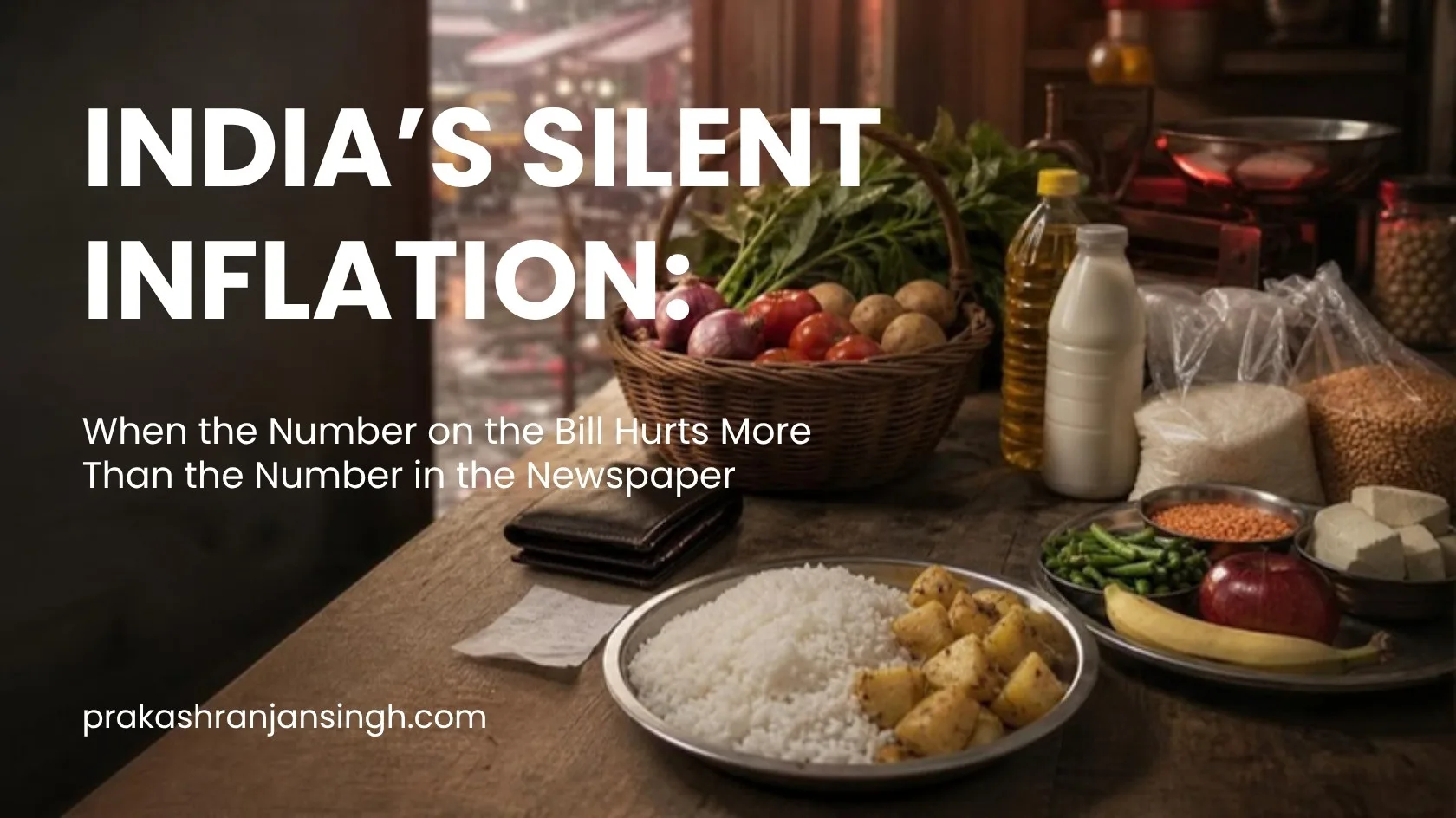
Inflation does not always arrive with a dramatic announcement.
Sometimes it quietly reduces the size of a cup of tea.
Sometimes the vegetable basket becomes smaller.
Sometimes a family stops buying fruits.
Sometimes dal is replaced by potatoes.
Sometimes cooking oil is used more carefully.
And sometimes a family continues to eat three meals a day—but those meals gradually become less nutritious.
This is silent inflation: the inflation that statistics measure in percentages, but families experience in compromises.
India’s latest official data actually confirms that the pressure is real. Retail CPI inflation rose to 4.82% in August 2026, while food inflation was considerably higher at 5.95%; rural food inflation was 6.13%. Some individual food items experienced much sharper increases—onion 48.27%, ginger 73.82% and garlic 43.60% year-on-year.
So the question is not simply, “Is inflation 4.82%?”
The more important question is:
Can an ordinary Indian family maintain the same quality of life when the price of essential food rises faster than its income?
Key Takeaways
- Food inflation is outrunning headline CPI — retail CPI was 4.82% in August 2026, but food inflation ran at 5.95% (6.13% in rural areas), and it is not evenly spread: onion rose 48.27% even as tomato and potato fell.
- Over 56% of Indians reportedly cannot afford a healthy diet — rice and wheat stay cheap while fruits, vegetables, pulses and dairy become harder to afford, so families quietly lose nutrition before they lose calories.
- The real fix is structural, not seasonal: higher farm productivity, climate-resilient agriculture and better logistics — shifting policy focus toward nutrition-per-rupee, not just tonnes-per-hectare.
Table of Contents
- 1. The Tea-Cup Test: Inflation Is Sometimes Visible Before It Is Measured
- 2. The ₹200 Vegetable Basket Is More Important Than the Inflation Percentage
- 3. But We Must Be Careful With the “Rice ₹100–₹200” Claim
- 4. Inflation Does Not Always Reduce Calories—It Can Reduce Nutrition
- 5. The Psychology of the Indian Household Under Inflation
- 6. Why Government Inflation Data Can Tell a Different Story
- 7. The Government Has Another Psychological Problem: Averages Can Create Comfort
- 8. Agriculture Is Becoming the Front Line of the Inflation Battle
- 9. India’s Future Food Challenge Is Not Merely “More Food”
- 10. The Hidden Inflation Multiplier: Energy and Logistics
- 11. The Most Dangerous Outcome: The Poor May Become Cheaper Eaters
- 12. The Psychology of the Middle Class Is Changing Too
- 13. What Should Government Measure More Carefully?
- 14. What Can Ordinary Families Do?
- 15. The Future: Three Possible Paths
- 16. India Needs to Change the Question
- 17. The Final Warning: Silent Inflation Can Become a Social Problem
1. The Tea-Cup Test: Inflation Is Sometimes Visible Before It Is Measured
Consider something as ordinary as tea.
A cup may still be advertised at ₹10 or ₹15, but consumers increasingly notice smaller quantities, less milk, weaker tea or smaller snacks accompanying it.
This is not necessarily evidence of deliberate cheating. Restaurants and tea stalls themselves face higher costs—milk, sugar, tea leaves, LPG, rent, electricity, wages and transportation.
The same phenomenon occurs throughout the economy.
A packet remains ₹20, but contains less.
A restaurant maintains the menu price but reduces portion size.
A vegetable seller charges the same per kilogram but customers buy only half a kilogram.
The price tag may remain stable while the purchasing power of ₹100 quietly falls.
This is why household inflation can feel considerably different from a single headline inflation number.
2. The ₹200 Vegetable Basket Is More Important Than the Inflation Percentage
A household doesn’t purchase an abstract CPI basket.
It purchases tomatoes, onions, potatoes, spinach, cauliflower, beans, oil, rice, dal, milk and cooking gas.
And these prices can behave very differently.
For example, in August 2026, official data showed tomato inflation at -31.09% and potato inflation at -13.14%, while onion inflation was 48.27%.
This illustrates an important point:
Inflation is not evenly distributed across the grocery basket.
One vegetable may become cheaper while another doubles in price.
Therefore, a household that regularly purchases several vegetables may experience a very different cost increase from the national average.
CRISIL’s August 2026 household-thali indicator similarly found that the cost of a home-cooked vegetarian thali increased 1% year-on-year, with onion, vegetable oil, rice and LPG among the important cost pressures.
3. But We Must Be Careful With the “Rice ₹100–₹200” Claim
There is an important factual distinction.
Ordinary rice in India does not have an average retail price of ₹100–₹200 per kilogram. Such prices may apply to particular premium, branded, specialty or organic varieties.
That distinction matters because an article about inflation becomes more powerful when its examples are accurate.
The stronger argument is not that all rice costs ₹200/kg.
It is this:
Even when staple grains remain relatively affordable, the complete nutritious food basket—vegetables, pulses, milk, eggs, fruits, oils, spices and cooking fuel—can become increasingly difficult for lower-income households to afford.
And this is where the inflation story becomes a nutrition story.
4. Inflation Does Not Always Reduce Calories—It Can Reduce Nutrition
This is perhaps the most dangerous psychological consequence.
When money becomes tight, families don’t necessarily stop eating.
They change what they eat.
Rice and wheat provide calories relatively cheaply.
Vegetables, fruits, pulses, milk, eggs, nuts and other nutrient-dense foods can cost considerably more.
UNICEF India reported that, using 2021 estimates, more than 56% of India’s population could not afford a healthy diet. It also noted that fruits and vegetables account for a large share of healthy-diet costs.
A 2026 analysis from Azim Premji University found that 31.2% of urban and 56.6% of rural populations would need to increase their current food expenditure to meet its estimated cost of a healthy diet, although the result varies according to the definition and benchmark used.
Therefore, the statement that “people are eating” does not necessarily mean people are adequately nourished.
A family can be full—and still be nutritionally deficient.
5. The Psychology of the Indian Household Under Inflation
Inflation changes behaviour long before it changes lifestyles visibly.
The first psychological response: substitution
Paneer becomes dal.
Dal becomes cheaper dal.
Fruits become seasonal fruits.
Green vegetables become potatoes.
Restaurant food becomes home food.
Premium rice becomes ordinary rice.
The second response: quantity reduction
Instead of eliminating an item completely, families reduce its quantity.
That makes the financial adjustment psychologically easier.
The third response: postponement
A family tells itself:
“We will buy it next month.”
Shoes can wait.
Medical check-ups can wait.
Fruit can wait.
Home repairs can wait.
Sometimes even education-related expenditure can be postponed.
The fourth response: normalisation
This may be the most dangerous.
After repeatedly seeing higher prices, people gradually accept them as normal.
₹100 stops feeling like ₹100.
The family simply adjusts its lifestyle around the new price.
6. Why Government Inflation Data Can Tell a Different Story
There is an important misunderstanding here.
Government inflation data is not necessarily saying:
“Nobody is suffering.”
It is measuring something different.
The CPI is a statistical measure constructed from a large basket of goods and services and collected across thousands of markets. For August 2026, the government said price data were collected from 1,407 urban markets and 1,465 villages, with a 100% response rate.
A household, however, has its own basket.
A pensioner has a different basket from a young professional.
A rural labourer has a different basket from a high-income urban household.
A family with children has a different basket from a retired couple.
And a vegetarian household has a different food basket from a non-vegetarian household.
Therefore:
Official inflation and personal inflation can both be real at the same time.
The statistical average is not the same thing as every family’s experience.
7. The Government Has Another Psychological Problem: Averages Can Create Comfort
Governments naturally watch macroeconomic indicators.
Inflation within a manageable range, GDP growth, fiscal deficit, food stocks, employment, foreign exchange reserves and industrial production are all important.
But there is a danger in governing through averages.
The average Indian does not go to the market and purchase an average basket.
He purchases today’s vegetables.
He pays today’s LPG price.
He buys today’s milk.
He pays today’s school fee.
He pays today’s rent.
And he receives today’s salary.
The psychological distance between macro-economic stability and household affordability can therefore become significant.
This does not mean governments ignore inflation. India has repeatedly used food stocks, imports, export restrictions, market interventions and other measures to manage food-price shocks.
But a structural problem remains:
Temporary price control cannot permanently substitute for productivity, storage, logistics and agricultural resilience.
8. Agriculture Is Becoming the Front Line of the Inflation Battle
India’s food problem is ultimately a production-and-distribution problem as much as a monetary problem.
There is an interesting contradiction in the latest agricultural data.
India’s 2025–26 foodgrain production was estimated at a record 376.56 million tonnes.
Yet the government has set a lower foodgrain target of 373.93 million tonnes for 2026–27, citing conditions associated with El Niño.
This does not mean India is heading toward a food shortage.
It means the future carries greater uncertainty.
The World Bank’s September 2026 food-security update notes that El Niño conditions were present and expected to strengthen through late 2026 and persist into early 2027, increasing risks from disrupted rainfall, extreme heat, drought and flooding.
And NITI Aayog’s agricultural working-group analysis has already highlighted potential future supply constraints in pulses, edible oils, fruits and vegetables unless productivity and cultivated area improve.
This is much more important than simply asking whether India will have enough rice.
9. India’s Future Food Challenge Is Not Merely “More Food”
India needs to ask a bigger question:
Can we produce affordable nutritious food for a population whose aspirations and purchasing power are changing under climate uncertainty?
The challenge involves:
higher agricultural productivity;
climate-resilient seeds;
better irrigation;
water conservation;
crop diversification;
stronger pulses and oilseed production;
cold-chain infrastructure;
modern warehouses;
reduction of post-harvest losses;
better farmer-market connectivity;
scientific forecasting;
affordable transportation;
food processing;
and stable agricultural policies.
The future food economy cannot depend exclusively upon producing more cereals.
India needs more nutrition per rupee.
10. The Hidden Inflation Multiplier: Energy and Logistics
A vegetable doesn’t magically become expensive after leaving the farm.
It travels.
Farmer → local trader → transporter → wholesale market → retailer → consumer.
Every stage consumes fuel, labour, electricity, storage and working capital.
The same applies to packaged groceries.
The September 2026 government economic review warned that geopolitical tensions, elevated crude prices and supply disruptions could create additional imported-inflation pressure.
Therefore, the price of crude oil can eventually appear in the price of:
vegetables + milk + groceries + transport + packaging + restaurant food.
Inflation can therefore travel through the economy like a chain reaction.
11. The Most Dangerous Outcome: The Poor May Become Cheaper Eaters
This is the social question India should watch most carefully.
When nutritious food becomes expensive, low-income households don’t necessarily stop eating.
They become cheaper eaters.
And that can create a long-term cycle:
Low income → cheaper diet → poor nutrition → weaker health → lower productivity → higher medical expenditure → lower savings → greater vulnerability.
Food inflation therefore has consequences far beyond the grocery bill.
It can affect:
health → education → productivity → household savings → human capital → economic growth.
The FAO, IFAD, UNICEF, WFP and WHO have similarly warned that persistent food-price inflation undermines access to healthy diets and is associated with food insecurity and child malnutrition.
12. The Psychology of the Middle Class Is Changing Too
Inflation doesn’t only affect the poor.
The middle class often experiences a different psychological pressure.
Income may rise—but so do:
school fees,
healthcare,
rent,
transportation,
insurance,
EMIs,
food,
domestic help,
digital subscriptions,
children’s education,
retirement requirements.
Consequently, a salary increase can create the illusion of progress while purchasing power barely improves.
A person earning ₹50,000 today may feel better than someone earning ₹30,000 ten years ago.
But the relevant question is:
How much can ₹50,000 actually buy?
That is the psychology of real income, rather than nominal income.
13. What Should Government Measure More Carefully?
CPI will remain essential.
But policymakers could complement it with more household-oriented indicators.
Imagine a monthly “Indian Household Affordability Index” measuring the cost of:
basic breakfast;
nutritious lunch;
nutritious dinner;
milk;
vegetables;
pulses;
fruits;
cooking oil;
LPG;
transport;
school-related expenditure;
basic healthcare.
Then compare this basket with:
minimum wage + median household income + pension income.
Such an indicator could answer a question CPI alone cannot:
How many hours of work does an ordinary person need to buy a nutritious day’s food?
That would bring inflation closer to everyday life.
14. What Can Ordinary Families Do?
There is no magical household solution to structural inflation.
But families can reduce vulnerability through intelligent food planning.
Buy seasonal produce.
Seasonal vegetables are generally less expensive.
Diversify proteins.
Use combinations of dal, chana, rajma, soy, eggs, milk or other affordable sources according to dietary preference.
Don’t confuse expensive food with nutritious food.
Reduce food wastage.
Food thrown away represents money thrown away.
Compare unit prices, not packet prices.
Maintain a household inflation budget.
Track essential expenditure every month.
And most importantly:
Do not respond to food inflation by sacrificing nutrition first.
Reducing unnecessary consumption is very different from reducing essential nutrition.
15. The Future: Three Possible Paths
India’s food economy could move in different directions.
Path 1 — Climate pressure continues
More erratic rainfall, heat waves and extreme weather increase production volatility.
Food prices become increasingly unpredictable.
Path 2 — Technology transforms agriculture
Precision farming, better seeds, irrigation technology, AI-based weather forecasting, improved storage and supply-chain digitisation increase productivity and reduce wastage.
Path 3 — India builds a nutrition-first food system
Agriculture policy increasingly focuses not merely on tonnes produced but on nutrition produced per hectare and nutrition available per rupee.
The third approach may require the greatest change in thinking.
16. India Needs to Change the Question
For decades, India’s agricultural question was:
“Do we have enough food?”
The next question should be:
“Can every Indian afford nutritious food?”
And after that:
“Can India continue providing affordable nutrition when climate, energy and global supply chains become more volatile?”
That is the real inflation challenge.
17. The Final Warning: Silent Inflation Can Become a Social Problem
Inflation rarely creates a revolution overnight.
It works slowly.
One less vegetable.
One less fruit.
One smaller cup.
One cheaper packet.
One postponed medical test.
One additional EMI.
One more month without savings.
Millions of households making these tiny adjustments simultaneously can produce a much larger social consequence.
India therefore needs to watch not only inflation, but affordability.
Not only food production, but nutrition.
Not only GDP growth, but household purchasing power.
Not only average prices, but the price of a healthy life.
The real measure of a successful economy is not merely whether inflation has fallen to a particular percentage.
It is whether an ordinary working family can enter a market, buy enough nutritious food for its children and return home without wondering which essential item it must sacrifice tomorrow.
That is the difference between economic growth on paper and economic security in the kitchen.
Frequently Asked Questions
Why does my household’s inflation feel higher than the official CPI number?
CPI is a statistical average built from a large, fixed basket of goods across thousands of markets. No single household buys that exact basket — a vegetarian family, a pensioner and a young professional each face different price movements. So official inflation and your personal, felt inflation can both be accurate at the same time.
Why did onion prices rise sharply in August 2026 while tomato and potato prices fell?
Food inflation is not evenly distributed. In August 2026, official data showed onion inflation at 48.27% even as tomato inflation fell -31.09% and potato inflation fell -13.14%. Crop-specific supply, weather and harvest timing move each vegetable differently, so a household’s actual grocery bill depends heavily on which items it buys most.
Is it true that ordinary rice in India now costs ₹100–₹200 per kilogram?
No — ordinary retail rice does not average ₹100–₹200 per kilogram nationally. Such prices apply to specific premium, branded or specialty varieties. The more accurate concern is that even where staple grains stay affordable, the full nutritious basket of vegetables, pulses, milk, eggs and cooking oil is becoming harder for lower-income households to afford.
How do Indian households typically cope with rising food prices?
Families generally go through four stages: substitution (cheaper alternatives like dal instead of paneer), quantity reduction (buying less of the same item), postponement (delaying non-essential purchases), and eventually normalisation, where higher prices simply become the new baseline for budgeting.
What can an ordinary family actually do to manage food inflation?
Buy seasonal produce, diversify protein sources (dal, chana, rajma, soy, eggs, milk), compare unit prices rather than packet prices, reduce food wastage, and track essential spending monthly. Most importantly, cut non-essential consumption before cutting essential nutrition.

Leave a Reply