

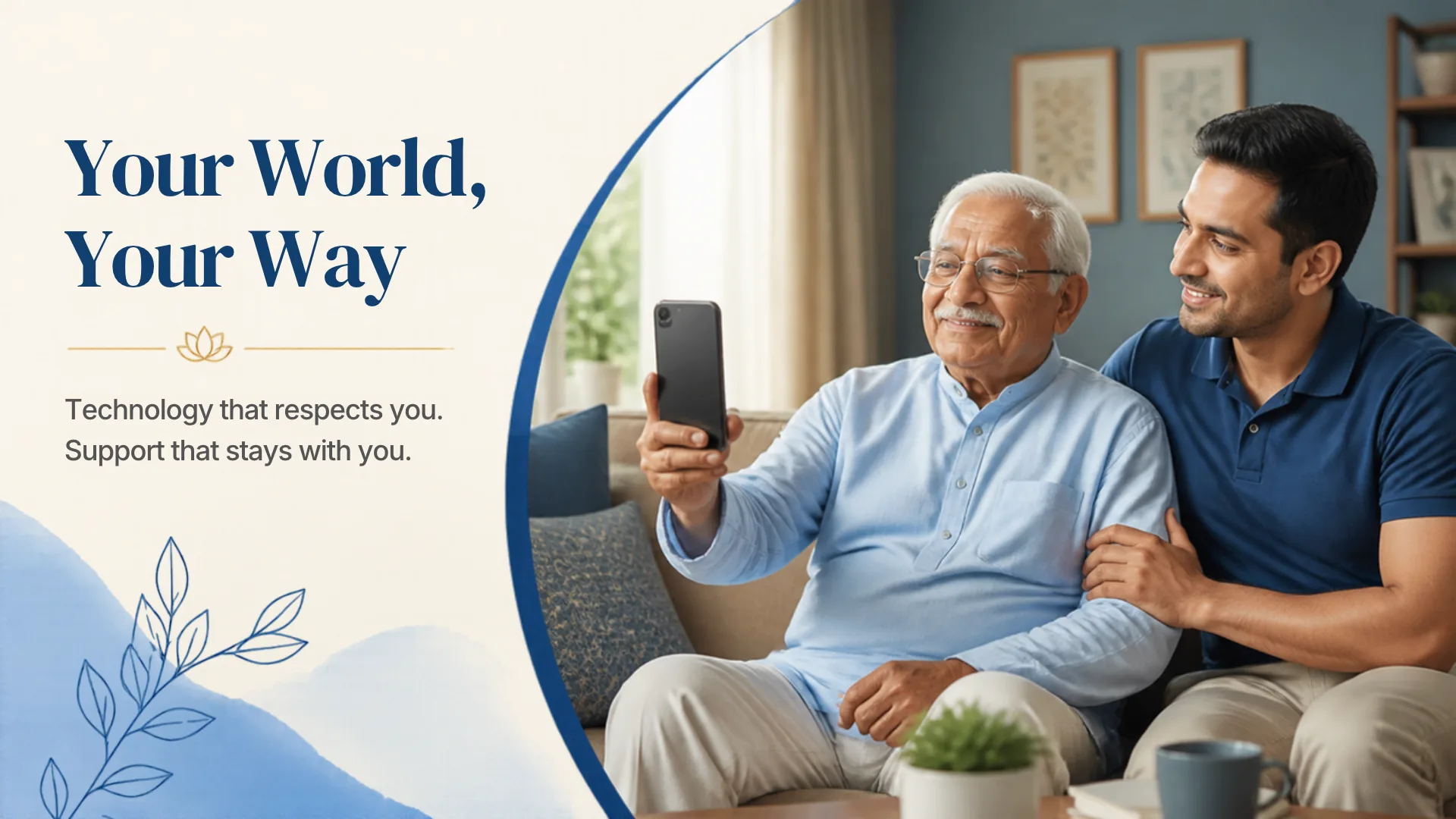
An elderly pensioner should spend the evening of life with dignity and peace, not worrying about bank visits, paperwork, biometric failures and the fear of losing a hard-earned pension. India’s Digital Life Certificate initiative is changing this experience. But awareness, accessibility and human assistance remain equally important.
The Jeevan Pramaan life certificate lets a pensioner prove he or she is alive from home with a face scan, and the usual last date for Central Government pensioners is 30 November. Pensioners aged 80 and above could start on 1 October, and those below 80 from 1 November. This guide explains the five ways to submit, the smartphone steps, the ₹70 doorstep fee, the free EPFO option and what to do if it fails. Start from the official Jeevan Pramaan portal.
Imagine an 85-year-old retired government employee who has spent nearly four decades serving the country. His eyesight is weakening, his knees are painful, and walking even a short distance has become difficult. His children are settled in different cities. His spouse is equally old and physically dependent on him.
Every year, he has to arrange transportation, find someone to accompany him, visit the bank, stand in a queue and submit a Life Certificate to establish that he is still alive.
For a younger person, this may appear to be a routine administrative exercise. For an elderly person, it can become an exhausting physical and emotional experience.
There is another dimension to this difficulty. For many pensioners, monthly pension is their only dependable source of income. It pays for medicines, food, electricity, household expenses and sometimes the medical needs of their spouse. The possibility of pension discontinuation creates anxiety that is much greater than the administrative importance of the certificate itself.
A person who has spent a lifetime fulfilling professional and family responsibilities should not have to struggle unnecessarily during the last stage of life merely to receive an entitlement earned through decades of service.
Thankfully, technology is changing this experience.
With the Jeevan Pramaan life certificate, the Government of India has introduced a Digital Life Certificate facility that allows pensioners to complete this annual requirement through smartphones, authorised service centres, banks and doorstep services.
The real importance of this initiative is not just digital transformation. It is the restoration of dignity, independence and peace of mind to millions of elderly citizens.
Key Takeaways
- Do it early — Central Government pensioners aged 80+ could start on 1 October and those below 80 from 1 November; the usual last date is 30 November, and a missed date can delay the pension.
- You have five ways, not one — smartphone face scan, India Post doorstep visit (₹70 incl. GST on success), Common Service Centre, bank branch or bank doorstep service.
- Never share OTPs or PINs — a life certificate needs no ATM PIN, UPI PIN or banking password, and you should confirm that the pension-disbursing agency accepted it.
Table of Contents
- 1. Why does a pensioner need to prove that he or she is alive every year?
- 2. The hidden psychological burden: What an annual Life Certificate means to an elderly person
- 3. Jeevan Pramaan life certificate: From physical verification to digital convenience
- 4. Five convenient ways to submit a Digital Life Certificate
- 5. Practical guide: How to submit a Digital Life Certificate using a smartphone
- 6. A special blessing for the bedridden: Doorstep Life Certificate service
- 7. How safe is the digital process? Convenience must not compromise security
- 8. What if the digital process fails? Do not panic or assume that pension will stop
- 9. Deadlines: Why pensioners should not postpone the exercise
- 10. What should pensioners and families do to avoid last-minute problems?
- 11. The responsibility of banks and government departments: Digitalisation must not create digital exclusion
- 12. The larger lesson: Retirement should be about peace, not proving one’s existence
- Frequently Asked Questions
1. Why does a pensioner need to prove that he or she is alive every year?
Pension is not a government favour. It is an entitlement arising from years of service under applicable pension rules.
However, pension is a continuing payment. The government and pension-disbursing agencies need to verify that the beneficiary is alive and eligible to receive the payment.
The annual Life Certificate serves several purposes:
- Prevents unauthorised pension withdrawals after the death of a pensioner.
- Protects public money against fraudulent pension claims.
- Helps maintain accurate pension records.
- Confirms the continuing eligibility of pension beneficiaries.
- Supports proper administration of family pension arrangements.
The requirement is therefore necessary. The question is whether the process should create physical hardship for people who are already struggling with age-related limitations.
The answer is clearly no.
The objective of modern administration should be to retain necessary verification while making the process as convenient as possible.
2. The hidden psychological burden: What an annual Life Certificate means to an elderly person
The difficulties of senior citizens are not limited to physical movement. Their psychological circumstances deserve equal attention.
Fear of losing financial security
For a retired person, pension is often the foundation of financial independence. Unlike a salaried employee, a pensioner may have no alternative monthly income.
Even a small uncertainty about pension continuation can disturb the entire household.
The thought that a missed certificate might stop the pension creates unnecessary mental pressure.
Loss of independence and self-respect
A person who once managed offices, employees, financial responsibilities and an entire family may now need assistance to travel to a bank or operate a smartphone.
This change in dependence can affect self-confidence.
Many elderly people hesitate to ask their children repeatedly for help because they do not want to become a burden.
Fear of technology
Digital applications, OTPs, passwords, biometric authentication and mobile connectivity may appear simple to younger generations.
But for someone who has never regularly used smartphones, these activities can be intimidating.
A failed face scan or an OTP that does not arrive may create frustration and the feeling that technology is not meant for them.
Loneliness and emotional isolation
Many retired people live alone or with an equally elderly spouse. Their children may be settled elsewhere.
For such individuals, even a bank visit requires planning and assistance.
The annual Life Certificate exercise can remind them of their physical limitations and dependence on others.
Fear of fraud and exploitation
Senior citizens are frequent targets of impersonation calls, fake bank officials and fraudulent links.
When someone asks for Aadhaar details, OTPs or personal information in the name of pension verification, an elderly person may find it difficult to distinguish genuine assistance from fraud.
This is why awareness and security education must accompany digital convenience.
The government has simplified the process, but families and financial institutions must ensure that technology does not become another source of anxiety.
3. Jeevan Pramaan life certificate: From physical verification to digital convenience
Launched on 10 November 2014, Jeevan Pramaan is the Government of India’s Aadhaar-based Digital Life Certificate initiative.
It is designed to help pensioners submit their Life Certificates electronically instead of depending exclusively on physical submission.
After successful Aadhaar-based authentication, a Digital Life Certificate is generated with a unique Pramaan ID.
The certificate is made electronically available to the relevant pension-disbursing agency.
One of the most useful developments is Face Authentication.
Earlier, digital biometric verification could require a fingerprint scanner or iris-reading equipment. With face authentication, an eligible pensioner can use a compatible smartphone camera.
This is particularly helpful for senior citizens whose fingerprints may have become difficult to capture because of age-related changes.
The initiative reflects an important principle: public services should adapt to citizens’ physical limitations rather than expect citizens to struggle with administrative procedures.
Official portal: jeevanpramaan.gov.in
4. Five convenient ways to submit a Digital Life Certificate
The biggest advantage of the current system is that pensioners have multiple options. They need not necessarily travel to their pension-disbursing bank.
A. Smartphone Face Authentication
This is one of the easiest methods for pensioners who have access to a compatible smartphone.
The pensioner can complete face authentication using the official Jeevan Pramaan application and AadhaarFaceRD application.
A separate fingerprint scanner is not required.
A family member can assist with the application, although the pensioner’s own face authentication is necessary.
B. India Post Payments Bank doorstep service
This is particularly useful for pensioners who are bedridden, physically weak or unable to travel.
Through India Post Payments Bank and the postal network, a postman or Gramin Dak Sevak can visit the pensioner’s home and assist with generating the Digital Life Certificate.
The facility is available to eligible pensioners even if they do not maintain an IPPB account, subject to the pension-disbursing agency’s participation.
A nominal fee of ₹70 (including GST) applies for a successful doorstep DLC, as Business Standard reported.
C. Common Service Centres (CSC)
Pensioners can visit an authorised Common Service Centre where an operator helps complete the digital authentication and certificate-generation process.
This is useful for those who do not own smartphones or are uncomfortable operating applications.
D. Bank branches
Pensioners can continue using their pension-disbursing bank branch or an appropriately equipped bank branch for assistance.
The traditional Life Certificate submission route remains relevant for people who prefer physical assistance.
E. Doorstep banking
Eligible pensioners can enquire about doorstep services through their bank.
This is particularly useful for bedridden or physically incapacitated senior citizens who cannot travel to a branch.
The important message is that the pensioner should choose the method that is easiest and safest. Digital convenience should be an option, not a compulsion.
5. Practical guide: How to submit a Digital Life Certificate using a smartphone
For families with elderly parents, this is perhaps the most useful part of the initiative.
A son or daughter can help their parents complete the process at home.
Step 1: Keep the necessary information ready
Before starting, arrange the following:
- Aadhaar number or Virtual ID.
- Mobile number for OTP verification.
- Pension Payment Order (PPO) number.
- Pension account number.
- Name of pension sanctioning authority.
- Name of pension-disbursing agency.
- Type of pension.
Make sure the pensioner’s Aadhaar and other details are correctly registered with the pension-disbursing agency.
Step 2: Download the official applications
Visit the official Jeevan Pramaan portal.
Download the Jeevan Pramaan application and AadhaarFaceRD application from the official portal or authorised app store.
Official website:
Step 3: Complete operator authentication
The application requires operator authentication. The pensioner can also act as the operator.
A family member or authorised assisting person may help with the process.
Step 4: Enter pension-related information
Enter the pensioner’s Aadhaar details, mobile number, PPO number and other required information.
Take particular care while entering the PPO number and pension-disbursing authority. Incorrect details can result in rejection or processing difficulties.
Step 5: Complete OTP verification
An OTP is sent to the registered mobile number.
Enter the OTP as instructed.
Never share an OTP with an unknown person over the telephone.
Step 6: Complete face authentication
- Sit in a well-lit room.
- Keep the mobile camera clean.
- Ensure that the pensioner’s face is clearly visible.
- Avoid strong light directly behind the face.
- Follow the instructions on the screen.
- Blink when instructed.
The application captures the face and performs Aadhaar-based authentication.
Step 7: Generate the Digital Life Certificate
After successful authentication, a unique Pramaan ID is generated.
An SMS acknowledgement is sent to the registered mobile number.
Step 8: Download and preserve the certificate
Visit the Jeevan Pramaan portal and use the Pramaan ID to download the certificate.
Keep the acknowledgement and certificate safely.
Official certificate download:
https://jeevanpramaan.gov.in/ppouser/login
Most importantly, do not assume that merely completing face authentication means the pension-disbursing agency has completed every required verification. Check the certificate status and confirm that it has been accepted.
6. A special blessing for the bedridden: Doorstep Life Certificate service
One of the most meaningful developments is the use of India’s postal network to provide services at the doorstep.
Consider a 90-year-old pensioner living alone with his spouse. He cannot walk properly and does not have children nearby.
For him, even arranging transportation to the bank may be difficult.
The doorstep Life Certificate service can remove this hardship.
A pensioner or family member can contact the nearest post office and enquire about the IPPB Digital Life Certificate facility.
A postal employee can visit the residence and assist with the authentication process.
This is an excellent example of technology supported by human service.
The technology verifies identity, while the postal employee provides the personal assistance that elderly citizens may need.
For pensioners covered under the Employees’ Pension Scheme (EPS), EPFO signed an agreement with IPPB in November 2025 for a doorstep DLC service, and the procedure was issued in January 2026. EPFO bears the cost, so the service is free for the pensioner on a successful submission. To request a postman’s home visit, call IPPB on 033-22029000. EPS pensioners should also note that their certificate is due within a year of the previous submission, so their date can differ from the 30 November cycle.
Pensioners should distinguish this specific free EPS facility from the general IPPB doorstep DLC service, which has a published charge.
7. How safe is the digital process? Convenience must not compromise security
Whenever Aadhaar, personal information and digital authentication are involved, security becomes important.
Jeevan Pramaan is an official government facility using Aadhaar-based authentication.
However, pensioners should understand that no digital system is completely free from risk.
Some practical precautions can prevent serious problems.
- Download applications only from official sources.
- Never click on unknown links received through SMS or WhatsApp.
- Never disclose OTPs, ATM PINs, UPI PINs or banking passwords.
- Do not allow unknown persons to operate your mobile phone.
- Use authorised bank officials, postal employees and CSC operators.
- Do not install remote-access applications at the request of an unknown caller.
- Do not pay unofficial agents claiming to guarantee pension continuation.
- Preserve the Pramaan ID and acknowledgement.
- Verify certificate acceptance through the official channel.
One important point must be understood: generating a Life Certificate does not require an ATM PIN, UPI PIN or banking password.
A genuine pension verification exercise should never become an excuse for someone to obtain access to your bank account. If you suspect a scam, follow our first-hour steps after online fraud.
Remember: A Life Certificate verifies life and identity. It does not authorise anyone to withdraw your money.
8. What if the digital process fails? Do not panic or assume that pension will stop
Technology may sometimes fail because of poor internet connectivity, incorrect information, camera problems or authentication errors.
Senior citizens should not become anxious if the first attempt is unsuccessful.
Here are some practical solutions.
| Problem | Practical solution |
|---|---|
| Face not recognised | Improve lighting, clean the camera and reposition the phone |
| OTP not received | Check mobile network and registered mobile number |
| Fingerprint not recognised | Use face authentication or another authorised method |
| Incorrect PPO details | Verify details with the pension-disbursing agency |
| Aadhaar not properly registered | Contact the bank or pension office for correction |
| Internet connectivity problem | Try again later or use an assisted service |
| Certificate rejected | Identify the reason, correct the details and regenerate the certificate |
| Certificate generated but pension not credited | Contact the pension-disbursing bank and check the payment status |
The most important precaution is not to wait until the last day.
If the online process fails, use another available route such as the bank branch, CSC or doorstep service.
For technical assistance, the Jeevan Pramaan portal provides:
Helpline: 1800 111 555
Email: [email protected]
9. Deadlines: Why pensioners should not postpone the exercise
For the regular annual Life Certificate cycle applicable to Central Government pensioners, the general submission schedule is:
- Pensioners aged 80 years and above: From 1 October.
- Pensioners below 80 years: From 1 November.
For the 2026 cycle, the usual last date for Central Government pensioners is 30 November, so complete the submission within the applicable window rather than waiting until the last day.
However, different State Government departments, autonomous bodies, public sector organisations and pension schemes may have different requirements.
EPFO pensioners and other scheme beneficiaries should follow their respective applicable instructions.
Missing the applicable deadline can result in pension payments being withheld or delayed pending verification.
Another important point is that a Digital Life Certificate is not valid forever. Its validity depends on the rules prescribed by the pension sanctioning authority.
Therefore, pensioners must ensure timely submission every year, even if they have used the digital facility successfully in the previous year.
10. What should pensioners and families do to avoid last-minute problems?
The process becomes much easier when families treat it as an annual responsibility rather than an emergency activity.
A simple practical approach can make a significant difference.
For pensioners:
- Keep Aadhaar, PPO and pension account information safely available.
- Verify the registered mobile number.
- Complete the certificate early in the applicable period.
- Preserve the Pramaan ID and acknowledgement.
- Check whether the certificate has been accepted.
- Contact the pension-disbursing bank if pension payment is delayed.
For children and family members:
- Do not wait for parents to ask for assistance.
- Help them install the official application if they wish to use a smartphone.
- Check the correctness of pension details.
- Arrange a doorstep visit if parents cannot travel.
- Explain how to identify fraudulent calls and messages.
- Keep a record of the certificate acknowledgement.
- Check whether the pension is credited normally after submission.
A little planning can save an elderly parent considerable physical effort and mental stress. While you update pension details, also check the nomination on the bank account.
11. The responsibility of banks and government departments: Digitalisation must not create digital exclusion
There is an important responsibility for financial institutions and government agencies.
Not every pensioner owns a smartphone. Not everyone can read English. Some people have poor eyesight, hearing difficulties, memory limitations or physical disabilities.
A truly pensioner-friendly system must recognise these differences.
Banks and pension-disbursing agencies should:
- Maintain dedicated counters for senior citizens.
- Organise special Life Certificate camps.
- Display information about digital and doorstep facilities.
- Provide assistance to pensioners who cannot use smartphones.
- Ensure that certificates are processed promptly.
- Monitor rejected and pending certificates.
- Help resolve Aadhaar, PPO and account-mapping issues.
- Avoid unnecessary repeated visits for the same verification.
Digitalisation should reduce the burden on citizens, not transfer the entire responsibility of operating government technology to elderly people.
The best model is a combination of digital efficiency and human sensitivity. For a wider view of deposit safety, read whether your money is safe in Indian banks.
12. The larger lesson: Retirement should be about peace, not proving one’s existence
India is moving rapidly towards digital banking, paperless administration, Aadhaar-based services and technology-driven governance.
These changes can improve transparency, reduce administrative costs and make public services more accessible.
But there is a human dimension that should never be forgotten.
Behind every pension account is a person who has spent decades working, raising a family, fulfilling responsibilities and contributing to society.
Some pensioners have lost their spouses. Some live alone. Some are dependent on medicines and regular medical attention. Some have children who cannot be physically present because of employment or family commitments.
For them, the monthly pension is not merely a financial transaction. It is financial independence, personal dignity and a sense of security. Planning that security early is the theme of our retirement planning guide.
The annual Life Certificate is a legitimate administrative requirement. But its fulfilment should never become a source of humiliation, exhaustion or unnecessary anxiety.
Technology should make a citizen’s life easier. Institutions should provide support when technology fails. Families should ensure that elderly parents are not left to manage complicated procedures alone.
A country that respects its senior citizens must understand that the final years of life are not a period for unnecessary administrative hardship.
They have already given the best years of their lives to their families, institutions and the nation. They deserve a system that comes to them rather than forcing them to run after it.
Jeevan Pramaan is an encouraging step towards that vision.
Let technology verify identity, let banks and institutions provide assistance, and let families provide care.
After a lifetime of service, our pensioners deserve security, dignity and peace of mind.
A pension is an earned right. A Life Certificate is an administrative necessity. But compassion in delivering public services is a national responsibility.
Let us make digital India a country where technology does not merely save time, but also saves elderly citizens from unnecessary physical and emotional hardship.
Official information sources: Jeevan Pramaan, Ministry of Electronics and Information Technology; Department of Pension and Pensioners’ Welfare; India Post Payments Bank; Employees’ Provident Fund Organisation.
Information updated for publication as of 3 November 2026. Pensioners should verify the applicable dates, service charges and scheme-specific requirements with their pension-disbursing authority.
Frequently Asked Questions
How can I submit my Jeevan Pramaan certificate at home?
Use the Jeevan Pramaan and AadhaarFaceRD apps on a compatible smartphone for a face scan, or ask India Post Payments Bank for a doorstep visit by a postman. A small fee of ₹70 including GST applies for a successful doorstep DLC, while EPS pensioners can use the free EPFO arrangement.
How do I download my life certificate online?
Open the pensioner login page on the Jeevan Pramaan portal, enter your Pramaan ID and the captcha, and verify with the OTP sent to your registered mobile number to download the signed certificate.
Why am I not receiving my Jeevan Pramaan OTP?
Check the mobile network and confirm that the number linked to your Aadhaar is the one you entered. If the number is wrong or not registered, update it with the bank, post office or Aadhaar centre and try again, or use an assisted route such as a bank branch or Common Service Centre.
How can I check the status of my life certificate?
Keep your Pramaan ID and the SMS acknowledgement, check the status on the Jeevan Pramaan portal, and confirm with your pension-disbursing bank that the certificate has been accepted.
What is the last date to submit the life certificate in 2026?
For Central Government pensioners the usual last date is 30 November. Pensioners aged 80 and above can submit from 1 October and those below 80 from 1 November. State, EPFO and other schemes may have their own rules, so check with your pension-disbursing authority.
Can a family member submit the certificate for me?
A family member can help with the app and act as the operator, but the pensioner’s own Aadhaar-based authentication, such as the face scan, is needed. Never hand your OTP or PINs to anyone.
Will my pension stop if I miss the last date?
Missing the date can lead to the pension being withheld or delayed until verification is done. Submit early, keep the acknowledgement and contact your pension-disbursing bank if a payment is delayed.
Is there a fee for the doorstep life certificate service?
A nominal fee of ₹70 including GST applies for a successful doorstep DLC through India Post Payments Bank. For EPS pensioners, EPFO bears the cost and the service is free on a successful submission.
Related Reading
- AI Banking Security: 21 Urgent Risks Threatening the World’s Digital Money
- NPS Withdrawal Rules: A Detailed, Actionable Checklist for Applicants
- Bank Mis-Selling in India: 7 Red Flags, 5 Steps to Complain
- Bank Strike in India: Will Banking Stop? What Still Works
- Pay to Fail: When Banks Charge for Transactions That Never Happen
See more of our stories on Google Search

Leave a Reply