

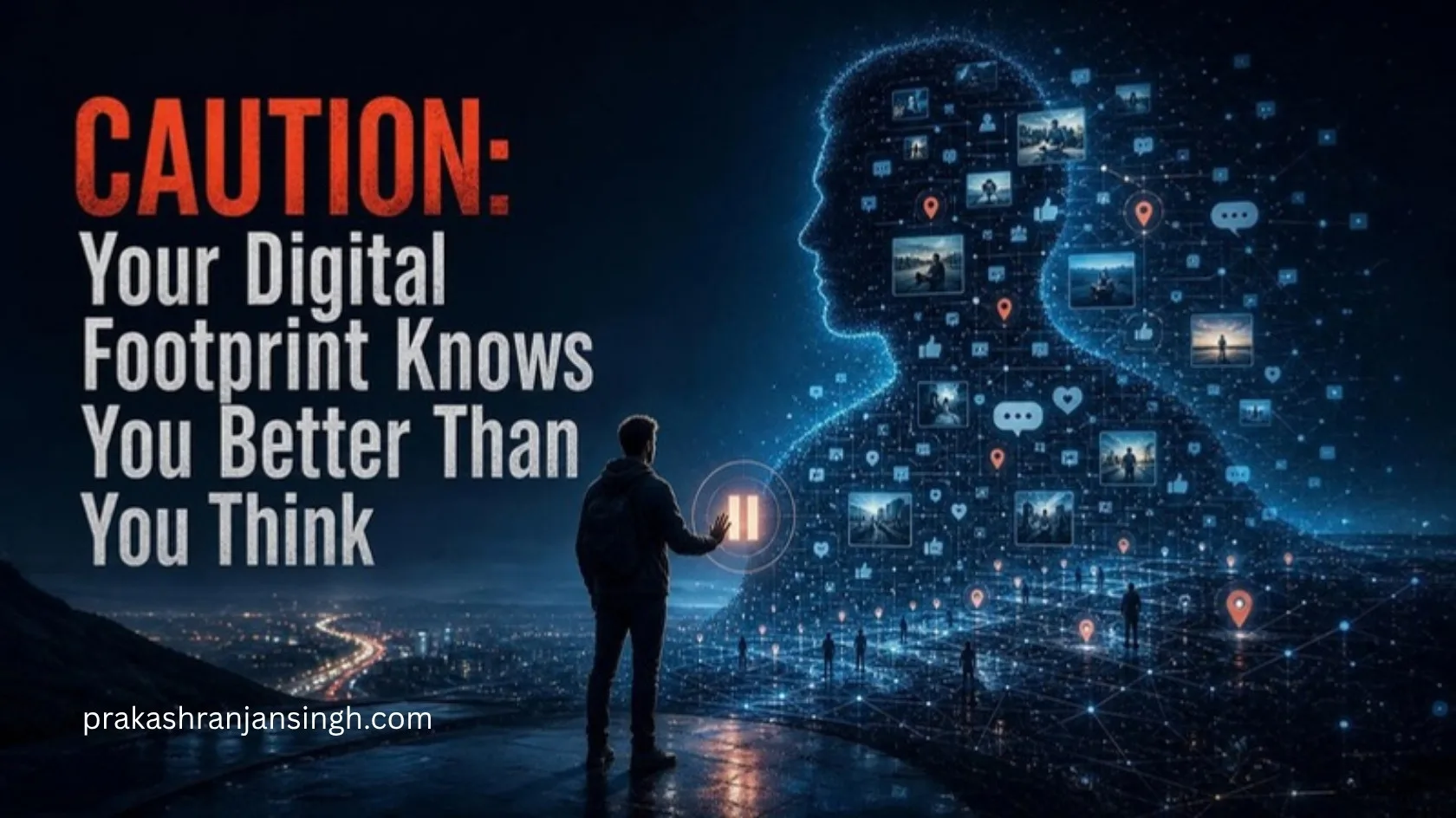
How Likes, Comments, Messages and Online Habits Are Quietly Creating a Permanent Audit Trail of Human Behaviour
Every single day, your digital footprint quietly grows a little larger, recording far more about you than you may ever realise.
Key Takeaways: Your Digital Footprint
- Every like, message and photo you post adds to a permanent digital footprint that others can interpret in ways you never intended.
- The Five-Question Rule (Section 14) is the single most practical benchmark: if you would not want a post public in five years, do not post it now.
- Recommended action: before adding to your digital footprint, pause and ask who could misread the post without context, then decide accordingly.
Table of Contents
There was a time when knowing a person required spending years with them.
Today, a few months—or sometimes a few minutes—of observing their digital activity can reveal an astonishing amount about their life.
What we like.
What we share.
Whom we follow.
Who follows us.
What time we are awake.
Where we go.
Whom we meet.
What makes us angry.
What makes us happy.
Which events we attend.
How quickly we respond.
What kind of language we use.
Even what we choose not to respond to.
Individually, these actions may appear meaningless.
Collectively, they create something much more powerful: a behavioural fingerprint.
And that fingerprint can be interpreted by friends, colleagues, employers, advertisers, strangers—and sometimes by people with malicious intentions.
The biggest problem is not that we are creating this digital trail.
The bigger problem is that we rarely understand how much information we are revealing while creating it.
1. Social Media Has Turned Human Behaviour Into Data
Every digital interaction leaves some form of evidence.
A “like” reveals preference.
A comment reveals opinion.
A photograph reveals location, relationships and lifestyle.
A WhatsApp message reveals timing, social connections and sometimes circumstances.
Repeated interaction with particular people reveals relationships.
Regular participation in certain groups reveals interests and communities.
The frequency and timing of activity can even reveal behavioural patterns.
One isolated action may tell very little.
But thousands of actions over months and years can create a surprisingly detailed picture of a human being.
It is almost like maintaining an invisible personal audit trail.
The difference is that traditional audits are usually created deliberately.
Our digital audit trail is created without consciously maintaining one.
2. The Most Dangerous Information Is Sometimes the Most Ordinary
Consider a simple example.
A woman working in a corporate office attends a late-night gathering with colleagues. She reaches home after midnight and sends a message to a common WhatsApp group:
“Reached home safely. Good night everyone.”
To most people, this is an innocent message.
But different people can interpret the same information differently.
A colleague may simply appreciate the update.
A friend may be happy that she reached safely.
Someone else may become curious about whom she was with.
Another person may make assumptions about her lifestyle.
A person with unhealthy intentions may start tracking the pattern.
Someone outside the group who later obtains the message could interpret it entirely differently.
The message itself is harmless.
The information surrounding the message may not be.
That is the fundamental lesson of the digital age:
Information does not have to be sensitive to become sensitive when combined with other information.
3. Context Can Completely Change the Meaning
Human beings are natural interpreters.
We constantly try to understand what other people are doing and why they are doing it.
Unfortunately, interpretation is not always accurate.
Suppose someone posts a photograph from an expensive restaurant.
One person thinks:
“They are celebrating.”
Another thinks:
“They are financially successful.”
Another thinks:
“They are showing off.”
Someone else thinks:
“They spend too much money.”
A competitor may think:
“They are doing better than me.”
And someone with malicious intentions may see an opportunity.
The photograph has not changed. The interpretation has.
Social media therefore creates an unusual psychological phenomenon:
One action can generate multiple realities in the minds of different observers.
4. Human Psychology Loves Stories—Even When Facts Are Missing
The human brain dislikes incomplete information.
When facts are missing, we naturally fill the gaps.
This is where assumptions begin.
A person who frequently posts photographs with the same individual may simply have a good friendship.
Observers may interpret it as a romantic relationship.
A person who becomes less active on social media may simply be busy.
Others may conclude that something is wrong.
Someone who attends several professional networking events may be building a career.
Others may perceive it as social climbing.
The problem is not merely social media.
The problem is human psychology interacting with incomplete information.
We see fragments and construct stories.
And once a story is formed, people often search for additional information that confirms their original belief.
This is closely related to confirmation bias.
5. The Digital Trail Can Outlive the Person’s Intention
One of the most important differences between physical and digital communication is longevity.
A spoken sentence may disappear within seconds.
A digital message may remain for years.
A photograph may be copied.
A screenshot may survive after the original post is deleted.
A comment can be taken out of context.
A message intended for a small group can potentially travel far beyond that group.
This creates a new psychological reality:
The intention behind an action may disappear, but the record of the action may remain.
Five years later, somebody may discover an old photograph or comment and interpret it using completely different circumstances.
The person has changed.
Their circumstances have changed.
Their opinions may have changed.
But the digital record remains.
6. Digital Footprints Can Become Weapons of Interpretation
The greatest danger is not always hacking or technological crime.
Sometimes the danger is much simpler:
Misinterpretation.
An innocent photograph can become gossip.
A professional interaction can become a rumour.
A late-night message can become a character judgment.
A political comment can affect professional relationships.
A personal disagreement can become permanent evidence in someone else’s narrative.
A harmless joke can be presented without context.
This is particularly dangerous in workplaces and close social communities.
People often judge others not on what actually happened but on what they believe happened.
7. Social Media Is Also Creating New Forms of Social Surveillance
We often think of surveillance as cameras, police systems or government monitoring.
But modern society has developed another form of surveillance:
Peer surveillance.
Friends observe friends.
Employees observe colleagues.
Neighbours observe neighbours.
Students observe teachers.
Professionals observe competitors.
Strangers observe public profiles.
And increasingly, algorithms observe everyone.
The remarkable part is that much of this surveillance is voluntary.
We voluntarily publish the information.
We voluntarily reveal our interests.
We voluntarily identify our social circles.
We voluntarily announce our movements.
We voluntarily upload photographs.
In many cases, we are building the surveillance system ourselves.
8. The Psychological Cost: People Start Performing Instead of Living
There is another consequence that is less visible.
When people know they are being observed, their behaviour changes.
They start thinking:
“How will people interpret this?”
“What will my colleagues think?”
“How many likes will this receive?”
“Will people judge me?”
“Should I post this?”
Life gradually becomes a performance.
Instead of simply experiencing an event, people begin documenting the event.
Instead of enjoying a dinner, they photograph it.
Instead of celebrating a birthday, they think about the post.
Instead of travelling, they think about the story.
Instead of having a private conversation, they sometimes think about how it might appear publicly.
This creates a psychological shift from living for experience to living for observation.
9. The Fear of Missing Out Makes People Reveal More
Social media has also created the powerful psychological phenomenon known as FOMO—Fear of Missing Out.
People see others attending parties, travelling, celebrating, networking and succeeding.
They feel pressure to demonstrate that they too are participating.
Consequently, they reveal more.
Where they are.
Who they are with.
What they are doing.
What they have purchased.
Where they are going next.
The desire for social recognition can therefore encourage people to disclose information that they might otherwise keep private.
The paradox is fascinating:
The desire to be socially visible can make a person personally vulnerable.
10. Algorithms Know Patterns That Humans May Not Notice
A single interaction may be meaningless.
But repeated behaviour creates patterns.
Suppose someone regularly interacts with particular subjects at particular times, follows certain communities, watches certain content and responds to certain people.
Over time, those activities can reveal preferences and behavioural tendencies.
Modern data analysis is designed precisely to identify patterns within large volumes of information.
This means that a person’s digital identity is potentially much larger than their profile photograph and biography.
It includes their behavioural patterns.
The individual may not know what those patterns reveal.
Someone analysing the data may know considerably more.
11. Social Status Has Also Become Digitally Observable
Social media can unintentionally reveal economic and social positioning.
Travel patterns.
Restaurants.
Events.
Professional networks.
Educational institutions.
Residential locations.
Purchasing behaviour.
Social connections.
Career movements.
These pieces of information may collectively create assumptions about a person’s social and economic status.
This can have positive consequences.
Networking becomes easier.
Professional opportunities can emerge.
Personal branding becomes possible.
But it can also create envy, discrimination, targeting and social comparison.
Visibility creates opportunity—but visibility also creates exposure.
12. The Workplace Needs a New Digital Etiquette
Organisations increasingly need to recognise that employees have lives outside the office.
A photograph from a social event should not automatically become a judgement about professional character.
A late-night outing does not automatically indicate irresponsibility.
A personal opinion should not automatically become a measure of professional competence.
At the same time, employees must understand that public disclosure can have consequences.
The answer is neither total freedom nor excessive control.
The answer is digital maturity.
Companies should educate employees about:
- responsible social-media usage;
- privacy settings;
- information sharing;
- screenshot risks;
- workplace boundaries;
- cyberbullying;
- digital reputation;
- consent before sharing photographs;
- and the dangers of interpreting incomplete information.
13. Parents and Children Need a Different Conversation
Telling young people simply:
“Don’t use social media.”
is unrealistic.
The more useful lesson is:
“Use it—but understand what you are leaving behind.”
Children and young adults need to understand that today’s joke can become tomorrow’s evidence.
Today’s photograph can become tomorrow’s embarrassment.
Today’s friendship can become tomorrow’s conflict.
Today’s public disclosure can become tomorrow’s security risk.
Digital literacy should therefore become as important as financial literacy.
Young people must learn not only how to use technology, but also how technology can interpret them.
14. Think Before You Post: The Five-Question Rule
Before posting anything, ask five simple questions:
1. Who needs to know this?
2. Could this information reveal my location, routine or relationship?
3. Could someone misunderstand it without context?
4. Would I be comfortable if this information became public five years from now?
5. Could someone with malicious intentions use this information against me?
If the answer to the last question is “possibly”, pause before posting.
A few seconds of hesitation can prevent years of regret.
15. The Golden Rule: Privacy Is Not Secrecy
There is an important distinction.
Privacy does not mean hiding wrongdoing.
Privacy means deciding who should have access to legitimate personal information.
Everyone has the right to maintain boundaries.
A person’s workplace does not need to know everything about their personal life.
Their social circle does not need to know everything about their family.
Their online followers do not need to know their daily movements.
And strangers certainly do not need access to every aspect of their lives.
In the digital age, privacy is not antisocial behaviour.
Privacy is responsible information management.
India’s Digital Personal Data Protection Rules, notified by the Ministry of Electronics and Information Technology, now give citizens formal rights over how their personal data is collected and used — a useful legal backdrop to the psychological reality described above.
16. The New Social Intelligence
The next generation will need a new kind of intelligence.
Not merely IQ.
Not merely emotional intelligence.
But digital-social intelligence.
It means understanding:
- what to disclose;
- what to keep private;
- what can be misunderstood;
- what can be permanently recorded;
- how others may interpret information;
- how algorithms can identify patterns;
- and how today’s digital behaviour can influence tomorrow’s opportunities.
Technology has given humanity an extraordinary ability to communicate.
But communication without awareness can create vulnerability.
17. The Final Thought: Your Digital Shadow Is Growing
Every generation leaves behind memories.
Our generation is leaving behind data.
Photographs.
Messages.
Comments.
Likes.
Locations.
Connections.
Searches.
Preferences.
Opinions.
Habits.
Together they create a digital shadow.
And unlike our physical shadow, this one can remain long after we have moved on.
The question, therefore, is no longer:
“What am I posting?”
The more important question is:
“What story about me am I allowing others to construct from what I post?”
Because in the digital age, we are not only communicating with people.
We are continuously creating a record of ourselves.
And once information enters the digital world, we may no longer control the meaning others attach to it.
Think before you click.
Think before you share.
Think before you reveal.
Because your digital footprint may be speaking about you long after you have stopped speaking yourself.
Frequently Asked Questions
Quick answers about managing your digital footprint responsibly.
What exactly is a digital footprint?
A digital footprint is the trail of data you leave behind through likes, comments, messages, photos and browsing activity. Individually these actions look harmless, but together they form a detailed behavioural picture that others, and algorithms, can interpret.
Can a digital footprint really be misused by people I know?
Yes. Most misuse of a digital footprint comes not from hackers but from ordinary misinterpretation by colleagues, acquaintances or family, who may read intentions into an innocent post that were never there.
How can I reduce the risks of my digital footprint without quitting social media?
Use the Five-Question Rule from Section 14 before posting, tighten your privacy settings, and remember that anything shared with even a small group can travel far beyond it.
Does privacy mean hiding something?
No. As explained above, privacy is not secrecy — it is the ordinary right to decide who has access to your personal information, separate from any question of wrongdoing.
Related Reading
- The Invisible Hand of Social Media Algorithms: Are We Losing Control of Human Thought?
- When Technology Controls Our Freedom: Are We Ready for a World Where Algorithms Decide for Us?
- We May Be Creating a Generation That Is Adult Before It Is Ready to Be an Adult
- Social Media Is Rewiring Our Financial Psychology — At What Cost?
- The AI Paradox: Are We Building Smarter Machines While Making Our Own Brains Less Active?
See more of our stories on Google Search



Leave a Reply