

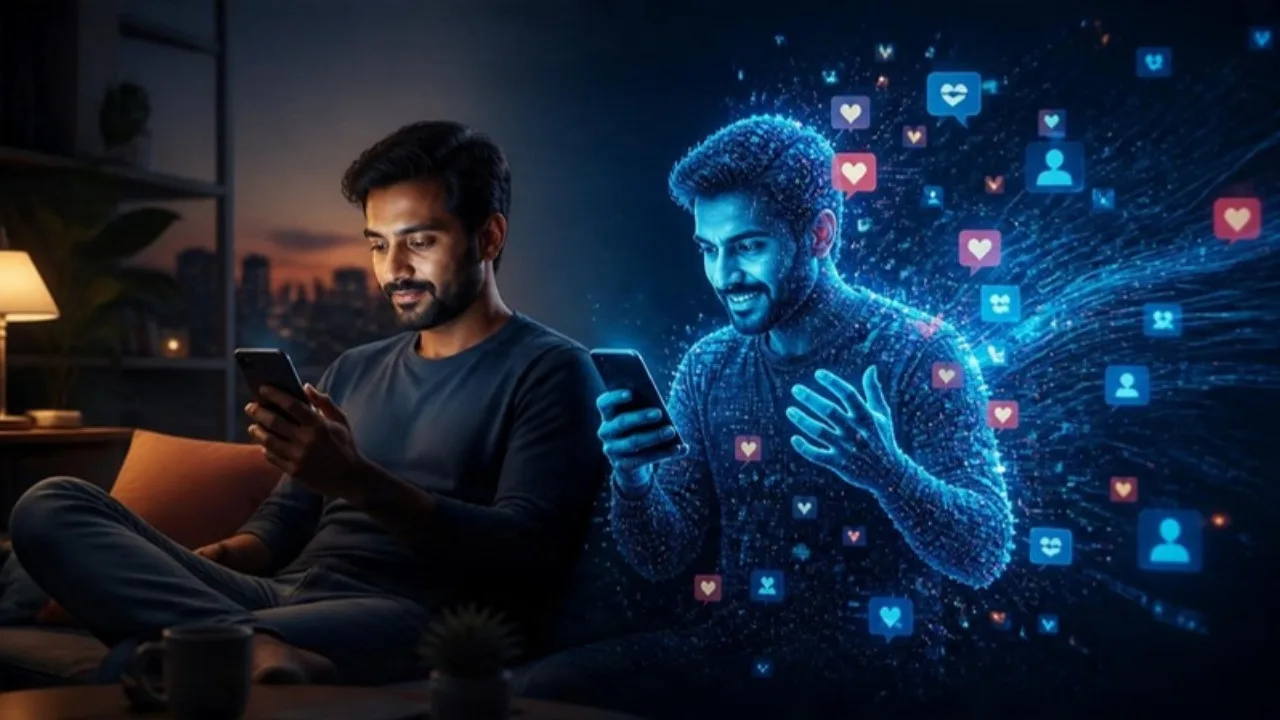
Your digital clone is the behavioural profile that AI and algorithms build from everything you post, like, share and react to online. It can exaggerate your angriest moments and outlive the posts that created it, so the best defence is a simple habit: think before you post, using a pause and a short checklist.
This article is general information, not investment, legal or medical advice.
In the age of AI, your social-media behaviour is becoming a second identity—and it may speak about you long after you have forgotten what you posted.
We are living through the fastest information ecosystem in human history. A thought that once remained inside our head for a few seconds can today become a permanent digital record. A reaction made in anger, a sarcastic comment, an impulsive share, an emotional post or even a seemingly harmless “like” can become part of a behavioural pattern that technology can analyse years later.
The greatest danger is that the person we create online may not be the person we actually are. And yet, increasingly, society may judge us by that digital version.
Key Takeaways
- Context disappears, the record stays. The internet remembers what you said but often forgets the circumstances, so a moment of anger can become a lasting reputation.
- AI connects dots humans cannot. Thousands of small interactions can reveal patterns, and algorithms that reward engagement may make your most emotional moments the most visible.
- Pause before you publish. Use the STOP rule and six questions: is it true, necessary, respectful, legally safe, clear in context, and comfortable on tomorrow’s front page?
Table of Contents
- How Is Your Social-Media Account Quietly Building a Digital Clone of You?
- The Internet Removes the Context That Human Relationships Normally Provide
- Instant Reaction Can Become Permanent Reputation
- AI Can Connect the Dots Humans Cannot See
- Your Digital Clone May Be More Extreme Than Your Real Personality
- Social Media Is Increasingly Becoming Part of Reputation Management
- A Social-Media Post Can Enter the Legal and Institutional World
- Freedom of Expression Also Requires Digital Responsibility
- The Five-Second Rule for Social Media
- Separate Your Emotion From Your Identity
- Before Posting, Ask Six Questions
- The New Rule of the Digital Age
How Is Your Social-Media Account Quietly Building a Digital Clone of You?
Every digital interaction leaves signals: what we watch, what we like, what we dislike, what we comment on, whom we follow, what we share, how frequently we react, what subjects make us angry and what makes us laugh.
Individually, these actions may appear insignificant. Collectively, they can reveal patterns.
Modern AI systems are increasingly capable of finding relationships within large volumes of behavioural data. The result is not necessarily a literal “clone” of a human being, but a digital behavioural profile—a model of what the system predicts about that person.
The uncomfortable question is: what happens when that digital profile becomes more visible than our real personality?
The Internet Removes the Context That Human Relationships Normally Provide
Human beings naturally interpret behaviour through context. If a friend makes an angry statement, we may know that he was frustrated, joking, tired or reacting to a particular incident. Social media often removes that context.
A sentence written in anger may be read six months later by someone who knows nothing about the circumstances. A joke may look like a serious opinion. A criticism may appear to represent a permanent ideology. An impulsive reaction may be interpreted as a carefully considered belief.
The internet remembers the statement but often forgets the circumstances. That is one of the fundamental dangers of digital communication.
Instant Reaction Can Become Permanent Reputation
The human brain is emotional and social. We react quickly to provocation, praise, criticism and fear. Social-media platforms are designed around rapid interaction. That combination creates a dangerous cycle:
Emotion → reaction → publication → amplification → interpretation → reputation.
Something written in thirty seconds may remain searchable for years. And the speed of communication makes matters worse: a statement can travel from one person’s phone to thousands of people before the author has even had an opportunity to reconsider it.
The delete button cannot always erase the memory created by the internet. Screenshots, reposts, archives and copies can continue circulating even after the original post disappears.
AI Can Connect the Dots Humans Cannot See
This is where the issue becomes much more serious. A human looking at one social-media post may see one opinion. An AI system analysing thousands of interactions may see a pattern.
For example, a collection of apparently unrelated activities could potentially help infer:
- interests and preferences,
- communication style,
- emotional tendencies,
- social connections,
- behavioural patterns,
- purchasing interests,
- political or social engagement,
- professional interests,
- likely responses to particular subjects.
This does not mean that every platform possesses a perfectly accurate psychological model of every individual. It means that the technological capability to analyse behavioural patterns at scale is fundamentally changing the meaning of our digital footprints. The digital version of us is increasingly becoming data-driven.
Your Digital Clone May Be More Extreme Than Your Real Personality
This is perhaps the most misunderstood aspect. Suppose a normally balanced person encounters ten provocative posts. He reacts emotionally to two of them. Those two reactions may receive more attention than hundreds of ordinary interactions.
Algorithms are often interested in engagement because engagement keeps people on platforms. Consequently, the most emotional moments of a person’s digital life may become disproportionately visible. The result can be a distorted representation:
- A reasonable person may appear unreasonable.
- A calm person may appear aggressive.
- A private person may appear controversial.
- A temporary emotion may look like a permanent belief.
In other words, our digital clone may exaggerate our extremes while ignoring our ordinary humanity.
Social Media Is Increasingly Becoming Part of Reputation Management
In the past, reputation was primarily built through direct human interaction. Today, reputation has another layer: digital reputation.
Employers, institutions, professional networks, business partners and ordinary citizens increasingly encounter information about people through digital channels. That makes social-media discipline particularly important for professionals. A person’s competence may have taken twenty years to build, but one irresponsible digital incident can create disproportionate reputational damage.
This is why social media should no longer be treated merely as entertainment. It is part of our public identity.
A Social-Media Post Can Enter the Legal and Institutional World
There is another dimension that people frequently underestimate. Digital communications can become relevant evidence in legal or institutional proceedings, depending on the circumstances and applicable law. Messages, emails, photographs, videos, social-media posts and other electronic records can potentially be examined to establish facts, chronology, communications or conduct.
In India, the evidentiary treatment of electronic records is governed by the Bharatiya Sakshya Adhiniyam, 2023, which came into force on 1 July 2024 and replaced the Indian Evidence Act, 1872.
Therefore, the casual belief that “it was only a social-media post” is increasingly dangerous. A digital statement may have consequences far beyond the platform on which it was originally published.
Freedom of Expression Also Requires Digital Responsibility
Freedom of expression is fundamental to a democratic society. But freedom does not eliminate consequences. The digital environment requires a mature distinction between having an opinion and publishing an impulsive reaction.
We should be able to disagree. We should be able to criticise. We should be able to question institutions and ideas. But disagreement does not require abuse, personal attacks, misinformation or reckless allegations.
The stronger the technology becomes, the more important individual self-control becomes. Technology gives us extraordinary power to speak. Wisdom determines whether we should speak immediately.
The Five-Second Rule for Social Media
Before posting something emotional, develop a simple discipline: STOP.
- S — Stop. Do not react immediately.
- T — Think. Is this an opinion, fact, allegation or emotion?
- O — Observe. Would I say the same thing publicly, face-to-face?
- P — Publish only if necessary. Will this post still represent me tomorrow—or five years from now?
For particularly sensitive posts, five seconds may not be enough. Sleep over it. A post written at midnight in anger may look very different in the morning.
Separate Your Emotion From Your Identity
One of the healthiest digital habits is to remember: you are not every thought you have. You are not every emotion you experience. And you certainly should not allow one impulsive digital reaction to define your entire personality.
A person may experience anger without being an angry person. A person may make a mistake without being a bad person. A person may disagree with an idea without hating the people who support it. But the digital world frequently compresses this complexity into a few lines of text.
That is why digital self-discipline is essentially the art of protecting the difference between a temporary emotion and a permanent identity.
Before Posting, Ask Six Questions
A useful personal checklist is:
- Is it true? Have I verified the information?
- Is it necessary? Does publishing it add meaningful value?
- Is it respectful? Am I attacking an idea or a person?
- Is it legally safe? Could this be interpreted as an allegation, threat, harassment or other legally problematic communication?
- Is the context clear? Could someone misunderstand it if they saw only this post?
- Would I be comfortable if it appeared on the front page tomorrow?
If the answer to the last question is no, pause before pressing “post.”
The New Rule of the Digital Age
Earlier generations were taught: “Think before you speak.” The digital generation needs an expanded version: “Think before you type, react, like, share, forward or publish—because technology may remember what emotion made you forget.”
Our digital footprint is gradually becoming a second biography. AI may analyse it. Algorithms may amplify it. Employers may encounter it. Institutions may examine it. Courts may consider relevant electronic records under applicable evidentiary rules. And society may form opinions from it.
Therefore, social-media discipline is no longer merely a matter of good manners. It is a component of personal, professional and digital risk management.
The most important lesson is simple: don’t allow a five-second emotion to create a five-year reputation.
In the age of AI, we are not merely communicating with other human beings. We are continuously generating data about ourselves—and that data is becoming the digital clone of who the world thinks we are. The responsibility, therefore, is not to stop expressing ourselves. It is to make sure that the digital person we create is worthy of the real person we are.
Frequently Asked Questions
What is a digital clone?
A digital clone is the behavioural profile that technology builds from your online activity: what you watch, like, share and comment on. It is not a literal copy of you, but a model of what systems predict about you.
Can AI really build a profile from my social-media activity?
Modern AI systems can find relationships within large volumes of behavioural data. This does not mean every platform has a perfect psychological model of every person, but the capability to analyse patterns at scale is changing what our digital footprints mean.
Does deleting a post remove it from the internet?
Not always. Screenshots, reposts, archives and copies can keep circulating even after the original post disappears, so the delete button cannot always erase the memory created by the internet.
Can social-media posts be used as evidence in India?
They can potentially be examined in legal or institutional proceedings, depending on the circumstances and applicable law. In India, electronic records are governed by the Bharatiya Sakshya Adhiniyam, 2023, in force since 1 July 2024.
What is the five-second rule for social media?
It is the STOP habit: Stop, Think, Observe, and Publish only if necessary. For very sensitive posts, sleep over it before posting.
How can I protect my online reputation?
Before posting, ask six questions: is it true, necessary, respectful, legally safe, clear in context, and comfortable if it appeared on the front page tomorrow. If the last answer is no, pause.
Why should I think before I post on social media?
A sentence written in thirty seconds can stay searchable for years, and screenshots, reposts and archives can keep it alive after you delete it. Pausing before you publish keeps a temporary emotion from becoming a permanent reputation.
Is a digital clone a literal copy of me?
Not necessarily. The post explains that it is a digital behavioural profile, a model of what a system predicts about you from your posts, likes and reactions. Because algorithms reward engagement, it can exaggerate your most emotional moments.
What six questions should I ask before posting?
The article’s STOP rule and six questions are: is it true, is it necessary, is it respectful, is it legally safe, is it clear in context, and would I be comfortable with it on tomorrow’s front page. It advises pausing before publishing anything emotional, since something written in thirty seconds may remain searchable for years. This is general information, not legal advice.
Why can my digital clone look more extreme than the real me?
According to the article, algorithms are often interested in engagement, so the most emotional moments of a person’s digital life may become disproportionately visible. A normally balanced person who reacts emotionally to two of ten provocative posts may appear unreasonable, aggressive or controversial, and a temporary emotion may look like a permanent belief, so the digital clone may exaggerate our extremes while ignoring our ordinary humanity.
Why does the internet remove the context behind what I said?
The article says human beings interpret behaviour through context, but social media often removes it. A sentence written in anger may be read six months later by someone who knows nothing about the circumstances, a joke may look like a serious opinion and an impulsive reaction like a considered belief. The internet remembers the statement but often forgets the circumstances.
Related Reading
- Cyber Fraud in the Digital Age: Awareness Is the Strongest Security
- When Technology Controls Our Freedom: Are We Ready for a World Where Algorithms Decide for Us?
- The World’s Most Dangerous Weapon Is Not a Gun, a Missile, or AI: It’s a Word
- The AI Paradox: Are We Building Smarter Machines While Making Our Own Brains Less Active?
- Social Media Is Rewiring Our Financial Psychology — At What Cost?
See more of our stories on Google Search

Leave a Reply