

Astrology isn’t the problem — its commercial exploitation is: rising unemployment and uncertainty are pushing vulnerable young Indians toward self-proclaimed astrologers selling guaranteed remedies for career, marriage, and money problems, and the real fix is ethical standards for commercial astrology plus stronger career counselling and mental health support, not banning belief itself.
How do you spot a fake astrologer in India? Treat a guarantee as the red flag: nobody can honestly promise a job, a marriage or money, and a costly remedy sold on the back of fear is a sale, not guidance. In August 2026 the Department of Consumer Affairs told the Central Information Commission that it has no specific guidelines for online astrology platforms, so the buyer has to know the warning signs.
Astrology has been an integral part of Indian civilization for thousands of years. It is based on astronomical observations, mathematical calculations, and the study of planetary positions. For millions of people, it remains a source of faith, cultural identity, and personal guidance. Whether one considers astrology a science, a tradition, or a belief system, it undeniably occupies an important place in Indian society.
However, the real concern today is not astrology itself—it’s when astrology becomes a business built on commercialization and misuse.
Key Takeaways
- Astrology itself isn’t the problem — its commercial exploitation is, as vulnerable young Indians are sold guaranteed remedies for career, marriage, and money problems.
- Rising unemployment and declining support systems have created a flourishing market for self-proclaimed astrologers who promise instant wealth and guaranteed success.
- The most actionable fix: ethical standards for commercial astrology services, plus stronger career counselling and mental health support — not banning belief itself.
Table of Contents
Fake Astrologer in India: Why Is Commercial Astrology Booming Right Now?
Modern India is facing a serious social challenge. Rising unemployment, increasing competition, family breakdown, declining emotional support systems, academic pressure, and uncertainty about the future, trends visible in MoSPI’s Periodic Labour Force Survey data, have created widespread frustration, particularly among the youth. Instead of receiving proper career counselling, psychological support, mentorship, and skill development, many vulnerable individuals seek instant solutions to complex problems.
This growing desperation has created a flourishing market for self-proclaimed astrologers who promise miraculous remedies, guaranteed success, instant wealth, marriage solutions, business growth, examination success, and relief from every imaginable problem. Many operate without deep knowledge of astrology, ethics, or responsibility. Their primary objective often appears to be commercial gain rather than genuine guidance.
If astrology has any predictive value, it demands precise birth details, accurate mathematical calculations, and careful interpretation by a knowledgeable practitioner. Such expertise cannot be replaced by mass-produced computer-generated reports, social media advertisements, or exaggerated claims of guaranteed success.
What Is This Doing to Human Capital in India?
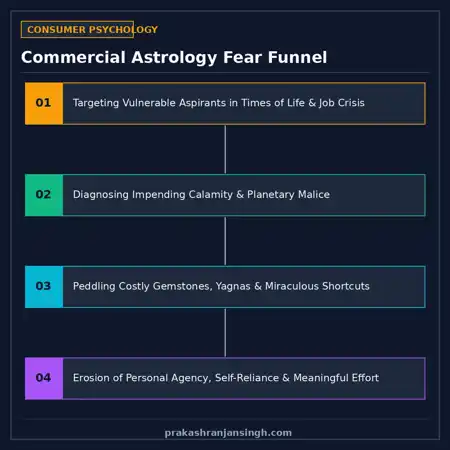
Unfortunately, many individuals begin to believe that wearing gemstones, performing expensive rituals, purchasing lucky objects, or following magical remedies can substitute for hard work, education, discipline, and perseverance. This mindset is dangerous because it shifts responsibility away from personal effort and practical decision-making.
The consequences extend far beyond individual financial loss.
When a young person spends years searching for supernatural shortcuts instead of upgrading skills, preparing for competitive examinations, learning technology, or building entrepreneurship, the nation loses valuable human capital. Productive energy is diverted into false hope rather than meaningful action.
Families under financial stress sometimes spend enormous amounts of money on rituals, gemstones, and remedies while neglecting investments in education, healthcare, or professional counselling. Emotional vulnerability becomes an opportunity for commercial exploitation.
This issue also raises ethical questions. Fear should never become a business model. Predicting disasters, exaggerating planetary effects, or convincing people that every failure is caused by destiny can create anxiety and dependence rather than confidence and resilience.

What Should Change — and Who Should Act?
India’s future depends on its demographic dividend. Vision 2047 can only become a reality if the country’s youth are encouraged to embrace scientific thinking, innovation, entrepreneurship, vocational training, and continuous learning. Faith and spirituality can certainly provide emotional strength, but they should complement—not replace—personal effort, rational decision-making, and professional guidance.
The government should consider establishing ethical standards for commercial astrology services, prohibit misleading advertisements promising guaranteed outcomes, and strengthen consumer protection against fraudulent claims. Educational institutions should expand career counselling, mental health support, and financial literacy so that young people are less vulnerable to exploitation during periods of uncertainty.
That regulatory gap is not hypothetical. In August 2026, the Department of Consumer Affairs told the Central Information Commission, in response to an RTI appeal, that it has no specific guidelines governing online astrology platforms — and the Commission directed the matter to the Ministry of Corporate Affairs and the Ministry of Electronics and Information Technology. Until that gap is closed, commercial astrology services selling guaranteed remedies continue to operate with no dedicated consumer-protection framework of their own.
Society, too, has a responsibility. Parents must guide their children with patience rather than pressure. Teachers should inspire confidence instead of fear. Religious and spiritual leaders should encourage honesty, ethics, and hard work rather than dependence on expensive rituals.
Astrology may continue to exist as a matter of personal belief and cultural tradition. But when it becomes a business built on exploiting human fear and insecurity, it ceases to be a source of guidance and becomes an obstacle to national development.
Astrology becomes a business that costs India its future when predictions replace preparation — India cannot achieve its aspiration of becoming a developed nation merely through predictions of a brighter future. It will achieve that future through knowledge, innovation, integrity, disciplined effort, and the productive use of its greatest asset—its people.
How to Spot a Fake Astrologer in India: Five Red Flags
The argument above can be turned into a practical checklist. Every item below follows from the behaviours described earlier in this essay, and any one of them should make you pause before paying.
- A guarantee. Promises of a job, a marriage, an exam result or sudden wealth. If astrology has any predictive value, it deals in tendencies, not certainties.
- Fear before remedy. Predicting disaster or exaggerating planetary effects, then offering to fix it for a fee.
- Costly substitutes for effort. Gemstones, rituals or lucky objects presented as a replacement for study, skill and hard work.
- No real calculation. A mass-produced, computer-generated report or a social media reply instead of an analysis built on your precise birth details.
- Dependence by design. Every setback is blamed on destiny and the fee keeps recurring, so confidence never builds.
What Can You Do If a Fake Astrologer Has Cheated You?
Start by keeping every receipt, chat message, advertisement and payment record. Then complain. The government’s National Consumer Helpline lists a toll-free number, 1915, along with an online portal, a mobile app and a WhatsApp route for registering a grievance.
The legal position is still thin. A guarantee used to sell a service can amount to a misleading advertisement, a term the Consumer Protection Act, 2019 defines in section 2(28). Under the Centre’s 2022 guidelines on misleading advertisements, the Central Consumer Protection Authority can impose penalties of up to ₹10 lakh, rising to ₹50 lakh for repeat violations. Whether a particular astrologer’s claim crosses that line is for the authority or a consumer commission to decide, and no dedicated astrology rulebook exists. That is the gap the ethical standards proposed above would close.
Frequently Asked Questions
Is astrology itself the problem?
No. Astrology has been part of Indian civilization for thousands of years as a source of faith and cultural identity. The real concern is when astrology becomes a business built on commercialization, with a fake astrologer in India promising guaranteed remedies for a fee.
Why is the fake astrologer business booming in India?
Rising unemployment, family breakdown and academic pressure have created widespread frustration. Instead of proper career counselling or mental health support, many vulnerable people turn to astrologers promising instant wealth, marriage solutions or exam success.
How can you spot a fake astrologer in India?
Watch for guaranteed outcomes, fear-based predictions followed by a paid remedy, costly gemstones or rituals sold as a substitute for effort, generic computer-made reports instead of a calculation from your birth details, and recurring fees that build dependence.
Is there any law against astrologers who guarantee results?
No dedicated astrology law was cited. In August 2026 the Department of Consumer Affairs told the CIC it has no guidelines for online astrology platforms. A guarantee used in an advertisement can still be treated as misleading under the Consumer Protection Act, 2019, case by case.
Where can you complain about a fake astrologer?
Keep all payment records and chats, then register a grievance with the National Consumer Helpline on 1915, or through its online portal, app or WhatsApp. For a refund claim, a consumer commission is the next step.
Related Reading
- Faith Demands Transparency: The Need for an Independent Inquiry into the Ayodhya Temple Donation Controversy
- Hindu Civilization at a Crossroads: The Need for Reform, Awareness, and Cultural Confidence
- Satyanarayana Katha: A Simple Story, A Profound Manual for Life
- Paper Leak: Buying a Government Job, Corruption Fueling Further Corruption
- The Psychology of Influence: Why Unemployed Youth Are Vulnerable to Manipulation and Why Society Must Respond
Leave a Reply