

The Ayodhya Ram Mandir donation case has shaken public trust more than any sum of money could: what’s needed now is a thorough, time-bound, independent inquiry into the collection and accounting process, plus modernised transparent governance for all major religious institutions handling public donations.
What is the Ayodhya Ram Mandir donation case? It concerns alleged theft of cash offerings during the counting of donations. An FIR was registered on 25 June 2026, eight people were arrested, and on 23 September a Special Investigation Team filed a chargesheet of about 74,000 pages, as reported. The allegations are yet to be tested at trial.

The construction of the Ram Mandir in Ayodhya is one of the most significant cultural and spiritual milestones in modern India. For millions of Hindus across the world, the temple is not merely a place of worship but a symbol of faith, sacrifice, and civilizational identity. Every donation made by devotees represents an offering to Lord Ram, given with complete trust that it will be used honestly and responsibly.
It is therefore deeply disturbing that reports and allegations of irregularities in the management of temple donations have surfaced in the public domain. Whether these allegations ultimately prove true or false, they have already created confusion and concern among countless devotees. The greatest casualty in such situations is not money—it is public trust.
Key Takeaways
- The Ayodhya temple donation controversy has shaken public trust more than any sum of money could, following reports of irregularities in donation management.
- Multiple entities are under scrutiny, including the temple trust and service providers associated with collecting and processing donations.
- The most actionable fix: a thorough, time-bound, independent inquiry into the collection and accounting process, plus modernised transparent governance for religious institutions.
Table of Contents
What Exactly Is Under Scrutiny in the Ayodhya Ram Mandir Donation Case?
The controversy has reportedly brought under scrutiny multiple entities involved in the donation management process, including the temple trust and service providers associated with the collection and processing of donations. If institutions of national reputation, such as banks or technology companies, were entrusted with handling any part of this process, the public naturally expects the highest standards of integrity, transparency, and accountability. However, it would be unfair to conclude that any individual or institution is guilty unless an impartial investigation establishes the facts.
The issue is larger than determining legal liability. It concerns moral responsibility. Every institution associated with managing donations offered in the name of faith has a duty not only to fulfil contractual obligations but also to uphold the confidence of millions of devotees. Technical compliance with agreements cannot substitute for ethical accountability when public faith is involved.
Religious donations are unlike ordinary financial transactions. They are acts of devotion. Devotees do not seek financial returns; they seek spiritual satisfaction. Any suspicion that these sacred offerings have been mishandled can leave a lasting scar on the collective consciousness of society.

What Is the Timeline of the Ayodhya Ram Mandir Donation Case?
The case has moved quickly since June 2026. Based on media reports of the police and court proceedings, the key steps so far are:
- 25 June 2026: An FIR was registered at the Ram Janmabhoomi police station after a complaint by a member of the Shri Ram Janmabhoomi Teerth Kshetra Trust, following a preliminary report by a Special Investigation Team formed by the Uttar Pradesh government.
- 26 June: Eight people who handled donated cash and valuables were arrested. Police reported recovering nearly ₹80 lakh in cash along with foreign currency. The Trust’s general secretary Champat Rai and trustee Anil Mishra resigned soon after.
- 27 July: The Supreme Court asked for a forensic auditor to join the reconstituted SIT as its fifth member, and for a status report. Petitioners had sought a CBI probe and a CAG examination of the Trust’s accounts.
- 23 September: The SIT filed a chargesheet of about 74,000 pages naming eight accused, all in judicial custody, under provisions including criminal breach of trust and the Prevention of Corruption Act. The SIT told the Supreme Court that CCTV footage and digital evidence showed 105 instances of unauthorised removal or concealment of currency in the counting process. About ₹79.8 lakh was recovered from seven of the eight accused.
The SIT also reportedly found no discrepancies in the handling of silver bricks and several other donated items. The defence had not yet received the chargesheet when it was filed, so the allegations are yet to be tested in court.
What Should Happen Next?
The need of the hour is neither sensationalism nor political blame. What India requires is a thorough, time-bound, and independent inquiry conducted by competent authorities. Every stage of the donation collection, accounting, reconciliation, auditing, and utilisation process should be examined. If no wrongdoing has occurred, the inquiry will restore confidence. If irregularities are established, those responsible—regardless of their position or influence—must face appropriate legal consequences.
That inquiry is now well advanced. As the timeline above shows, the SIT has filed its chargesheet and the Supreme Court has added a forensic auditor to the team. The eight accused remain presumed innocent until a trial decides otherwise, and the larger question of how donation counting was supervised is still open.
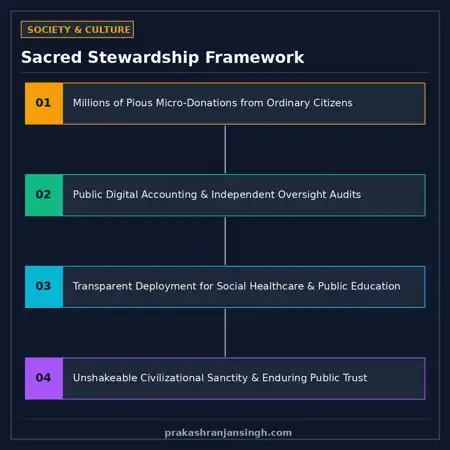
This episode also highlights the urgent need to modernise the governance of major religious institutions. Every large temple, mosque, church, gurudwara, and other public place of worship receiving substantial donations should maintain transparent digital accounting systems, undergo regular independent audits, and publish annual financial reports accessible to the public. Faith flourishes where transparency exists.
The counting room is where this matters most. Four safeguards would make cash theft far harder:
- Independent review of CCTV footage from counting rooms, not only recording it.
- Two-person custody of cash at every step from the donation box to the bank.
- Digital receipts and daily reconciliation of counted amounts against bank deposits.
- Regular external audits with the findings published for donors.
The Ayodhya temple donation episode is a reminder that the Ram Mandir belongs not to any individual or organisation but to the faith of millions of devotees. Protecting that faith requires honesty, accountability, and openness. The nation deserves facts, not speculation; transparency, not secrecy.
If the allegations are found to be baseless, the institutions concerned should be publicly cleared so that confidence is restored. If they are substantiated, corrective action must be swift and exemplary. In either case, the truth must prevail.
A civilization as old as India has survived because faith has always been accompanied by a sense of duty. Today, that duty lies with every institution entrusted with managing the sacred offerings of the people. Transparency is not an attack on religion—it is the strongest protection of its sanctity.
What Is the Current Status of the Ram Mandir Donation Case?
The case is moving on two tracks, the Supreme Court and the trial court in Ayodhya. Based on media reports from July to September 2026:
- Supreme Court: its 27 July order, as reported by LiveLaw, asked Uttar Pradesh to include a forensic auditor in the SIT and sought a status report. A report of 22 September said the Court told the SIT to file its chargesheet by 25 September and listed the next detailed hearing for 2 November 2026.
- Investigation: reports say the SIT questioned 173 witnesses and checked 803 valuable items kept in a bank locker against receipts, finding no discrepancies.
- Bail: ThePrint reported on 23 September that bail had been rejected for six of the eight accused, while two were still seeking it and their hearing had been deferred.
These details change quickly, so check the latest court reports before relying on them. None of this is a finding of guilt. The accused are presumed innocent until a trial decides otherwise, which is exactly why the safeguards above matter: a system that is transparent from the donation box to the bank protects honest staff as much as it deters theft.
Frequently Asked Questions
What is the Ayodhya Ram Mandir donation case about?
It concerns alleged theft of cash offerings during collection and counting of donations to the Ram Mandir. An FIR was registered on 25 June 2026, eight people were arrested, and a Special Investigation Team has since filed a chargesheet. The allegations are yet to be tested at trial.
What did the SIT chargesheet say?
Filed on 23 September 2026, the roughly 74,000-page chargesheet names eight accused under provisions including criminal breach of trust and the Prevention of Corruption Act. The SIT told the Supreme Court that CCTV and digital evidence showed 105 instances of unauthorised removal or concealment of currency.
How much money was recovered in the Ram Mandir donation theft case?
Police reported recovering about ₹79.8 lakh from seven of the eight accused. Reports give no total figure for the amount allegedly taken, and the allegations are yet to be tested at trial.
What is the current status of the case and what did the Supreme Court order?
On 27 July 2026 the Supreme Court asked for a forensic auditor to join the SIT and sought a status report. A 22 September report said the SIT was told to file its chargesheet by 25 September, with the next detailed hearing on 2 November 2026. The accused remain presumed innocent until trial.
What should happen next?
A fair trial for the accused, along with transparent governance for major religious institutions: independent review of counting-room CCTV, two-person custody of cash, daily reconciliation with bank deposits, and published external audits.
Related Reading
- When Astrology Becomes a Business: A Threat to India’s Human Capital
- Hindu Civilization at a Crossroads: The Need for Reform, Awareness, and Cultural Confidence
- When Spirituality Creates Conflict: Are Modern Dharmagurus Teaching the Complete Wisdom of Sanatan Dharma?
- Satyanarayana Katha: A Simple Story, A Profound Manual for Life
- Paper Leak: Buying a Government Job, Corruption Fueling Further Corruption
Leave a Reply