

Quick summary: Buying a government job instead of earning it doesn’t stop the damage at unfair selection — it can turn public service itself into a scheme to recover the bribe, making corruption self-perpetuating. Paper leak punishment in India is set by the Public Examinations Act, 2024, and paper leaks and recruitment fraud deserve the strictest enforcement because they threaten the moral foundation of the Republic, not just one exam.
“If someone spends ₹1 crore to get a government job, will they spend the next 30 years serving the nation… or recovering their investment?”
This is an uncomfortable question.
Key Takeaways
- Buying a government job doesn’t stop the damage at unfair selection — it can turn public service into a scheme to recover the bribe, making corruption self-perpetuating.
- India ranked 91st out of 182 countries on Transparency International’s Corruption Perceptions Index 2025, scoring 39 out of 100.
- A ₹1 crore bribe for a post paying ₹40,000-₹60,000 a month would take roughly 14-21 years of salary just to repay the principal — recruitment fraud deserves the strictest punishment.
Table of Contents
Why Are India’s Youth Protesting?
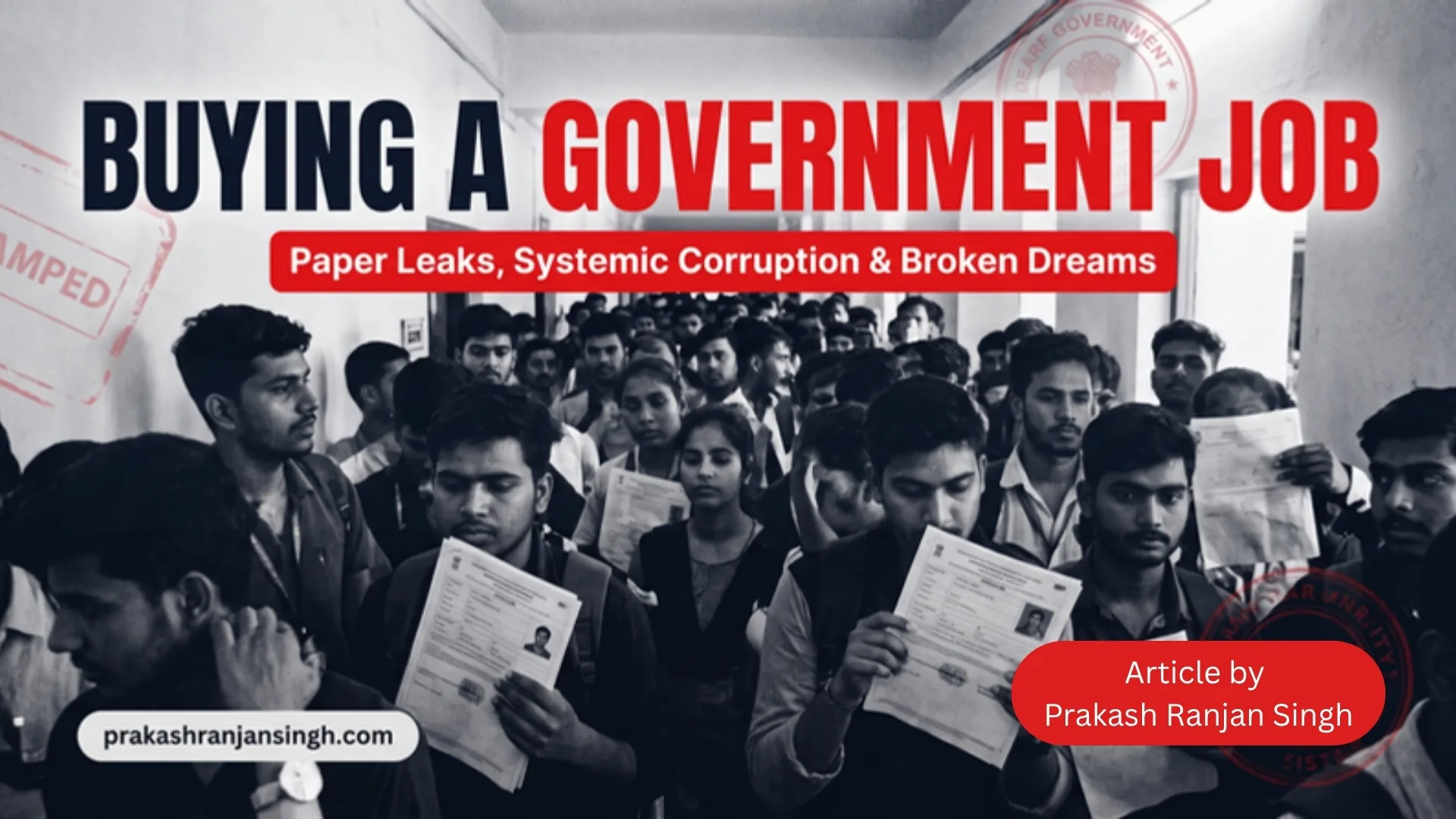
Across the country, thousands of young people are protesting against paper leaks and recruitment irregularities. Their anger is not just about one examination—it is about a growing fear that honesty is losing to money and influence.
If recruitment can be manipulated, the damage doesn’t end on the day of selection.
A deserving candidate loses a dream.
A family loses hope.
And the country may lose an honest public servant.
The Danger of Buying a Government Job We Rarely Discuss
But there is another danger that we rarely discuss.
If a person believes they have obtained a government post through an illegal payment, the temptation to recover that money can become enormous. Public service may gradually turn into personal profit. Every signature, every approval, every file, every public interaction can become an opportunity to “earn back” the investment.
That is how corruption, if left unchecked, can become self-perpetuating — and it is exactly what happens when buying a government job is treated as normal. India ranked 91st out of 182 countries on Transparency International’s Corruption Perceptions Index 2025, scoring 39 out of 100 — a reminder of how much ground public institutions still need to cover.
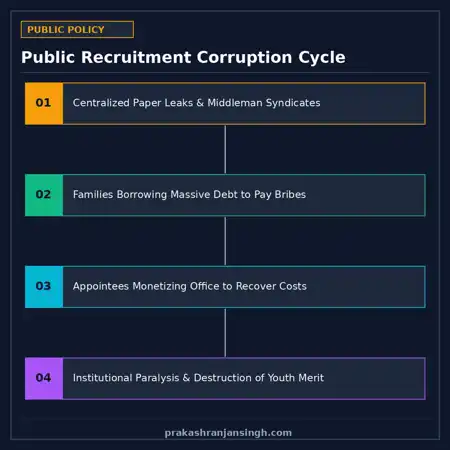
The cost is paid not only in money—but in delayed justice, poor public services, reduced trust in institutions, and lost opportunities for millions of honest citizens.
Why Do People Still Pay for Buying a Government Job?
Despite the risks, buying a government job remains tempting because a government post in India still carries something private-sector jobs rarely offer: near-permanent security, a pension, and social status that follows a family for generations. For many households, that promise feels worth almost any price, including a bribe that will take decades to recover.
But the arithmetic of buying a government job rarely works out the way the buyer imagines. A person who pays ₹1 crore for a post earning ₹40,000-₹60,000 a month is not “investing” in security — they are mortgaging their integrity for a salary that alone would take roughly 14-21 years just to repay the principal, before even accounting for the temptation to recover it faster through corruption. The families who see paper leaks as a shortcut rarely calculate this real cost.

What India’s Youth Deserve
India’s youth are among the most talented in the world.
They deserve examinations that reward hard work, not shortcuts… merit, not money… integrity, not influence.
The fight against paper leaks is not just about protecting exams.
It is about protecting the moral foundation of our Republic.
One honest recruitment can change a family. One corrupt recruitment can affect thousands of families.
What Is the Paper Leak Punishment in India Under the Law?
India does have a dedicated law. The Public Examinations (Prevention of Unfair Means) Act, 2024 covers central recruitment and entrance examinations such as those run by the UPSC, SSC, railway and banking recruitment bodies and the NTA. Many states also have their own laws for state-level recruitment. According to PRS Legislative Research’s summary of the Act, there are four main penalty categories:
- Persons resorting to unfair means: imprisonment of 3 to 5 years and a fine of up to ₹10 lakh.
- Service providers: a fine of up to ₹1 crore, recovery of the proportionate cost of the examination, and a four-year bar on conducting public examinations.
- Directors or senior management who consented to or connived in the offence: imprisonment of 3 to 10 years and a fine of ₹1 crore.
- Organised paper-leak crime: imprisonment of 5 to 10 years and a fine of at least ₹1 crore, with the property of a guilty institution liable to be attached.
PRS also notes that all offences under the Act are cognisable, non-bailable and non-compoundable.
The law has since been in the news again. In July 2026 the Lok Sabha was reported to have passed an amendment bill that would raise these penalties. I could not confirm Rajya Sabha passage, presidential assent or notification, and press reports differ on some figures, so please check the Ministry of Education or the Gazette of India before relying on any number. This is general information, not legal advice.
Punishment is only half the answer; I have written separately about how competitive examinations can be reinvented to stop leaks. The point of this essay is the other side of the same story: tougher punishment matters, but it only works when the buyer of a job, the seller and the leaker all expect to be caught.
How Common Are Paper Leaks in India?
Nobody has a complete official count. A Newslaundry analysis published in July 2024 documented 89 suspected paper leak cases over ten years, meaning cases where an FIR was lodged or the exam was cancelled. At least 6.5 crore candidates had appeared in those exams, and a retest was held for at least 48 of the papers. The same report notes that the Union government told Parliament that data on specific incidents is “not maintained”, so the count rests on media reports, not official records.
Even as an approximate figure, it shows why the loss is bigger than any one exam. Each leak means lakhs of honest candidates preparing for months, sometimes for years, only to see the result cancelled or doubted.
How Can Aspirants Protect Themselves From Recruitment Fraud?
These are general precautions, not legal advice:
- Never pay anyone for a job or a “guaranteed” result. No genuine government recruitment asks for money outside the published application fee.
- Check every claim on the official website of the recruiting body, not through a middleman, a social media page or a messaging group.
- Remember that paying is not safe either. As I understand it, the Prevention of Corruption Act, as amended in 2018, also makes giving a bribe to a public servant an offence, so the buyer can face the same law as the seller.
- Report suspected fraud to the local police and the recruiting body, and keep screenshots, receipts and call records.
A family that gathers ₹1 crore for a shortcut would be better off investing it in honest preparation, skills or a business, and families who stand firm on this make the next buyer less likely.
Should Recruitment Fraud Carry the Strictest Punishment?
Now the question is yours:
Should recruitment fraud and paper leaks be treated as crimes against the future of the nation, with the strictest possible punishment for everyone involved?
Comment “YES” if you believe every government job should be won only through merit. Share this post if you believe India’s youth deserve a fair chance.
Ultimately, the debate over buying a government job is not just about individual dishonesty — it is about whether the next generation grows up believing that influence beats effort. Every time a case of buying a government job goes unpunished, it teaches a young, honest aspirant the wrong lesson.
Frequently Asked Questions
Why is buying a government job dangerous beyond the unfairness of the selection itself?
Because someone who pays a large bribe to secure a post may feel pressure to recover that investment once in office. Public service can gradually turn into personal profit, with every signature, approval, or file becoming a chance to “earn back” the money spent, making corruption self-perpetuating.
How does India rank on corruption globally?
India ranked 91st out of 182 countries on Transparency International’s Corruption Perceptions Index 2025, scoring 39 out of 100 — a sign of how much ground public institutions still need to cover.
Does buying a government job actually pay off financially?
Rarely. A person who pays ₹1 crore for a post earning ₹40,000-₹60,000 a month would need roughly 14-21 years of salary just to repay the principal, before even factoring in the temptation to recover it faster through corruption — the arithmetic works against the buyer far more than it seems.
What is the paper leak punishment in India?
Under the Public Examinations (Prevention of Unfair Means) Act, 2024, as summarised by PRS Legislative Research, a person resorting to unfair means faces 3 to 5 years in prison and a fine of up to ₹10 lakh, and organised paper-leak crime carries 5 to 10 years and a fine of at least ₹1 crore. An amendment raising penalties was reported to have passed the Lok Sabha in July 2026; check the Gazette for its final status. This is general information, not legal advice.
Is giving a bribe for a government job also an offence?
As I understand it, the Prevention of Corruption Act, as amended in 2018, makes giving a bribe to a public servant an offence, so the person who pays can face legal action as well as the person who takes. This is general information, not legal advice; consult a qualified lawyer for a specific situation.
Related Reading
- India at a Demographic Crossroads: Is the Nation Sleepwalking into a Human Capital Crisis?
- Are We Truly Free? Freedom of Nation Vs Freedom of a Mind
- The Invisible Burden of Unfulfilled Social Responsibilities: Why Strong Families Build Strong Nations
- The Shiny Picture May Turn Gloomy: Is India Sleepwalking Towards a Jobs–Debt–Technology Trap?
- The Psychology of Influence: Why Unemployed Youth Are Vulnerable to Manipulation and Why Society Must Respond

Leave a Reply