

Modern success — salary, promotions, status — isn’t translating into fulfilment because many people are quietly neglecting family and social responsibilities while chasing careers, and reconnecting with parents, elders, and communities isn’t old-fashioned sentiment but the actual foundation of emotional resilience and, ultimately, proof that strong families build strong nations.
What is the importance of family in nation building? The family is where citizens first learn responsibility, honesty and care for others, and where care for the old and the young begins. When those bonds weaken, the cost shows up in the data: economists estimate that about 30 million Indians aged 60 and above now live alone.
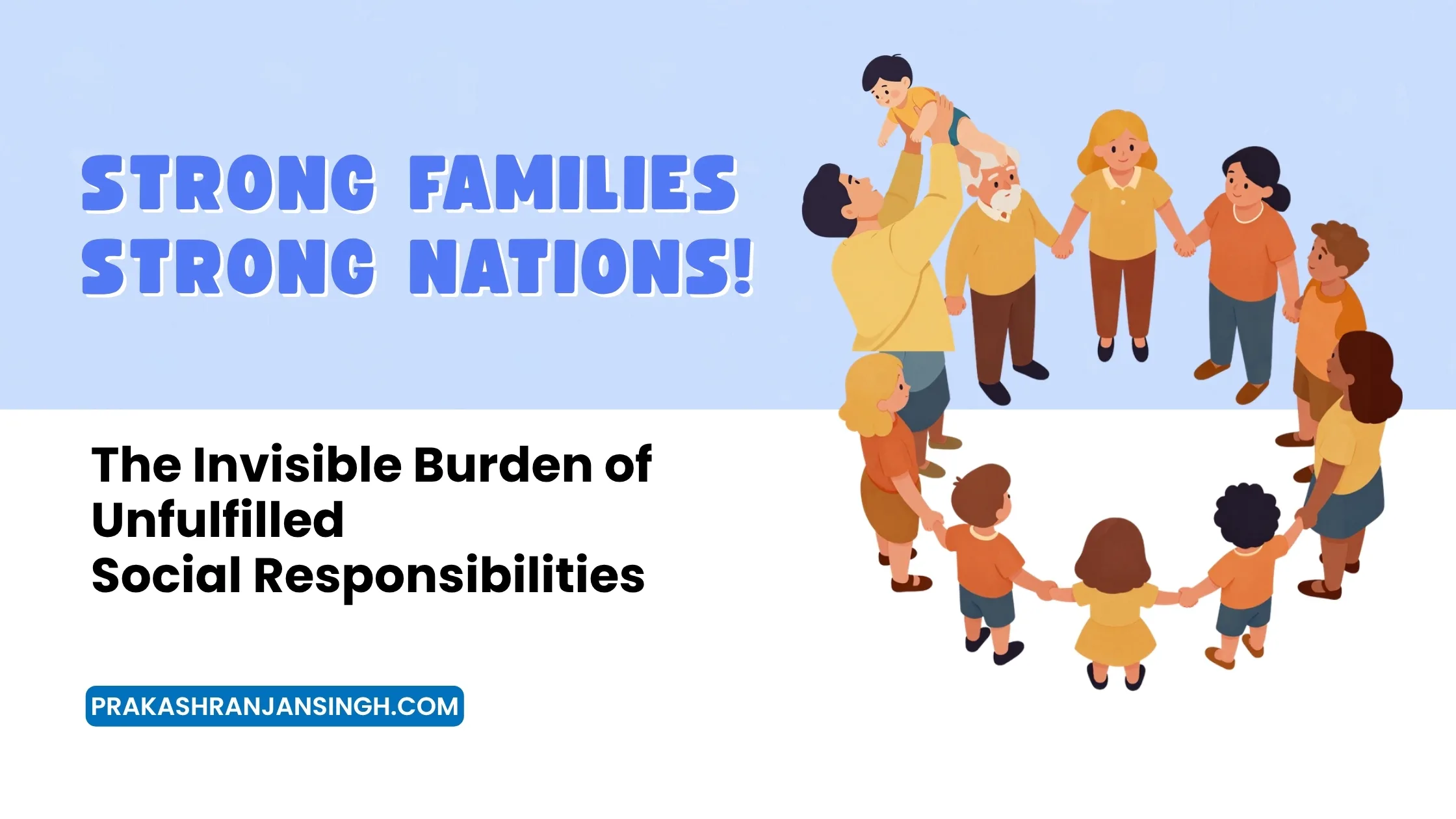
The world is changing at an unprecedented pace. Artificial intelligence, automation, globalization, and intense competition have transformed the way we live and work. Success today is often measured by salary, promotions, professional achievements, and social status. While these accomplishments are important, many people are quietly paying a heavy emotional price for this modern lifestyle.
Despite living in an age of material abundance and technological advancement, stress, loneliness, anxiety, and dissatisfaction are becoming increasingly common. This raises an important question: Why are so many people feeling emotionally exhausted despite having more opportunities than ever before?
One possible answer lies in an invisible burden that many of us carry—the burden of unfulfilled social and family responsibilities.
Every human being is born into a network of relationships. We have responsibilities towards our parents, grandparents, spouse, children, siblings, neighbours, relatives, and society. These responsibilities are not merely traditions handed down through generations; they nurture emotional security, mutual trust, and social harmony. When we fulfill them sincerely, they give us a sense of purpose and inner satisfaction. When we neglect them for long periods, they can create feelings of guilt, emotional distance, and dissatisfaction.
Key Takeaways
- Modern success — salary, promotions, status — isn’t translating into fulfilment because many people are quietly neglecting family and social responsibilities while chasing careers.
- The joint family system was more than a living arrangement — it was a support system where wisdom, traditions, and emotional strength passed naturally between generations.
- The most actionable fix: reconnecting with parents, elders, and communities — not as old-fashioned sentiment, but as the actual foundation of emotional resilience.
Table of Contents
What Is the Importance of Family in Nation Building?
The family is the first school of citizenship. A child learns honesty, respect and duty at home long before any classroom teaches them, and an adult who is emotionally secure at home tends to work, vote and serve with more care. A nation’s progress depends on these qualities as much as on GDP, technology or infrastructure.
The sections below look at what modern life costs families, what the data on India’s elderly show, and what each of us can do about it.
The Hidden Cost of Modern Life
Today’s generation is under immense pressure. Long working hours, demanding corporate cultures, job insecurity, continuous learning requirements, financial commitments, and digital distractions consume most of their time and energy. Many young professionals leave their hometowns to build careers in distant cities, often living far from their parents and extended families.
The result is that many people struggle to balance career aspirations with family and social obligations. They may send money home but have little time to talk to their parents. They may love their family deeply but rarely share meaningful moments with them. Festivals become holidays rather than occasions for togetherness. Neighbours become strangers, and community bonds weaken.
Over time, these small gaps can grow into emotional distances that affect both individuals and families.
Why Relationships Matter
Human beings are not machines designed only for productivity. We are emotional beings who thrive on love, belonging, respect, and connection. A caring conversation with parents, a visit to grandparents, helping a neighbour in need, or spending quality time with family can provide emotional strength that no financial achievement can replace.
When relationships become weak, many people experience an unexplained feeling of emptiness. They may continue to perform their professional duties but lose the enthusiasm, optimism, and peace of mind that come from strong emotional foundations.
Success without meaningful relationships often feels incomplete.
The Wisdom of Our Elders
Every generation benefits from the experience of the one before it. Our parents and grandparents have faced hardships, economic struggles, family responsibilities, and social challenges. Their experiences may not always provide ready-made solutions for today’s world, but they often offer valuable lessons in resilience, patience, sacrifice, and integrity.
The joint family system was more than a living arrangement. It was a support system where wisdom, traditions, values, and emotional strength were passed naturally from one generation to another. Children grew up learning respect, compassion, discipline, and responsibility through everyday life.
As joint families have become less common, many young people have gained greater independence but may also have fewer opportunities to learn directly from older generations.
Modern lifestyles have many advantages, but preserving intergenerational relationships can help retain the emotional and cultural strengths that families have long provided.
The scale of what’s being lost is measurable. An analysis published in January 2026 ahead of Budget 2026, by economists at NCAER and the Great Lakes Institute of Management and drawing on Periodic Labour Force Survey data for 2023-24, estimates that roughly 20% of India’s 150-million-plus population aged 60+ — about 30 million people — now live alone or with only another elderly household member, and it cites a survey in which more than half of older adults reported feeling lonely and about a third reported social isolation. India’s elderly population is projected to reach 230 million by 2036 and nearly 350 million by 2050, even as senior-care infrastructure remains, in the researchers’ words, under-resourced relative to the scale of need. The joint family isn’t just a sentimental loss; its absence shows up as a measurable public health gap.

Why Strong Families Build Strong Nations Through Timeless Values
Some people believe that traditional family values belong to the past. In reality, values such as respect for parents, gratitude, honesty, compassion, responsibility, and service remain relevant in every era.
Technology changes. Fashion changes. Professions change. But human emotions remain the same.
Parents still sacrifice for their children. Children still seek love and guidance. Grandparents still wish to share their blessings and experience. Neighbours still appreciate kindness during difficult times.
These values are timeless because they reflect fundamental human needs.
The Emotional Power of Caring for Parents
Every parent dreams of seeing their children happy and successful. As parents grow older, they often need less material support than emotional companionship, respect, and reassurance.
A satisfied and respected parent creates an atmosphere of blessings, confidence, and emotional stability within the family, a connection supported by the Harvard Study of Adult Development. Whether one views blessings through a spiritual, cultural, or psychological lens, caring relationships can strengthen confidence, reduce stress, and foster resilience across generations.
Families that care for their elders also teach children by example. Young minds observe how parents treat grandparents and often carry those lessons into their own adulthood.
Thus, every act of respect strengthens the moral foundation of the next generation.
Social Responsibility Begins at Home
Many people think social responsibility means donating money or participating in social campaigns. These are valuable acts, but the first responsibility begins within our own homes: respecting parents, supporting our spouse, guiding our children, helping neighbours, standing by relatives during difficult times, and protecting our cultural heritage.
These everyday actions quietly strengthen society. A nation is built from families. Families are built on relationships. Relationships are built on responsibility. When this chain becomes weak, society also becomes weaker.
Reconnecting With Our Roots
Modernity and tradition should not be seen as opposites. We can embrace innovation while preserving the values that have sustained families and communities for generations.
Our customs and rituals are not merely ceremonies. Many serve as opportunities for families to gather, strengthen relationships, express gratitude, and maintain a shared sense of identity. While practices naturally evolve over time, staying connected to our cultural heritage can help many people feel rooted and supported.
A tree can grow taller only when its roots remain strong. Likewise, individuals and nations flourish when they remain connected to their values while adapting to change.
Building a Strong Nation Through Strong Families
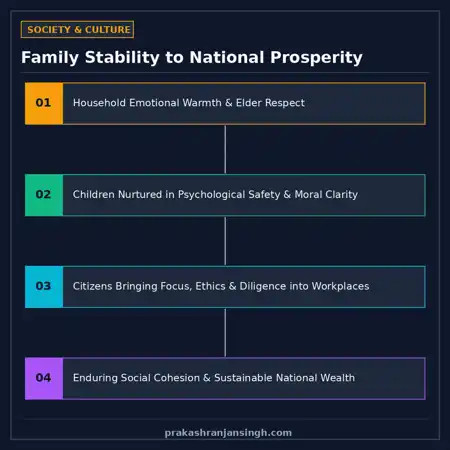
A nation’s progress is not measured only by GDP, technology, or infrastructure. True development also depends on the emotional well-being, character, and social responsibility of its citizens.
Employees who are emotionally secure often work with greater focus. Students supported by strong families frequently develop greater confidence. Communities built on trust become more resilient. Children raised with values become responsible citizens.
When millions of families become stronger, the nation becomes stronger — this is the simplest proof that strong families build strong nations. Economic development and family values should complement each other rather than compete.
A Call to Every Generation
The younger generation should pursue excellence in education and careers with determination. At the same time, they should strive to remain connected to their parents, grandparents, and communities.
Older generations, in turn, can encourage younger family members with understanding, adaptability, and guidance rather than judgment. Both generations have much to learn from one another.
The future belongs not to those who abandon their roots, but to those who combine the wisdom of the past with the opportunities of the future.
What Can You Do Today? Five Ways to Strengthen Your Family
Strengthening a family does not need a campaign. These five steps follow directly from the argument above, and each can start this week:
- Fix a weekly call or visit with your parents. If you live in another city, a regular video call counts, and the talk should be about them, not only about money.
- Turn festivals back into togetherness. Be present for family occasions instead of treating them as a day off.
- Ask an elder for one story of hardship. Resilience, patience and integrity are learned from lived experience, and older relatives are the nearest source.
- Help one neighbour or relative this month. Small, concrete help rebuilds the community bonds that weaken when neighbours become strangers.
- Let children see how you treat your parents. Young minds copy what they watch, so respect shown to grandparents is the lesson that lasts.
Conclusion
Our greatest achievements will never be measured only by the wealth we accumulate or the positions we hold. They will also be measured by the relationships we nurture, the responsibilities we honor, and the values we pass on.
Strong families build strong nations one household at a time: a family where parents are respected creates children who understand gratitude. A society where neighbours care for one another creates trust. A nation where family values and social responsibility remain strong creates citizens who are not only successful but also compassionate, ethical, and resilient.
Let us build careers without abandoning our families. Let us embrace modernity without forgetting our traditions. Let us achieve success without losing our humanity.
For when our parents smile with contentment, our elders feel respected, our families remain united, and our communities stand together, we create something greater than personal success—we build the foundation of a strong, harmonious, and prosperous nation.
Frequently Asked Questions
What is the importance of family in nation building?
The family is where citizens first learn responsibility, honesty and care for others. Emotionally secure employees work with greater focus, students backed by strong families gain confidence, and communities built on trust become more resilient, so stronger families add up to a stronger nation.
Why does career success not bring fulfilment?
Success is often measured by salary, promotions and status, but many people quietly neglect family and social responsibilities while chasing careers. Over time that neglect creates guilt, emotional distance and dissatisfaction, however much they earn.
What did the joint family system provide that is being lost?
The joint family was a support system where wisdom, traditions, values and emotional strength passed naturally between generations, and children learned respect, compassion and responsibility through everyday life. As it fades, young people gain independence but get fewer chances to learn from elders.
How do strong families actually build strong nations?
Employees who are emotionally secure work with greater focus, students supported by strong families develop greater confidence, and communities built on trust become more resilient. When millions of families become stronger, the nation becomes stronger.
How many elderly Indians live alone?
An analysis published in January 2026 by economists at NCAER and the Great Lakes Institute of Management, using PLFS 2023-24 data, estimates that about 20% of Indians aged 60 and above, roughly 30 million people, live alone or with only another elderly household member.
Related Reading
- Nationalism: The Strength That Makes a Nation Great
- Hindu Civilization at a Crossroads: The Need for Reform, Awareness, and Cultural Confidence
- The Cry We Have Stopped Hearing Why India Needs a Psychological Revolution on Relationships, Consent and Human Dignity
- The Extraordinary Power of Small Acts of Kindness: Why Tiny Gestures Can Transform Society
- Patriotism and Youth: India and China Comparative Analysis

Leave a Reply