

How to stop paper leak in India comes down to five fixes: move question papers digitally in encrypted form, give each candidate a different paper, authenticate every candidate and device, professionalise and audit the testing agencies, and prosecute organised networks fast. Each fix is explained below, along with what the 2024 law already does.
Traditional exam systems keep failing India’s youth through recurring paper leaks, and genuine paper leak exam reform already exists in technology India has proven at scale: AI-generated unique question sets per candidate, biometric authentication, and secure digital delivery could make organised paper leaks virtually impossible while restoring merit-based trust in competitive exams.
Every year, millions of young Indians dedicate years of their lives preparing for competitive examinations with dreams of becoming doctors, engineers, civil servants, bankers, teachers, and defence personnel. For many families, these examinations represent hope, social mobility, and financial security. Success is often determined by years of sacrifice, discipline, and relentless hard work.
Unfortunately, this journey is increasingly being overshadowed by one of the biggest threats to India’s education system—the recurring problem of examination paper leaks.
Key Takeaways
- Genuine paper leak exam reform already exists in technology India has proven at scale: AI-generated unique question sets per candidate, biometric authentication, and secure digital delivery.
- A leaked paper destroys the confidence of honest candidates, wastes public resources, delays recruitment, and weakens trust in institutions.
- Because every candidate would receive a unique AI-generated set of questions instead of an identical printed paper, organised paper leaks would become virtually impossible.
What’s the Real Cost of Delaying Paper Leak Exam Reform?
Whenever a paper is leaked, the consequences extend far beyond the cancellation of a single examination. It destroys the confidence of honest candidates, wastes public resources, delays recruitment, and weakens trust in institutions. For a young aspirant who has spent years preparing, a leaked paper is not merely an administrative failure; it is an emotional setback that creates frustration, anxiety, and uncertainty about the future.
India is a nation blessed with one of the world’s youngest populations. This demographic advantage can become our greatest strength only if the youth believe that opportunities are awarded through merit and fairness. If that belief weakens, the nation risks losing not only talent but also the enthusiasm and productive energy of millions of young citizens.
The repeated occurrence of paper leaks suggests that traditional examination methods have reached their limitations. Printing confidential question papers, transporting them under security, storing them at multiple centres, and distributing them simultaneously create several vulnerable points where leaks can occur despite the best precautions.
Table of Contents
What India’s 2024 Law and Expert Committee Already Say
Reform does not start from a blank page. Parliament passed the Public Examinations (Prevention of Unfair Means) Act, 2024 in February 2024, and it was brought into force on 21 June 2024. It is aimed squarely at organised leak networks: jail terms of 5 to 10 years and a minimum fine of Rs 1 crore for organised offences, and heavy fines plus a four-year debarment for service providers found involved in malpractice. Individuals who use unfair means can also be punished.
A law punishes after the damage is done; design prevents it. The committee headed by former ISRO chairman K. Radhakrishnan, set up in 2024 after the NEET-UG controversy, recommended computer-assisted secure pen-and-paper testing, in which encrypted papers reach exam centres digitally and are printed shortly before the exam, along with a digital authentication framework using biometrics, less reliance on outsourced agencies, and eventually computer adaptive testing. In July 2026, after a fresh NEET-UG controversy, the Centre announced a task force under Nandan Nilekani to recommend the next phase of reforms, as Outlook’s explainer notes. The direction of travel, technology plus accountability, is exactly what this post argues for. The open question is implementation.
Could AI-Randomized Exams Actually Solve This?
The answer may lie in embracing modern technology rather than relying solely on conventional systems.
Artificial Intelligence, advanced encryption, biometric authentication, cloud computing, and secure digital platforms have transformed banking, healthcare, and digital payments. India has already demonstrated its technological capability through Digital India, Aadhaar authentication, UPI, and large-scale digital public infrastructure. The same innovation can now be applied to competitive examinations.
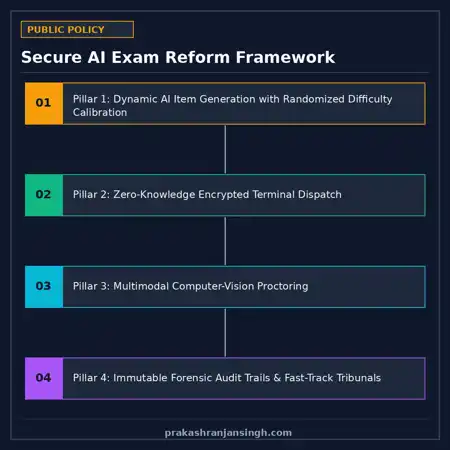
Imagine an examination system where candidates authenticate themselves using secure digital credentials and biometric verification. Instead of receiving an identical printed question paper, every candidate receives a unique set of AI-generated multiple-choice questions drawn randomly from a large and carefully validated question bank based on the prescribed syllabus. While the difficulty level remains scientifically balanced, no two candidates receive exactly the same sequence of questions.
Such a system would make organised paper leaks virtually impossible because there would no longer be a single question paper available for theft or circulation before the examination.
The examination could be conducted through secure digital devices at authorised examination centres equipped with protected software that prevents unauthorised access, copying, or communication. AI-enabled monitoring systems could detect suspicious behaviour in real time, while automated evaluation would provide results quickly, reducing delays and administrative costs.
What Would This Actually Fix?
Paper leak exam reform delivers significant benefits: elimination of paper leaks caused by physical handling of question papers, faster declaration of results, reduced expenditure on printing, transportation, and storage, greater transparency and accountability, environment-friendly paperless examinations, improved confidence among candidates, and better utilisation of technology for large-scale recruitment.

What Would It Take to Actually Build This?
Naturally, implementing such a system would require careful planning. A massive, encrypted question bank prepared by expert subject panels would be essential. AI systems must be independently audited to ensure fairness, balanced difficulty levels, and freedom from bias. Robust cybersecurity measures would be needed to protect examination platforms from hacking attempts. Examination centres must provide secure infrastructure and reliable connectivity, while contingency plans should be available for technical failures.
Technology alone cannot guarantee integrity. Human oversight, legal safeguards, periodic audits, and strict accountability must remain integral parts of the examination ecosystem. AI should strengthen transparency—not replace responsible governance.
The objective is not merely to digitise examinations but to rebuild public trust. Every deserving candidate must believe that success depends only on knowledge, preparation, and merit—not on access to leaked papers or unfair advantages.
India aspires to become a developed nation under the vision of Viksit Bharat 2047. Achieving this goal requires institutions that inspire confidence among the youth. Paper leak exam reform is therefore not simply an administrative improvement; it is an investment in the nation’s future.
The energy, intelligence, and aspirations of India’s young population are among our greatest national assets. Protecting the integrity of competitive examinations is essential to protecting that asset. By combining technology, Artificial Intelligence, strong cybersecurity, and transparent governance, India can build an examination system that is secure, efficient, and worthy of the trust of millions.
The future of our youth should never be compromised by a leaked question paper. It should be shaped by merit, innovation, and equal opportunity.
How to Stop Paper Leak in India: 5 Fixes for Exam Reform
- Move the paper digitally, not physically. Encrypted delivery to the exam centre, with the paper unlocked or printed only shortly before the exam, removes the printing press, the transport van and the overnight storage room, which are the weakest links today.
- Give every candidate a different paper. Randomised sets drawn from a large, validated question bank leave no single paper to steal. Difficulty must be statistically balanced across sets so the result stays fair.
- Authenticate every candidate and every device. Biometric and secure digital identity checks, with continuous verification during the exam, close the door on impersonation and remote-access cheating. Banks run layered authentication and audit trails every day, as we discussed in our piece on AI and banking security; exams need the same discipline.
- Professionalise and audit the testing agency. Fewer outsourced vendors, independent audits of the AI, the question bank and the software, and automatic blacklisting of any vendor involved in a leak. The accountability questions mirror those raised by AI in the judicial system.
- Prosecute organised networks fast. Time-bound investigations and fast-track trials matter as much as the technology, because a leak that carries no consequence will be repeated.
The law is also being tightened. According to the Press Information Bureau, the Public Examinations (Prevention of Unfair Means) Amendment Bill, 2026 was passed by the Lok Sabha on 29 July 2026 and by the Rajya Sabha soon after, and a Deccan Herald report dated 1 August 2026 says it has received the President’s assent. As described by the Government, it raises the jail term for individuals to 5 to 10 years, raises the maximum fine on service providers to Rs 5 crore with an eight-year debarment, and sets up Special Fast Track Courts with a two-month investigation and three-month trial timeline, which supports the fifth fix above. I could not confirm the commencement date, so check the PIB explainer and the Gazette before relying on the new figures. Knowing how to stop paper leak in India is one thing; enforcing it is the test.
Until these fixes arrive, aspirants should rely only on official exam websites for notices, and should never pay anyone who promises a “leaked” paper. Such offers are usually fraud, and using unfair means is itself punishable under the 2024 Act. The wider cost of failure is visible in our analysis of India’s jobs, debt and technology trap: when merit-based entry points lose credibility, young people lose faith in the whole system.
Frequently Asked Questions
How would AI-generated exams actually stop paper leaks?
Instead of an identical printed question paper, every candidate would receive a unique set of AI-generated questions drawn randomly from a large, validated question bank, so there would no longer be a single paper available for theft or circulation before the exam. Candidates would also authenticate through secure digital credentials and biometric verification.
What benefits would this deliver beyond stopping leaks?
It would mean faster declaration of results, reduced expenditure on printing, transportation and storage, greater transparency and accountability, and paperless, environment-friendly examinations, alongside improved confidence among candidates.
What would it take to build such a system safely?
A massive, encrypted question bank prepared by expert subject panels, independent audits of the AI for fairness and bias, robust cybersecurity, and secure infrastructure at examination centres. Human oversight, legal safeguards, and strict accountability must remain part of the system. Technology should strengthen transparency, not replace governance.
What does the Public Examinations (Prevention of Unfair Means) Act, 2024 say?
The Act, in force since 21 June 2024, targets organised paper-leak networks with jail terms of 5 to 10 years and a minimum fine of Rs 1 crore, imposes heavy fines and a four-year debarment on service providers involved in malpractice, and also punishes individuals who use unfair means.
What did the Radhakrishnan Committee recommend on exam security?
The committee headed by former ISRO chairman K. Radhakrishnan recommended computer-assisted secure pen-and-paper testing, where encrypted papers reach centres digitally and are printed shortly before the exam, a digital authentication framework using biometrics, less reliance on outsourced agencies, and eventually computer adaptive testing.
Leave a Reply