

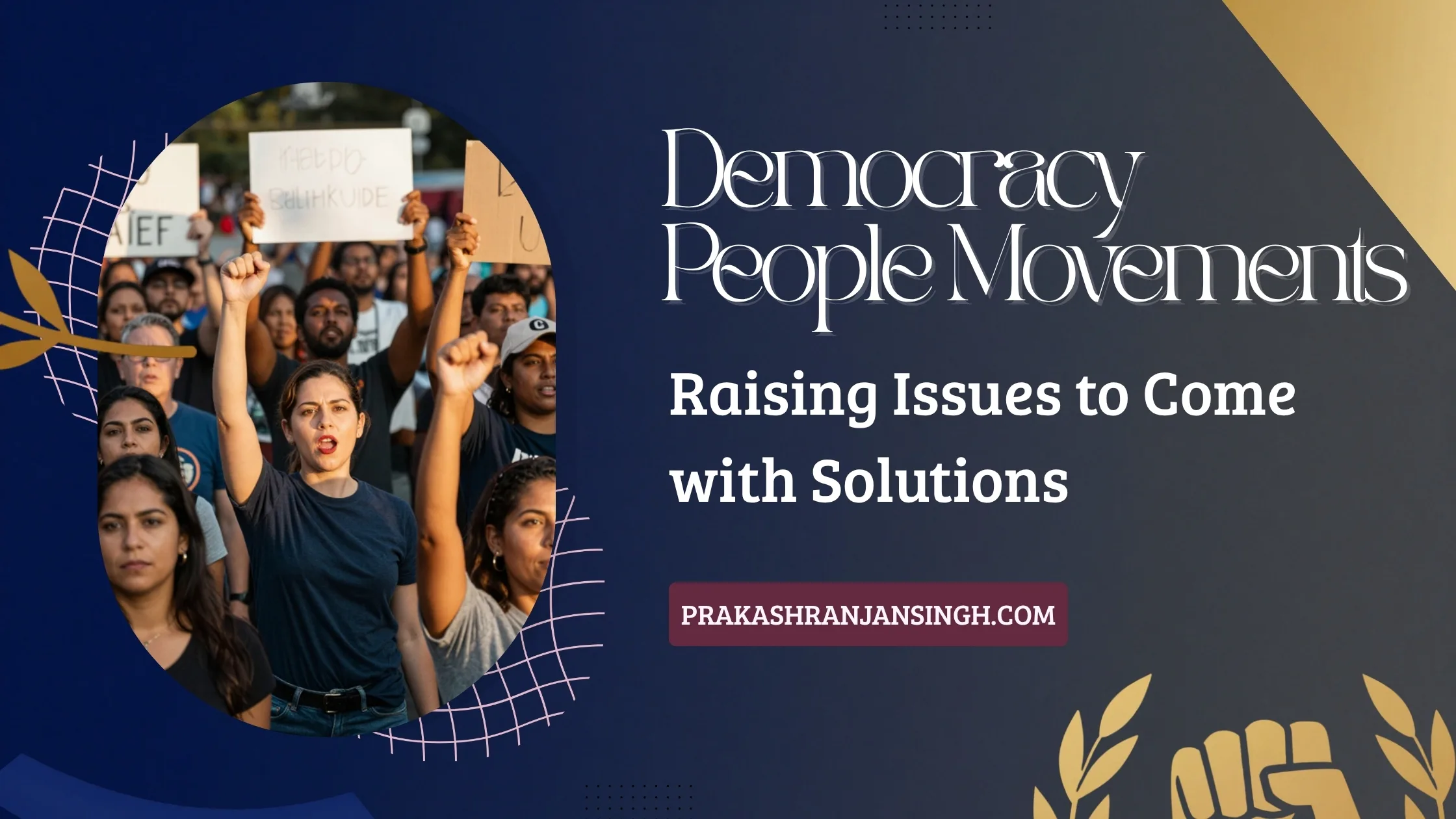
Democracy and people movements in India are strongest at raising issues but often stop short of proposing solutions, and youth-led protests over exam reforms and accountability show what’s possible when energy turns constructive: AI-assisted policy analysis, expert panels, and pilot projects can turn a protest into a genuine democratic problem-solving lab.
So how do you make a protest effective? Define the problem with numbers, put a specific, costed proposal on the table, offer a pilot, and use the official channels alongside the street. That is how the RTI campaign became a law and how years of anger over leaked papers led to the Public Examinations Bill passed by Parliament in February 2024. The seven steps are set out below.
India is the world’s largest democracy, home to more than 1.4 billion people, extraordinary cultural diversity, and one of the youngest populations on Earth. Such a vast nation naturally faces challenges in education, employment, healthcare, agriculture, infrastructure, governance, and environmental protection. In a democracy, it is both natural and healthy for citizens to raise these issues through peaceful public movements.
Recent youth-led movements, including protests over examination reforms and youth concerns, have demonstrated that organized public participation can bring national attention to important issues and encourage governments to respond. Reports indicate that such movements have focused on alleged examination irregularities, accountability, and reforms in the education system, prompting discussions and policy responses.
Key Takeaways
- India’s democracy is strong at raising issues through peaceful movements but needs to shift toward proposing workable solutions alongside protest.
- Recent youth-led protests over examination irregularities and accountability prompted real discussions and policy responses from government.
- Movements gain influence when they stay peaceful and constitutional, base demands on evidence, and pair criticism with practical, costed proposals.
Table of Contents
Why Do Democracy and People Movements Need to Be More Solution-Oriented?
Every protest begins with a problem, but lasting progress comes from solving that problem. Raising a voice is the first step; presenting workable solutions is the next.
India possesses tremendous intellectual strength. Its engineers, scientists, entrepreneurs, students, researchers, civil servants, and innovators have repeatedly demonstrated their ability to solve complex challenges. Every public movement should therefore become a platform not only for criticism but also for innovation.
For example, if students protest examination irregularities, the movement could simultaneously recommend stronger digital security for examinations, transparent recruitment and evaluation systems, independent monitoring mechanisms, AI-based fraud detection, faster grievance redressal systems, and time-bound accountability for officials. Such constructive proposals enable governments, experts, and citizens to work together toward meaningful reform.
How Can Youth Become True Nation Builders?
Young people have played a leading part in many of the movements that shaped modern India. Today’s youth are educated, technologically connected, and creative, a trend reflected in MoSPI’s Periodic Labour Force Survey data. Their energy should be directed not only toward mobilization but also toward policy thinking, research, and community-led innovation.
Imagine if every nationwide movement created a panel of subject experts, public consultation papers, draft policy recommendations, pilot projects, and citizen innovation competitions. The movement would then become a laboratory for democratic problem-solving rather than only a platform for expressing dissatisfaction.
Can Technology Strengthen Democratic Participation?
Modern technology allows millions of citizens to collaborate on solutions. Online surveys, public consultations, AI-assisted policy analysis, open-data platforms, and digital suggestion portals can help transform public opinion into practical recommendations.
Instead of asking only, “What is wrong?”, citizens can also ask: What is the best solution? How much will it cost? How can it be implemented? Who will monitor it? How can success be measured? These questions make democratic participation more constructive.
What Does Shared Responsibility Actually Look Like?
Healthy democracy and people movements require governments to be responsible for governance, while citizens also share responsibility for nation-building. Constructive criticism, informed debate, peaceful protest, and practical suggestions together strengthen democratic institutions.
Movements become more influential when they remain peaceful and constitutional, base their demands on facts and evidence, welcome dialogue, present practical alternatives, and encourage long-term institutional reforms.
India’s future will not be determined only by the number of protests it witnesses, but by the number of solutions it creates. Public movements should continue to hold institutions accountable, while also becoming platforms for innovation, policy ideas, and constructive nation-building.
If every movement evolves from “raising issues” to “creating solutions,” India’s immense talent and youthful energy can become a powerful force for democratic progress. That is the deeper lesson democracy and people movements teach: a democracy is strongest not only when its citizens speak boldly, but also when they help design the path forward.
Which Indian People Movements Actually Turned Protest into Law?
The clearest example is the Right to Information Act. It did not begin in a ministry. The Mazdoor Kisan Shakti Sangathan (MKSS), formed in 1990 in rural Rajasthan, held public hearings where villagers asked for muster rolls and bills and compared them with what was really paid. The campaign grew into a national demand, and Parliament passed the Right to Information Act in 2005. The movement did not stop at saying that corruption exists. It helped draft the tool that lets any citizen ask for the record.
Exam reform shows the same pattern at an earlier stage. Years of anger over leaked papers were followed by the Public Examinations (Prevention of Unfair Means) Act, 2024, which Parliament passed in February 2024 and the Centre brought into force on 21 June 2024. It covers central recruitment and entrance exams such as those run by UPSC, SSC, the Railway Recruitment Boards, NTA and IBPS. Unfair means can attract 3 to 5 years of imprisonment and a fine of up to Rs 10 lakh, and organised paper-leak crime can attract 5 to 10 years and a fine of at least Rs 1 crore. Whether enforcement matches the law is a separate question, which I looked at in my post on paper leaks and exam reform.
The lesson from both is simple. Anger gets attention, but a specific, drafted, costed proposal is what gets a ministry or a legislature to act. Young people who care about this should also read how patriotism and youth can be channelled into that kind of work.
How to Make a Protest Effective: 7 Steps From Raising Issues to Proposing Solutions
In banking, a complaint does not get a loan sanctioned. A proposal does: purpose, amount, security, repayment plan and monitoring. A movement that wants a government to say yes should prepare its demand with the same discipline. Here is a checklist I would give any group that wants to make a protest effective and see it turn into policy.
- State the problem in one sentence with a number. Which exam, how many candidates, how many shifts, how many months of delay.
- Separate facts from allegations. Use court orders, official notifications and RTI replies. Keep rumours out of the demand paper.
- Write a one-page ask. Name the exact rule, office or procedure that should change, and what it should change to.
- Cost it. Say who pays, roughly how much, and from which budget head. A demand with no cost looks like a slogan.
- Propose a pilot. Try the fix on one exam or one district first, so officials are not asked to bet the whole system.
- Fix a timeline and a measure. For example, grievances disposed within a stated number of days, or the share of exams held without a reported leak.
- Use the official doors and stay peaceful. Submit comments when a draft law is published (the Centre’s Pre-Legislative Consultation Policy expects ministries to put draft Bills in the public domain for at least 30 days, although it is guidance, not law), file RTI applications, approach courts where needed, and keep every protest within the constitutional right to assemble peaceably.
None of this replaces protest. It helps make a protest effective and harder to ignore, because the other side can no longer say that the movement has no alternative to offer.
Frequently Asked Questions
Why do India’s protest movements struggle to move beyond raising issues?
Movements are effective at drawing national attention to problems like examination irregularities, but converting that energy into workable solutions requires expert panels, policy papers, and pilot projects, which most movements don’t organize. Building that structure is what turns dissent into democratic problem-solving.
How can technology help make people movements more solution-oriented?
Online surveys, public consultations, AI-assisted policy analysis, open-data platforms, and digital suggestion portals let citizens collaborate on practical recommendations rather than just criticism. These tools help movements answer questions like cost, implementation, and how success will be measured.
What role can India’s youth play in nation-building beyond protest?
India’s youth are educated, technologically connected, and creative, and their energy can extend into policy thinking, research, and community-led innovation, not just mobilization. Movements that create expert panels, consultation papers, and citizen innovation competitions turn youth energy into a democratic problem-solving lab.
Is peaceful protest a fundamental right in India?
Yes, within limits. Article 19(1)(a) protects freedom of speech and expression, and Article 19(1)(b) protects the right to assemble peaceably and without arms. The State can impose reasonable restrictions in the interest of public order, sovereignty and integrity of India. Violence or damage to public property is not protected.
Which Indian people movement led to a national law?
The Right to Information Act, 2005 is the best known example. It grew out of the MKSS campaign in rural Rajasthan from 1990, which used public hearings to demand access to government records, and it ended with a law that any citizen can use.
Related Reading
- Beyond Aadhaar: Can Behavioural Intelligence Become India’s Greatest National Resource?
- Understanding Gen Z
- India’s Youth Power
- Are We Truly Free? Freedom of Nation Vs Freedom of a Mind and The Science Behind It
- The Shiny Picture May Turn Gloomy: Is India Sleepwalking Towards a Jobs–Debt–Technology Trap?
Leave a Reply